• About
  • Privacy Policy
  • Terms of Use
  • Donation
  • Contact
No Result
View All Result
Archaeology News
  • Home
  • News
    • Archaeology
    • Anthropology
    • Paleontology
  • Academic
    • Books
    • Conferences
    • Universities
  • Articles
  • VR Tours
  • Quiz & Game
  • Download
  • Encyclopedia
  • Forum
Archaeology News
No Result
View All Result
Home News Archaeology

Iron Age purple dye factory unearthed on Israel’s Carmel coast

by Dario Radley
April 19, 2025

Archaeologists have found a large Iron Age industrial complex on Israel’s Carmel Coast that produced the luxurious purple dye once exclusively reserved for royalty and high priests. The discovery, made at Tel Shiqmona near modern Haifa, is of an ancient production site operating on a commercial scale between 1100 and 600 BCE. This period is consistent with the biblical Kingdom of Israel and the era of the First Temple in Jerusalem.

Iron Age purple dye factory unearthed on Israel’s Carmel coast
Hexaplex trunculus shell collected near Tel Shiqmona. 400 such shells were identified by two free-style divers within 90 mins at a depth of one to two meters on October 20, 2020. Photo by Ayelet Gilboa. Credit: G. Shalvi et al., PLOS ONE (2025)

Published in PLOS ONE, the research was led by Dr. Golan Shalvi from the Zinman Institute of Archaeology at Tel Aviv University and the University of Chicago, and Professor Ayelet Gilboa. The excavation team comprised experts from different institutions in the United States and Israel.

Tel Shiqmona is currently recognized as the only site in the Near East—and possibly throughout the Mediterranean—where a continuous record of purple-dye workshops has been revealed. The find presents unparalleled evidence of the tools, scale, and methods used in the production and extraction of Tyrian purple, a precious and expensive dye derived from the mucus of marine mollusks.

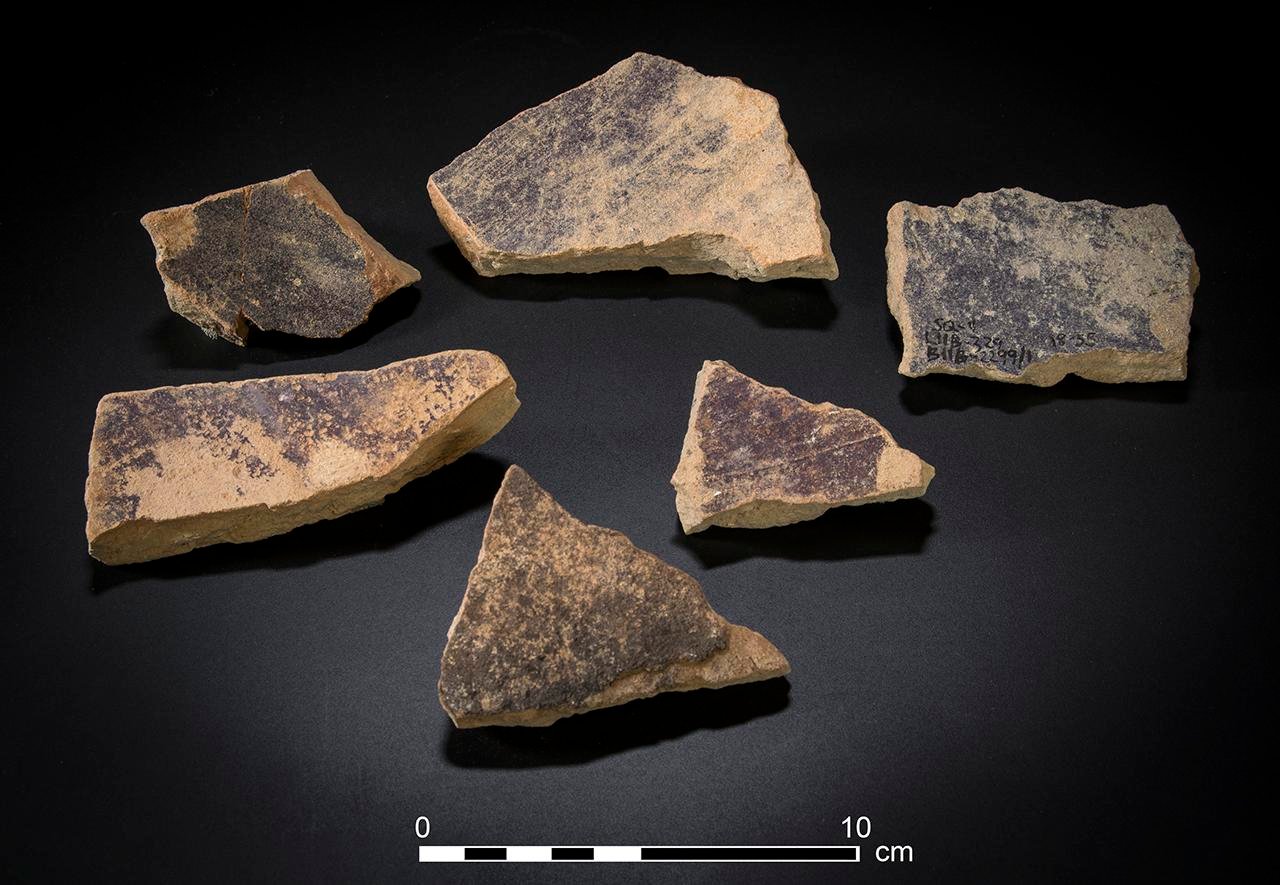
Among the most significant discoveries were huge ceramic vats, some of which were stained a deep purple. One meter high and 80 centimeters in width at their openings, the vats each held about 350 liters. Up to 15–20 of these vats would have been in use simultaneously, scientists estimate, during peak periods, emphasizing the industrial scale of the site.
Iron Age purple dye factory unearthed on Israel’s Carmel coast
Body sherds of purple dye vats with purple dye remains (Photos by Moshe Caine). Credit: G. Shalvi et al., PLOS ONE (2025)

There were a total of 176 production-related artifacts for dye discovered—135 of them stained with purple pigment. They include grinding stones, mollusk shells, and other processing tools. The consistent form and spatial organization suggest a very efficient system of production that existed for nearly 500 years.

RelatedStories
Bronze Age towers in Sardinia remained centers of worship and ritual in the Iron Age
Bronze Age towers in Sardinia remained centers of worship and ritual in the Iron Age

May 23, 2026
2,300-year-old Iron Age riverside structure discovered beneath German city astonishes archaeologists

2,300-year-old Iron Age riverside structure discovered beneath German city

May 22, 2026

According to Prof. Zohar Amar of Bar-Ilan University and co-author of the study, purple dye—the argaman in Hebrew—was produced by exposing the greenish mucus from sea snails to air, which caused a chemical reaction that changed it into the famous purple color. The pigment was chemically bonded to the textiles in a multi-step process. While Tel Shiqmona’s humid climate has likely destroyed any remaining fabric, the presence of purple-dyed material in the dry Timna Valley suggests that Tel Shiqmona may have been the source of that dye.

The significance of this dye in culture is noted in biblical references. Purple and blue yarns are part of the sacred materials used for constructing the Tabernacle, as per the Book of Exodus (25:2–7). This dye is also mentioned in the Assyrian King Sennacherib’s inscription, dating back to around 690 BCE.

Although earlier archaeological excavations at Tel Shiqmona were carried out as early as the 1960s, most of the material from that period remained unpublished. Dr. Shalvi and his team went back to the location to illuminate its stratigraphy and reanalyze older material before finally confirming that dye production had started there around 1100 BCE. Production intensified with the rise of the Kingdom of Israel and later saw a resurgence during the Assyrian period before declining following the Babylonian conquest around 586 BCE, bringing with it broad economic collapse as well as the destruction of the First Temple in Jerusalem.
More information: Shalvi G, Sukenik N, Waiman-Barak P, Dunseth ZC, Bar S, Pinsky S, et al. (2025) Tel Shiqmona during the Iron Age: A first glimpse into an ancient Mediterranean purple dye ‘factory’. PLoS ONE 20(4): e0321082. doi:10.1371/journal.pone.0321082

Share:

Share on Facebook Share on X (Twitter) Share on LinkedIn Share on Pinterest Share on WhatsApp Share on Email

You May Also Like...

Bronze Age towers in Sardinia remained centers of worship and ritual in the Iron Age
Archaeology

Bronze Age towers in Sardinia remained centers of worship and ritual in the Iron Age

May 23, 2026
Rare 19th-century bone dental bridge found in Portugal points to early cosmetic tooth replacement
Anthropology

Rare 19th-century bone dental bridge found in Portugal points to early cosmetic tooth replacement

May 23, 2026
Medieval well hidden beneath Sheffield Castle surveyed with drone technology
Archaeology

Medieval well hidden beneath Sheffield Castle surveyed with drone technology

May 23, 2026
Nondestructive DNA sampling uncovers 1,300 years of history preserved in ancient parchments
Archaeology

Nondestructive DNA sampling uncovers 1,300 years of history preserved in ancient parchments

May 22, 2026
2,300-year-old Iron Age riverside structure discovered beneath German city astonishes archaeologists
Archaeology

2,300-year-old Iron Age riverside structure discovered beneath German city

May 22, 2026
100 Abbasid-era gold jewelry pieces found at ancient Dariyah site in Saudi Arabia
Archaeology

100 Abbasid-era gold jewelry pieces found at ancient Dariyah site in Saudi Arabia

May 22, 2026

Follow us


Instagram
242K

Facebook
117K

Threads
46K

LinkedIn
14K

Twitter
6K

YouTube
1K
Bronze Age towers in Sardinia remained centers of worship and ritual in the Iron Age

Bronze Age towers in Sardinia remained centers of worship and ritual in the Iron Age

May 23, 2026
Rare 19th-century bone dental bridge found in Portugal points to early cosmetic tooth replacement

Rare 19th-century bone dental bridge found in Portugal points to early cosmetic tooth replacement

May 23, 2026
Medieval well hidden beneath Sheffield Castle surveyed with drone technology

Medieval well hidden beneath Sheffield Castle surveyed with drone technology

May 23, 2026
Nondestructive DNA sampling uncovers 1,300 years of history preserved in ancient parchments

Nondestructive DNA sampling uncovers 1,300 years of history preserved in ancient parchments

May 22, 2026

Archaeology News online magazine

Archaeology News is an international online magazine that covers all aspects of archaeology.


Categories

  • Academics
    • Books
    • Conferences
    • Universities
  • Articles
  • Download
  • Game
  • News
    • Anthropology
    • Archaeology
    • Paleontology
  • Quiz
  • Tours

Subscribe to our newsletter

© 2024 - Archaeology News Online Magazine. All Rights Reserved.

  • About
  • Privacy Policy
  • Terms of Use
  • Donation
  • Contact

Manage Consent
To provide the best experiences, we use technologies like cookies to store and/or access device information. Consenting to these technologies will allow us to process data such as browsing behavior or unique IDs on this site. Not consenting or withdrawing consent, may adversely affect certain features and functions.
Functional Always active
The technical storage or access is strictly necessary for the legitimate purpose of enabling the use of a specific service explicitly requested by the subscriber or user, or for the sole purpose of carrying out the transmission of a communication over an electronic communications network.
Preferences
The technical storage or access is necessary for the legitimate purpose of storing preferences that are not requested by the subscriber or user.
Statistics
The technical storage or access that is used exclusively for statistical purposes. The technical storage or access that is used exclusively for anonymous statistical purposes. Without a subpoena, voluntary compliance on the part of your Internet Service Provider, or additional records from a third party, information stored or retrieved for this purpose alone cannot usually be used to identify you.
Marketing
The technical storage or access is required to create user profiles to send advertising, or to track the user on a website or across several websites for similar marketing purposes.
  • Manage options
  • Manage services
  • Manage {vendor_count} vendors
  • Read more about these purposes
View preferences
  • {title}
  • {title}
  • {title}
  • Home
  • News
    • Archaeology
    • Anthropology
    • Paleontology
  • Academic
    • Books
    • Conferences
    • Universities
  • Articles
  • VR Tours
  • Quiz & Game
  • Download
  • Encyclopedia
  • Forum

About  .  Contact  .  Donation

© 2024 - Archaeology News Online Magazine. All Rights Reserved