• About
  • Privacy Policy
  • Terms of Use
  • Donation
  • Contact
No Result
View All Result
Archaeology News
  • Home
  • News
    • Archaeology
    • Anthropology
    • Paleontology
  • Academic
    • Books
    • Conferences
    • Universities
  • Articles
  • VR Tours
  • Quiz & Game
  • Download
  • Encyclopedia
  • Forum
Archaeology News
No Result
View All Result
Home News Archaeology

Ancient Maya population may have topped 16 million at peak, new lidar study reveals

by Dario Radley
August 8, 2025

A sweeping new research study has shifted our image of the Maya civilization of the ancient past, and it appears that its population during the Late Classic period (CE 600–900) might have reached as high as 16 million people, roughly 45% higher than previous estimates. The research, led by Tulane University’s Middle American Research Institute (MARI) and published in the Journal of Archaeological Science: Reports, employs one of the largest regional-scale lidar (light detection and ranging) analyses ever conducted in the Central Maya Lowlands.

Ancient Maya population may have topped 16 million at peak, new lidar study reveals
Well-preserved ancient Maya murals are seen inside a temple in Bonampak, Mexico. Credit: Arian Zwegers / CC BY 2.0

The team, directed by Francisco Estrada-Belli, reprocessed and merged both publicly and privately commissioned lidar data sets — such as environmental lidar collected by NASA’s Goddard Space Flight Center — to map 95,000 square kilometers of regions in modern Guatemala, southern Mexico, and western Belize. The high-resolution images not only demonstrated a population greater than that previously estimated, between 9.5 million and 16 million, but also revealed a very uniform model of settlement and agriculture in both rural and urban zones.

“We expected a modest increase in population estimates from our 2018 lidar analysis, but seeing a 45% jump was truly surprising,” Estrada-Belli said. “This new data confirms just how densely populated and socially organized the Maya Lowlands were at their peak.”

Contrary to the common supposition that rural settlements were isolated, nearly all settlements discovered during the survey were within a five-kilometer radius of a large or medium plaza group, which are civic-ceremonial centers controlled by elites. The findings show that rural communities were fully embedded in networks of religious, economic, and political interaction. “No rural community could be regarded as isolated, disembedded, or independent,” the researchers stated.
Ancient Maya population may have topped 16 million at peak, new lidar study reveals
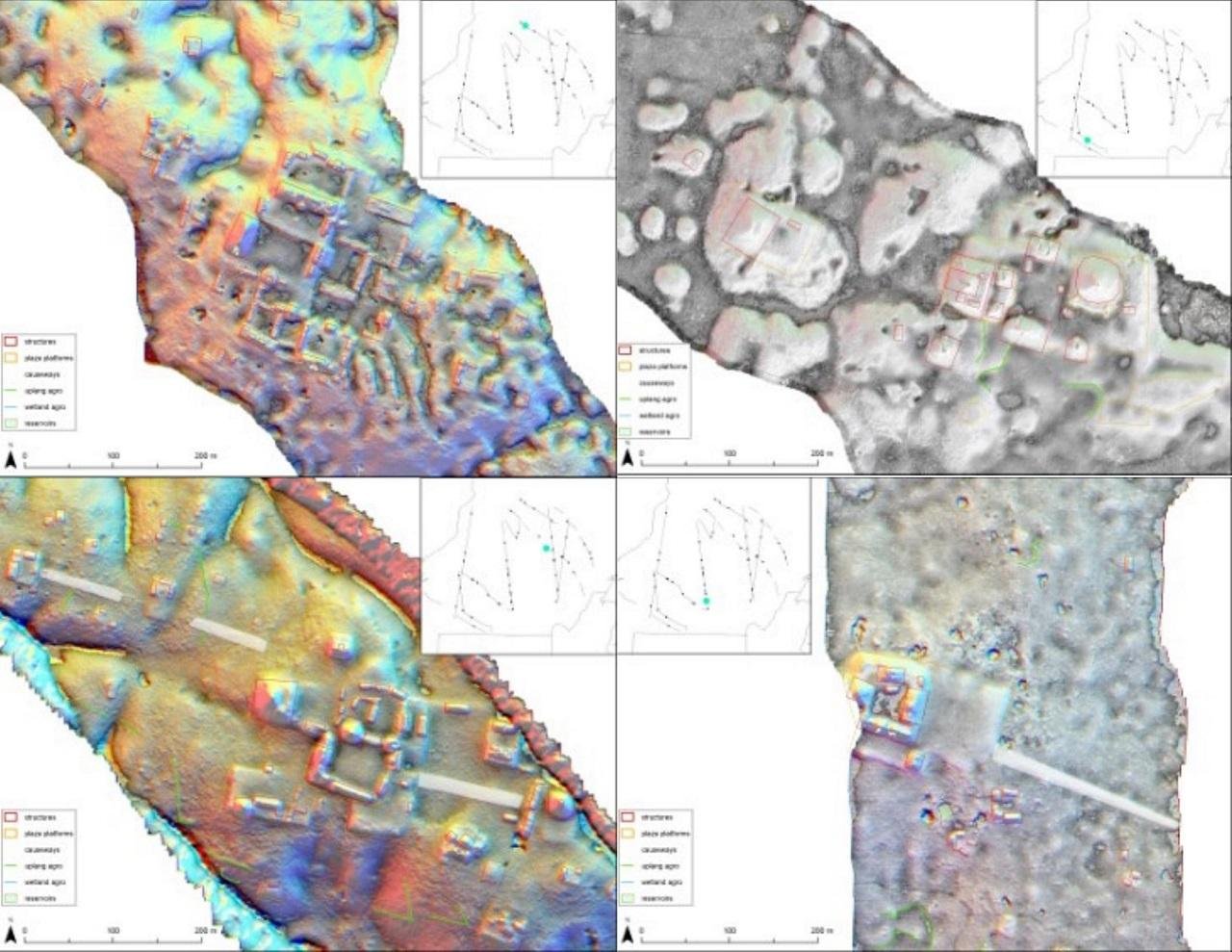
Major ceremonial centers in the G-LiHT dataset. Lidar maps of the 4 largest centers in the G-LIHT dataset and associated agricultural features. Credit: F. Estrada-Belli et al., Journal of Archaeological Science, Reports (2025) – (This image is used under the terms of the CC BY-NC-ND license for non-commercial, educational, and informational purposes. If you are the copyright holder and have any concerns regarding its use, please contact us for prompt removal.)

Lidar imagery also revealed extensive agricultural infrastructure, particularly in the densely populated north, which pointed toward elite control of food production and distribution. Across the region, settlements followed a consistent pattern: residential and farm zones clustered around groups of elite plazas, which formed tiered administrative and exchange networks. The plazas may have been marketplaces, further reinforcing the interconnectedness of Maya society.

The research paints a picture of a civilization that was not a collection of independent city-states but an interwoven complex of governance, trade, and agriculture across large areas of tropical forest. While a highly organized society could have enhanced resilience to localized shortages, the huge population scale and interdependence may have made the Maya vulnerable to ecological stress and political instability in the centuries leading to their downfall.

Ancient Maya population may have topped 16 million at peak, new lidar study reveals
A Mayan woman in Central Park, Antigua Guatemala, Sacatepéquez, Guatemala. Credit: Adam Jones / CC BY-SA 2.0

The descendants of the Maya, some eight million in total, continue to live today in southern Mexico and Central America, preserving aspects of a cultural legacy every bit as remarkable as it is complex.

More information: Tulane University
Publication: Estrada-Belli, F., Canuto, M. A., Šprajc, I., & Fernandez-Diaz, J. C. (2025). New regional-scale Classic Maya population density estimates and settlement distribution models through airborne lidar scanning. Journal of Archaeological Science, Reports, 66(105288), 105288. doi:10.1016/j.jasrep.2025.105288

Share:

Share on Facebook Share on X (Twitter) Share on LinkedIn Share on Pinterest Share on WhatsApp Share on Email

You May Also Like...

Ancient city of Ihnasya reveals Aphrodite statue, Senusret III inscription, and Roman basilica remains in Egypt
Archaeology

Ancient city of Ihnasya reveals Aphrodite statue, Senusret III inscription, and Roman basilica remains in Egypt

June 2, 2026
Rare funerary cache discovered at ancient Heliopolis site
Archaeology

Rare funerary cache discovered at ancient Heliopolis site

June 2, 2026
Archaeologists find Queen Elisenda’s remains among 25 medieval skeletons, including individuals with unexplained stab wounds
Anthropology

Archaeologists find Queen Elisenda’s remains among 25 medieval skeletons, including individuals with unexplained stab wounds

June 1, 2026
Copper Age children in Spain suffered widespread respiratory disease, skeletal study suggests
Anthropology

Copper Age children in Spain suffered widespread respiratory disease, skeletal study suggests

June 1, 2026
Unknown World War II mass grave with 14 German soldiers uncovered at quarry site in Poland
Anthropology

Unknown World War II mass grave with 14 German soldiers uncovered at quarry site in Poland

May 31, 2026
Volunteers restore England’s mysterious Cerne Abbas Giant as climate and erosion threaten ancient landmark
Archaeology

Volunteers restore England’s mysterious Cerne Abbas Giant as climate and erosion threaten ancient landmark

May 31, 2026

Comments 1

  1. Editorial Team says:
    1 second ago

    Disclaimer: This website is a science-focused magazine that welcomes both academic and non-academic audiences. Comments are written by users and may include personal opinions or unverified claims. They do not necessarily reflect the views of our editorial team or rely on scientific evidence.

    Comment Policy: We kindly ask all commenters to engage respectfully. Comments that contain offensive, insulting, degrading, discriminatory, or racist content will be automatically removed.

  2. Shaun Maurice Cox says:
    2 months ago

    I wish I knew more about how I have Mayan DNA from 4-7 generations back. It is bothering me that I can’t find answers. 23 & me, doesn’t help much. It seems to be on my father’s side but who knows. I don’t but clearly, I have a much better understanding of my character, gifts and features because I am Mayan and the percentage of that DNA has supercede all other DNAs, no matter their percentages more. I am definitely a descendent of a Mayan Woman from South Guatemala Hills and that has changed my perception of a lot about me.

Follow us


Instagram
242K

Facebook
117K

Threads
47K

LinkedIn
15K

Twitter
6K

YouTube
1K

Archaeology News online magazine

Archaeology News is an international online magazine that covers all aspects of archaeology.


Categories

  • Academics
    • Books
    • Conferences
    • Universities
  • Articles
  • Download
  • Game
  • News
    • Anthropology
    • Archaeology
    • Paleontology
  • Quiz
  • Tours

Subscribe to our newsletter

© 2024 - Archaeology News Online Magazine. All Rights Reserved.

  • About
  • Privacy Policy
  • Terms of Use
  • Donation
  • Contact

Manage Consent
To provide the best experiences, we use technologies like cookies to store and/or access device information. Consenting to these technologies will allow us to process data such as browsing behavior or unique IDs on this site. Not consenting or withdrawing consent, may adversely affect certain features and functions.
Functional Always active
The technical storage or access is strictly necessary for the legitimate purpose of enabling the use of a specific service explicitly requested by the subscriber or user, or for the sole purpose of carrying out the transmission of a communication over an electronic communications network.
Preferences
The technical storage or access is necessary for the legitimate purpose of storing preferences that are not requested by the subscriber or user.
Statistics
The technical storage or access that is used exclusively for statistical purposes. The technical storage or access that is used exclusively for anonymous statistical purposes. Without a subpoena, voluntary compliance on the part of your Internet Service Provider, or additional records from a third party, information stored or retrieved for this purpose alone cannot usually be used to identify you.
Marketing
The technical storage or access is required to create user profiles to send advertising, or to track the user on a website or across several websites for similar marketing purposes.
  • Manage options
  • Manage services
  • Manage {vendor_count} vendors
  • Read more about these purposes
View preferences
  • {title}
  • {title}
  • {title}
  • Home
  • News
    • Archaeology
    • Anthropology
    • Paleontology
  • Academic
    • Books
    • Conferences
    • Universities
  • Articles
  • VR Tours
  • Quiz & Game
  • Download
  • Encyclopedia
  • Forum

About  .  Contact  .  Donation

© 2024 - Archaeology News Online Magazine. All Rights Reserved