• About
  • Privacy Policy
  • Terms of Use
  • Donation
  • Contact
No Result
View All Result
Archaeology News
  • Home
  • News
    • Archaeology
    • Anthropology
    • Paleontology
  • Academic
    • Books
    • Conferences
    • Universities
  • Articles
  • VR Tours
  • Quiz & Game
  • Download
  • Encyclopedia
  • Forum
Archaeology News
No Result
View All Result
Home News Archaeology

Roman soldier’s 1,900-year-old tombstone mysteriously found in a New Orleans backyard

by Dario Radley
October 16, 2025

When Daniella Santoro and her husband, Aaron Lorenz, went to clear weeds behind their home in New Orleans’ Carrollton neighborhood, they discovered a heavy marble slab with an inscription in Latin. Santoro, an anthropologist at Tulane University, was at first concerned that her house was sitting atop a forgotten local cemetery. But what she and experts found subsequently was even more astonishing: a 1,900-year-old Roman tombstone that originally sat atop the grave of a sailor from the empire’s Mediterranean fleet.
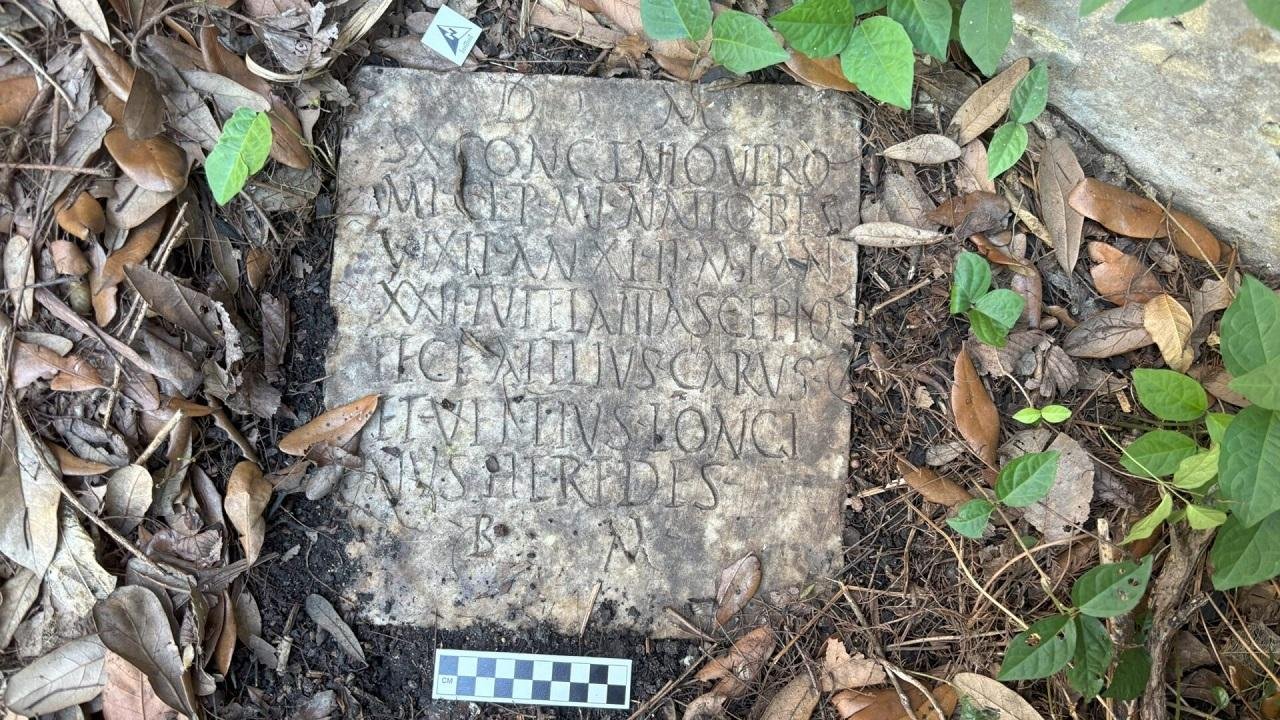
Roman soldier’s 1,900-year-old tombstone mysteriously found in a New Orleans backyard
Roman soldier’s 1,900-year-old tombstone mysteriously found in a New Orleans backyard. Credit: D. Ryan Gray / Preservation Resource Center of New Orleans

The tablet, about a foot wide and slightly longer, bore a long inscription in Latin. As soon as photographs of it were shared with classical scholars in the United States and Europe, including Tulane’s Susann Lusnia and Harald Stadler of the University of Innsbruck, the message was translated. It read:

“To the Spirits of the Dead for Sextus Congenius Verus, soldier of the praetorian fleet Misenensis, from the tribe of the Bessi [of Thrace], (who) lived 42 years (and) served 22 in the military, on the trireme [warship] Asclepius. Atilius Carus and Vettius Longinus, his heirs, made (this) for him, well deserving.”

The words identified the stone as the tombstone of Sextus Congenius Verus, a Roman sailor from Thrace. This mariner served on board the warship Asclepius in the imperial fleet based at Misenum, near Naples. Specialists confirmed that it was a genuine second-century CE funerary monument. But how did it end up in the yard of a New Orleans residence?

Roman soldier’s 1,900-year-old tombstone mysteriously found in a New Orleans backyard
Daniella Santoro and Aaron Lorenz with the ‘mystery stone’ in front of them. Credit: Susann Lusnia / Preservation Resource Center of New Orleans

Archaeologist D. Ryan Gray of the University of New Orleans traced the inscription to an item previously documented in Italy. A nearly identical headstone had been exhibited at the National Archaeological Museum of Civitavecchia, an ancient port northwest of Rome. The museum itself was destroyed in an Allied bombing during World War II, and the artifact was listed as missing after the war.
RelatedStories

Ancient DNA study rewrites fall of Rome, reveals small migrations shaped Central Europe

Ancient DNA study rewrites fall of Rome, reveals small migrations shaped Central Europe

May 1, 2026
Roman cup found in Spain reveals new link to Hadrian’s Wall and Roman soldiers

Roman cup found in Spain reveals new link to Hadrian’s Wall and Roman soldiers

April 29, 2026

The evidence hinted at a possible explanation: the stone disappeared during wartime chaos and somehow arrived on the other side of the Atlantic. It may have been taken by an American soldier in the Civitavecchia area after Allied troops liberated Rome in 1944—a time when looting and illicit antiquities trade were common.

Historical investigation revealed that the New Orleans property had been owned by Frank Simon, a shoe company manager who resided there for decades before he died in 1945. He was not a likely candidate to have brought the artifact home. A neighbor who served in the U.S. Navy also appeared to be a possible link, but subsequent military records showed he had served only in the Pacific theater. The true route of the gravestone’s journey to Louisiana is not yet known.

Roman soldier’s 1,900-year-old tombstone mysteriously found in a New Orleans backyard
The shotgun house. Credit: D. Ryan Gray / Preservation Resource Center of New Orleans

With help from the Antiquities Coalition, they contacted the FBI’s Art Crime Team, which now holds the headstone while arrangements are made for its repatriation to Italy.

Further research confirmed the artifact’s provenance as matching the destroyed Civitavecchia museum’s records. Local curators were ecstatic that the missing Roman tombstone had survived and would soon be coming home.

While the full story of its transatlantic journey may never be known, the rediscovery of Sextus Congenius Verus’ tombstone is a reminder of how fragments of the ancient world can unexpectedly surface in modern lives.

More information: Preservation Resource Center of New Orleans

Share33Tweet21Share6ShareSend

You May Also Like...

7,000-year-old beaver bone pit discovered in Germany reveals Neolithic fur hunting practices
Archaeology

7,000-year-old beaver bone pit discovered in Germany reveals Neolithic fur hunting practices

May 1, 2026
Ancient DNA study rewrites fall of Rome, reveals small migrations shaped Central Europe
Anthropology

Ancient DNA study rewrites fall of Rome, reveals small migrations shaped Central Europe

May 1, 2026
New copy of earliest known English poem discovered in Rome manuscript
Archaeology

New copy of earliest known English poem discovered in Rome manuscript

April 30, 2026
How coral buildings are helping archaeologists date colonial-era sites in French Polynesia
Archaeology

How coral buildings are helping archaeologists date colonial-era sites in French Polynesia

April 30, 2026
Ancient cremation pyre uncovered at Sizewell site in England reveals rare prehistoric burial ritual
Archaeology

Ancient cremation pyre uncovered at Sizewell site in England reveals rare prehistoric burial ritual

April 30, 2026
Ancient mass grave in Jordan confirms victims of Justinian Plague pandemic
Anthropology

Ancient mass grave in Jordan confirms victims of Justinian Plague pandemic

April 29, 2026

Comments 0

  1. Editorial Team says:
    1 second ago

    Disclaimer: This website is a science-focused magazine that welcomes both academic and non-academic audiences. Comments are written by users and may include personal opinions or unverified claims. They do not necessarily reflect the views of our editorial team or rely on scientific evidence.

    Comment Policy: We kindly ask all commenters to engage respectfully. Comments that contain offensive, insulting, degrading, discriminatory, or racist content will be automatically removed.

    Reply

Leave a Reply Cancel reply

Your email address will not be published. Required fields are marked *

Follow us


Instagram
244K

Facebook
118K

Threads
46K

LinkedIn
14K

Twitter
6K

YouTube
1K
  • Trending
  • Comments
  • Latest
Shipwreck Salvage. Credit: rawpixel.com / Public Domain

2,000-year-old shipwreck discovered off Turkish coast with remarkably preserved stacked ceramics

July 2, 2025
A new study suggests the mysterious Voynich Manuscript may be a medieval cipher

A new study suggests the mysterious Voynich Manuscript may be a medieval cipher

January 3, 2026
Viking age DNA reveals 9,000-year-old HIV-resistant gene originating near the Black Sea

Viking age DNA reveals 9,000-year-old HIV-resistant gene originating near the Black Sea

May 18, 2025
3D analysis reveals Shroud of Turin image likely came from sculpture, not Jesus’ body

3D analysis reveals Shroud of Turin image likely came from sculpture, not Jesus’ body

August 3, 2025
Moses may be named in ancient Egyptian mine inscriptions, sparking debate over earliest biblical references

Moses may be named in ancient Egyptian mine inscriptions, sparking debate over earliest biblical references

July 31, 2025
3D analysis reveals Shroud of Turin image likely came from sculpture, not Jesus’ body

3D analysis reveals Shroud of Turin image likely came from sculpture, not Jesus’ body

Moses may be named in ancient Egyptian mine inscriptions, sparking debate over earliest biblical references

Moses may be named in ancient Egyptian mine inscriptions, sparking debate over earliest biblical references

$1 million prize offered to decipher 5,300-year-old Indus Valley script

$1 million prize offered to decipher 5,300-year-old Indus Valley script

Oldest ever genetic data from a human relative found in 2-million-year-old fossilized teeth

Oldest ever genetic data from a human relative found in 2-million-year-old fossilized teeth

Exceptionally large Roman shoes discovered at Magna fort near Hadrian’s Wall

Exceptionally large Roman shoes discovered at Magna fort near Hadrian’s Wall

7,000-year-old beaver bone pit discovered in Germany reveals Neolithic fur hunting practices

7,000-year-old beaver bone pit discovered in Germany reveals Neolithic fur hunting practices

May 1, 2026
Ancient DNA study rewrites fall of Rome, reveals small migrations shaped Central Europe

Ancient DNA study rewrites fall of Rome, reveals small migrations shaped Central Europe

May 1, 2026
New copy of earliest known English poem discovered in Rome manuscript

New copy of earliest known English poem discovered in Rome manuscript

April 30, 2026
How coral buildings are helping archaeologists date colonial-era sites in French Polynesia

How coral buildings are helping archaeologists date colonial-era sites in French Polynesia

April 30, 2026
Ancient cremation pyre uncovered at Sizewell site in England reveals rare prehistoric burial ritual

Ancient cremation pyre uncovered at Sizewell site in England reveals rare prehistoric burial ritual

April 30, 2026

Archaeology News online magazine

Archaeology News is an international online magazine that covers all aspects of archaeology.


Categories

  • Academics
    • Books
    • Conferences
    • Universities
  • Articles
  • Download
  • Game
  • News
    • Anthropology
    • Archaeology
    • Paleontology
  • Quiz
  • Tours

Subscribe to our newsletter

© 2024 - Archaeology News Online Magazine. All Rights Reserved.

  • About
  • Privacy Policy
  • Terms of Use
  • Donation
  • Contact

Manage Consent
To provide the best experiences, we use technologies like cookies to store and/or access device information. Consenting to these technologies will allow us to process data such as browsing behavior or unique IDs on this site. Not consenting or withdrawing consent, may adversely affect certain features and functions.
Functional Always active
The technical storage or access is strictly necessary for the legitimate purpose of enabling the use of a specific service explicitly requested by the subscriber or user, or for the sole purpose of carrying out the transmission of a communication over an electronic communications network.
Preferences
The technical storage or access is necessary for the legitimate purpose of storing preferences that are not requested by the subscriber or user.
Statistics
The technical storage or access that is used exclusively for statistical purposes. The technical storage or access that is used exclusively for anonymous statistical purposes. Without a subpoena, voluntary compliance on the part of your Internet Service Provider, or additional records from a third party, information stored or retrieved for this purpose alone cannot usually be used to identify you.
Marketing
The technical storage or access is required to create user profiles to send advertising, or to track the user on a website or across several websites for similar marketing purposes.
  • Manage options
  • Manage services
  • Manage {vendor_count} vendors
  • Read more about these purposes
View preferences
  • {title}
  • {title}
  • {title}
  • Home
  • News
    • Archaeology
    • Anthropology
    • Paleontology
  • Academic
    • Books
    • Conferences
    • Universities
  • Articles
  • VR Tours
  • Quiz & Game
  • Download
  • Encyclopedia
  • Forum

About  .  Contact  .  Donation

© 2024 - Archaeology News Online Magazine. All Rights Reserved