• About
  • Privacy Policy
  • Terms of Use
  • Donation
  • Contact
No Result
View All Result
Archaeology News
  • Home
  • News
    • Archaeology
    • Anthropology
    • Paleontology
  • Academic
    • Books
    • Conferences
    • Universities
  • Articles
  • VR Tours
  • Quiz & Game
  • Download
  • Encyclopedia
  • Forum
Archaeology News
No Result
View All Result
Home News Archaeology

Ancient shipwrecks rewrite 500 years of Iron Age Mediterranean trade

by Dario Radley
October 15, 2025

Archaeologists from the University of California at San Diego and the University of Haifa have discovered the oldest known Iron Age ship cargoes found in a known port city in Israel, yielding direct, rare evidence of maritime trade in the eastern Mediterranean. The discovery, published in Antiquity, redefines what was known about seaborne trade during the Iron Age and reveals how shifts in regional power influenced trade between Egypt, Phoenicia, and the southern Levant.
Ancient shipwrecks rewrite 500 years of Iron Age Mediterranean trade
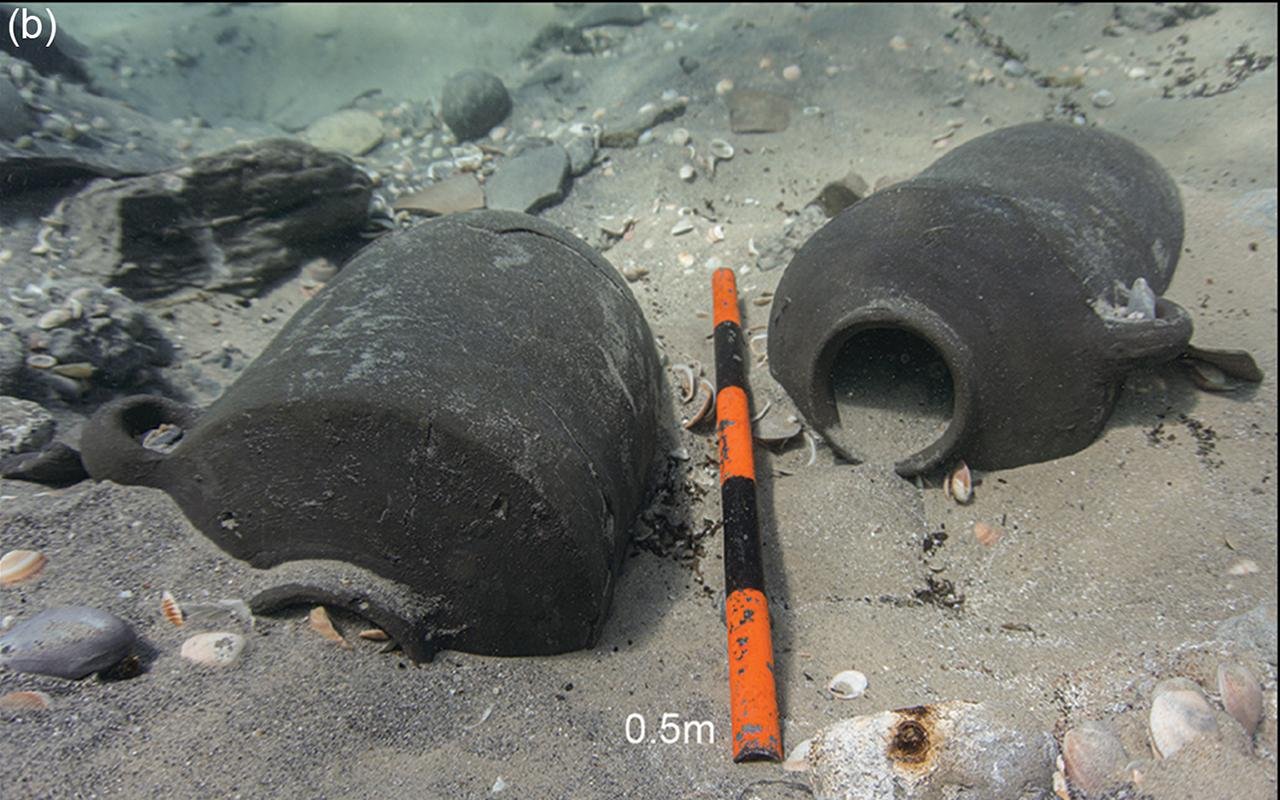
In situ storage jars. Archaeologists discovered the oldest known Iron Age ship cargoes in a port city in Israel. Credit: A. Yasur-Landau et al., Antiquity (2025)

The finds were recovered at the Dor Lagoon—also known as Tantura Lagoon—on Israel’s Carmel Coast, which was home to the ancient port city of Dor. A research team led by Thomas E. Levy of UC San Diego and Assaf Yasur-Landau of the University of Haifa found three submerged cargo assemblages dating from the 11th to 6th centuries BCE. These results provide the earliest direct link between maritime activities and an Iron Age urban center in the region, bridging a gap previously known only through land-based evidence.

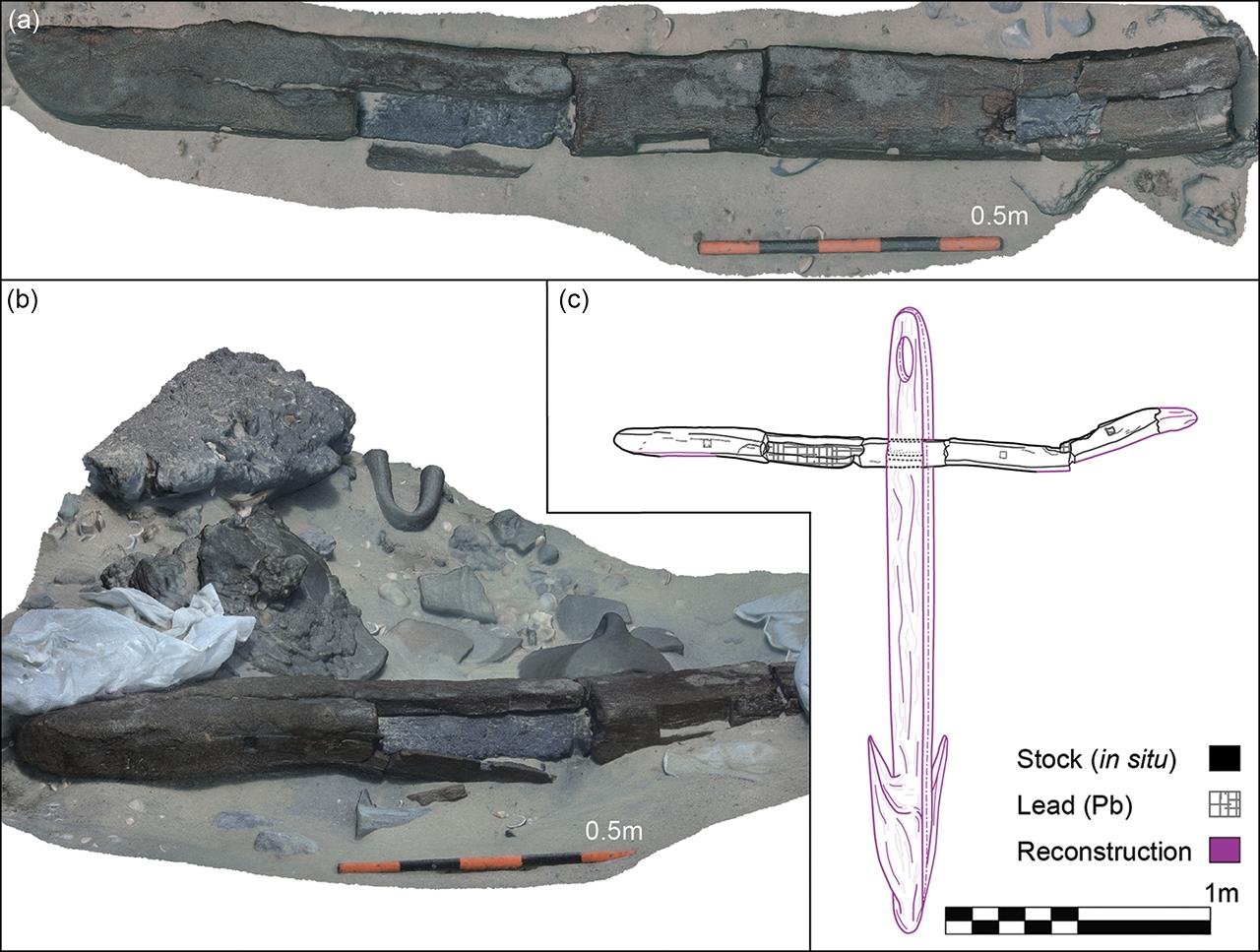
The first assemblage, Dor M, dates to the 11th century BCE. It includes storage jars and an anchor with Cypro-Minoan inscriptions, connecting Dor to Cyprus, Egypt, and the Phoenician coast. This phase is contemporary with the Egyptian Report of Wenamun, a literary text describing voyages to Dor and nearby ports, attesting to the city’s place in early Mediterranean networks of trade following the Late Bronze Age collapse.
Ancient shipwrecks rewrite 500 years of Iron Age Mediterranean trade
a & b) 3D model of the composite anchor stock in situ; c) schematic reconstruction of the anchor (figure by Marko Runjajić). Credit: A. Yasur-Landau et al., Antiquity (2025)

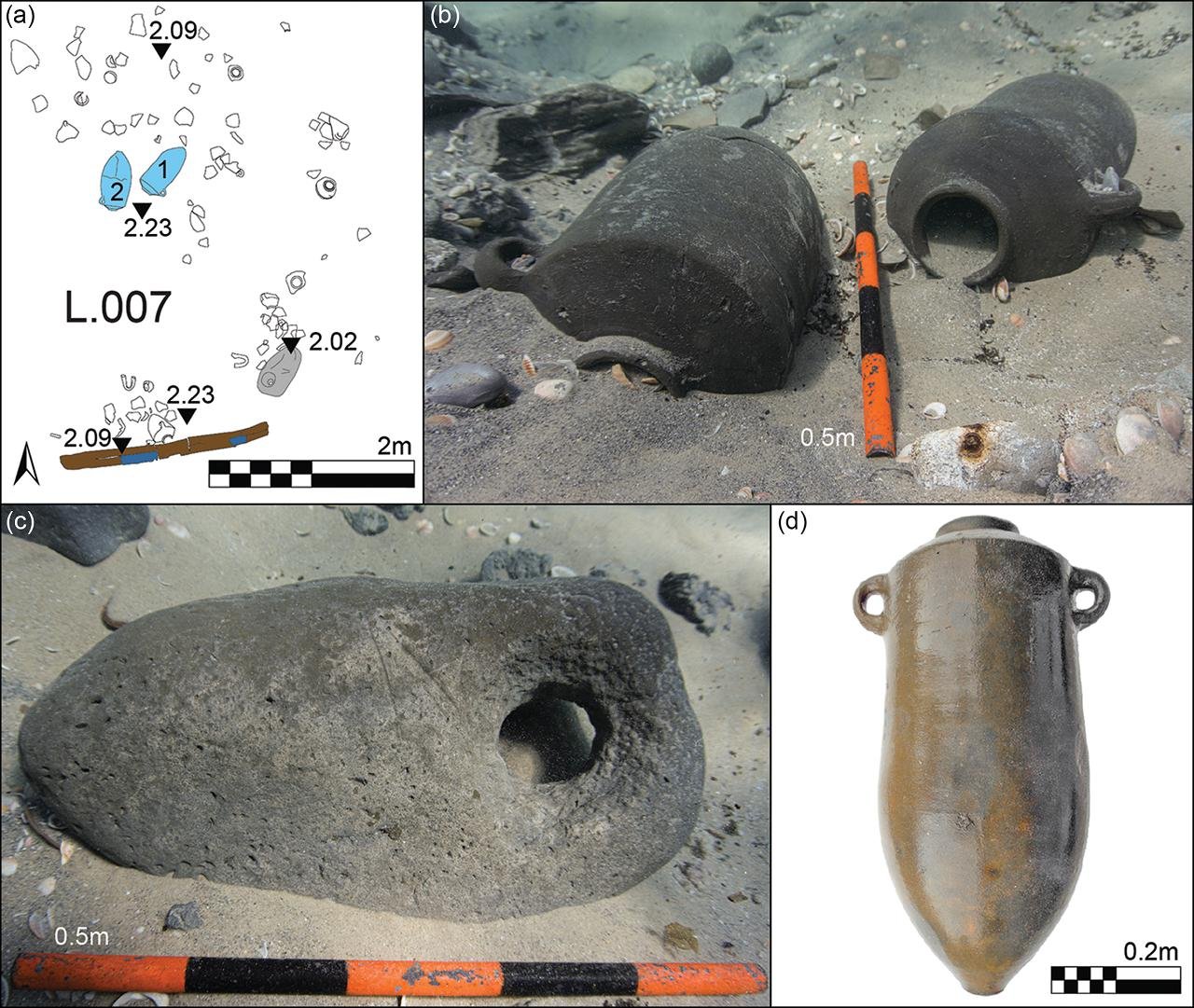
The second assemblage, Dor L1, dates from the late 9th to early 8th century BCE and contains Phoenician-style jars and thin-walled bowls. Unlike Dor M, there is no evidence of Egyptian or Cypriot contact. Archaeological remains from this period show reduced imports and regional isolation, but the cargo contents prove that maritime trade persisted despite the decline in Dor’s influence.
Ancient shipwrecks rewrite 500 years of Iron Age Mediterranean trade
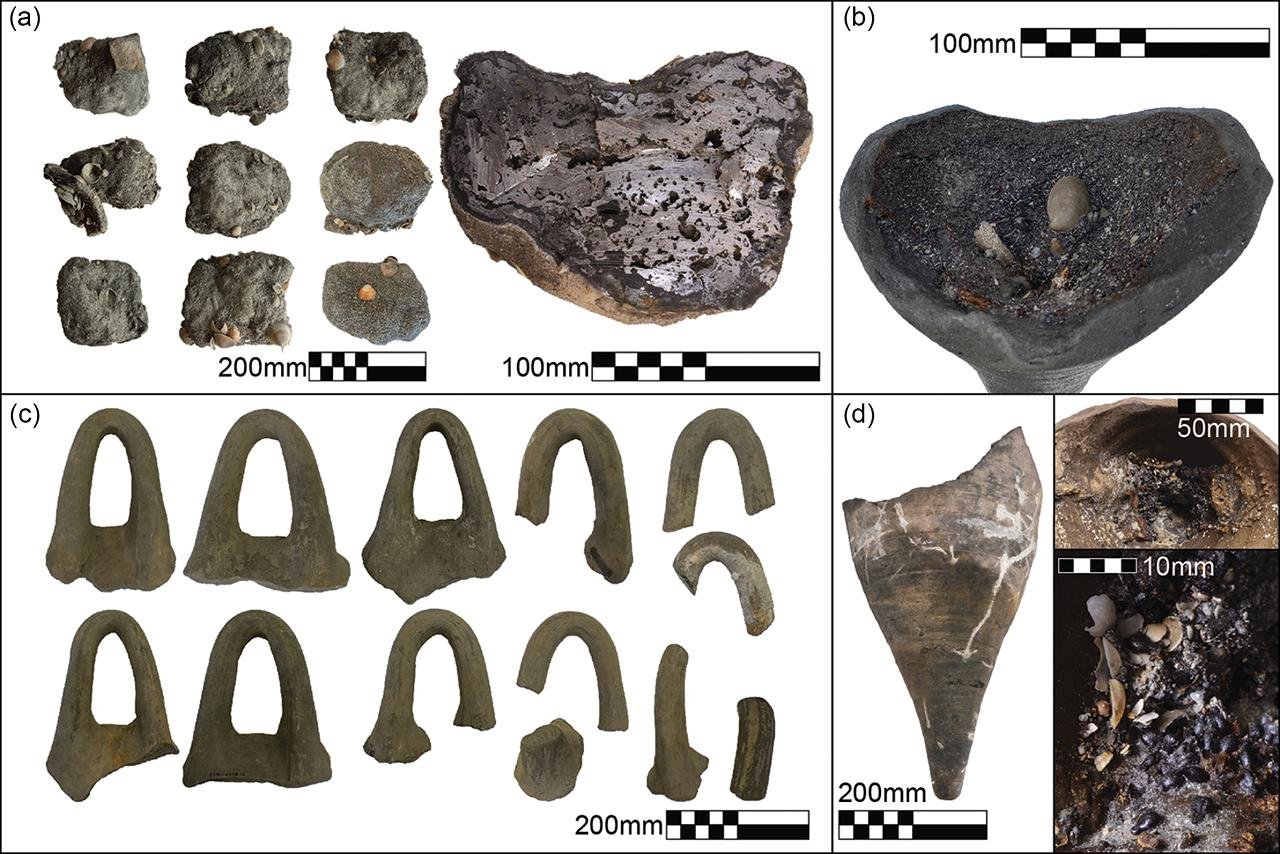
Finds from L23.006: a) iron blooms; b) basket-handle amphora base containing resin; c) basket-handle amphora handles; d) basket-handle amphora base containing grape seeds from L23.007 (figure by Marko Runjajić & Jonathan Gottlieb). Credit: A. Yasur-Landau et al., Antiquity (2025)

The most well-preserved and latest cargo is Dor L2, which dates to the late 7th or early 6th century BCE. It includes Cypriot-style basket-handle amphorae and iron blooms—intermediate products of iron smelting—and shows metal trade on an industrial scale. Radiocarbon dating assigns this cargo to a period when Dor was under Assyrian or Babylonian rule after having previously returned to Phoenician control. Similar finds from Anatolian coastal wrecks show that Dor was connected to an expanding maritime network that linked the eastern Mediterranean’s major powers.


RelatedStories

2,300-year-old Iron Age riverside structure discovered beneath German city astonishes archaeologists

2,300-year-old Iron Age riverside structure discovered beneath German city

May 22, 2026
massive jar in Laos contained remains of 37 people, revealing ancient burial rituals and Asian trade links

Massive jar in Laos contained remains of 37 people, revealing ancient burial rituals and Asian trade links

May 19, 2026

Plant residues, including grape seeds and date pits found in amphorae, helped refine the dating and content of the cargoes. Together, they illustrate cycles of economic expansion and contraction linked to political change in the Iron Age Mediterranean world.
Ancient shipwrecks rewrite 500 years of Iron Age Mediterranean trade
Cargo from Dor L1, L23.007: a) plan; b) in situ storage jars; c) stone anchor in L24.023; d) storage jar (figure by Marko Runjajić). Credit: A. Yasur-Landau et al., Antiquity (2025)

The study combines traditional underwater archaeology with cutting-edge digital technology such as 3D modeling, multispectral imaging, and digital mapping. The “cyber-archaeology” approach, established through a collaborative effort between UC San Diego’s Qualcomm Institute and the University of Haifa, enables accurate reconstruction of submerged trading routes and harbor structures.

So far, only a quarter of the Dor sandbar containing the cargoes has been excavated. Further excavation may yield additional artifacts, including fragments of ship hulls. Already at this early stage, the finds prove that Dor was a dynamic maritime center whose prosperity mirrored the rise and fall of regional empires.

These cargoes—representing 500 years of Iron Age history—demonstrate that despite shifting political powers, sea trade remained a constant force binding distant coastlines and shaping the ancient economy of the Mediterranean.

More information: University of California – San Diego
Publication: Yasur-Landau, A., Runjajić, M., Shegol, E., Rosen, R., Johnson, K., Cvikel, D., … Levy, T. E. (2025). Iron Age ship cargoes from the harbour of Dor (Israel). Antiquity, 1–17. doi:10.15184/aqy.2025.71

Share:

Share on Facebook Share on X (Twitter) Share on LinkedIn Share on Pinterest Share on WhatsApp Share on Email

You May Also Like...

2,300-year-old Iron Age riverside structure discovered beneath German city astonishes archaeologists
Archaeology

2,300-year-old Iron Age riverside structure discovered beneath German city

May 22, 2026
100 Abbasid-era gold jewelry pieces found at ancient Dariyah site in Saudi Arabia
Archaeology

100 Abbasid-era gold jewelry pieces found at ancient Dariyah site in Saudi Arabia

May 22, 2026
Neanderthals gathered shellfish like modern humans 115,000 years ago, study finds
Anthropology

Neanderthals gathered shellfish like modern humans 115,000 years ago, study finds

May 21, 2026
Ancient pigeons were already living alongside humans 3,400 years ago, study finds
Archaeology

Ancient pigeons were already living alongside humans 3,400 years ago, study finds

May 21, 2026
Ancient Venetic sanctuary with rare inscriptions unearthed beneath road project in Italy
Archaeology

Ancient Venetic sanctuary with rare inscriptions unearthed beneath road project in Italy

May 21, 2026
1,000-year-old dingo burial in Australia reveals deep ties between Barkindji people and dingoes
Archaeology

1,000-year-old ritually buried dingo in Australia reveals deep ties between Barkindji people and dingoes

May 20, 2026

Comments 0

  1. Editorial Team says:
    1 second ago

    Disclaimer: This website is a science-focused magazine that welcomes both academic and non-academic audiences. Comments are written by users and may include personal opinions or unverified claims. They do not necessarily reflect the views of our editorial team or rely on scientific evidence.

    Comment Policy: We kindly ask all commenters to engage respectfully. Comments that contain offensive, insulting, degrading, discriminatory, or racist content will be automatically removed.

    Reply

Leave a Reply Cancel reply

Your email address will not be published. Required fields are marked *

Follow us


Instagram
242K

Facebook
117K

Threads
46K

LinkedIn
14K

Twitter
6K

YouTube
1K
2,300-year-old Iron Age riverside structure discovered beneath German city astonishes archaeologists

2,300-year-old Iron Age riverside structure discovered beneath German city

May 22, 2026
100 Abbasid-era gold jewelry pieces found at ancient Dariyah site in Saudi Arabia

100 Abbasid-era gold jewelry pieces found at ancient Dariyah site in Saudi Arabia

May 22, 2026
Neanderthals gathered shellfish like modern humans 115,000 years ago, study finds

Neanderthals gathered shellfish like modern humans 115,000 years ago, study finds

May 21, 2026
Ancient pigeons were already living alongside humans 3,400 years ago, study finds

Ancient pigeons were already living alongside humans 3,400 years ago, study finds

May 21, 2026

Archaeology News online magazine

Archaeology News is an international online magazine that covers all aspects of archaeology.


Categories

  • Academics
    • Books
    • Conferences
    • Universities
  • Articles
  • Download
  • Game
  • News
    • Anthropology
    • Archaeology
    • Paleontology
  • Quiz
  • Tours

Subscribe to our newsletter

© 2024 - Archaeology News Online Magazine. All Rights Reserved.

  • About
  • Privacy Policy
  • Terms of Use
  • Donation
  • Contact

Manage Consent
To provide the best experiences, we use technologies like cookies to store and/or access device information. Consenting to these technologies will allow us to process data such as browsing behavior or unique IDs on this site. Not consenting or withdrawing consent, may adversely affect certain features and functions.
Functional Always active
The technical storage or access is strictly necessary for the legitimate purpose of enabling the use of a specific service explicitly requested by the subscriber or user, or for the sole purpose of carrying out the transmission of a communication over an electronic communications network.
Preferences
The technical storage or access is necessary for the legitimate purpose of storing preferences that are not requested by the subscriber or user.
Statistics
The technical storage or access that is used exclusively for statistical purposes. The technical storage or access that is used exclusively for anonymous statistical purposes. Without a subpoena, voluntary compliance on the part of your Internet Service Provider, or additional records from a third party, information stored or retrieved for this purpose alone cannot usually be used to identify you.
Marketing
The technical storage or access is required to create user profiles to send advertising, or to track the user on a website or across several websites for similar marketing purposes.
  • Manage options
  • Manage services
  • Manage {vendor_count} vendors
  • Read more about these purposes
View preferences
  • {title}
  • {title}
  • {title}
  • Home
  • News
    • Archaeology
    • Anthropology
    • Paleontology
  • Academic
    • Books
    • Conferences
    • Universities
  • Articles
  • VR Tours
  • Quiz & Game
  • Download
  • Encyclopedia
  • Forum

About  .  Contact  .  Donation

© 2024 - Archaeology News Online Magazine. All Rights Reserved