• About
  • Privacy Policy
  • Terms of Use
  • Donation
  • Contact
No Result
View All Result
Archaeology News
  • Home
  • News
    • Archaeology
    • Anthropology
    • Paleontology
  • Academic
    • Books
    • Conferences
    • Universities
  • Articles
  • VR Tours
  • Quiz & Game
  • Download
  • Encyclopedia
  • Forum
Archaeology News
No Result
View All Result
Home News Anthropology

Ancient genomes show 100,000 years of human isolation and striking genetic differences in southern Africa

by Dario Radley
December 6, 2025

A new genetic study indicates that ancient communities in southern Africa lived in long-term isolation, developing a distinct set of genetic traits that shaped early Homo sapiens. Researchers analyzed the entire genomes of 28 individuals who lived between approximately 10,200 and 150 years ago in regions south of the Limpopo River. Their findings, published in Nature, provide some of the strongest evidence to date that southern Africa played a major role in human evolution.

Ancient humans lived in isolation in southern Africa for nearly 100,000 years, new study shows
A San Bushman gathering food in Botswana, southern Africa. Credit: Andy Maano / CC BY-SA 4.0

According to the research, this region represents a genetically isolated population of humans for at least 100,000 years and possibly more like 200,000 years. The genetic patterns of individuals living over 1,400 years ago fell outside the range of variation of modern peoples, including present-day Khoe-San. This ancient southern African ancestry contained an astonishing degree of diversity, including genetic variants that have vanished in other groups.

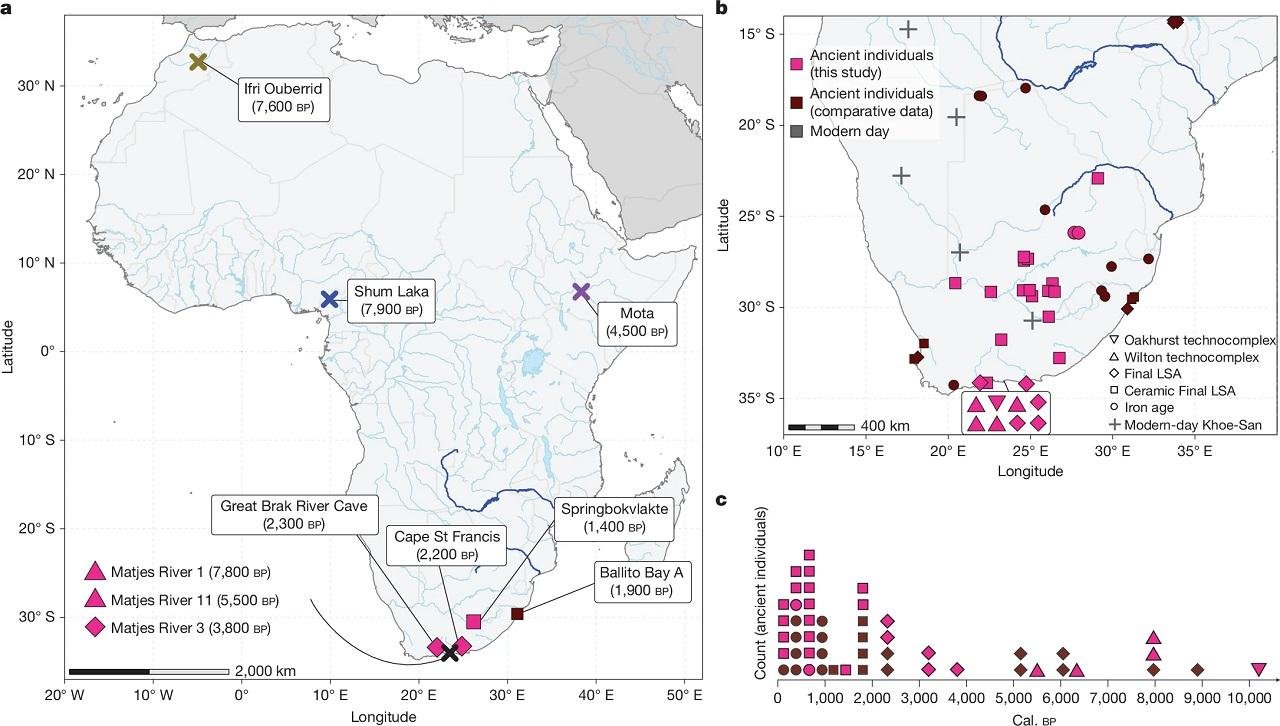
For much of that long period, there is no evidence of external gene flow into the south. At sites like the Matjes River Rock Shelter, archaeological layers reveal identifiable cultural changes in tools and techniques over many millennia, but the DNA suggests that the same population endured through these changes. This stability stands in contrast to patterns in many other parts of the world, where technological or cultural transitions are often associated with new waves of migrants.

Genetic models suggest that southern Africa might have functioned as a refugium, a favorable area for humans to survive through changing climates. The ancient population mostly lived in isolation, but there were occasional migrations northward during milder climatic periods. Traces of their DNA turn up in individuals from present-day Malawi around 8,000 years ago, suggesting small-scale movement out of the region long before any major influx arrived in the south.
Ancient humans lived in isolation in southern Africa for nearly 100,000 years, new study shows
Archaeological sites and dates of sampled and comparative individuals. Credit: M. Jakobsson et al., Nature (2025)

Perhaps the most intriguing result of the study is the finding of dozens of genetic variants unique to Homo sapiens, which were widespread in ancient southern Africans. Many of these changes seem linked to kidney function, fluid balance, and sweating, characteristics that might have given early humans an advantage in body temperature regulation. Some variants relate to neuron growth, cognitive abilities, and immune function, suggesting that aspects of human attention, brain development, and complex thinking may be rooted in these ancient populations.
RelatedStories

Neanderthals gathered shellfish like modern humans 115,000 years ago, study finds

Neanderthals gathered shellfish like modern humans 115,000 years ago, study finds

May 21, 2026
Homo erectus in Java: 140,000-year-old fossils found in submerged river valley

400,000-year-old Homo erectus proteins reveal genetic links to Denisovans and modern humans

May 14, 2026

Scientists estimate that roughly half of all genetic variation present in modern humans can be traced to this prehistoric southern African group. Much of that genetic legacy persists in modern San communities of Namibia, Botswana, and South Africa, which retain up to 80 percent of ancient southern African ancestry.

The study challenges long-standing assumptions that Homo sapiens originated only in eastern Africa. Instead, the evidence shows that southern Africa supported longstanding populations of our species and made key contributions to the genetic and behavioral traits of modern humans.

More information: Jakobsson, M., Bernhardsson, C., McKenna, J. et al. (2025). Homo sapiens-specific evolution unveiled by ancient southern African genomes. Nature. doi:10.1038/s41586-025-09811-4

Share:

Share on Facebook Share on X (Twitter) Share on LinkedIn Share on Pinterest Share on WhatsApp Share on Email

You May Also Like...

100 Abbasid-era gold jewelry pieces found at ancient Dariyah site in Saudi Arabia
Archaeology

100 Abbasid-era gold jewelry pieces found at ancient Dariyah site in Saudi Arabia

May 22, 2026
Neanderthals gathered shellfish like modern humans 115,000 years ago, study finds
Anthropology

Neanderthals gathered shellfish like modern humans 115,000 years ago, study finds

May 21, 2026
Ancient pigeons were already living alongside humans 3,400 years ago, study finds
Archaeology

Ancient pigeons were already living alongside humans 3,400 years ago, study finds

May 21, 2026
Ancient Venetic sanctuary with rare inscriptions unearthed beneath road project in Italy
Archaeology

Ancient Venetic sanctuary with rare inscriptions unearthed beneath road project in Italy

May 21, 2026
1,000-year-old dingo burial in Australia reveals deep ties between Barkindji people and dingoes
Archaeology

1,000-year-old ritually buried dingo in Australia reveals deep ties between Barkindji people and dingoes

May 20, 2026
Ancient texts reveal how Persian and Greek rule shaped language in Central Asia
Archaeology

Ancient texts reveal how Persian and Greek rule shaped language in Central Asia

May 20, 2026

Comments 0

  1. Editorial Team says:
    1 second ago

    Disclaimer: This website is a science-focused magazine that welcomes both academic and non-academic audiences. Comments are written by users and may include personal opinions or unverified claims. They do not necessarily reflect the views of our editorial team or rely on scientific evidence.

    Comment Policy: We kindly ask all commenters to engage respectfully. Comments that contain offensive, insulting, degrading, discriminatory, or racist content will be automatically removed.

    Reply

Leave a Reply Cancel reply

Your email address will not be published. Required fields are marked *

Follow us


Instagram
242K

Facebook
117K

Threads
46K

LinkedIn
14K

Twitter
6K

YouTube
1K
100 Abbasid-era gold jewelry pieces found at ancient Dariyah site in Saudi Arabia

100 Abbasid-era gold jewelry pieces found at ancient Dariyah site in Saudi Arabia

May 22, 2026
Neanderthals gathered shellfish like modern humans 115,000 years ago, study finds

Neanderthals gathered shellfish like modern humans 115,000 years ago, study finds

May 21, 2026
Ancient pigeons were already living alongside humans 3,400 years ago, study finds

Ancient pigeons were already living alongside humans 3,400 years ago, study finds

May 21, 2026
Ancient Venetic sanctuary with rare inscriptions unearthed beneath road project in Italy

Ancient Venetic sanctuary with rare inscriptions unearthed beneath road project in Italy

May 21, 2026

Archaeology News online magazine

Archaeology News is an international online magazine that covers all aspects of archaeology.


Categories

  • Academics
    • Books
    • Conferences
    • Universities
  • Articles
  • Download
  • Game
  • News
    • Anthropology
    • Archaeology
    • Paleontology
  • Quiz
  • Tours

Subscribe to our newsletter

© 2024 - Archaeology News Online Magazine. All Rights Reserved.

  • About
  • Privacy Policy
  • Terms of Use
  • Donation
  • Contact

Manage Consent
To provide the best experiences, we use technologies like cookies to store and/or access device information. Consenting to these technologies will allow us to process data such as browsing behavior or unique IDs on this site. Not consenting or withdrawing consent, may adversely affect certain features and functions.
Functional Always active
The technical storage or access is strictly necessary for the legitimate purpose of enabling the use of a specific service explicitly requested by the subscriber or user, or for the sole purpose of carrying out the transmission of a communication over an electronic communications network.
Preferences
The technical storage or access is necessary for the legitimate purpose of storing preferences that are not requested by the subscriber or user.
Statistics
The technical storage or access that is used exclusively for statistical purposes. The technical storage or access that is used exclusively for anonymous statistical purposes. Without a subpoena, voluntary compliance on the part of your Internet Service Provider, or additional records from a third party, information stored or retrieved for this purpose alone cannot usually be used to identify you.
Marketing
The technical storage or access is required to create user profiles to send advertising, or to track the user on a website or across several websites for similar marketing purposes.
  • Manage options
  • Manage services
  • Manage {vendor_count} vendors
  • Read more about these purposes
View preferences
  • {title}
  • {title}
  • {title}
  • Home
  • News
    • Archaeology
    • Anthropology
    • Paleontology
  • Academic
    • Books
    • Conferences
    • Universities
  • Articles
  • VR Tours
  • Quiz & Game
  • Download
  • Encyclopedia
  • Forum

About  .  Contact  .  Donation

© 2024 - Archaeology News Online Magazine. All Rights Reserved