• About
  • Privacy Policy
  • Terms of Use
  • Donation
  • Contact
No Result
View All Result
Archaeology News
  • Home
  • News
    • Archaeology
    • Anthropology
    • Paleontology
  • Academic
    • Books
    • Conferences
    • Universities
  • Articles
  • VR Tours
  • Quiz & Game
  • Download
  • Encyclopedia
  • Forum
Archaeology News
No Result
View All Result
Home News Archaeology

How coral buildings are helping archaeologists date colonial-era sites in French Polynesia

by Dario Radley
April 30, 2026

Archaeologists working in the Pacific have found a new way to date colonial-era buildings by studying the coral blocks used to build them. The method offers a more direct way to estimate construction dates in regions where written records are limited or incomplete.
How coral buildings are helping archaeologists date colonial-era sites in French Polynesia
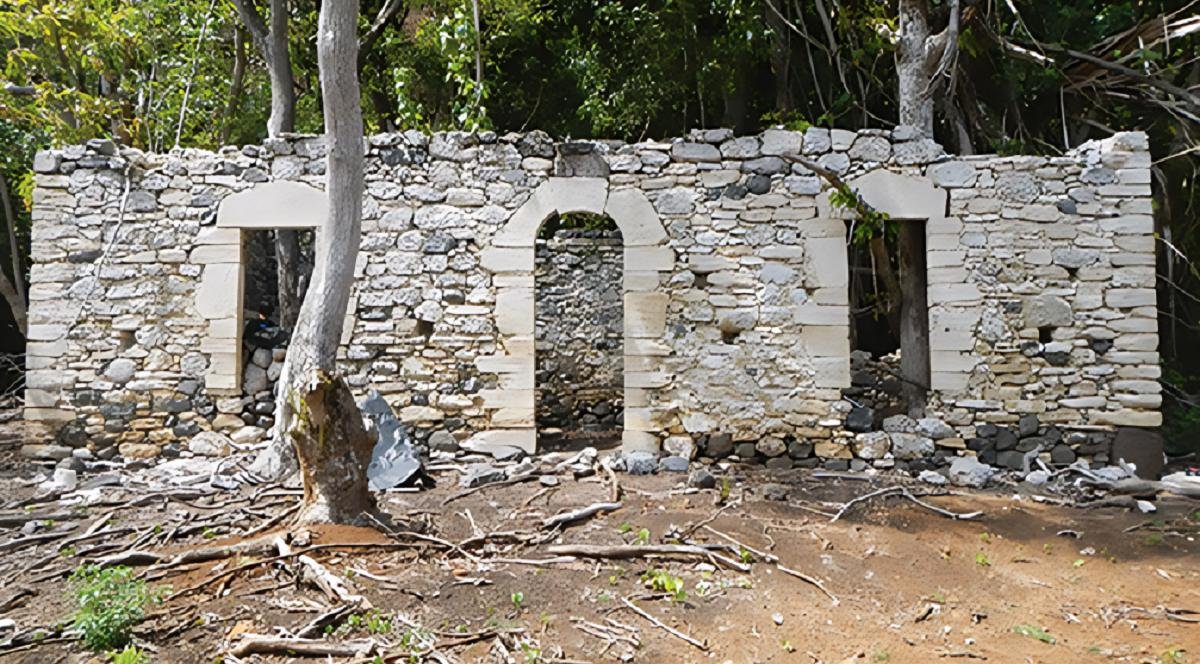
Photograph of the building AKH-20. Credit: James Flexner, Antiquity (2026); CC BY-NC-SA 4.0

A new study published by Cambridge University Press tested uranium-thorium, or U-Th, dating on coral blocks from nineteenth-century buildings in the Mangareva Islands, part of French Polynesia. The research focused on missionary-style structures linked to the arrival of French Catholic missionaries, whose building projects reshaped local architecture and settlement patterns across the islands.

Dating historical sites from the colonial period often depends on written archives or artifacts such as coins, ceramics, and glass. These sources help create rough timelines, though they often leave room for uncertainty. Objects did not always reach remote islands soon after production, and some sites contain very little datable material. Scientific methods also have limits. Radiocarbon dating becomes less precise for recent centuries, while tropical environments rarely preserve timber suitable for tree-ring analysis.

Coral offered a practical alternative.

U-Th dating works by measuring the radioactive decay of uranium into thorium, which allows scientists to estimate when a coral organism died. Since coral was widely used as a construction material across Polynesia, the death date of the coral provides a minimum age for the building in which the block was placed.
RelatedStories

3D metrological analysis connects dispersed Egyptian artifacts and recovers their lost histories

3D metrological analysis connects dispersed Egyptian artifacts and recovers their lost histories

February 17, 2026
New 3D digital analysis maps Paleolithic engravings at Cova Matutano

New 3D method maps Paleolithic engravings at Cova Matutano

February 8, 2026

The study, led by archaeologist James Flexner, sampled minimally weathered branch corals from nine ruined buildings in Mangareva. These included seven stone cottages known locally as are po’atu, a coral watchtower, and a school with documented construction dates used as a control.
How coral buildings are helping archaeologists date colonial-era sites in French Polynesia
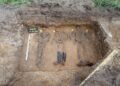
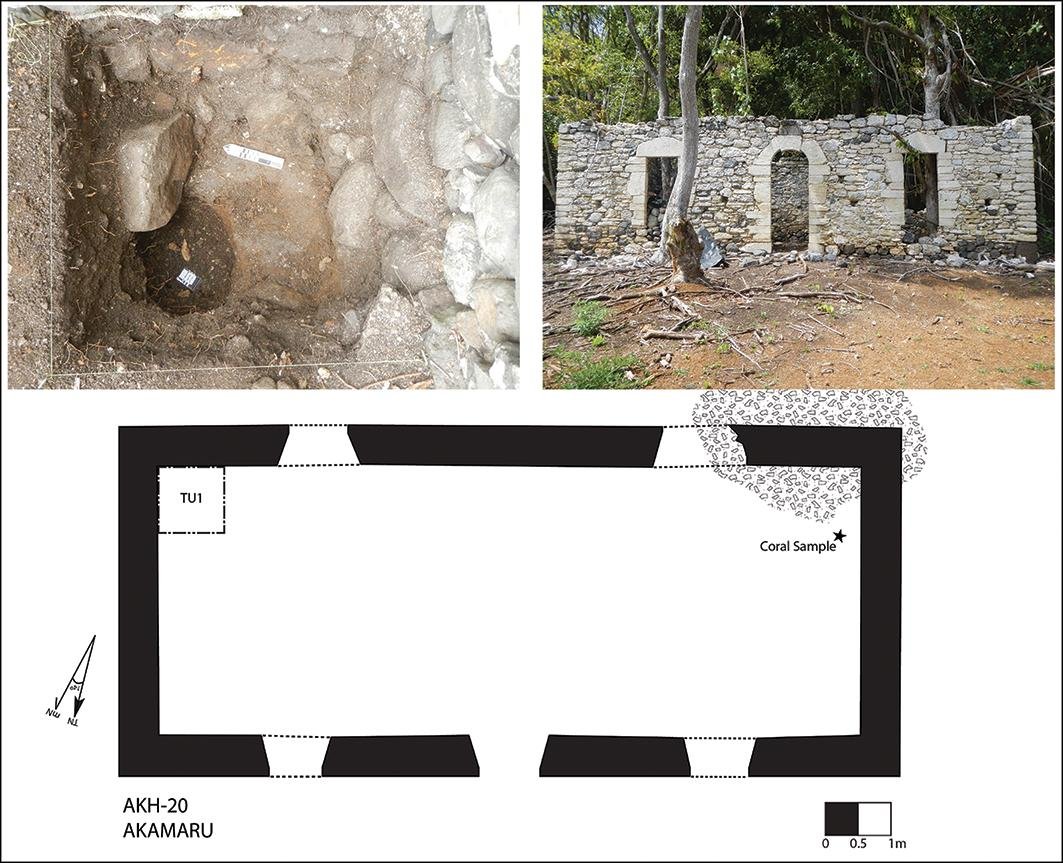
Plan of AKH-20 (below), showing location of test pit and coral sample, along with photographs of the building (top right) and pit feature PN-318 (top left). Credit: James Flexner, Antiquity (2026); CC BY-NC-SA 4.0

Laboratory results showed dates that generally matched the expected period of missionary activity. Several samples clustered in the 1830s and 1840s, the decades after French Catholic missionaries arrived in Mangareva in 1834. During this period, missionaries introduced stone construction methods and trained local Polynesian converts to build in masonry, creating a noticeable shift away from earlier architectural traditions.

The are po’atu houses became a visible feature of this social change. Built in stone and coral, these small dwellings reflected both missionary influence and the growing presence of Polynesian Catholic communities.

One building produced especially useful results when researchers compared coral dates from a house with material from a nearby pit feature. Both returned similar mid-1840s dates. The pit contained food remains, metal objects, glass fragments, and other materials linked to daily life. Archaeologists suggest the deposits and building activity may belong to the same short period, possibly tied to a communal gathering or feast before the house was completed.

Not every sample produced a straightforward answer.

Some coral blocks returned dates older than the buildings themselves, including a few from before sustained European contact with the islands. Researchers explain this through what archaeologists call inbuilt age. Builders may have collected coral from reef areas where organisms had already died years or decades earlier. In other cases, they may have reused materials from older structures, including traditional ceremonial platforms known as marae.

This means the coral does not always reveal the exact year of construction. Instead, the dates indicate the earliest possible moment when a building could have been assembled.

Even with this limitation, the method still provides useful chronological information, especially for sites with little documentary evidence. In places like Mangareva, many colonial-era structures are linked to Indigenous communities rather than official colonial records, leaving gaps in the historical timeline.

The study was based on a relatively small sample set, though the findings suggest wider potential. Similar coral-based architecture appears throughout French Polynesia and other tropical regions. Expanding this work across more islands could help archaeologists test how common inbuilt age is and improve dating methods for relatively recent buildings.

By focusing on the materials inside the walls rather than relying only on artifacts or archives, researchers are building a clearer picture of how communities in the Pacific adapted during a period of religious conversion, settlement change, and colonial expansion.
More information: Flexner, J. (2026). Direct dating of colonial-era coral building materials using the U-Th method in the Mangareva Islands, French Polynesia. Antiquity, 1–12. doi:10.15184/aqy.2026.10325
ShareTweetShareShareSend

You May Also Like...

New copy of earliest known English poem discovered in Rome manuscript
Archaeology

New copy of earliest known English poem discovered in Rome manuscript

April 30, 2026
Ancient cremation pyre uncovered at Sizewell site in England reveals rare prehistoric burial ritual
Archaeology

Ancient cremation pyre uncovered at Sizewell site in England reveals rare prehistoric burial ritual

April 30, 2026
Ancient mass grave in Jordan confirms victims of Justinian Plague pandemic
Anthropology

Ancient mass grave in Jordan confirms victims of Justinian Plague pandemic

April 29, 2026
Roman cup found in Spain reveals new link to Hadrian’s Wall and Roman soldiers
Archaeology

Roman cup found in Spain reveals new link to Hadrian’s Wall and Roman soldiers

April 29, 2026
How Nile River stability shaped the rise of ancient Napata in Sudan’s Kushite kingdom
Archaeology

How Nile River stability shaped the rise of ancient Napata in Sudan’s Kushite kingdom

April 28, 2026
AI reconstructs face of Pompeii victim killed in Mount Vesuvius eruption
Archaeology

AI reconstructs face of Pompeii victim killed in Mount Vesuvius eruption

April 28, 2026

Comments 0

  1. Editorial Team says:
    1 second ago

    Disclaimer: This website is a science-focused magazine that welcomes both academic and non-academic audiences. Comments are written by users and may include personal opinions or unverified claims. They do not necessarily reflect the views of our editorial team or rely on scientific evidence.

    Comment Policy: We kindly ask all commenters to engage respectfully. Comments that contain offensive, insulting, degrading, discriminatory, or racist content will be automatically removed.

    Reply

Leave a Reply Cancel reply

Your email address will not be published. Required fields are marked *

Follow us


Instagram
244K

Facebook
118K

Threads
46K

LinkedIn
14K

Twitter
6K

YouTube
1K
  • Trending
  • Comments
  • Latest
Shipwreck Salvage. Credit: rawpixel.com / Public Domain

2,000-year-old shipwreck discovered off Turkish coast with remarkably preserved stacked ceramics

July 2, 2025
A new study suggests the mysterious Voynich Manuscript may be a medieval cipher

A new study suggests the mysterious Voynich Manuscript may be a medieval cipher

January 3, 2026
Viking age DNA reveals 9,000-year-old HIV-resistant gene originating near the Black Sea

Viking age DNA reveals 9,000-year-old HIV-resistant gene originating near the Black Sea

May 18, 2025
3D analysis reveals Shroud of Turin image likely came from sculpture, not Jesus’ body

3D analysis reveals Shroud of Turin image likely came from sculpture, not Jesus’ body

August 3, 2025
Moses may be named in ancient Egyptian mine inscriptions, sparking debate over earliest biblical references

Moses may be named in ancient Egyptian mine inscriptions, sparking debate over earliest biblical references

July 31, 2025
3D analysis reveals Shroud of Turin image likely came from sculpture, not Jesus’ body

3D analysis reveals Shroud of Turin image likely came from sculpture, not Jesus’ body

Moses may be named in ancient Egyptian mine inscriptions, sparking debate over earliest biblical references

Moses may be named in ancient Egyptian mine inscriptions, sparking debate over earliest biblical references

$1 million prize offered to decipher 5,300-year-old Indus Valley script

$1 million prize offered to decipher 5,300-year-old Indus Valley script

Oldest ever genetic data from a human relative found in 2-million-year-old fossilized teeth

Oldest ever genetic data from a human relative found in 2-million-year-old fossilized teeth

Exceptionally large Roman shoes discovered at Magna fort near Hadrian’s Wall

Exceptionally large Roman shoes discovered at Magna fort near Hadrian’s Wall

New copy of earliest known English poem discovered in Rome manuscript

New copy of earliest known English poem discovered in Rome manuscript

April 30, 2026
How coral buildings are helping archaeologists date colonial-era sites in French Polynesia

How coral buildings are helping archaeologists date colonial-era sites in French Polynesia

April 30, 2026
Ancient cremation pyre uncovered at Sizewell site in England reveals rare prehistoric burial ritual

Ancient cremation pyre uncovered at Sizewell site in England reveals rare prehistoric burial ritual

April 30, 2026
Ancient mass grave in Jordan confirms victims of Justinian Plague pandemic

Ancient mass grave in Jordan confirms victims of Justinian Plague pandemic

April 29, 2026
Roman cup found in Spain reveals new link to Hadrian’s Wall and Roman soldiers

Roman cup found in Spain reveals new link to Hadrian’s Wall and Roman soldiers

April 29, 2026

Archaeology News online magazine

Archaeology News is an international online magazine that covers all aspects of archaeology.


Categories

  • Academics
    • Books
    • Conferences
    • Universities
  • Articles
  • Download
  • Game
  • News
    • Anthropology
    • Archaeology
    • Paleontology
  • Quiz
  • Tours

Subscribe to our newsletter

© 2024 - Archaeology News Online Magazine. All Rights Reserved.

  • About
  • Privacy Policy
  • Terms of Use
  • Donation
  • Contact

Manage Consent
To provide the best experiences, we use technologies like cookies to store and/or access device information. Consenting to these technologies will allow us to process data such as browsing behavior or unique IDs on this site. Not consenting or withdrawing consent, may adversely affect certain features and functions.
Functional Always active
The technical storage or access is strictly necessary for the legitimate purpose of enabling the use of a specific service explicitly requested by the subscriber or user, or for the sole purpose of carrying out the transmission of a communication over an electronic communications network.
Preferences
The technical storage or access is necessary for the legitimate purpose of storing preferences that are not requested by the subscriber or user.
Statistics
The technical storage or access that is used exclusively for statistical purposes. The technical storage or access that is used exclusively for anonymous statistical purposes. Without a subpoena, voluntary compliance on the part of your Internet Service Provider, or additional records from a third party, information stored or retrieved for this purpose alone cannot usually be used to identify you.
Marketing
The technical storage or access is required to create user profiles to send advertising, or to track the user on a website or across several websites for similar marketing purposes.
  • Manage options
  • Manage services
  • Manage {vendor_count} vendors
  • Read more about these purposes
View preferences
  • {title}
  • {title}
  • {title}
  • Home
  • News
    • Archaeology
    • Anthropology
    • Paleontology
  • Academic
    • Books
    • Conferences
    • Universities
  • Articles
  • VR Tours
  • Quiz & Game
  • Download
  • Encyclopedia
  • Forum

About  .  Contact  .  Donation

© 2024 - Archaeology News Online Magazine. All Rights Reserved