
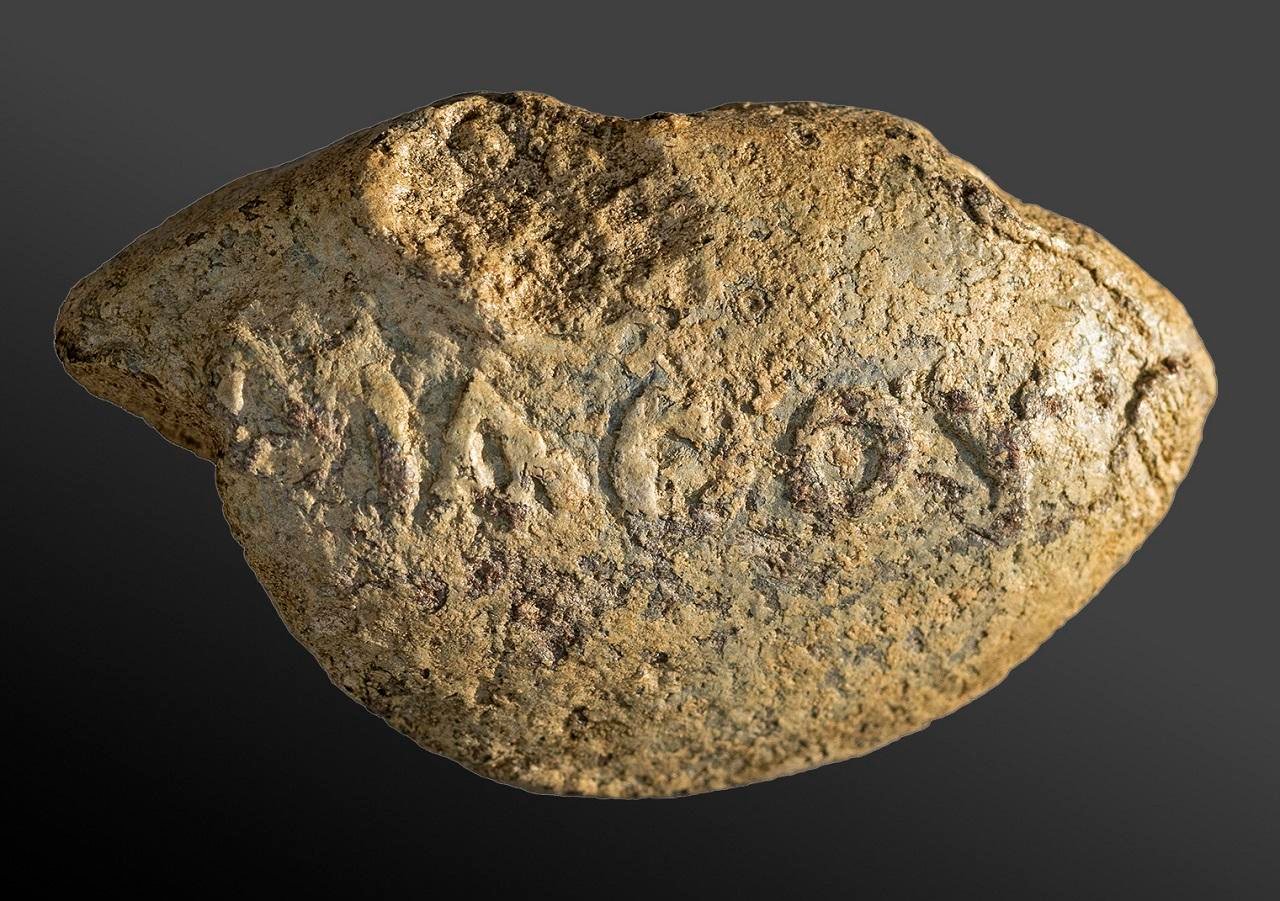
Archaeologists working at Hippos, an ancient city overlooking the Sea of Galilee in the present-day Golan Heights, recovered a 2,000-year-old lead sling bullet carrying a short Greek inscription. The artifact surfaced during 2025 fieldwork near a riverbed close to a necropolis, where teams frequently survey with metal detectors across the ruins of the Hellenistic and Roman settlement.
Hippos belonged to the Decapolis, a group of cities established after the campaigns of Alexander the Great’s successors and later developed under Roman influence. The hilltop location gave strong control over routes near the eastern side of the Sea of Galilee. Archaeological layers from the site reflect repeated conflict, including earlier phases linked to Ptolemaic rule and later conquest by Seleucid forces following the Battle of Paneion around 199 BCE.
The object measures a little over one inch in length, about 3.2 centimeters, and weighs close to 45 grams. Lead formed the material, poured into a mold during production. The bullet has an almond shape, typical for Hellenistic military ammunition. One side shows heavy damage from impact, indicating high-velocity contact during use.
Researchers identified Greek letters ΜΑΘΟΥ engraved on the surface. Linguistic analysis links the word to mathaíno, meaning learn in Greek. The grammatical form suggests an imperative expression interpreted as learn your lesson. Archaeologists note the phrasing carries a sharp tone often associated with battlefield communication.
Michael Eisenberg from the University of Haifa, lead author of the study published in Palestine Exploration Quarterly, described the inscription as a form of local sarcastic expression used by defenders of the city. The phrase appears designed to mock opposing forces during combat rather than serve a neutral label. The team links the wording to a wider tradition of humorous or provocative markings on ancient ammunition.
Sling bullets of lead appear frequently in excavations across the region. Hippos alone has produced 69 examples over 26 years of research. Most date to the second century BCE. Many carry simple symbols such as scorpions, lightning bolts, or references to divine figures and military leaders. Other sites across the Levant have produced bullets marked with short phrases such as take a taste or receive this, suggesting a pattern of psychological messaging during warfare.
Sling technology offered armies a low-cost but highly effective weapon system. A trained slinger could strike targets at distances close to 300 meters. Soldiers placed the projectile in a leather pouch and released it with a rapid swing. Production remained simple, since molds allowed rapid casting during periods of conflict.
The Hippos inscription stands apart from other finds because of its direct wording and unusual grammatical structure. Scholars note the Greek form uses a middle voice construction, where action and reception blend within a single expression. This linguistic choice appears to intensify the message directed toward opponents during combat.
Archaeologists link the bullet to one of several military episodes in the region. Hippos experienced shifting control between Hellenistic powers, beginning with a fortified position under Ptolemaic influence. Later Seleucid forces captured the area and established a formal polis. Later Roman administration maintained the strategic importance of the site.
The discovery adds a rare personal tone to ancient military history. Instead of only recording conflict through architecture and weapon fragments, the inscription reveals direct expression from defenders during active warfare, preserved in a small piece of lead fired across a battlefield nearly two millennia ago.







Disclaimer: This website is a science-focused magazine that welcomes both academic and non-academic audiences. Comments are written by users and may include personal opinions or unverified claims. They do not necessarily reflect the views of our editorial team or rely on scientific evidence.
Comment Policy: We kindly ask all commenters to engage respectfully. Comments that contain offensive, insulting, degrading, discriminatory, or racist content will be automatically removed.