• About
  • Privacy Policy
  • Terms of Use
  • Donation
  • Contact
No Result
View All Result
Archaeology News
  • Home
  • News
    • Archaeology
    • Anthropology
    • Paleontology
  • Academic
    • Books
    • Conferences
    • Universities
  • Articles
  • VR Tours
  • Quiz & Game
  • Download
  • Encyclopedia
  • Forum
Archaeology News
No Result
View All Result
Home News Archaeology

World’s oldest fortresses discovered in Stone Age Siberia

by Dario Radley
December 8, 2023

An international team, led by researchers from Freie Universität Berlin, has unearthed fortified prehistoric settlements in the remote Siberian region.

World’s oldest fortresses discovered in Stone Age Siberia
The prehistoric fortified settlement sits atop a section of land overlooking the bountiful Amnya River in Siberia, Russia. Credit: Nikita GolovThe prehistoric fortified settlement sits atop a section of land overlooking the bountiful Amnya River in Siberia, Russia. Credit: Nikita Golovanov/Antiquity (2023)

Published in the journal Antiquity, the study titled “The World’s Oldest-Known Promontory Fort: Amnya and the Acceleration of Hunter-Gatherer Diversity in Siberia 8000 Years Ago” details the discovery of the world’s oldest-known fortress.

The fortified settlement of Amnya, situated in Siberia’s Lower Ob’ region, stands as the northernmost Stone Age fort in Eurasia. Researchers, including Professor Henny Piezonka and Dr. Natalia Chairkina from Freie Universität Berlin, conducted extensive fieldwork in 2019, revealing ten house pits encircled by earthen walls and wooden palisades, suggesting advanced architectural and defensive capabilities.

This discovery, approximately 8,000 years old according to radiocarbon dating, challenges the established notion that such structures emerged only after the adoption of agriculture.

World’s oldest fortresses discovered in Stone Age Siberia
One of the house pits (top) and an outer defense line with bank and ditch III (bottom) at the Amnya site. Credit: E. Dubovtseva/Piezonka et al, Antiquity (2023)

Tanja Schreiber, an archaeologist from the Institute of Prehistoric Archaeology in Berlin and a co-author of the study said: “Through detailed archaeological examinations at Amnya, we collected samples for radiocarbon dating, confirming the prehistoric age of the site and establishing it as the world’s oldest-known fort.”


RelatedStories

7,000-year-old beaver bone pit discovered in Germany reveals Neolithic fur hunting practices

7,000-year-old beaver bone pit discovered in Germany reveals Neolithic fur hunting practices

May 1, 2026
60,000-year-old ostrich eggshell engravings reveal humanity’s earliest geometric designs

60,000-year-old ostrich eggshell engravings reveal humanity’s earliest geometric designs

February 26, 2026

The prehistoric inhabitants of Amnya, living in Siberia’s taiga environment, led a sophisticated lifestyle centered around abundant resources. Fish from the Amnya River, elk, and reindeer were hunted using bone and stone-tipped spears, and surplus fish oil and meat were preserved in elaborately decorated pottery. This challenges previous assumptions about the capabilities and complexity of hunter-gatherer societies.

The research team’s findings hint at the competitive nature of these ancient communities. The abundance of natural resources in the Siberian taiga, including annual fish runs and migrating herds, likely influenced the construction of fortified settlements. These strategic locations overlooking rivers may have served as a means to control and exploit productive fishing spots, revealing a competitive aspect previously thought absent in hunter-gatherer societies.

The study challenges the traditional narrative associating the rise of societal complexity with the advent of agriculture.

While the purpose of these fortifications remains speculative, theories range from protection during violent conflicts to territorial marking, and even safe storage of high-calorie resources like fish oil. The fortresses may have also emerged as a response to increased inter-group conflict as immigrants migrated into northern Siberia.

The research, spanning various disciplines and involving German and Russian researchers, suggests that the need for such fortifications challenges the idea that competition and violence were absent in the pre-agricultural world.
More information: Piezonka H, Chairkina N, Dubovtseva E, Kosinskaya L, Meadows J, Schreiber T. (2023). The world’s oldest-known promontory fort: Amnya and the acceleration of hunter-gatherer diversity in Siberia 8000 years ago. Antiquity. 2023;97(396):1381-1401. doi:10.15184/aqy.2023.164

Share:

Share on Facebook Share on X (Twitter) Share on LinkedIn Share on Pinterest Share on WhatsApp Share on Email

You May Also Like...

Bronze Age towers in Sardinia remained centers of worship and ritual in the Iron Age
Archaeology

Bronze Age towers in Sardinia remained centers of worship and ritual in the Iron Age

May 23, 2026
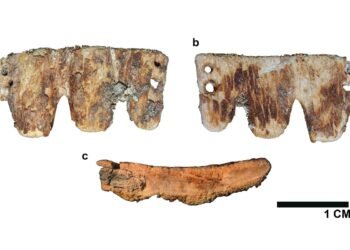
Rare 19th-century bone dental bridge found in Portugal points to early cosmetic tooth replacement
Anthropology

Rare 19th-century bone dental bridge found in Portugal points to early cosmetic tooth replacement

May 23, 2026
Medieval well hidden beneath Sheffield Castle surveyed with drone technology
Archaeology

Medieval well hidden beneath Sheffield Castle surveyed with drone technology

May 23, 2026
Nondestructive DNA sampling uncovers 1,300 years of history preserved in ancient parchments
Archaeology

Nondestructive DNA sampling uncovers 1,300 years of history preserved in ancient parchments

May 22, 2026
2,300-year-old Iron Age riverside structure discovered beneath German city astonishes archaeologists
Archaeology

2,300-year-old Iron Age riverside structure discovered beneath German city

May 22, 2026
100 Abbasid-era gold jewelry pieces found at ancient Dariyah site in Saudi Arabia
Archaeology

100 Abbasid-era gold jewelry pieces found at ancient Dariyah site in Saudi Arabia

May 22, 2026

Follow us


Instagram
242K

Facebook
117K

Threads
46K

LinkedIn
14K

Twitter
6K

YouTube
1K
Bronze Age towers in Sardinia remained centers of worship and ritual in the Iron Age

Bronze Age towers in Sardinia remained centers of worship and ritual in the Iron Age

May 23, 2026
Rare 19th-century bone dental bridge found in Portugal points to early cosmetic tooth replacement

Rare 19th-century bone dental bridge found in Portugal points to early cosmetic tooth replacement

May 23, 2026
Medieval well hidden beneath Sheffield Castle surveyed with drone technology

Medieval well hidden beneath Sheffield Castle surveyed with drone technology

May 23, 2026
Nondestructive DNA sampling uncovers 1,300 years of history preserved in ancient parchments

Nondestructive DNA sampling uncovers 1,300 years of history preserved in ancient parchments

May 22, 2026

Archaeology News online magazine

Archaeology News is an international online magazine that covers all aspects of archaeology.


Categories

  • Academics
    • Books
    • Conferences
    • Universities
  • Articles
  • Download
  • Game
  • News
    • Anthropology
    • Archaeology
    • Paleontology
  • Quiz
  • Tours

Subscribe to our newsletter

© 2024 - Archaeology News Online Magazine. All Rights Reserved.

  • About
  • Privacy Policy
  • Terms of Use
  • Donation
  • Contact

Manage Consent
To provide the best experiences, we use technologies like cookies to store and/or access device information. Consenting to these technologies will allow us to process data such as browsing behavior or unique IDs on this site. Not consenting or withdrawing consent, may adversely affect certain features and functions.
Functional Always active
The technical storage or access is strictly necessary for the legitimate purpose of enabling the use of a specific service explicitly requested by the subscriber or user, or for the sole purpose of carrying out the transmission of a communication over an electronic communications network.
Preferences
The technical storage or access is necessary for the legitimate purpose of storing preferences that are not requested by the subscriber or user.
Statistics
The technical storage or access that is used exclusively for statistical purposes. The technical storage or access that is used exclusively for anonymous statistical purposes. Without a subpoena, voluntary compliance on the part of your Internet Service Provider, or additional records from a third party, information stored or retrieved for this purpose alone cannot usually be used to identify you.
Marketing
The technical storage or access is required to create user profiles to send advertising, or to track the user on a website or across several websites for similar marketing purposes.
  • Manage options
  • Manage services
  • Manage {vendor_count} vendors
  • Read more about these purposes
View preferences
  • {title}
  • {title}
  • {title}
  • Home
  • News
    • Archaeology
    • Anthropology
    • Paleontology
  • Academic
    • Books
    • Conferences
    • Universities
  • Articles
  • VR Tours
  • Quiz & Game
  • Download
  • Encyclopedia
  • Forum

About  .  Contact  .  Donation

© 2024 - Archaeology News Online Magazine. All Rights Reserved