• About
  • Privacy Policy
  • Terms of Use
  • Donation
  • Contact
No Result
View All Result
Archaeology News
  • Home
  • News
    • Archaeology
    • Anthropology
    • Paleontology
  • Academic
    • Books
    • Conferences
    • Universities
  • Articles
  • VR Tours
  • Quiz & Game
  • Download
  • Encyclopedia
  • Forum
Archaeology News
No Result
View All Result
Home News Paleontology

Mystery of the giant ape’s extinction finally solved

by Dario Radley
January 12, 2024

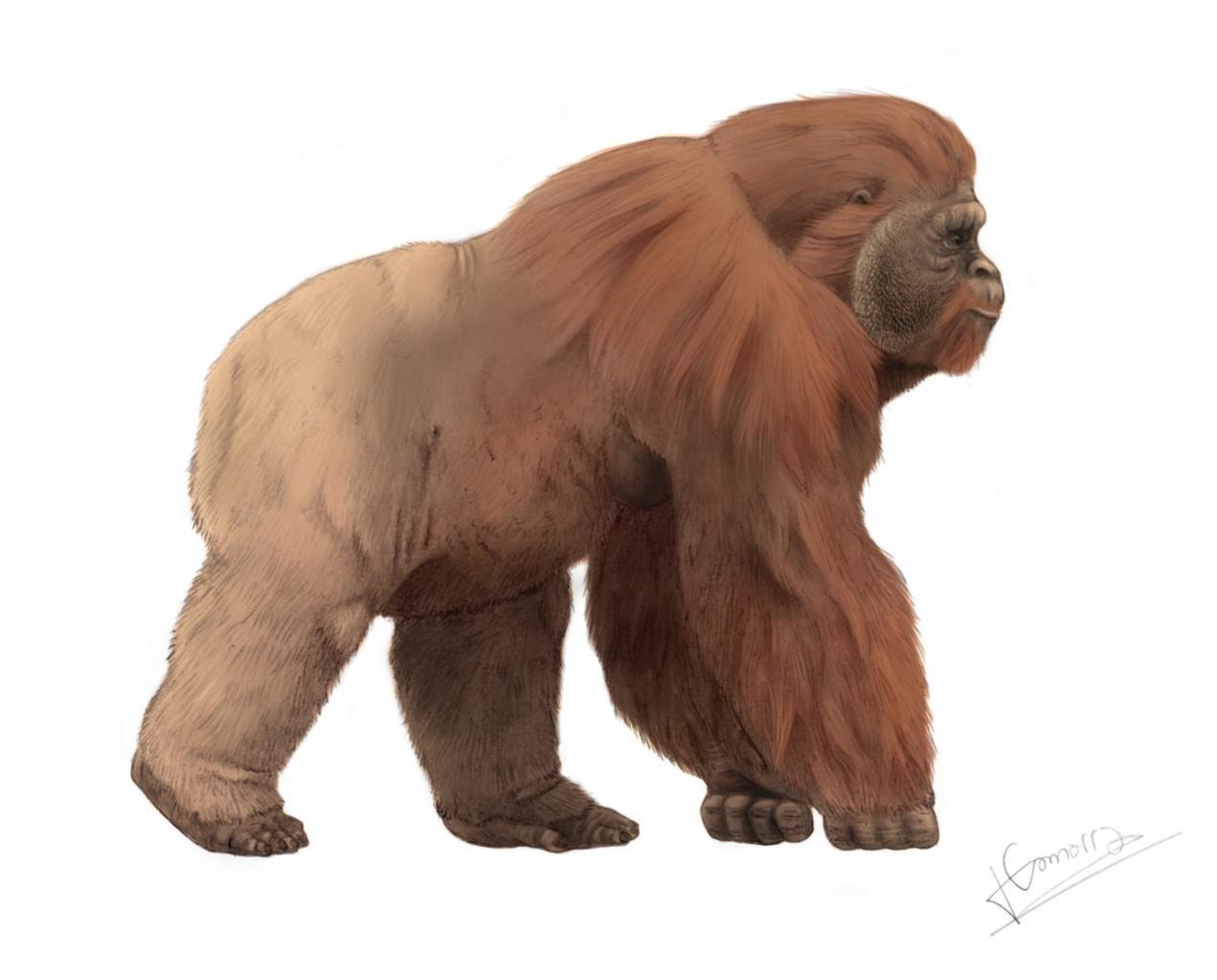
An international team of researchers from Chinese, Australian, and US institutions has unraveled the mysteries surrounding the extinction of Gigantopithecus blacki, the largest primate ever to walk the Earth.
Mystery of the giant ape's extinction finally solved
An illustration of a Gigantopithecus blacki. Credit: Concavenator, CC BY-SA 4.0

The study, published in the journal Nature, sheds light on the colossal ape’s demise between 295,000 and 215,000 years ago, exposing its inability to adapt to a changing environment.

Gigantopithecus blacki, often referred to as the “real-life King Kong,” once roamed the lush karst plains of southern China, towering at three meters tall and weighing over 250 kilograms. Discovered by anthropologist Ralph von Koenigswald in 1935, the species is only known through approximately 2,000 fossilized teeth and four jawbones.

For over 85 years, the extinction of G. blacki remained a perplexing enigma in paleontology. Palaeontologist and co-lead author Professor Yingqi Zhang, from the Institute of Vertebrate Palaeontology and Palaeoanthropology at the Chinese Academy of Sciences (IVPP), states, “The unresolved cause of its disappearance has become the Holy Grail in this discipline.”

To crack this longstanding puzzle, a multidisciplinary team conducted a comprehensive regional analysis, examining evidence from 22 caves in Guangxi Province, southern China. Luminescence dating, uranium series, and electron-spin resonance techniques were employed to establish a definitive timeframe for G. blacki’s extinction between 295,000 and 215,000 years ago.

RelatedStories

Horse domestication began centuries earlier than thought, study reveals early riding and management in 4th millennium BCE

Horse domestication began centuries earlier than thought, study reveals early riding and management in 4th millennium BCE

May 15, 2026
Cut marks on 1.6-million-year-old bones reveal early humans moved and processed meat in Kenya

Cut marks on 1.6-million-year-old bones reveal early humans moved and processed meat in Kenya

May 13, 2026

Associate Professor Kira Westaway, a geochronologist from Macquarie University and co-lead author, emphasizes the significance of a precise timeline, stating, “Without robust dating, you are simply looking for clues in the wrong places.” The research involved six Australian universities, with contributions from Macquarie University, Southern Cross University, Wollongong University, and the University of Queensland.

Detailed pollen analysis, fauna reconstructions, stable isotope analysis of teeth, and micro-level analysis of cave sediments revealed the environmental conditions leading to G. blacki’s extinction. The study unveiled a thriving population of G. blacki in a rich and diverse forest around 2.3 million years ago. However, by 700,000 to 600,000 years ago, changing environmental conditions, marked by more seasonal climates and alterations in forest structure, led to the decline of G. blacki.

Comparisons with orangutans (Pongo), close relatives of G. blacki, showed the adaptability of the latter. Orangutans adjusted their size, behavior, and habitat preferences, while G. blacki, an ultimate specialist, struggled with a less nutritious fallback food source, reduced mobility, and chronic stress. Professor Zhang notes, “G. blacki was the ultimate specialist, compared to the more agile adapters like orangutans, and this ultimately led to its demise.”

Associate Professor Westaway says: “With the threat of a sixth mass extinction event looming over us, there is an urgent need to understand why species go extinct. Exploring the reasons for past unresolved extinctions gives us a good starting point to understand primate resilience and the fate of other large animals, in the past and future.”
More information: Zhang Y, Westaway KE, Haberle S, et al. (2024). The demise of the giant ape Gigantopithecus blacki. Nature. doi: 10.1038/s41586-023-06900-0
ShareTweetShareShareSend

You May Also Like...

World War II mass grave in Poland reveals remains of German officer killed during Battle of Lauban
Anthropology

World War II mass grave in Poland reveals remains of German officer killed during Battle of Lauban

May 19, 2026
massive jar in Laos contained remains of 37 people, revealing ancient burial rituals and Asian trade links
Anthropology

Massive jar in Laos contained remains of 37 people, revealing ancient burial rituals and Asian trade links

May 19, 2026
6,000-year-old necropolis in Spain rewrites origins of Europe’s first megalithic tombs
Archaeology

6,000-year-old necropolis in Spain rewrites origins of Europe’s first megalithic tombs

May 18, 2026
Ancient settlement with weaving workshop and longhouses uncovered in Germany gravel pit
Archaeology

Ancient settlement with weaving workshop and longhouses uncovered in Germany gravel pit

May 17, 2026
Pompeii victim identified as Roman physician killed while fleeing Vesuvius eruption
Anthropology

Pompeii victim identified as Roman physician killed while fleeing Vesuvius eruption

May 17, 2026
Archaeologists uncover hidden whisky smuggler bothy in Scottish Highlands with rare copper still piece
Archaeology

Archaeologists uncover hidden whisky smuggler bothy in Scottish Highlands with rare copper still piece

May 16, 2026

Comments 1

  1. Editorial Team says:
    1 second ago

    Disclaimer: This website is a science-focused magazine that welcomes both academic and non-academic audiences. Comments are written by users and may include personal opinions or unverified claims. They do not necessarily reflect the views of our editorial team or rely on scientific evidence.

    Comment Policy: We kindly ask all commenters to engage respectfully. Comments that contain offensive, insulting, degrading, discriminatory, or racist content will be automatically removed.

  2. Barbara Wright says:
    2 years ago

    There was a whole lot going on on this planet before we came along. If all these species became extinct, does that mean us humans could become extinct too and evolve into something else? I have heard that many of our babies are born without wisdom teeth. That’s a change. This is all so incredibly interesting. I love it.

Follow us


Instagram
242K

Facebook
117K

Threads
46K

LinkedIn
14K

Twitter
6K

YouTube
1K
World War II mass grave in Poland reveals remains of German officer killed during Battle of Lauban

World War II mass grave in Poland reveals remains of German officer killed during Battle of Lauban

May 19, 2026
massive jar in Laos contained remains of 37 people, revealing ancient burial rituals and Asian trade links

Massive jar in Laos contained remains of 37 people, revealing ancient burial rituals and Asian trade links

May 19, 2026
6,000-year-old necropolis in Spain rewrites origins of Europe’s first megalithic tombs

6,000-year-old necropolis in Spain rewrites origins of Europe’s first megalithic tombs

May 18, 2026
Ancient settlement with weaving workshop and longhouses uncovered in Germany gravel pit

Ancient settlement with weaving workshop and longhouses uncovered in Germany gravel pit

May 17, 2026

Archaeology News online magazine

Archaeology News is an international online magazine that covers all aspects of archaeology.


Categories

  • Academics
    • Books
    • Conferences
    • Universities
  • Articles
  • Download
  • Game
  • News
    • Anthropology
    • Archaeology
    • Paleontology
  • Quiz
  • Tours

Subscribe to our newsletter

© 2024 - Archaeology News Online Magazine. All Rights Reserved.

  • About
  • Privacy Policy
  • Terms of Use
  • Donation
  • Contact

Manage Consent
To provide the best experiences, we use technologies like cookies to store and/or access device information. Consenting to these technologies will allow us to process data such as browsing behavior or unique IDs on this site. Not consenting or withdrawing consent, may adversely affect certain features and functions.
Functional Always active
The technical storage or access is strictly necessary for the legitimate purpose of enabling the use of a specific service explicitly requested by the subscriber or user, or for the sole purpose of carrying out the transmission of a communication over an electronic communications network.
Preferences
The technical storage or access is necessary for the legitimate purpose of storing preferences that are not requested by the subscriber or user.
Statistics
The technical storage or access that is used exclusively for statistical purposes. The technical storage or access that is used exclusively for anonymous statistical purposes. Without a subpoena, voluntary compliance on the part of your Internet Service Provider, or additional records from a third party, information stored or retrieved for this purpose alone cannot usually be used to identify you.
Marketing
The technical storage or access is required to create user profiles to send advertising, or to track the user on a website or across several websites for similar marketing purposes.
  • Manage options
  • Manage services
  • Manage {vendor_count} vendors
  • Read more about these purposes
View preferences
  • {title}
  • {title}
  • {title}
  • Home
  • News
    • Archaeology
    • Anthropology
    • Paleontology
  • Academic
    • Books
    • Conferences
    • Universities
  • Articles
  • VR Tours
  • Quiz & Game
  • Download
  • Encyclopedia
  • Forum

About  .  Contact  .  Donation

© 2024 - Archaeology News Online Magazine. All Rights Reserved