• About
  • Privacy Policy
  • Terms of Use
  • Donation
  • Contact
No Result
View All Result
Archaeology News
  • Home
  • News
    • Archaeology
    • Anthropology
    • Paleontology
  • Academic
    • Books
    • Conferences
    • Universities
  • Articles
  • VR Tours
  • Quiz & Game
  • Download
  • Encyclopedia
  • Forum
Archaeology News
No Result
View All Result
Home News Anthropology

Ancient Mesopotamians felt love in their liver and anger in their feet, Akkadian texts reveal

by Dario Radley
December 6, 2024

A recent study has revealed how emotions were understood and experienced in ancient Mesopotamia. The findings, published in iScience on December 4, were based on an analysis of over one million words of Akkadian texts, written in cuneiform script on clay tablets between 934 and 612 BCE.
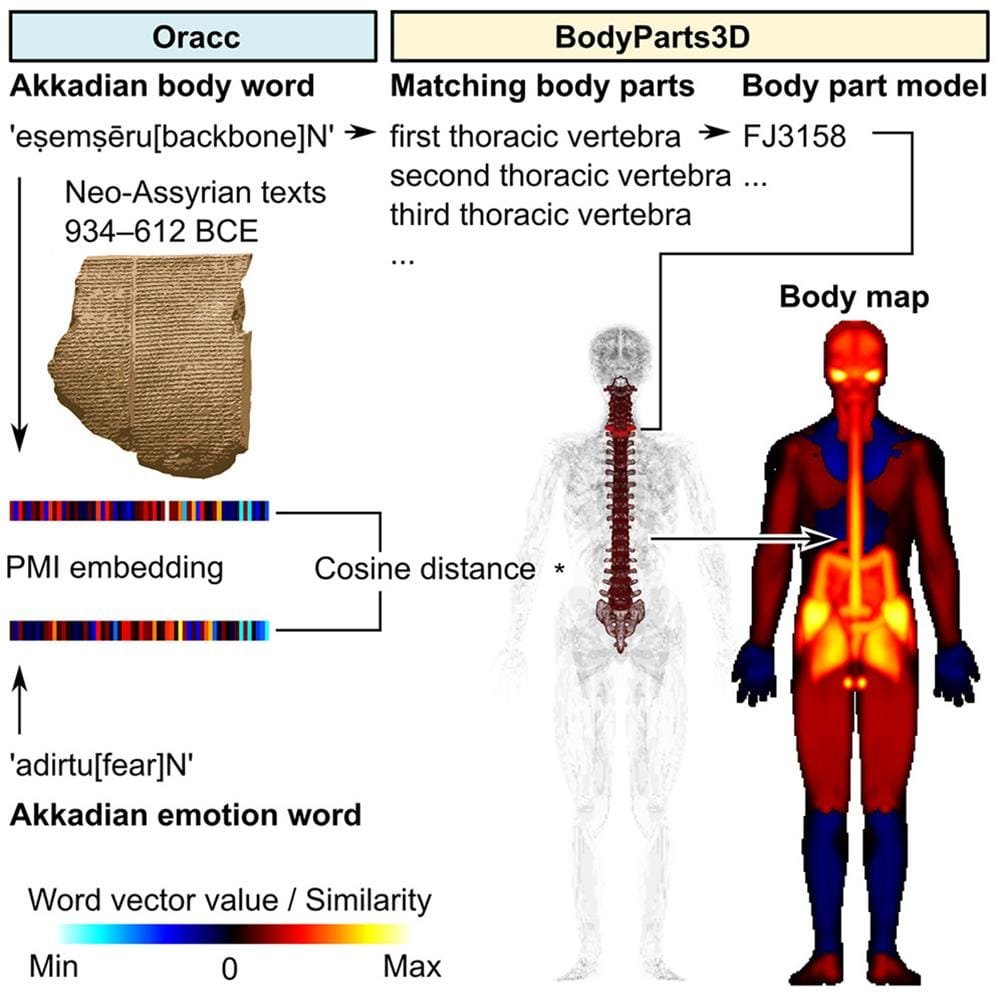
Ancient Mesopotamians felt love in their liver and anger in their feet, Akkadian texts reveal
Akkadian texts reveal how Mesopotamian humans experienced emotions in their bodies. Credit: Juha M. Lahnakoski et. al, Science (2024), CC BY 4.0

Led by Professor Saana Svärd from the University of Helsinki, the multidisciplinary research team included experts from Aalto University, the University of Turku, and Johannes Gutenberg-Universität Mainz. Their work represents the first quantitative analysis linking emotions to body parts in ancient texts. “Even in ancient Mesopotamia, there was a rough understanding of anatomy, for example, the importance of the heart, liver, and lungs,” Svärd explained.

Emotions in the Liver, Heart, and Feet
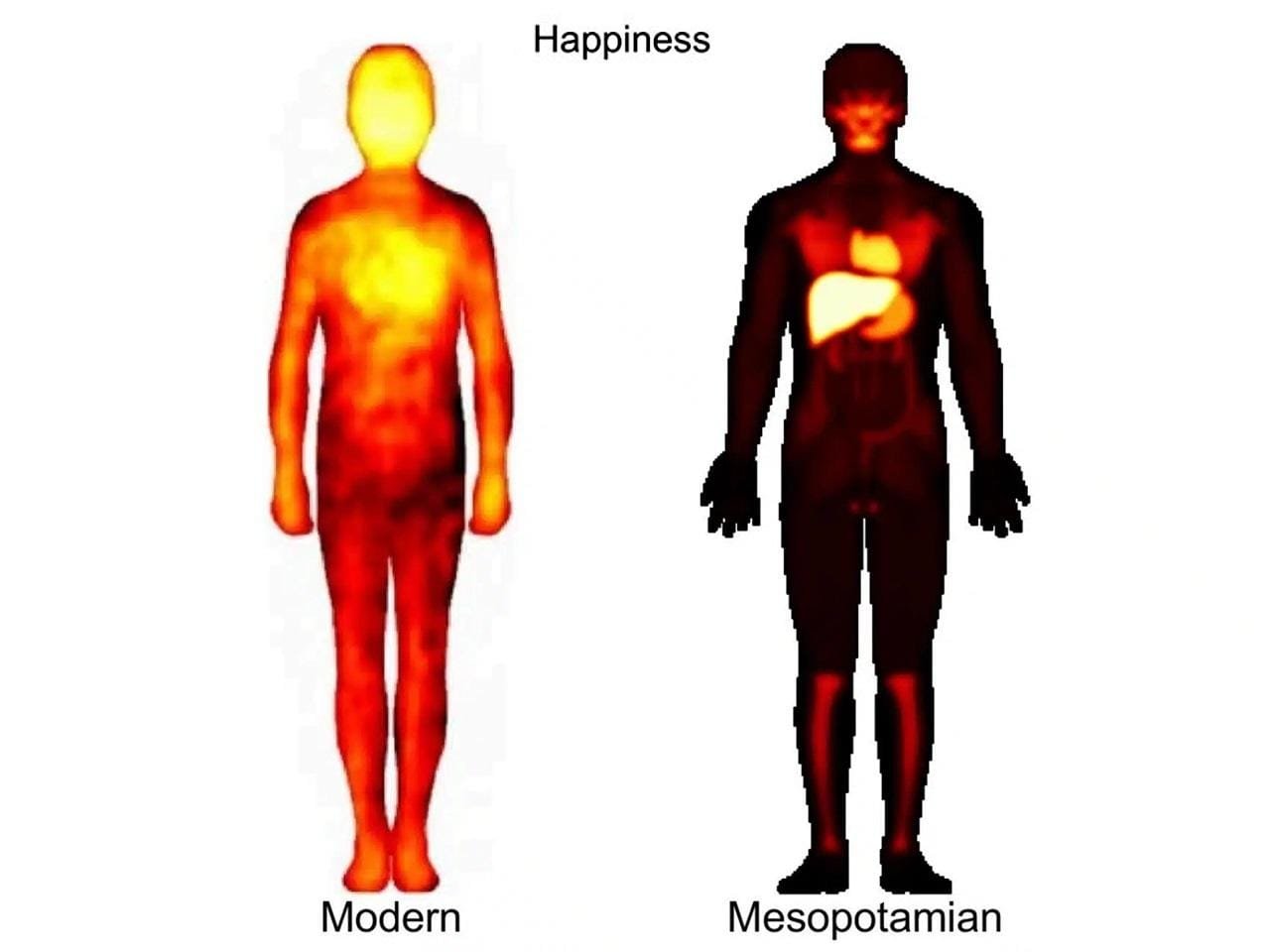
In ancient Mesopotamian texts, happiness was often associated with the liver. Descriptions of joy used terms such as “open,” “shining,” and “full,” highlighting the symbolic and functional importance of the organ. Cognitive neuroscientist Juha Lahnakoski, a visiting researcher at Aalto University, noted the parallels with modern body maps of happiness, except for the unique “glow” in the liver described by Mesopotamians.

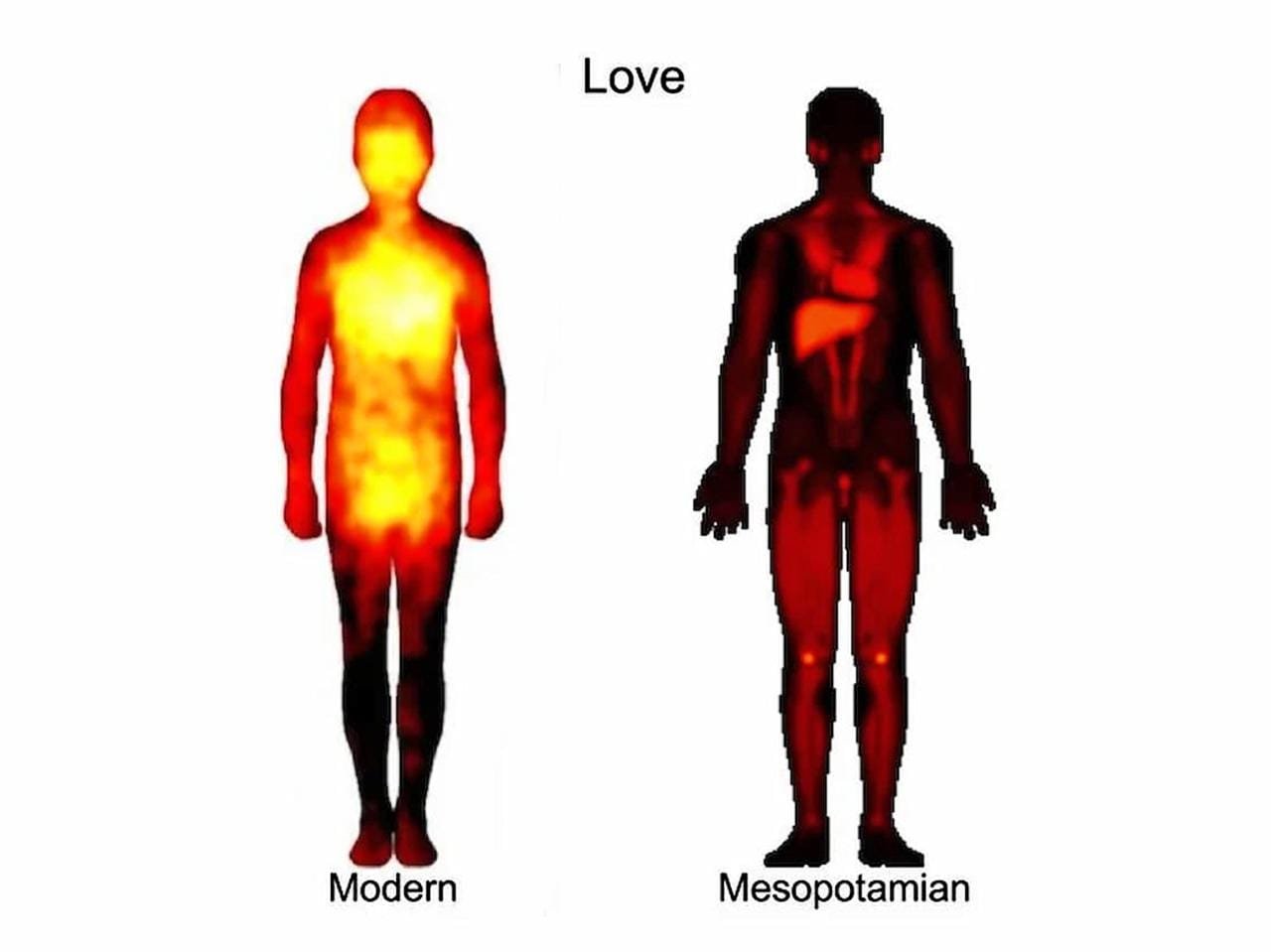
While modern humans often report feeling anger in their upper body and hands, Mesopotamians described anger as concentrated in their feet, using terms like “heated” and “enraged.” Love was another emotion with intriguing differences. Both modern and ancient individuals associate love with the heart, but Mesopotamians also connected it to the liver and knees. This association may reflect the emotional intensity symbolized by bending or bringing someone to their knees.
Ancient Mesopotamians felt love in their liver and anger in their feet, Akkadian texts reveal
In ancient Mesopotamian texts, happiness was often associated with the liver. Credit: Juha M. Lahnakoski et. al, Science (2024), CC BY 4.0

Methodology and Comparative Analysis
The study employed corpus linguistics, a method developed over years at the Center of Excellence in Ancient Near Eastern Empires (ANEE) led by Svärd. This approach enabled researchers to analyze large datasets and map the linguistic descriptions of emotions to specific body parts. The team drew comparisons with modern body maps published a decade ago by Finnish researcher Lauri Nummenmaa and colleagues, which were based on self-reported bodily experiences.

RelatedStories

Archaeologists identify forgotten city of Alexandria on the Tigris in southern Iraq

Archaeologists identify forgotten city of Alexandria on the Tigris in southern Iraq

February 3, 2026
Unexpected discovery: sand layer beneath Ishtar Temple in Assur reveals city’s founding and ancient ritual practices

Unexpected discovery: sand layer beneath Ishtar Temple in Assur reveals city’s founding and ancient ritual practices

February 2, 2026

The researchers cautioned against direct comparisons between modern and ancient body maps. “Texts are texts, and emotions are lived and experienced,” Svärd emphasized. The modern maps rely on participants coloring body images based on their feelings, while Mesopotamian maps are inferred from linguistic descriptions in texts produced by scribes, who represented the elite literate class.
Ancient Mesopotamians felt love in their liver and anger in their feet, Akkadian texts reveal
Modern individuals associate love with the heart, but Mesopotamians also connected it to the liver and knees. Credit: Juha M. Lahnakoski et. al, Science (2024), CC BY 4.0

Future Research
The study opens new avenues for exploring how emotions are expressed and experienced across different cultures and times. “It could be a useful way to explore intercultural differences in the way we experience emotions,” Svärd noted. The team plans to extend their research to a 20th-century English text corpus containing 100 million words and also analyze Finnish data to further examine emotional expressions.

This research reveals that while some emotions like love have shared physical expressions across millennia, others, such as anger and happiness, differ significantly in their bodily associations. By delving into these ancient texts, scholars not only uncover the emotional lives of the Mesopotamians but also gain insights into the evolving interplay between the mind and body throughout human history.
More information: Lahnakoski, J. M., Bennett, E., Nummenmaa, L., Steinert, U., Sams, M., & Svärd, S. (2024). Embodied emotions in ancient Neo-Assyrian texts revealed by bodily mapping of emotional semantics. iScience, (111365), 111365. doi:10.1016/j.isci.2024.111365
Share5Tweet3Share1ShareSend

You May Also Like...

Roman cup found in Spain reveals new link to Hadrian’s Wall and Roman soldiers
Archaeology

Roman cup found in Spain reveals new link to Hadrian’s Wall and Roman soldiers

April 29, 2026
How Nile River stability shaped the rise of ancient Napata in Sudan’s Kushite kingdom
Archaeology

How Nile River stability shaped the rise of ancient Napata in Sudan’s Kushite kingdom

April 28, 2026
AI reconstructs face of Pompeii victim killed in Mount Vesuvius eruption
Archaeology

AI reconstructs face of Pompeii victim killed in Mount Vesuvius eruption

April 28, 2026
Ancient Roman toilets in Bulgaria reveal early spread of intestinal parasites
Anthropology

Ancient Roman toilets in Bulgaria reveal early spread of intestinal parasites

April 28, 2026
Ancient Roman shipwreck reveals hidden secrets of waterproofing and Mediterranean repairs
Archaeology

Ancient Roman shipwreck reveals hidden secrets of waterproofing and Mediterranean repairs

April 27, 2026
42 lost pages of Codex H recovered, revealing early New Testament structure and scribal practices
Archaeology

42 lost pages of Codex H recovered, revealing early New Testament structure and scribal practices

April 26, 2026

Follow us


Instagram
244K

Facebook
118K

Threads
46K

LinkedIn
14K

Twitter
6K

YouTube
1K
  • Trending
  • Comments
  • Latest
Shipwreck Salvage. Credit: rawpixel.com / Public Domain

2,000-year-old shipwreck discovered off Turkish coast with remarkably preserved stacked ceramics

July 2, 2025
A new study suggests the mysterious Voynich Manuscript may be a medieval cipher

A new study suggests the mysterious Voynich Manuscript may be a medieval cipher

January 3, 2026
Viking age DNA reveals 9,000-year-old HIV-resistant gene originating near the Black Sea

Viking age DNA reveals 9,000-year-old HIV-resistant gene originating near the Black Sea

May 18, 2025
3D analysis reveals Shroud of Turin image likely came from sculpture, not Jesus’ body

3D analysis reveals Shroud of Turin image likely came from sculpture, not Jesus’ body

August 3, 2025
Moses may be named in ancient Egyptian mine inscriptions, sparking debate over earliest biblical references

Moses may be named in ancient Egyptian mine inscriptions, sparking debate over earliest biblical references

July 31, 2025
3D analysis reveals Shroud of Turin image likely came from sculpture, not Jesus’ body

3D analysis reveals Shroud of Turin image likely came from sculpture, not Jesus’ body

Moses may be named in ancient Egyptian mine inscriptions, sparking debate over earliest biblical references

Moses may be named in ancient Egyptian mine inscriptions, sparking debate over earliest biblical references

$1 million prize offered to decipher 5,300-year-old Indus Valley script

$1 million prize offered to decipher 5,300-year-old Indus Valley script

Oldest ever genetic data from a human relative found in 2-million-year-old fossilized teeth

Oldest ever genetic data from a human relative found in 2-million-year-old fossilized teeth

Exceptionally large Roman shoes discovered at Magna fort near Hadrian’s Wall

Exceptionally large Roman shoes discovered at Magna fort near Hadrian’s Wall

Roman cup found in Spain reveals new link to Hadrian’s Wall and Roman soldiers

Roman cup found in Spain reveals new link to Hadrian’s Wall and Roman soldiers

April 29, 2026
How Nile River stability shaped the rise of ancient Napata in Sudan’s Kushite kingdom

How Nile River stability shaped the rise of ancient Napata in Sudan’s Kushite kingdom

April 28, 2026
AI reconstructs face of Pompeii victim killed in Mount Vesuvius eruption

AI reconstructs face of Pompeii victim killed in Mount Vesuvius eruption

April 28, 2026
Ancient Roman toilets in Bulgaria reveal early spread of intestinal parasites

Ancient Roman toilets in Bulgaria reveal early spread of intestinal parasites

April 28, 2026
Ancient Roman shipwreck reveals hidden secrets of waterproofing and Mediterranean repairs

Ancient Roman shipwreck reveals hidden secrets of waterproofing and Mediterranean repairs

April 27, 2026

Archaeology News online magazine

Archaeology News is an international online magazine that covers all aspects of archaeology.


Categories

  • Academics
    • Books
    • Conferences
    • Universities
  • Articles
  • Download
  • Game
  • News
    • Anthropology
    • Archaeology
    • Paleontology
  • Quiz
  • Tours

Subscribe to our newsletter

© 2024 - Archaeology News Online Magazine. All Rights Reserved.

  • About
  • Privacy Policy
  • Terms of Use
  • Donation
  • Contact

Manage Consent
To provide the best experiences, we use technologies like cookies to store and/or access device information. Consenting to these technologies will allow us to process data such as browsing behavior or unique IDs on this site. Not consenting or withdrawing consent, may adversely affect certain features and functions.
Functional Always active
The technical storage or access is strictly necessary for the legitimate purpose of enabling the use of a specific service explicitly requested by the subscriber or user, or for the sole purpose of carrying out the transmission of a communication over an electronic communications network.
Preferences
The technical storage or access is necessary for the legitimate purpose of storing preferences that are not requested by the subscriber or user.
Statistics
The technical storage or access that is used exclusively for statistical purposes. The technical storage or access that is used exclusively for anonymous statistical purposes. Without a subpoena, voluntary compliance on the part of your Internet Service Provider, or additional records from a third party, information stored or retrieved for this purpose alone cannot usually be used to identify you.
Marketing
The technical storage or access is required to create user profiles to send advertising, or to track the user on a website or across several websites for similar marketing purposes.
  • Manage options
  • Manage services
  • Manage {vendor_count} vendors
  • Read more about these purposes
View preferences
  • {title}
  • {title}
  • {title}
  • Home
  • News
    • Archaeology
    • Anthropology
    • Paleontology
  • Academic
    • Books
    • Conferences
    • Universities
  • Articles
  • VR Tours
  • Quiz & Game
  • Download
  • Encyclopedia
  • Forum

About  .  Contact  .  Donation

© 2024 - Archaeology News Online Magazine. All Rights Reserved