• About
  • Privacy Policy
  • Terms of Use
  • Donation
  • Contact
No Result
View All Result
Archaeology News
  • Home
  • News
    • Archaeology
    • Anthropology
    • Paleontology
  • Academic
    • Books
    • Conferences
    • Universities
  • Articles
  • VR Tours
  • Quiz & Game
  • Download
  • Encyclopedia
  • Forum
Archaeology News
No Result
View All Result
Home News Anthropology

Genetic study reveals family sacrifices in 1,500-year-old Moche tomb in Peru

by Dario Radley
December 26, 2024

Archaeologists have uncovered evidence of a unique ritual sacrifice involving close family members in the ancient Moche culture of Peru. Genetic analysis of six individuals buried in a 1,500-year-old tomb at Huaca Cao Viejo, part of the El Brujo archaeological complex, reveals that two adolescents were sacrificed to their close relatives during funerary rites for high-status individuals.

Genetic study reveals family sacrifices in 1,500-year-old Moche tomb in Peru
A reconstruction of what the Señora de Cao might have looked like, on display at the Musée du Quai Branly – Jacques Chirac. Credit: Jean-Pierre Dalbéra, CC BY 2.0

The Moche civilization thrived along Peru’s northern coast between 300 and 950 CE, known for its elaborate social hierarchy and ceremonial human sacrifices to deities. However, the recent discovery marks the first documented instance of sacrifices involving adolescent relatives during funerary ceremonies. “Most of what we know about human sacrifices with the Moche relates to very public and gruesome forms of human sacrifice,” said Lars Fehren-Schmitz, an archaeogeneticist at the University of California, Santa Cruz, in a statement to Live Science. “No evidence has pointed to the sacrifice of close or adolescent relatives like we observed.”

The burial site, discovered in 2005, held the remains of six individuals, including the well-preserved body of a high-status woman known as Señora de Cao. Alongside her were three men and two adolescents, a boy and a girl, who had been strangled with plant fiber ropes. Genetic analysis confirmed that the two teenagers were closely related to the adults buried in the tomb. The boy is believed to have been sacrificed following his father’s death, while the girl appears to have been offered during her aunt’s burial.

“This study provides the first confirmation of familial relationships within an elite Moche burial group from Huaca Cao Viejo, offering new insights into Moche social organization, burial practices, and kinship-based politics,” the researchers wrote. Using genomic sequencing, the team reconstructed a family tree spanning at least four generations. Señora de Cao was identified as the probable aunt of the sacrificed girl, while one of the men was likely the father of the girl and the brother of Señora de Cao. Another man buried in the tomb, who had died decades earlier, may have been the siblings’ father or grandfather.

Genetic study reveals family sacrifices in 1,500-year-old Moche tomb in Peru
Map of the Señora Group Enclosure. Credit: J. Quilter et al., PNAS (2025)

While sacrifices were a common practice in Moche culture, these findings suggest a previously undocumented form of ritual that was more private and perhaps reserved for high-status individuals. “The idea is that this is a more private and dignified form of ritual killing probably reserved for individuals of higher societal or religious/spiritual status,” Fehren-Schmitz explained.


RelatedStories

Homo erectus in Java: 140,000-year-old fossils found in submerged river valley

400,000-year-old Homo erectus proteins reveal genetic links to Denisovans and modern humans

May 14, 2026
DNA identifies four more members of Franklin Expedition, solving 160-year arctic mystery

DNA identifies four more members of Franklin Expedition, solving 160-year arctic mystery

May 7, 2026

Isotopic analysis provided additional context, revealing that most individuals buried in the tomb had diets rich in maize and animal protein and spent their childhoods near the Chicama Valley. However, the sacrificed girl showed evidence of a distinct diet and geographic origin, indicating she may have been raised far from her parental home.

Genetic study reveals family sacrifices in 1,500-year-old Moche tomb in Peru
Frescos on walls beside the tomb of the “Senora de Cao”, a female spiritual and political Moche leader. Credit: Jorge Gobbi, CC BY 2.0

This discovery underscores the central role of kinship in Moche society, not only in transmitting status and authority but also in their ceremonial practices. By linking the living and the deceased through familial sacrifices, the Moche reinforced their connection to both ancestors and the divine.

The findings were published in the Proceedings of the National Academy of Sciences (PNAS).
More information: Quilter, J., Harkins, K., Fanco Jordan, R., Marsh, E., Prieto, G., Verano, J., … Fehren-Schmitz, L. (2025). Family relations of Moche elite burials on the North Coast of Peru (~500 CE): Analyses of the Señora de Cao and relatives. Proceedings of the National Academy of Sciences of the United States of America, 122(1). doi:10.1073/pnas.2416321121

Share:

Share on Facebook Share on X (Twitter) Share on LinkedIn Share on Pinterest Share on WhatsApp Share on Email

You May Also Like...

Neanderthals gathered shellfish like modern humans 115,000 years ago, study finds
Anthropology

Neanderthals gathered shellfish like modern humans 115,000 years ago, study finds

May 21, 2026
Ancient pigeons were already living alongside humans 3,400 years ago, study finds
Archaeology

Ancient pigeons were already living alongside humans 3,400 years ago, study finds

May 21, 2026
Ancient Venetic sanctuary with rare inscriptions unearthed beneath road project in Italy
Archaeology

Ancient Venetic sanctuary with rare inscriptions unearthed beneath road project in Italy

May 21, 2026
1,000-year-old dingo burial in Australia reveals deep ties between Barkindji people and dingoes
Archaeology

1,000-year-old ritually buried dingo in Australia reveals deep ties between Barkindji people and dingoes

May 20, 2026
Ancient texts reveal how Persian and Greek rule shaped language in Central Asia
Archaeology

Ancient texts reveal how Persian and Greek rule shaped language in Central Asia

May 20, 2026
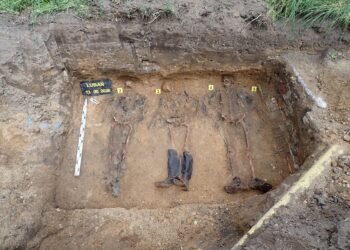
World War II mass grave in Poland reveals remains of German officer killed during Battle of Lauban
Anthropology

World War II mass grave in Poland reveals remains of German officer killed during Battle of Lauban

May 19, 2026

Follow us


Instagram
242K

Facebook
117K

Threads
46K

LinkedIn
14K

Twitter
6K

YouTube
1K
Neanderthals gathered shellfish like modern humans 115,000 years ago, study finds

Neanderthals gathered shellfish like modern humans 115,000 years ago, study finds

May 21, 2026
Ancient pigeons were already living alongside humans 3,400 years ago, study finds

Ancient pigeons were already living alongside humans 3,400 years ago, study finds

May 21, 2026
Ancient Venetic sanctuary with rare inscriptions unearthed beneath road project in Italy

Ancient Venetic sanctuary with rare inscriptions unearthed beneath road project in Italy

May 21, 2026
1,000-year-old dingo burial in Australia reveals deep ties between Barkindji people and dingoes

1,000-year-old ritually buried dingo in Australia reveals deep ties between Barkindji people and dingoes

May 20, 2026

Archaeology News online magazine

Archaeology News is an international online magazine that covers all aspects of archaeology.


Categories

  • Academics
    • Books
    • Conferences
    • Universities
  • Articles
  • Download
  • Game
  • News
    • Anthropology
    • Archaeology
    • Paleontology
  • Quiz
  • Tours

Subscribe to our newsletter

© 2024 - Archaeology News Online Magazine. All Rights Reserved.

  • About
  • Privacy Policy
  • Terms of Use
  • Donation
  • Contact

Manage Consent
To provide the best experiences, we use technologies like cookies to store and/or access device information. Consenting to these technologies will allow us to process data such as browsing behavior or unique IDs on this site. Not consenting or withdrawing consent, may adversely affect certain features and functions.
Functional Always active
The technical storage or access is strictly necessary for the legitimate purpose of enabling the use of a specific service explicitly requested by the subscriber or user, or for the sole purpose of carrying out the transmission of a communication over an electronic communications network.
Preferences
The technical storage or access is necessary for the legitimate purpose of storing preferences that are not requested by the subscriber or user.
Statistics
The technical storage or access that is used exclusively for statistical purposes. The technical storage or access that is used exclusively for anonymous statistical purposes. Without a subpoena, voluntary compliance on the part of your Internet Service Provider, or additional records from a third party, information stored or retrieved for this purpose alone cannot usually be used to identify you.
Marketing
The technical storage or access is required to create user profiles to send advertising, or to track the user on a website or across several websites for similar marketing purposes.
  • Manage options
  • Manage services
  • Manage {vendor_count} vendors
  • Read more about these purposes
View preferences
  • {title}
  • {title}
  • {title}
  • Home
  • News
    • Archaeology
    • Anthropology
    • Paleontology
  • Academic
    • Books
    • Conferences
    • Universities
  • Articles
  • VR Tours
  • Quiz & Game
  • Download
  • Encyclopedia
  • Forum

About  .  Contact  .  Donation

© 2024 - Archaeology News Online Magazine. All Rights Reserved