• About
  • Privacy Policy
  • Terms of Use
  • Donation
  • Contact
No Result
View All Result
Archaeology News
  • Home
  • News
    • Archaeology
    • Anthropology
    • Paleontology
  • Academics
    • Books
    • Conferences
    • Universities
  • Articles
  • VR Tours
  • Quiz & Game
  • Download
  • Encyclopedia
  • Forum
Archaeology News
No Result
View All Result
Home News Anthropology

First burials: evidence of Neanderthals and Homo sapiens sharing culture 110,000 years ago

by Dario Radley
March 14, 2025

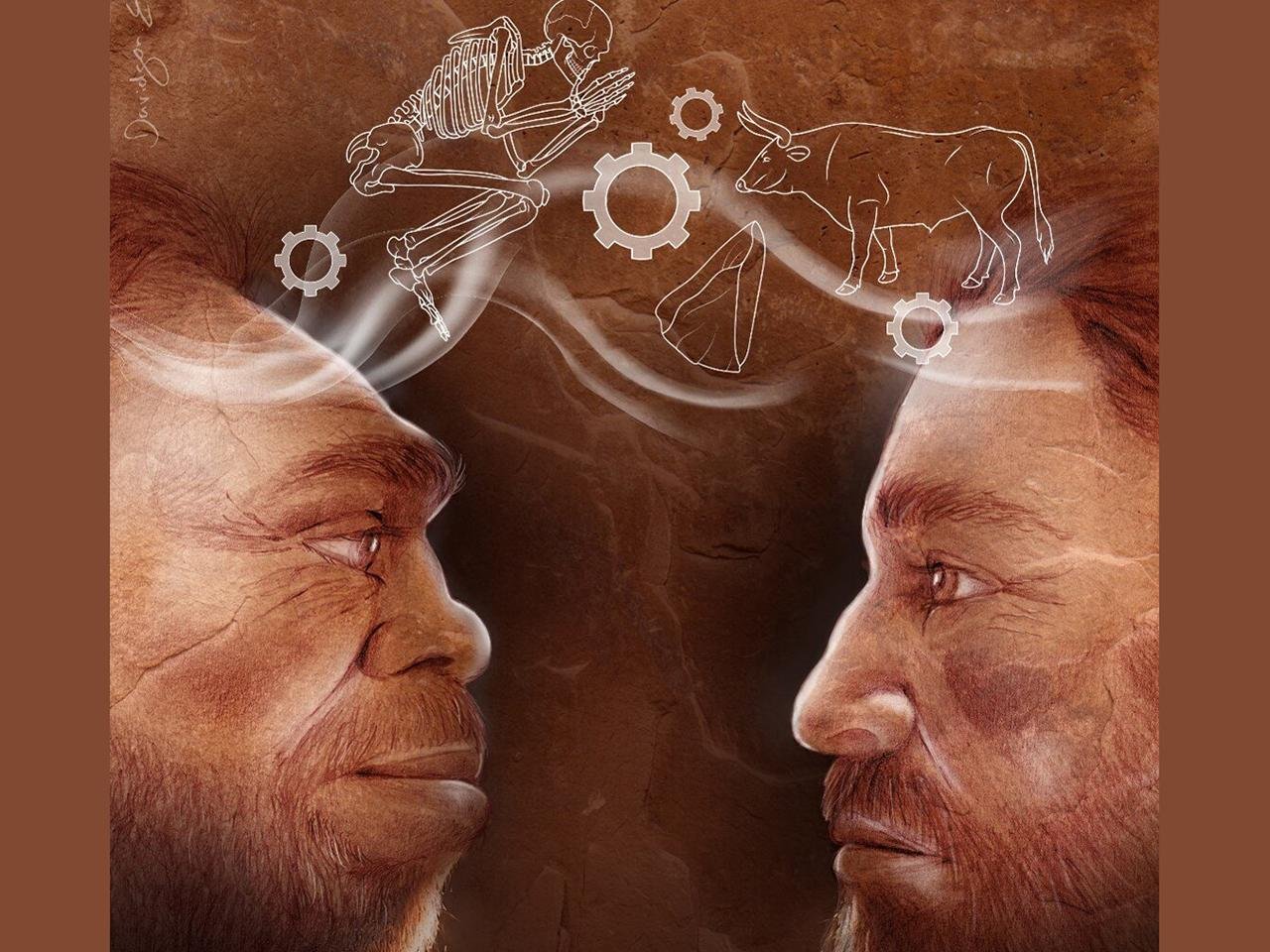
A recent discovery in Tinshemet Cave, central Israel, is changing the way we look at early human interactions. Archaeologists have found human burials from the Middle Paleolithic period, and they revealed that Neanderthals and Homo sapiens not only lived in the same region but also shared aspects of daily life, technology, and funerary practices. The findings, published in Nature Human Behaviour, challenge previous assumptions and show that human connections played a key role in cultural and technological evolution.
First burials: evidence of Neanderthals and Homo sapiens sharing culture 110,000 years ago
Illustration representing Homo sapiens and the Neanderthal sharing technology and behavior. Credit: Efrat Bakshitz

Excavations in Tinshemet Cave, led by Professor Yossi Zaidner of the Hebrew University of Jerusalem, Professor Israel Hershkovitz of Tel Aviv University, and Dr. Marion Prévost of the Hebrew University of Jerusalem, have been going on since 2017. They aim to understand the nature of interactions between different human groups in the Levant during the Middle Paleolithic (80,000–130,000 years ago). While researchers have long debated whether these groups were competitors, peaceful neighbors, or collaborators, the findings in Tinshemet Cave show a much more entwined relationship than previously thought.

The cave yielded five human burials – the first from this period discovered in over fifty years – along with stone tools, ochre pigments, and remains of large game such as aurochs, horses, and deer. The burials were in fetal position and often with red ochre and it looks like there were symbolic rituals. This is similar to what we see in other prehistoric sites like Skhul and Qafzeh caves, so it seems that early human populations in the Levant shared cultural traditions.

The ochre might have been used for body decoration, and its presence shows that symbolic expression was common among these groups. The stone tools were crafted using the Levallois technique, a sophisticated method used by both Neanderthals and early modern humans.
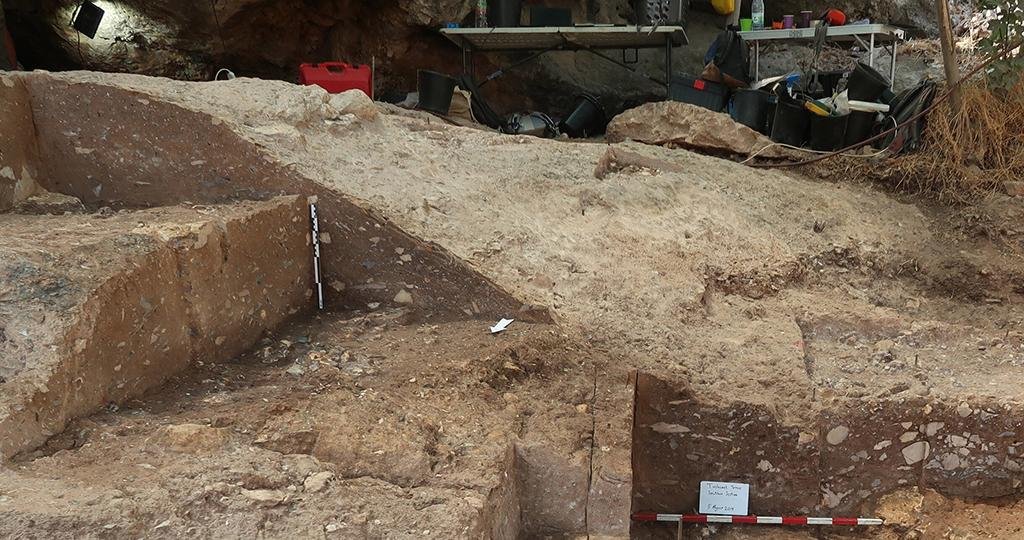
First burials: evidence of Neanderthals and Homo sapiens sharing culture 110,000 years ago
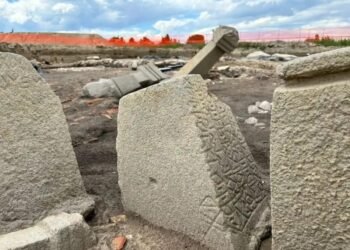
Exposed section of archaeological sediments dated to 110 thousand years ago at Tinshemet cave. Credit: Yossi Zaidner

Professor Zaidner emphasizes the importance of human connections in driving technological and cultural innovations: “Our data show that human connections and population interactions have been fundamental in driving cultural and technological innovations.”
RelatedStories

Reconstruction of a male Neanderthal with a child at the Natural History Museum, Vienna.

Were Neanderthals capable of making art?

October 31, 2025
42,000-year-old ochre crayons reveal Neanderthals engaged in symbolic behavior

42,000-year-old ochre crayons reveal Neanderthals engaged in symbolic behavior

October 30, 2025

Dr. Prévost points out the Levant’s special position as a crossroads for human migration. She notes that “climatic improvement during the Middle Paleolithic increased the region’s carrying capacity, leading to demographic expansion and intensified contact between different Homo taxa.”
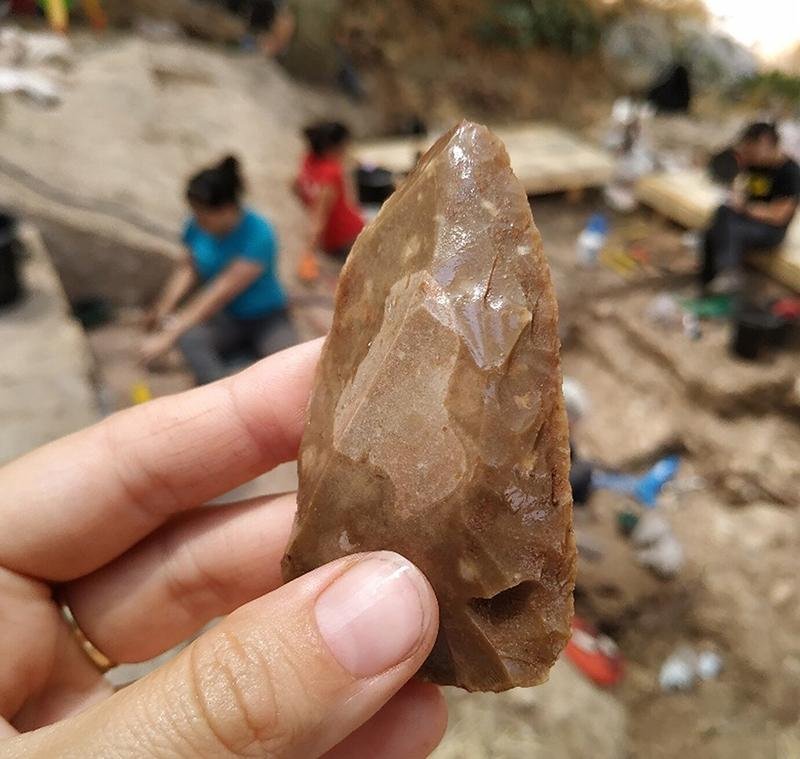
First burials: evidence of Neanderthals and Homo sapiens sharing culture 110,000 years ago
Lithic artefact from Tinshemet Cave made using technology shared by Homo sapiens and Neanderthals. Credit- Marion Prévost

Professor Hershkovitz emphasized the depth of these relationships, saying that these early humans were not just coexisting, but interacting. “These findings paint a picture of dynamic interactions shaped by both cooperation and competition,” he said

The finds in Tinshemet Cave show that Neanderthals, early Homo sapiens, and possibly other human lineages influenced each other’s behavior for tens of thousands of years. While we are still waiting to know if the remains are of hybrids of modern humans and Neanderthals, the shared cultural elements are clear evidence of long-term interaction.

The researchers plan to conduct further studies on the remains to better understand the genetic relationships between these groups.
More information: Hebrew University of Jerusalem
Zaidner, Y., Prévost, M., Shahack-Gross, R. et al. (2025). Evidence from Tinshemet Cave in Israel suggests behavioural uniformity across Homo groups in the Levantine mid-Middle Palaeolithic circa 130,000–80,000 years ago. Nat Hum Behav. doi:10.1038/s41562-025-02110-y
Share7Tweet5Share1ShareSend

You May Also Like...

Misread medieval tale misled generations of historians about the Black Death's spread, study finds
Archaeology

Misread medieval tale misled generations of historians about the Black Death’s spread, study finds

November 7, 2025
Signatures meant more in Mesopotamia than they do now − what cylinder seals say about ancient and modern life
Archaeology

Signatures meant more in Mesopotamia than they do now − what cylinder seals say about ancient and modern life

November 7, 2025
Daily life uncovered in Hellenistic military settlement at Pyla-Vigla, Cyprus
Archaeology

New discoveries reveal daily life in a Hellenistic military settlement at Pyla-Vigla, Cyprus

November 7, 2025
Viking treasures unearthed in Sweden reveal a society in transition
Archaeology

Viking treasures unearthed in Sweden reveal a society in transition

November 6, 2025
Archaeologists unearth 5,000-year-old winepress and Canaanite ritual artifacts near Tel Megiddo
Archaeology

Archaeologists unearth 5,000-year-old winepress and Canaanite ritual artifacts near Tel Megiddo

November 5, 2025
5,000-year-old monumental building in Iraq reveals ties to the world’s first cities
Archaeology

5,000-year-old monumental building in Iraq reveals ties to the world’s first cities

November 3, 2025

Comments 0

  1. Editorial Team says:
    1 second ago
    Disclaimer: This website is a science-focused magazine that welcomes both academic and non-academic audiences. Comments are written by users and may include personal opinions or unverified claims. They do not necessarily reflect the views of our editorial team or rely on scientific evidence.
    Reply

Leave a Reply Cancel reply

Your email address will not be published. Required fields are marked *

Follow us


Instagram
245K

Facebook
117K

Threads
45K

LinkedIn
14K

Twitter
6K

YouTube
1K
  • Trending
  • Comments
  • Latest
Shipwreck Salvage. Credit: rawpixel.com / Public Domain

2,000-year-old shipwreck discovered off Turkish coast with remarkably preserved stacked ceramics

July 2, 2025
Viking age DNA reveals 9,000-year-old HIV-resistant gene originating near the Black Sea

Viking age DNA reveals 9,000-year-old HIV-resistant gene originating near the Black Sea

May 18, 2025
Complete copy of the Canopus Decree unearthed in Egypt after 150 years

Complete copy of the Canopus Decree unearthed in Egypt after 150 years

September 13, 2025
Mystery of Armenia’s 6,000-year-old dragon stones solved

Mystery of Armenia’s 6,000-year-old dragon stones solved

September 23, 2025
Moses may be named in ancient Egyptian mine inscriptions, sparking debate over earliest biblical references

Moses may be named in ancient Egyptian mine inscriptions, sparking debate over earliest biblical references

July 31, 2025
Moses may be named in ancient Egyptian mine inscriptions, sparking debate over earliest biblical references

Moses may be named in ancient Egyptian mine inscriptions, sparking debate over earliest biblical references

3D analysis reveals Shroud of Turin image likely came from sculpture, not Jesus’ body

3D analysis reveals Shroud of Turin image likely came from sculpture, not Jesus’ body

$1 million prize offered to decipher 5,300-year-old Indus Valley script

$1 million prize offered to decipher 5,300-year-old Indus Valley script

Oldest ever genetic data from a human relative found in 2-million-year-old fossilized teeth

Oldest ever genetic data from a human relative found in 2-million-year-old fossilized teeth

Exceptionally large Roman shoes discovered at Magna fort near Hadrian’s Wall

Exceptionally large Roman shoes discovered at Magna fort near Hadrian’s Wall

Misread medieval tale misled generations of historians about the Black Death's spread, study finds

Misread medieval tale misled generations of historians about the Black Death’s spread, study finds

November 7, 2025
Signatures meant more in Mesopotamia than they do now − what cylinder seals say about ancient and modern life

Signatures meant more in Mesopotamia than they do now − what cylinder seals say about ancient and modern life

November 7, 2025
Daily life uncovered in Hellenistic military settlement at Pyla-Vigla, Cyprus

New discoveries reveal daily life in a Hellenistic military settlement at Pyla-Vigla, Cyprus

November 7, 2025
Viking treasures unearthed in Sweden reveal a society in transition

Viking treasures unearthed in Sweden reveal a society in transition

November 6, 2025
Archaeologists unearth 5,000-year-old winepress and Canaanite ritual artifacts near Tel Megiddo

Archaeologists unearth 5,000-year-old winepress and Canaanite ritual artifacts near Tel Megiddo

November 5, 2025

Archaeology News online magazine

Archaeology News is an international online magazine that covers all aspects of archaeology.


Categories

  • Academics
    • Books
    • Conferences
    • Universities
  • Articles
  • Download
  • Game
  • News
    • Anthropology
    • Archaeology
    • Paleontology
  • Quiz
  • Tours

Subscribe to our newsletter

© 2024 - Archaeology News Online Magazine. All Rights Reserved.

  • About
  • Privacy Policy
  • Terms of Use
  • Donation
  • Contact

Welcome Back!

Login to your account below

Forgotten Password? Sign Up

Create New Account!

Fill the forms below to register

All fields are required. Log In

Retrieve your password

Please enter your username or email address to reset your password.

Log In

Add New Playlist

Manage Consent
To provide the best experiences, we use technologies like cookies to store and/or access device information. Consenting to these technologies will allow us to process data such as browsing behavior or unique IDs on this site. Not consenting or withdrawing consent, may adversely affect certain features and functions.
Functional Always active
The technical storage or access is strictly necessary for the legitimate purpose of enabling the use of a specific service explicitly requested by the subscriber or user, or for the sole purpose of carrying out the transmission of a communication over an electronic communications network.
Preferences
The technical storage or access is necessary for the legitimate purpose of storing preferences that are not requested by the subscriber or user.
Statistics
The technical storage or access that is used exclusively for statistical purposes. The technical storage or access that is used exclusively for anonymous statistical purposes. Without a subpoena, voluntary compliance on the part of your Internet Service Provider, or additional records from a third party, information stored or retrieved for this purpose alone cannot usually be used to identify you.
Marketing
The technical storage or access is required to create user profiles to send advertising, or to track the user on a website or across several websites for similar marketing purposes.
Manage options Manage services Manage {vendor_count} vendors Read more about these purposes
View preferences
{title} {title} {title}
  • Home
  • News
    • Archaeology
    • Anthropology
    • Paleontology
  • Academics
    • Books
    • Conferences
    • Universities
  • Articles
  • VR Tours
  • Quiz & Game
  • Download
  • Encyclopedia
  • Forum

About  .  Contact  .  Donation

© 2024 - Archaeology News Online Magazine. All Rights Reserved