• About
  • Privacy Policy
  • Terms of Use
  • Donation
  • Contact
No Result
View All Result
Archaeology News
  • Home
  • News
    • Archaeology
    • Anthropology
    • Paleontology
  • Academic
    • Books
    • Conferences
    • Universities
  • Articles
  • VR Tours
  • Quiz & Game
  • Download
  • Encyclopedia
  • Forum
Archaeology News
No Result
View All Result
Home News Anthropology

Neanderthals in Spain deliberately deposited animal skulls in cave, revealing symbolic behavior

by Dario Radley
January 31, 2026

Archaeologists working in central Spain have documented strong evidence for a long-standing Neanderthal practice focused on the collection and placement of large animal skulls deep inside Des Cubierta Cave. The findings come from a detailed study of Level 3, a Middle Paleolithic deposit dated to cold phases between about 135,000 and 43,000 years ago.
Neanderthals in Spain deliberately deposited animal skulls in cave, revealing symbolic behavior
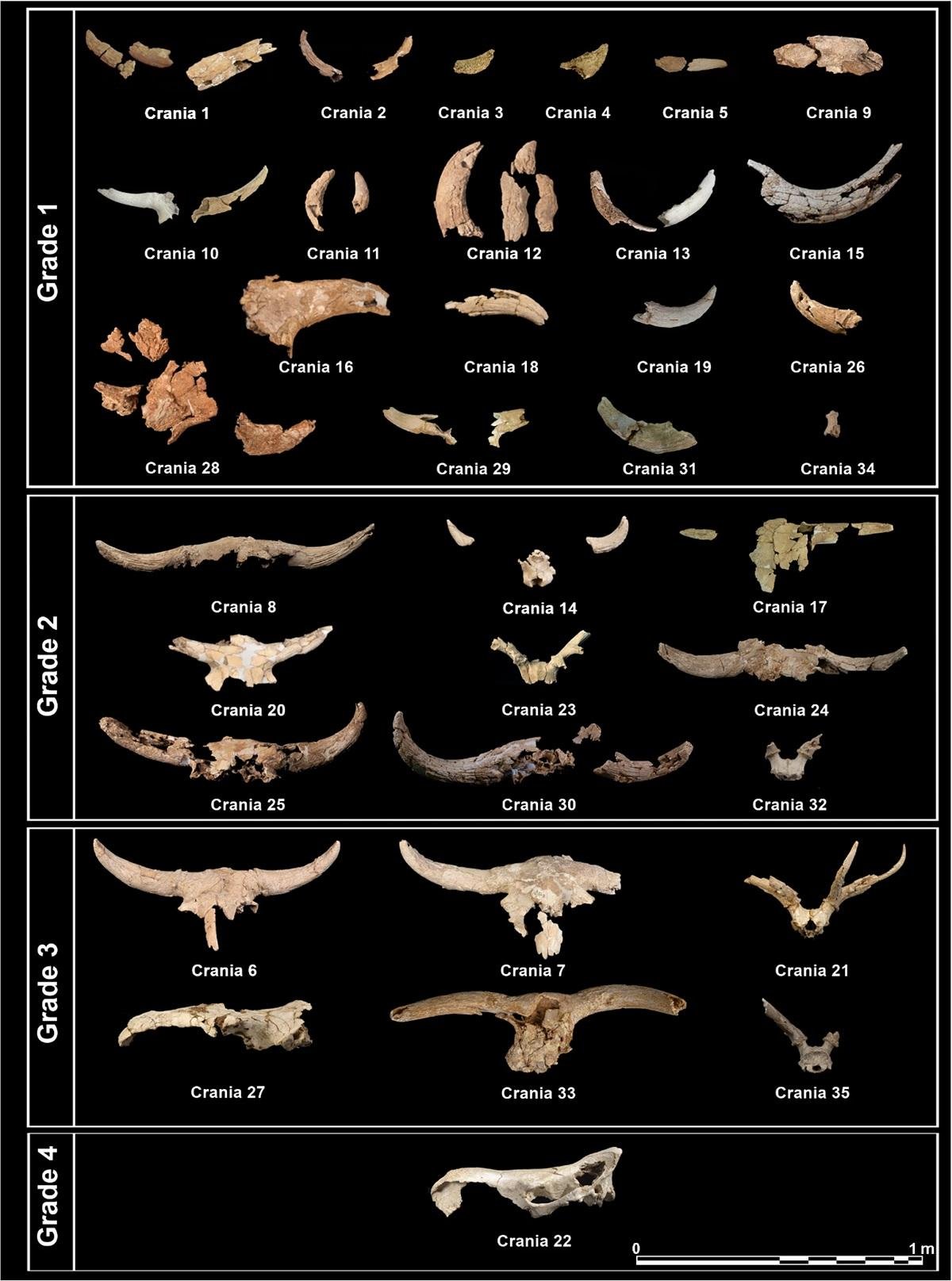
Photographs of the primary fragments of the crania from Level 3, categorized by grades of completeness, illustrating preservation variability across specimens. Credit: L. Villaescusa et al., Archaeological and Anthropological Sciences (2026); CC BY 4.0

Excavations revealed 35 skulls from large hoofed mammals, including steppe bison and aurochs. Most skulls lack lower jaws, and every specimen belongs to a horned or antlered species. Researchers also recovered more than 1,400 stone tools in the same layer. These tools match Mousterian technology, a stone tool tradition linked with Neanderthals. Traces of fire use also appear in this level.

At first glance, the bone cluster looked disordered due to repeated rockfalls inside the cave over thousands of years. To separate natural processes from human activity, the team mapped the exact positions of stones, bones, and tools. They compared the spread of rockfall debris with the distribution of archaeological materials. Geological fragments formed a cone-shaped deposit, while skulls and tools followed different spatial patterns. This contrast supports deliberate placement by Neanderthals rather than random burial by falling rock.

Geostatistical analysis of stone sizes helped define the shape and growth of the debris cone. Size sorting and changes in stone density point to pauses in sediment buildup, which created stable surfaces inside the cave at different times. Archaeological materials rest above early rockfall layers, showing human visits occurred after initial debris accumulation.
Neanderthals in Spain deliberately deposited animal skulls in cave, revealing symbolic behavior
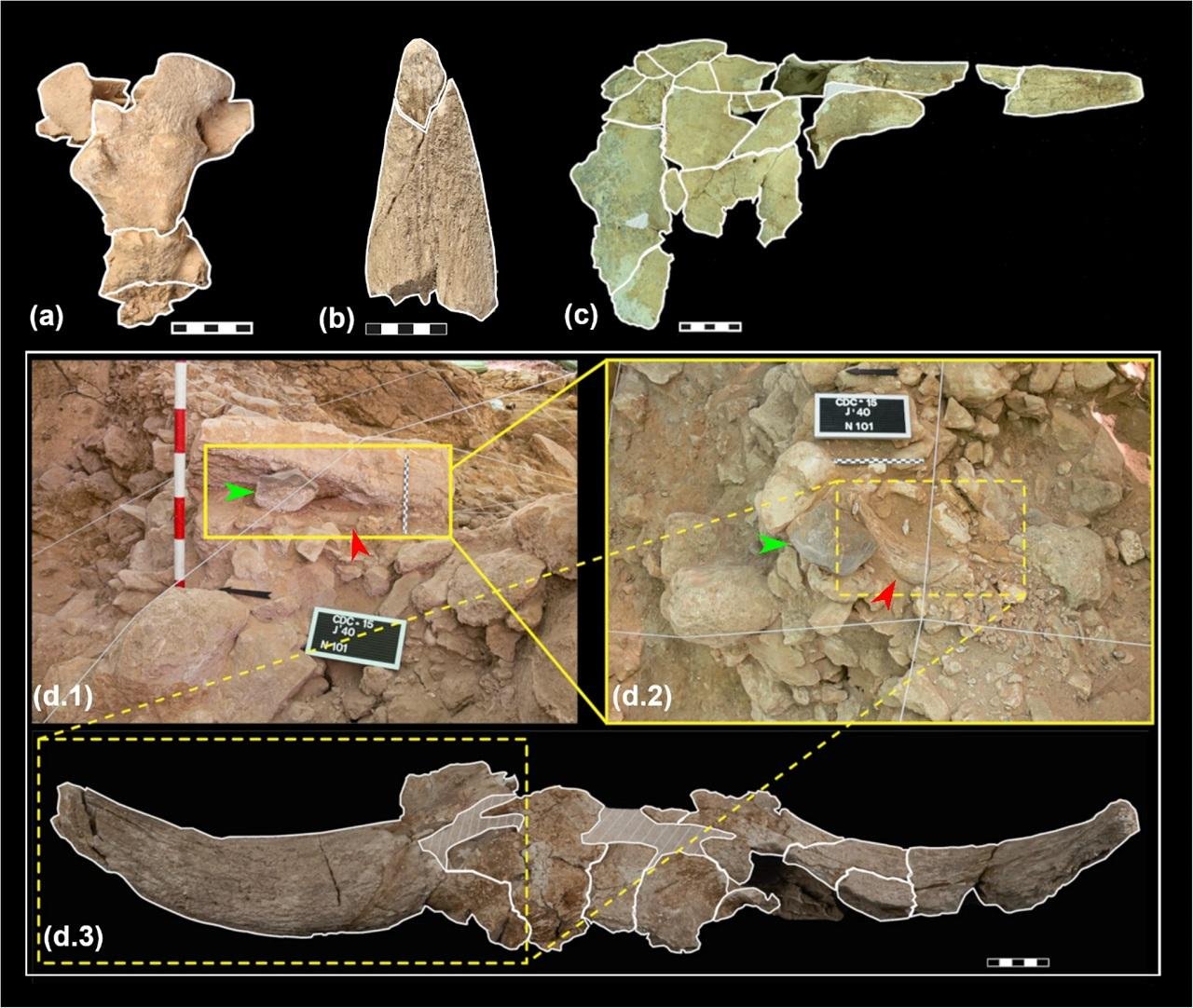
Selected examples of refits, with coordinated fragments outlined in white. (a) Refit 4 (b) Refit 24 (c) Refit 20 (d) Refit 31 (d.1) Lateral view of a large boulder above the right horn of Crania 24 -pointed out with a red arrow- with a porphyry beside it, pointed out with the green arrow (d.2) Top view of the right horn and the porphyry after removal of the boulder, revealing numerous cranial fragments (d.3) Crania 24 after restoration. Credit: L. Villaescusa et al., Archaeological and Anthropological Sciences (2026); CC BY 4.0

Bone refitting offered another line of evidence. Researchers matched broken skull fragments found close together, which indicates limited movement after deposition. The cave shape and the slope of the sediment cone influenced how far pieces shifted. Central areas of the gallery, near the cone’s middle, preserved skulls in better condition. Southern zones, where the passage narrows and surfaces become uneven, show heavier fragmentation due to gravity, erosion, and soil processes.

RelatedStories

Horse domestication began centuries earlier than thought, study reveals early riding and management in 4th millennium BCE

Horse domestication began centuries earlier than thought, study reveals early riding and management in 4th millennium BCE

May 15, 2026
Oldest known dental treatment found in 59,000-year-old Neanderthal tooth from Siberia

Oldest known dental treatment found in 59,000-year-old Neanderthal tooth from Siberia

May 14, 2026

The repeated appearance of horned skulls in specific cave areas suggests patterned behavior rather than food storage or butchery waste. Other animal bones common in living areas appear in much lower numbers here. The cave section holding the skulls shows no clear signs of daily habitation, which points toward a special purpose for this space.

Researchers conclude Neanderthals returned to this location many times over a long span. Each visit added new skulls to earlier deposits. Such continuity implies shared knowledge passed across generations. The consistent focus on horned heads, careful placement, and use of a non-domestic cave chamber support the interpretation of a cultural tradition with symbolic meaning.

Beyond behavioral insights, the study highlights the value of combining spatial statistics, geology, and bone analysis in complex cave settings. Careful separation of natural and human processes allowed a clearer view of how Neanderthals shaped this underground environment. Des Cubierta Cave now stands as one of the strongest cases for structured, repeated deposition of animal skulls by Neanderthals in Europe, adding weight to growing evidence for socially learned traditions among these ancient humans.
More information: Villaescusa, L., Baquedano, E., Martín-Perea, D.M. et al. (2026). Towards a formation model of the Neanderthal symbolic accumulation of herbivore crania: Spatial patterns shaped by rockfall dynamics in Level 3 of Des-Cubierta Cave (Lozoya valley, Madrid, Spain). Archaeol Anthropol Sci 18, 16. doi:10.1007/s12520-025-02382-5
ShareTweetShareShareSend

You May Also Like...

Ancient texts reveal how Persian and Greek rule shaped language in Central Asia
Archaeology

Ancient texts reveal how Persian and Greek rule shaped language in Central Asia

May 20, 2026
World War II mass grave in Poland reveals remains of German officer killed during Battle of Lauban
Anthropology

World War II mass grave in Poland reveals remains of German officer killed during Battle of Lauban

May 19, 2026
massive jar in Laos contained remains of 37 people, revealing ancient burial rituals and Asian trade links
Anthropology

Massive jar in Laos contained remains of 37 people, revealing ancient burial rituals and Asian trade links

May 19, 2026
6,000-year-old necropolis in Spain rewrites origins of Europe’s first megalithic tombs
Archaeology

6,000-year-old necropolis in Spain rewrites origins of Europe’s first megalithic tombs

May 18, 2026
Ancient settlement with weaving workshop and longhouses uncovered in Germany gravel pit
Archaeology

Ancient settlement with weaving workshop and longhouses uncovered in Germany gravel pit

May 17, 2026
Pompeii victim identified as Roman physician killed while fleeing Vesuvius eruption
Anthropology

Pompeii victim identified as Roman physician killed while fleeing Vesuvius eruption

May 17, 2026

Comments 0

  1. Editorial Team says:
    1 second ago

    Disclaimer: This website is a science-focused magazine that welcomes both academic and non-academic audiences. Comments are written by users and may include personal opinions or unverified claims. They do not necessarily reflect the views of our editorial team or rely on scientific evidence.

    Comment Policy: We kindly ask all commenters to engage respectfully. Comments that contain offensive, insulting, degrading, discriminatory, or racist content will be automatically removed.

    Reply

Leave a Reply Cancel reply

Your email address will not be published. Required fields are marked *

Follow us


Instagram
242K

Facebook
117K

Threads
46K

LinkedIn
14K

Twitter
6K

YouTube
1K
Ancient texts reveal how Persian and Greek rule shaped language in Central Asia

Ancient texts reveal how Persian and Greek rule shaped language in Central Asia

May 20, 2026
World War II mass grave in Poland reveals remains of German officer killed during Battle of Lauban

World War II mass grave in Poland reveals remains of German officer killed during Battle of Lauban

May 19, 2026
massive jar in Laos contained remains of 37 people, revealing ancient burial rituals and Asian trade links

Massive jar in Laos contained remains of 37 people, revealing ancient burial rituals and Asian trade links

May 19, 2026
6,000-year-old necropolis in Spain rewrites origins of Europe’s first megalithic tombs

6,000-year-old necropolis in Spain rewrites origins of Europe’s first megalithic tombs

May 18, 2026

Archaeology News online magazine

Archaeology News is an international online magazine that covers all aspects of archaeology.


Categories

  • Academics
    • Books
    • Conferences
    • Universities
  • Articles
  • Download
  • Game
  • News
    • Anthropology
    • Archaeology
    • Paleontology
  • Quiz
  • Tours

Subscribe to our newsletter

© 2024 - Archaeology News Online Magazine. All Rights Reserved.

  • About
  • Privacy Policy
  • Terms of Use
  • Donation
  • Contact

Manage Consent
To provide the best experiences, we use technologies like cookies to store and/or access device information. Consenting to these technologies will allow us to process data such as browsing behavior or unique IDs on this site. Not consenting or withdrawing consent, may adversely affect certain features and functions.
Functional Always active
The technical storage or access is strictly necessary for the legitimate purpose of enabling the use of a specific service explicitly requested by the subscriber or user, or for the sole purpose of carrying out the transmission of a communication over an electronic communications network.
Preferences
The technical storage or access is necessary for the legitimate purpose of storing preferences that are not requested by the subscriber or user.
Statistics
The technical storage or access that is used exclusively for statistical purposes. The technical storage or access that is used exclusively for anonymous statistical purposes. Without a subpoena, voluntary compliance on the part of your Internet Service Provider, or additional records from a third party, information stored or retrieved for this purpose alone cannot usually be used to identify you.
Marketing
The technical storage or access is required to create user profiles to send advertising, or to track the user on a website or across several websites for similar marketing purposes.
  • Manage options
  • Manage services
  • Manage {vendor_count} vendors
  • Read more about these purposes
View preferences
  • {title}
  • {title}
  • {title}
  • Home
  • News
    • Archaeology
    • Anthropology
    • Paleontology
  • Academic
    • Books
    • Conferences
    • Universities
  • Articles
  • VR Tours
  • Quiz & Game
  • Download
  • Encyclopedia
  • Forum

About  .  Contact  .  Donation

© 2024 - Archaeology News Online Magazine. All Rights Reserved