• About
  • Privacy Policy
  • Terms of Use
  • Donation
  • Contact
No Result
View All Result
Archaeology News
  • Home
  • News
    • Archaeology
    • Anthropology
    • Paleontology
  • Academic
    • Books
    • Conferences
    • Universities
  • Articles
  • VR Tours
  • Quiz & Game
  • Download
  • Encyclopedia
  • Forum
Archaeology News
No Result
View All Result
Home News Anthropology

Scents of ancient Egypt: tracing embalming recipes by analyzing air around mummies

by Dario Radley
February 6, 2026

Anyone who has stood near an ancient Egyptian mummy notices a persistent musty odor. Researchers once linked this smell to age and decay. New chemical work shows a different cause. The odor forms from a complex mix of volatile organic compounds released by embalming materials and preserved tissues. These compounds record details about balm ingredients and changes in mummification practices over time.
Scents of ancient Egypt: tracing embalming recipes by analyzing air around mummies
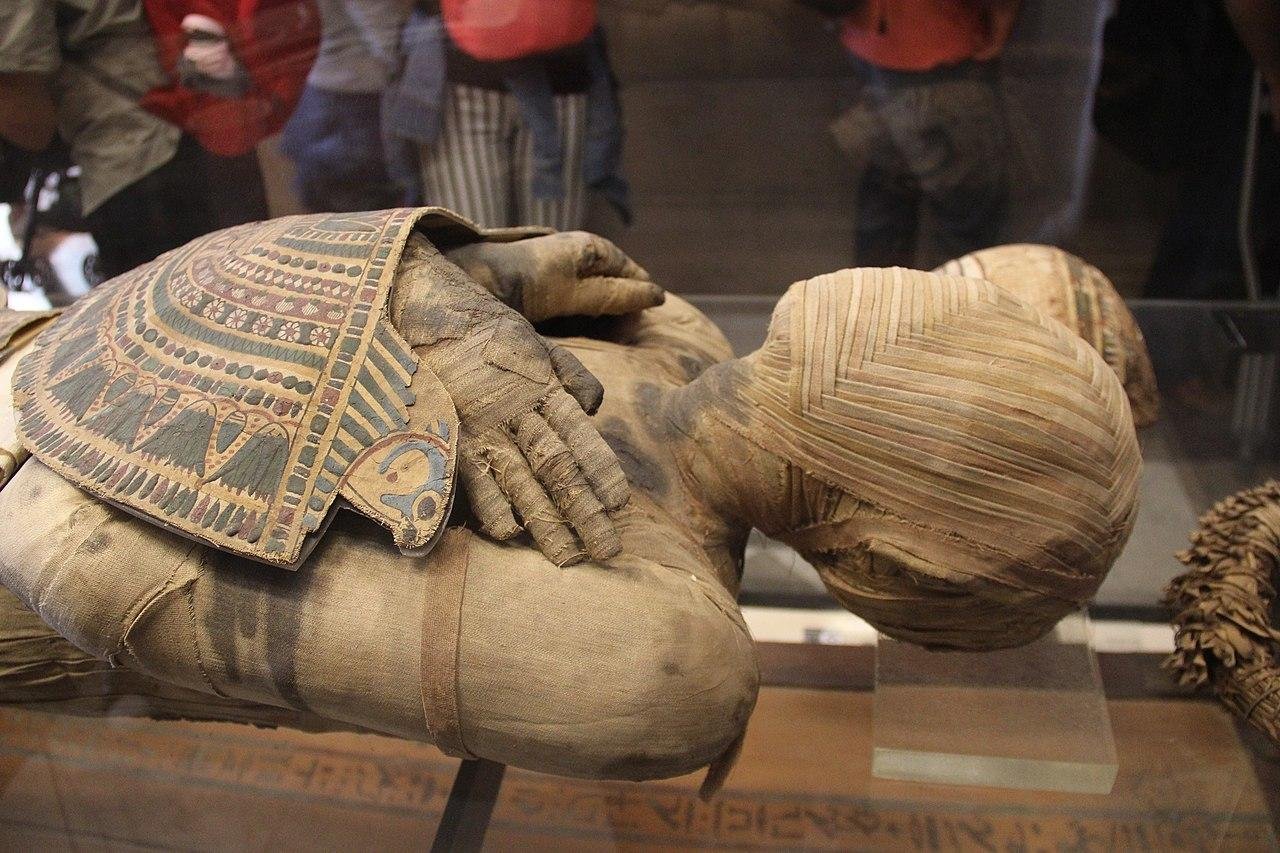
Ancient Egyptian mummy, Ptolemaic period, 3rd–2nd century BCE. Ancient Egypt Gallery, Louvre Museum. Credit: Gary Todd

A research team from the University of Bristol analyzed air surrounding Egyptian mummies instead of removing physical samples. Traditional chemical studies often require cutting bandages or dissolving material, a process that damages fragile remains. The Bristol approach relies on headspace solid phase microextraction combined with gas chromatography and high-resolution mass spectrometry. This method captures gases present above mummified bodies and storage containers, then separates and identifies individual molecules.

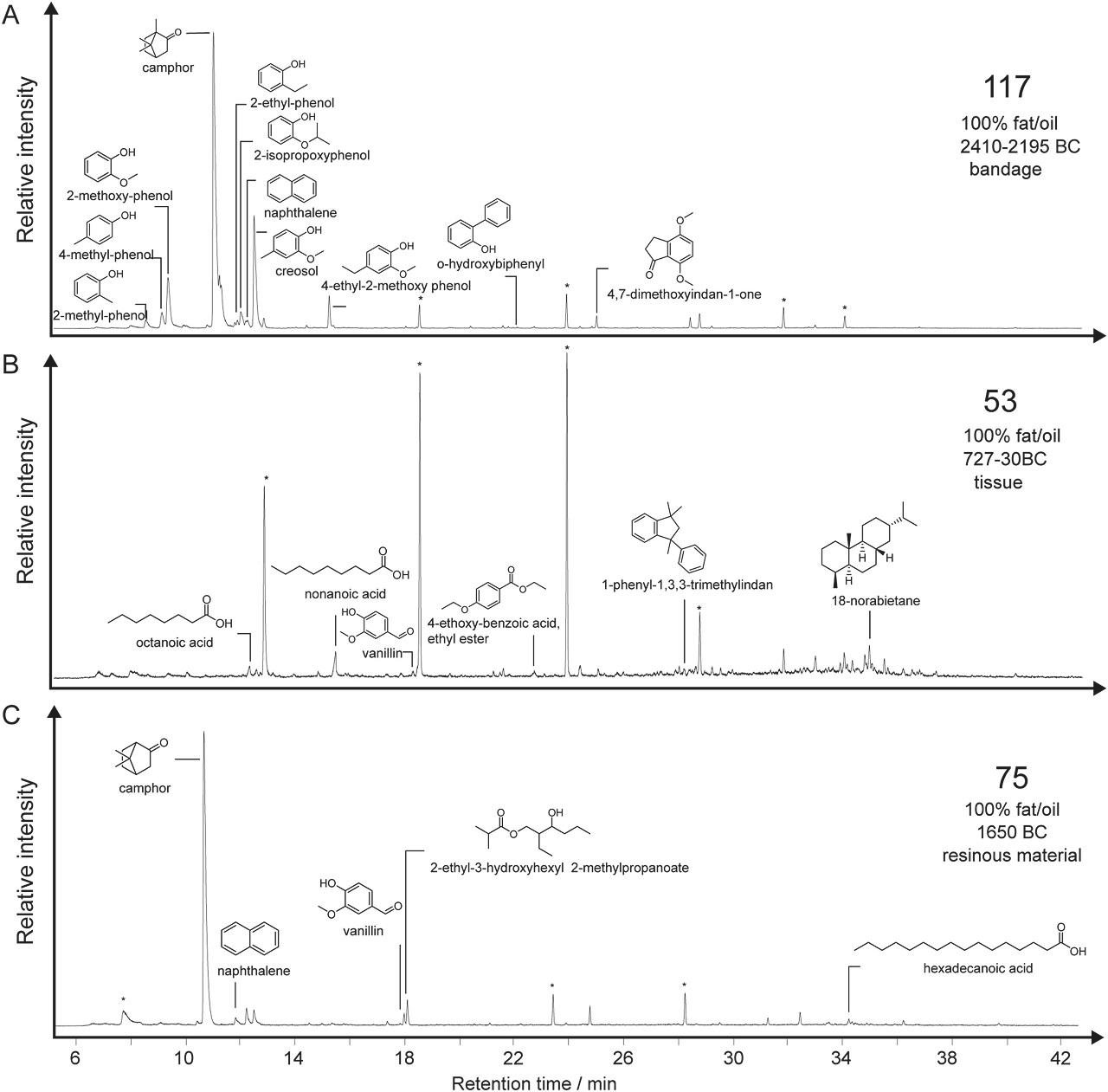
The study examined 35 samples of balms and bandages taken from 19 mummies spanning more than 2,000 years of Egyptian history. Across all samples, researchers identified 81 distinct volatile organic compounds. These compounds grouped into four main categories linked to embalming substances. Fats and oils produced aromatic compounds and short-chain fatty acids. Beeswax contributed mono-carboxylic fatty acids and cinnamic compounds. Plant resins released aromatic compounds and sesquiterpenoids. Bitumen produced naphthenic compounds, even when present in very small amounts.
Scents of ancient Egypt: tracing embalming recipes by analyzing air around mummies
Representative chromatograms of embalming materials composed of 100 % fat/oil obtained from a bandage (A), a human tissue (B) and a resinous material (C). ∗ indicates siloxane contamination. Credit: W. Zhao et al., Journal of Archaeological Science (2026)

Chemical patterns varied across historical periods. Earlier mummies showed simpler profiles dominated by fats and oils. Later mummies displayed more complex mixtures that included imported resins and bitumen, materials associated with higher cost and specialized preparation. Volatile profiles also differed between body regions. Samples from heads often contained different compound patterns than samples from torsos, suggesting embalmers applied distinct recipes to separate parts of the body.
Scents of ancient Egypt: tracing embalming recipes by analyzing air around mummies
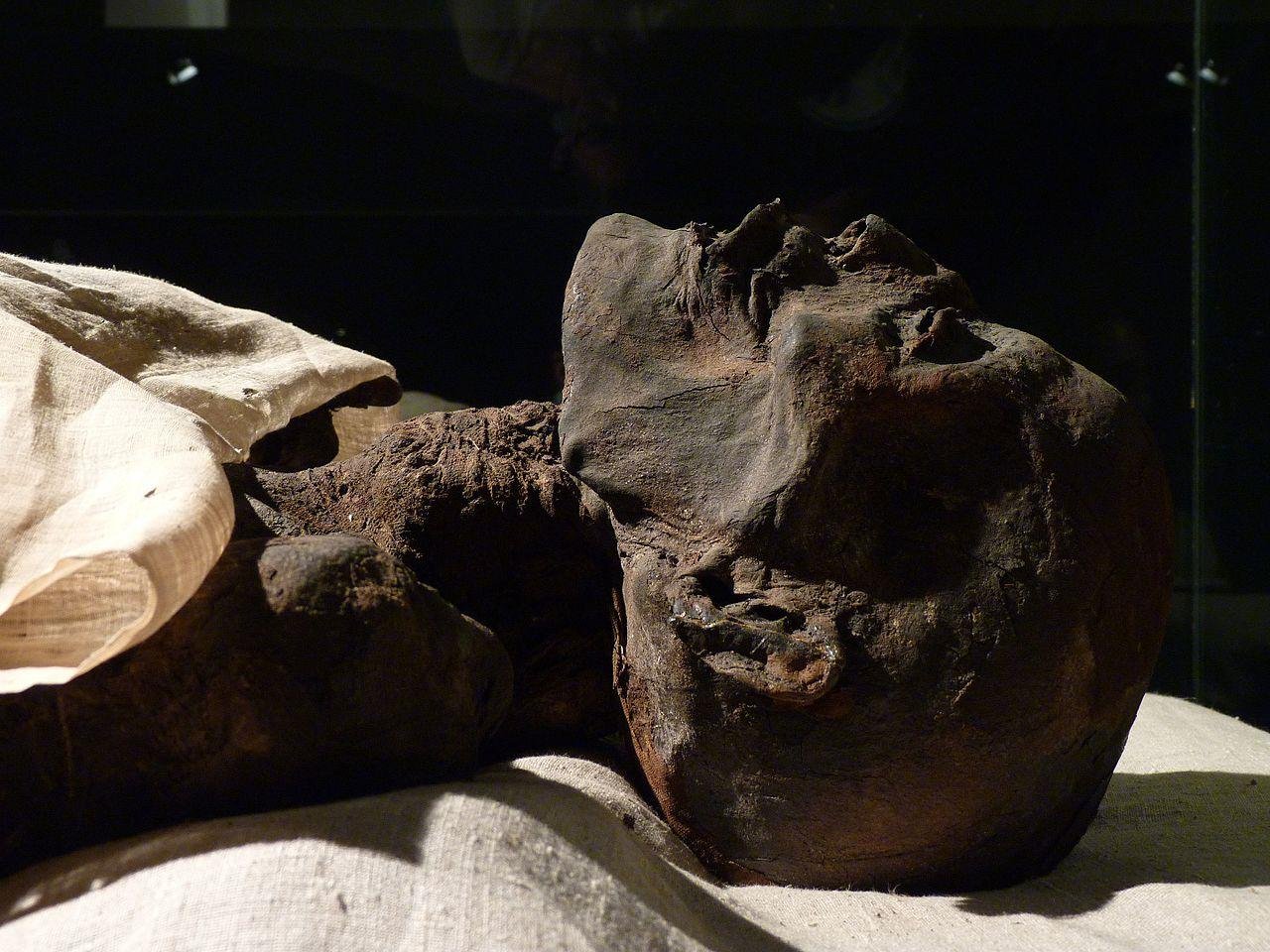
Mummy of Ramesses I. Credit: Alyssa Bivins / CC BY-SA 4.0

The findings, published in the Journal of Archaeological Science, demonstrate a close link between volatile profiles and known balm compositions. Volatile analysis also proved sensitive enough to detect bitumen markers present at extremely low mass fractions, a task difficult with earlier methods focused only on soluble residues.


RelatedStories

Ancient Egyptian tombs, painted coffins, and cat mummies unearthed in Luxor necropolis

Ancient Egyptian tombs, painted coffins, and cat mummies unearthed in Luxor necropolis

May 16, 2026
700-year-old mummy from Bolivia reveals scarlet fever bacterium present in the Americas before European contact

700-year-old mummy from Bolivia reveals scarlet fever bacterium present in the Americas before European contact

May 4, 2026

This approach expands the study of ancient Egyptian funerary practices by adding a sensory and chemical dimension. By pairing volatile data with earlier analyses of solid balm components, researchers gain a more complete view of mummification recipes, material choices, and preservation strategies. Museums and collections benefit as well. Air sampling offers a rapid, non-destructive screening tool for fragile mummies, allowing curators to gather chemical information while preserving physical integrity. Physical sampling still plays a role for detailed work, yet volatile analysis provides an effective first step for studying embalmed remains across collections and time periods.

More information: Zhao, W., Clark, K. A., Evershed, R. P., Roffet-Salque, M., & Bull, I. D. (2026). Volatile compounds reveal the composition of embalming materials used in Egyptian mummification. Journal of Archaeological Science, 187(106490), 106490. doi:10.1016/j.jas.2026.106490

Share:

Share on Facebook Share on X (Twitter) Share on LinkedIn Share on Pinterest Share on WhatsApp Share on Email

You May Also Like...

Ancient shipwreck with 300 amphorae found off Italy could reshape views of Mediterranean wine trade
Archaeology

Ancient shipwreck with 300 amphorae found off Italy could reshape views of Mediterranean wine trade

May 29, 2026
Ancient DNA reveals 700-kilometer migration along Peru’s coast before the Inca Empire
Anthropology

Ancient DNA reveals 700-kilometer migration along Peru’s coast before the Inca Empire

May 29, 2026
6,000-year-old mega-structure unearthed at prehistoric settlement in Romania
Archaeology

6,000-year-old mega-structure unearthed at prehistoric settlement in Romania

May 29, 2026
Medieval bone study identifies microbial communities driving archaeological bone degradation and preservation
Anthropology

Medieval bone study identifies microbial communities driving archaeological bone degradation and preservation

May 28, 2026
A large hidden hydraulic system mapped around the Urartian fortress of Argishtikhinili in Armenia
Archaeology

A large hidden hydraulic system mapped around the Urartian fortress of Argishtikhinili in Armenia

May 28, 2026
Sasanian military helmets reveal advanced brass technology across the Persian Empire
Archaeology

Sasanian military helmets reveal advanced brass technology across the Persian Empire

May 28, 2026

Comments 0

  1. Editorial Team says:
    1 second ago

    Disclaimer: This website is a science-focused magazine that welcomes both academic and non-academic audiences. Comments are written by users and may include personal opinions or unverified claims. They do not necessarily reflect the views of our editorial team or rely on scientific evidence.

    Comment Policy: We kindly ask all commenters to engage respectfully. Comments that contain offensive, insulting, degrading, discriminatory, or racist content will be automatically removed.

    Reply

Leave a Reply Cancel reply

Your email address will not be published. Required fields are marked *

Follow us


Instagram
242K

Facebook
117K

Threads
47K

LinkedIn
15K

Twitter
6K

YouTube
1K
Ancient shipwreck with 300 amphorae found off Italy could reshape views of Mediterranean wine trade

Ancient shipwreck with 300 amphorae found off Italy could reshape views of Mediterranean wine trade

May 29, 2026
Ancient DNA reveals 700-kilometer migration along Peru’s coast before the Inca Empire

Ancient DNA reveals 700-kilometer migration along Peru’s coast before the Inca Empire

May 29, 2026
6,000-year-old mega-structure unearthed at prehistoric settlement in Romania

6,000-year-old mega-structure unearthed at prehistoric settlement in Romania

May 29, 2026
Medieval bone study identifies microbial communities driving archaeological bone degradation and preservation

Medieval bone study identifies microbial communities driving archaeological bone degradation and preservation

May 28, 2026

Archaeology News online magazine

Archaeology News is an international online magazine that covers all aspects of archaeology.


Categories

  • Academics
    • Books
    • Conferences
    • Universities
  • Articles
  • Download
  • Game
  • News
    • Anthropology
    • Archaeology
    • Paleontology
  • Quiz
  • Tours

Subscribe to our newsletter

© 2024 - Archaeology News Online Magazine. All Rights Reserved.

  • About
  • Privacy Policy
  • Terms of Use
  • Donation
  • Contact

Manage Consent
To provide the best experiences, we use technologies like cookies to store and/or access device information. Consenting to these technologies will allow us to process data such as browsing behavior or unique IDs on this site. Not consenting or withdrawing consent, may adversely affect certain features and functions.
Functional Always active
The technical storage or access is strictly necessary for the legitimate purpose of enabling the use of a specific service explicitly requested by the subscriber or user, or for the sole purpose of carrying out the transmission of a communication over an electronic communications network.
Preferences
The technical storage or access is necessary for the legitimate purpose of storing preferences that are not requested by the subscriber or user.
Statistics
The technical storage or access that is used exclusively for statistical purposes. The technical storage or access that is used exclusively for anonymous statistical purposes. Without a subpoena, voluntary compliance on the part of your Internet Service Provider, or additional records from a third party, information stored or retrieved for this purpose alone cannot usually be used to identify you.
Marketing
The technical storage or access is required to create user profiles to send advertising, or to track the user on a website or across several websites for similar marketing purposes.
  • Manage options
  • Manage services
  • Manage {vendor_count} vendors
  • Read more about these purposes
View preferences
  • {title}
  • {title}
  • {title}
  • Home
  • News
    • Archaeology
    • Anthropology
    • Paleontology
  • Academic
    • Books
    • Conferences
    • Universities
  • Articles
  • VR Tours
  • Quiz & Game
  • Download
  • Encyclopedia
  • Forum

About  .  Contact  .  Donation

© 2024 - Archaeology News Online Magazine. All Rights Reserved