• About
  • Privacy Policy
  • Terms of Use
  • Donation
  • Contact
No Result
View All Result
Archaeology News
  • Home
  • News
    • Archaeology
    • Anthropology
    • Paleontology
  • Academic
    • Books
    • Conferences
    • Universities
  • Articles
  • VR Tours
  • Quiz & Game
  • Download
  • Encyclopedia
  • Forum
Archaeology News
No Result
View All Result
Home News Anthropology

Neanderthals hunted and butchered straight-tusked elephants 125,000 years ago

Dario Radley by Dario Radley
February 2, 2023
Share on FacebookShare on Linkedin.Share on RedditShare on Whatsapp

Around 125,000 years ago, Neanderthals gathered on the muddy shores of a lake in east-central Germany to hunt enormous elephants. They used sharp stone tools to harvest up to 4 tons of meat from each animal.
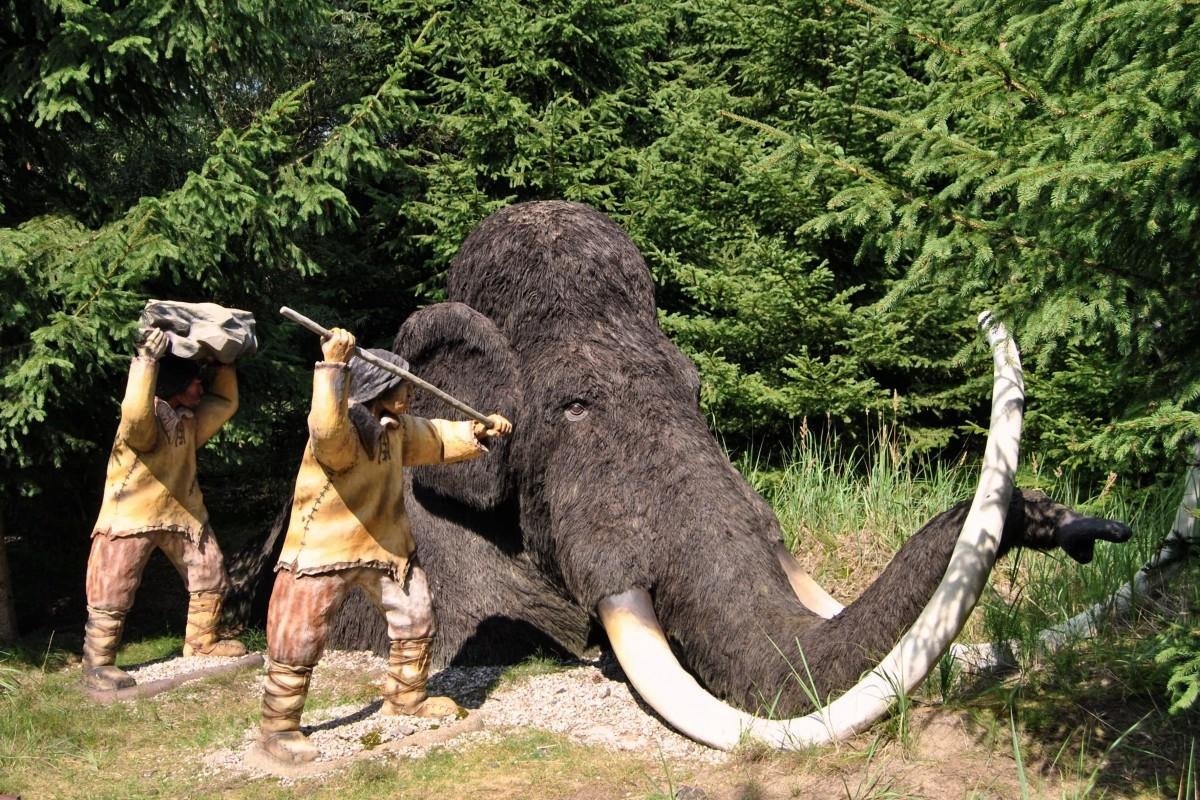
Neanderthals hunted and butchered straight-tusked elephants 125,000 years ago
CC0 Public Domain

The findings, published in Science Advances, challenge previous assumptions about Neanderthal social structures, revealing a level of organization and communal living that was previously underestimated.

The revelation stems from a trove of animal bones and stone tools discovered in the 1980s by coal miners near the town of Neumark-Nord. Archaeologists, including Lutz Kindler and Sabine Gaudzinski-Windheuser from the MONREPOS Archaeological Research Center, spent a decade examining the remains, uncovering bones and tusks from over 70 mostly adult male straight-tusked elephants, an extinct species twice the size of modern African elephants. The site dates back to the Eemian interglacial, 75,000 years before the arrival of modern humans in Western Europe.

The extent of the butchery, as evidenced by strategic cut marks on nearly every bone, suggests a highly organized and thorough process. Wil Roebroeks, an archaeologist at the University of Leiden and study co-author, emphasizes, “They really went for every scrap of meat and fat.” The absence of scavenger gnawing indicates that Neanderthals utilized every part of the elephant, from meat to fat pads on the feet.

The researchers estimate that the meat from a single elephant could sustain 350 people for a week or 100 people for a month, challenging the conventional belief that Neanderthals lived in small, highly mobile groups of around 20 individuals. This discovery implies the existence of larger, more settled communities capable of both slaughtering and efficiently processing entire elephants.


RelatedStories

Archaic humans were selective hunters, not mass slaughterers, new study reveals

Archaic humans were selective hunters, not mass slaughterers, new study reveals

December 6, 2025
Ice Age hunters built mammoth-bone shelters in Ukraine, new study reveals precise timeline

Scientists redate Ukraine’s mammoth-bone structures, uncovering Ice Age survival tactics

November 29, 2025

April Nowell, an archaeologist at the University of Victoria, remarks, “This is really hard and time-consuming work. Why would you slaughter the whole elephant if you’re going to waste half the portions?” The findings indicate a level of competence and planning in Neanderthal behavior previously unrecognized.
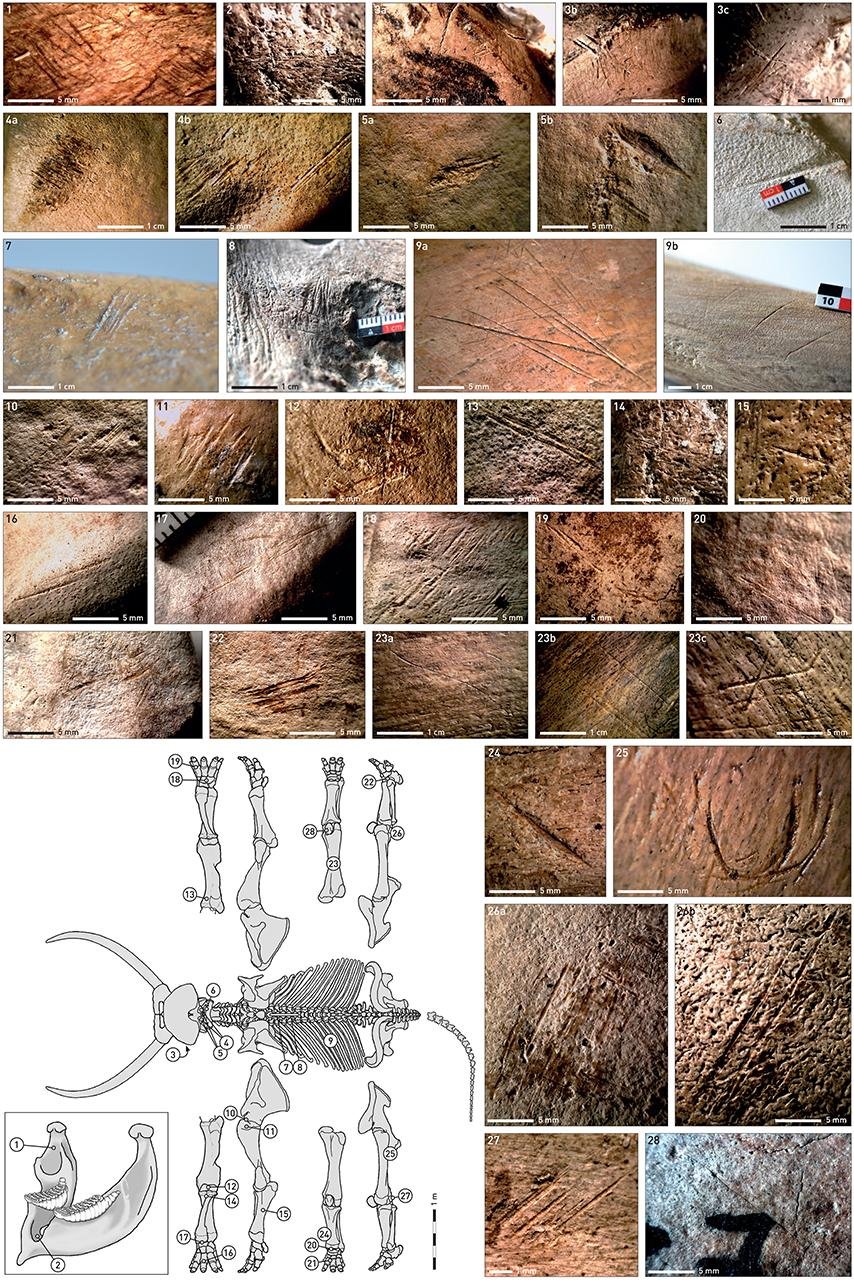
Neanderthals hunted and butchered straight-tusked elephants 125,000 years ago
Cut marks on skeletons of P. antiquus from Neumark-Nord. Credit: Sabine Gaudzinski-Windheuser et al, Sci. Adv (2023)

The colossal scale of the elephant gatherings suggests the possibility of seasonal events or communal storage practices. Annemieke Milks, an archaeologist from the University of Reading, notes, “Maybe it’s a large, seasonal gathering, or they’re storing food—or both.” The researchers propose that Neanderthals were adept at dealing with significant amounts of food in one go, a unique advantage illustrated by the clarity of the archaeological evidence.

The implications extend beyond hunting practices to challenge existing views of Neanderthal sophistication. Gary Haynes, a retired archaeologist from the University of Nevada, Reno, says, “If one regional group of Neanderthals was capable of such behavior, other groups elsewhere surely would have been capable, too.” The prevailing image of Neanderthals as primitive beings is evolving, with evidence suggesting adaptability to various environments and climates.

Adult male elephants, which roamed alone without the protection of a female-led herd, were likely targeted, requiring a high level of coordination and planning in the hunt. Britt Starkovich, an archaeologist at the University of Tübingen, comments, “Neanderthals knew what they were doing. They knew which kinds of individuals to hunt, where to find them, and how to execute the attack.”

The findings challenge the perception that Neanderthals lived in small, nomadic groups. Instead, the evidence suggests the possibility of larger, more settled communities capable of collaborative endeavors. The study’s co-author, Wil Roebroeks, affirms that Neanderthals were not merely primitive beings, stating, “This lets us imagine Neanderthals as more like modern humans rather than as humanoid brutes, as they once were interpreted.”

More information: Sabine Gaudzinski-Windheuser et al, (2023). Hunting and processing of straight-tusked elephants 125.000 years ago: Implications for Neanderthal behavior. Sci. Adv.9, eadd8186. DOI:10.1126/sciadv.add8186
ShareTweetShareShareSend

You May Also Like...

First known Andean trophy head with a cleft lip from southern Peru
Anthropology

First known Andean trophy head with a cleft lip from southern Peru

December 9, 2025
First evidence of lost-wax silver casting in Bronze Age Western Europe uncovered at El Argar, Spain
Archaeology

First evidence of lost-wax silver casting in Bronze Age Western Europe uncovered at El Argar, Spain

December 9, 2025
Longest and most intact section of Hasmonean city wall uncovered in Jerusalem
Archaeology

Longest and most intact section of Hasmonean city wall uncovered in Jerusalem

December 9, 2025
Ancient Egyptian pleasure barge unearthed in Alexandria’s sunken harbor
Archaeology

Ancient Egyptian pleasure boat unearthed in Alexandria’s sunken harbor

December 8, 2025
New study reveals archaic 'hobbits' were even smaller than previously thought
Anthropology

Drought may have driven the extinction of Homo floresiensis, the “Hobbit”

December 8, 2025
Digital archaeology reveals lost Pompeii towers rising above elite Roman villas
Archaeology

Digital archaeology reveals lost towers of Pompeii rising above elite Roman villas

December 7, 2025

Follow us


Instagram
245K

Facebook
117K

Threads
45K

LinkedIn
14K

Twitter
6K

YouTube
1K
  • Trending
  • Comments
  • Latest
Shipwreck Salvage. Credit: rawpixel.com / Public Domain

2,000-year-old shipwreck discovered off Turkish coast with remarkably preserved stacked ceramics

July 2, 2025
Viking age DNA reveals 9,000-year-old HIV-resistant gene originating near the Black Sea

Viking age DNA reveals 9,000-year-old HIV-resistant gene originating near the Black Sea

May 18, 2025
Complete copy of the Canopus Decree unearthed in Egypt after 150 years

Complete copy of the Canopus Decree unearthed in Egypt after 150 years

September 13, 2025
Mystery of Armenia’s 6,000-year-old dragon stones solved

Mystery of Armenia’s 6,000-year-old dragon stones solved

September 23, 2025
Moses may be named in ancient Egyptian mine inscriptions, sparking debate over earliest biblical references

Moses may be named in ancient Egyptian mine inscriptions, sparking debate over earliest biblical references

July 31, 2025
3D analysis reveals Shroud of Turin image likely came from sculpture, not Jesus’ body

3D analysis reveals Shroud of Turin image likely came from sculpture, not Jesus’ body

Moses may be named in ancient Egyptian mine inscriptions, sparking debate over earliest biblical references

Moses may be named in ancient Egyptian mine inscriptions, sparking debate over earliest biblical references

$1 million prize offered to decipher 5,300-year-old Indus Valley script

$1 million prize offered to decipher 5,300-year-old Indus Valley script

Oldest ever genetic data from a human relative found in 2-million-year-old fossilized teeth

Oldest ever genetic data from a human relative found in 2-million-year-old fossilized teeth

Exceptionally large Roman shoes discovered at Magna fort near Hadrian’s Wall

Exceptionally large Roman shoes discovered at Magna fort near Hadrian’s Wall

First known Andean trophy head with a cleft lip from southern Peru

First known Andean trophy head with a cleft lip from southern Peru

December 9, 2025
First evidence of lost-wax silver casting in Bronze Age Western Europe uncovered at El Argar, Spain

First evidence of lost-wax silver casting in Bronze Age Western Europe uncovered at El Argar, Spain

December 9, 2025
Longest and most intact section of Hasmonean city wall uncovered in Jerusalem

Longest and most intact section of Hasmonean city wall uncovered in Jerusalem

December 9, 2025
Ancient Egyptian pleasure barge unearthed in Alexandria’s sunken harbor

Ancient Egyptian pleasure boat unearthed in Alexandria’s sunken harbor

December 8, 2025
New study reveals archaic 'hobbits' were even smaller than previously thought

Drought may have driven the extinction of Homo floresiensis, the “Hobbit”

December 8, 2025

Archaeology News online magazine

Archaeology News is an international online magazine that covers all aspects of archaeology.


Categories

  • Academics
    • Books
    • Conferences
    • Universities
  • Articles
  • Download
  • Game
  • News
    • Anthropology
    • Archaeology
    • Paleontology
  • Quiz
  • Tours

Subscribe to our newsletter

© 2024 - Archaeology News Online Magazine. All Rights Reserved.

  • About
  • Privacy Policy
  • Terms of Use
  • Donation
  • Contact

Welcome Back!

Login to your account below

Forgotten Password? Sign Up

Create New Account!

Fill the forms below to register

All fields are required. Log In

Retrieve your password

Please enter your username or email address to reset your password.

Log In

Add New Playlist

Manage Consent
To provide the best experiences, we use technologies like cookies to store and/or access device information. Consenting to these technologies will allow us to process data such as browsing behavior or unique IDs on this site. Not consenting or withdrawing consent, may adversely affect certain features and functions.
Functional Always active
The technical storage or access is strictly necessary for the legitimate purpose of enabling the use of a specific service explicitly requested by the subscriber or user, or for the sole purpose of carrying out the transmission of a communication over an electronic communications network.
Preferences
The technical storage or access is necessary for the legitimate purpose of storing preferences that are not requested by the subscriber or user.
Statistics
The technical storage or access that is used exclusively for statistical purposes. The technical storage or access that is used exclusively for anonymous statistical purposes. Without a subpoena, voluntary compliance on the part of your Internet Service Provider, or additional records from a third party, information stored or retrieved for this purpose alone cannot usually be used to identify you.
Marketing
The technical storage or access is required to create user profiles to send advertising, or to track the user on a website or across several websites for similar marketing purposes.
  • Manage options
  • Manage services
  • Manage {vendor_count} vendors
  • Read more about these purposes
View preferences
  • {title}
  • {title}
  • {title}
  • Home
  • News
    • Archaeology
    • Anthropology
    • Paleontology
  • Academic
    • Books
    • Conferences
    • Universities
  • Articles
  • VR Tours
  • Quiz & Game
  • Download
  • Encyclopedia
  • Forum

About  .  Contact  .  Donation

© 2024 - Archaeology News Online Magazine. All Rights Reserved