• About
  • Privacy Policy
  • Terms of Use
  • Donation
  • Contact
No Result
View All Result
Archaeology News
  • Home
  • News
    • Archaeology
    • Anthropology
    • Paleontology
  • Academic
    • Books
    • Conferences
    • Universities
  • Articles
  • VR Tours
  • Quiz & Game
  • Download
  • Encyclopedia
  • Forum
Archaeology News
No Result
View All Result
Home News Anthropology

Medieval vampire burial unearthed in Chełm, Poland

by Dario Radley
September 12, 2024

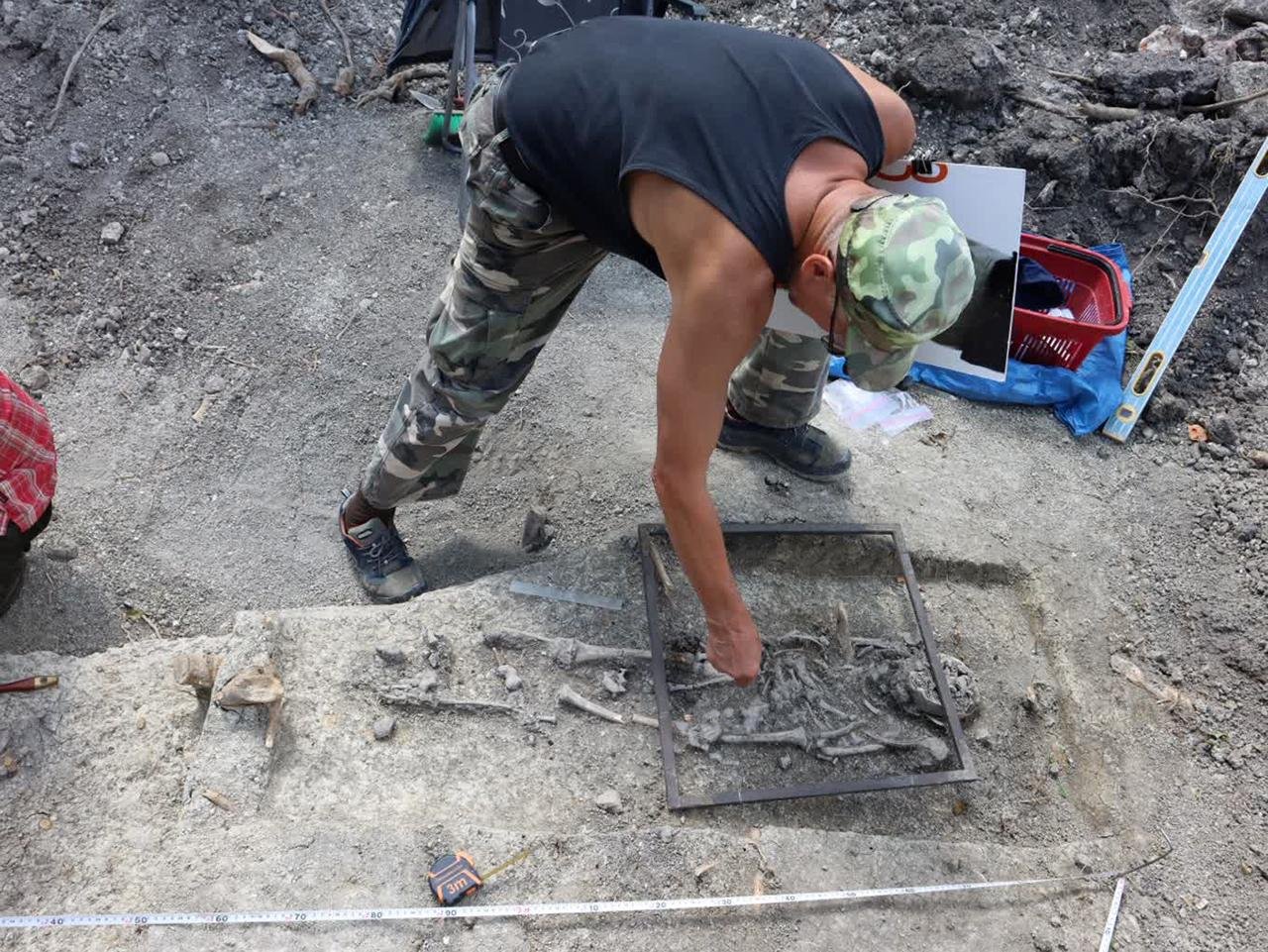
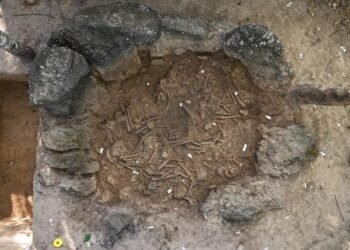
In a recent archaeological excavation on Góra Chełmska in Chełm, Poland, a mysterious burial site has been uncovered, sparking renewed interest in medieval beliefs about the supernatural.
Medieval vampire burial unearthed in Chełm, Poland
Credit: Lublin Voivodeship Conservator of Monuments

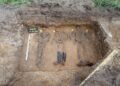
The remains of two children, dating back to the 13th century, were found during renovation work on the fence surrounding the gardens of the former Uniate bishops’ palace, a site of historical and religious significance in the region. One of these burials has been identified as a “vampire burial,” a term used to describe specific practices intended to prevent the deceased from rising from the grave and causing harm to the living.

The excavation was led by Dr. Stanisław Gołub, an archaeologist with the Lublin Voivodeship Conservator of Monuments. His team discovered two children’s skeletons buried in an area that, according to historical records, had not previously been associated with any known cemetery. The remains were uncovered while workers were removing tree roots as part of the renovation project.

What sets this discovery apart is the unusual treatment of one of the skeletons. Dr. Gołub explained that the skull of the child had been intentionally separated from the body and placed face-down in the grave. Heavy stones were also positioned on the torso. These practices are consistent with anti-vampire rituals found in various parts of medieval Europe, particularly in Eastern Europe, where folklore about vampires and revenants—reanimated corpses—was prevalent.

According to Dr. Gołub, such measures were believed to prevent the deceased from returning as malevolent spirits or vampires. “The burial clearly shows signs of anti-vampire practices, which were aimed at stopping the dead from rising again,” he said in a statement.

RelatedStories

800-year-old medieval notebook found in German latrine still contains readable Latin writing

800-year-old medieval notebook found in German latrine still contains readable Latin writing

May 16, 2026
Ancient burials, Roman well, and Anglo-Saxon house uncovered during A46 Newark bypass excavations

Ancient burials, Roman well, and Anglo-Saxon house uncovered during A46 Newark bypass excavations

May 12, 2026

The discovery of postholes at the burial site, which likely served as grave markers, further supports the notion that this was a special or monitored grave. In similar cases across Poland, markers were used to observe the graves for any signs of reanimation. For example, a previous discovery in Pień revealed a woman buried with a padlock on her toe and a scythe across her throat—further examples of the lengths to which medieval communities went to prevent the “undead” from returning.

The burials were found in gypsum soil and oriented along an east-west axis, a common burial practice of the time. No coffins or funerary items were discovered, which adds to the mystery of why these children were buried in such a way in an area not designated as a cemetery. According to the Lublin Provincial Conservator of Monuments, this site was part of a cathedral complex, but the presence of these graves raises questions about whether an undocumented burial ground once existed there.

Chełm, a city rich in Byzantine and Slavic cultural influences, was a religious and administrative center during the Middle Ages. Góra Chełmska, where the discovery was made, was home to fortifications and religious buildings but had no known cemetery, making the find even more significant. Archaeologists believe the remains date to the 13th century, based on the stratigraphy of the site and nearby pottery fragments.

The broader implications of this discovery are profound. Anti-vampire burials reflect deeply rooted fears in medieval society about the supernatural. It was widely believed in some Eastern European cultures that certain people, after death, could return as vampires, threatening the living by spreading disease or feeding on their blood. Such beliefs were often linked to those who had died under unusual or suspicious circumstances, such as suicides or individuals believed to have been possessed by malevolent spirits.

Researchers hope to gain more information about burial practices and living conditions at the time. This find adds to the body of evidence from archaeological excavations across Eastern Europe, documenting the widespread fear of vampires and the lengths to which communities went to protect themselves from the perceived threat of the undead.
Lublin Voivodeship Conservator of Monuments

ShareTweetShareShareSend

You May Also Like...

World War II mass grave in Poland reveals remains of German officer killed during Battle of Lauban
Anthropology

World War II mass grave in Poland reveals remains of German officer killed during Battle of Lauban

May 19, 2026
massive jar in Laos contained remains of 37 people, revealing ancient burial rituals and Asian trade links
Anthropology

Massive jar in Laos contained remains of 37 people, revealing ancient burial rituals and Asian trade links

May 19, 2026
6,000-year-old necropolis in Spain rewrites origins of Europe’s first megalithic tombs
Archaeology

6,000-year-old necropolis in Spain rewrites origins of Europe’s first megalithic tombs

May 18, 2026
Ancient settlement with weaving workshop and longhouses uncovered in Germany gravel pit
Archaeology

Ancient settlement with weaving workshop and longhouses uncovered in Germany gravel pit

May 17, 2026
Pompeii victim identified as Roman physician killed while fleeing Vesuvius eruption
Anthropology

Pompeii victim identified as Roman physician killed while fleeing Vesuvius eruption

May 17, 2026
Archaeologists uncover hidden whisky smuggler bothy in Scottish Highlands with rare copper still piece
Archaeology

Archaeologists uncover hidden whisky smuggler bothy in Scottish Highlands with rare copper still piece

May 16, 2026

Follow us


Instagram
242K

Facebook
117K

Threads
46K

LinkedIn
14K

Twitter
6K

YouTube
1K
World War II mass grave in Poland reveals remains of German officer killed during Battle of Lauban

World War II mass grave in Poland reveals remains of German officer killed during Battle of Lauban

May 19, 2026
massive jar in Laos contained remains of 37 people, revealing ancient burial rituals and Asian trade links

Massive jar in Laos contained remains of 37 people, revealing ancient burial rituals and Asian trade links

May 19, 2026
6,000-year-old necropolis in Spain rewrites origins of Europe’s first megalithic tombs

6,000-year-old necropolis in Spain rewrites origins of Europe’s first megalithic tombs

May 18, 2026
Ancient settlement with weaving workshop and longhouses uncovered in Germany gravel pit

Ancient settlement with weaving workshop and longhouses uncovered in Germany gravel pit

May 17, 2026

Archaeology News online magazine

Archaeology News is an international online magazine that covers all aspects of archaeology.


Categories

  • Academics
    • Books
    • Conferences
    • Universities
  • Articles
  • Download
  • Game
  • News
    • Anthropology
    • Archaeology
    • Paleontology
  • Quiz
  • Tours

Subscribe to our newsletter

© 2024 - Archaeology News Online Magazine. All Rights Reserved.

  • About
  • Privacy Policy
  • Terms of Use
  • Donation
  • Contact

Manage Consent
To provide the best experiences, we use technologies like cookies to store and/or access device information. Consenting to these technologies will allow us to process data such as browsing behavior or unique IDs on this site. Not consenting or withdrawing consent, may adversely affect certain features and functions.
Functional Always active
The technical storage or access is strictly necessary for the legitimate purpose of enabling the use of a specific service explicitly requested by the subscriber or user, or for the sole purpose of carrying out the transmission of a communication over an electronic communications network.
Preferences
The technical storage or access is necessary for the legitimate purpose of storing preferences that are not requested by the subscriber or user.
Statistics
The technical storage or access that is used exclusively for statistical purposes. The technical storage or access that is used exclusively for anonymous statistical purposes. Without a subpoena, voluntary compliance on the part of your Internet Service Provider, or additional records from a third party, information stored or retrieved for this purpose alone cannot usually be used to identify you.
Marketing
The technical storage or access is required to create user profiles to send advertising, or to track the user on a website or across several websites for similar marketing purposes.
  • Manage options
  • Manage services
  • Manage {vendor_count} vendors
  • Read more about these purposes
View preferences
  • {title}
  • {title}
  • {title}
  • Home
  • News
    • Archaeology
    • Anthropology
    • Paleontology
  • Academic
    • Books
    • Conferences
    • Universities
  • Articles
  • VR Tours
  • Quiz & Game
  • Download
  • Encyclopedia
  • Forum

About  .  Contact  .  Donation

© 2024 - Archaeology News Online Magazine. All Rights Reserved