• About
  • Privacy Policy
  • Terms of Use
  • Donation
  • Contact
No Result
View All Result
Archaeology News
  • Home
  • News
    • Archaeology
    • Anthropology
    • Paleontology
  • Academic
    • Books
    • Conferences
    • Universities
  • Articles
  • VR Tours
  • Quiz & Game
  • Download
  • Encyclopedia
  • Forum
Archaeology News
No Result
View All Result
Home News Archaeology

2,200-year-old Egyptian hallucinogenic rituals confirmed by vase depicting dwarf god

by Dario Radley
November 17, 2024

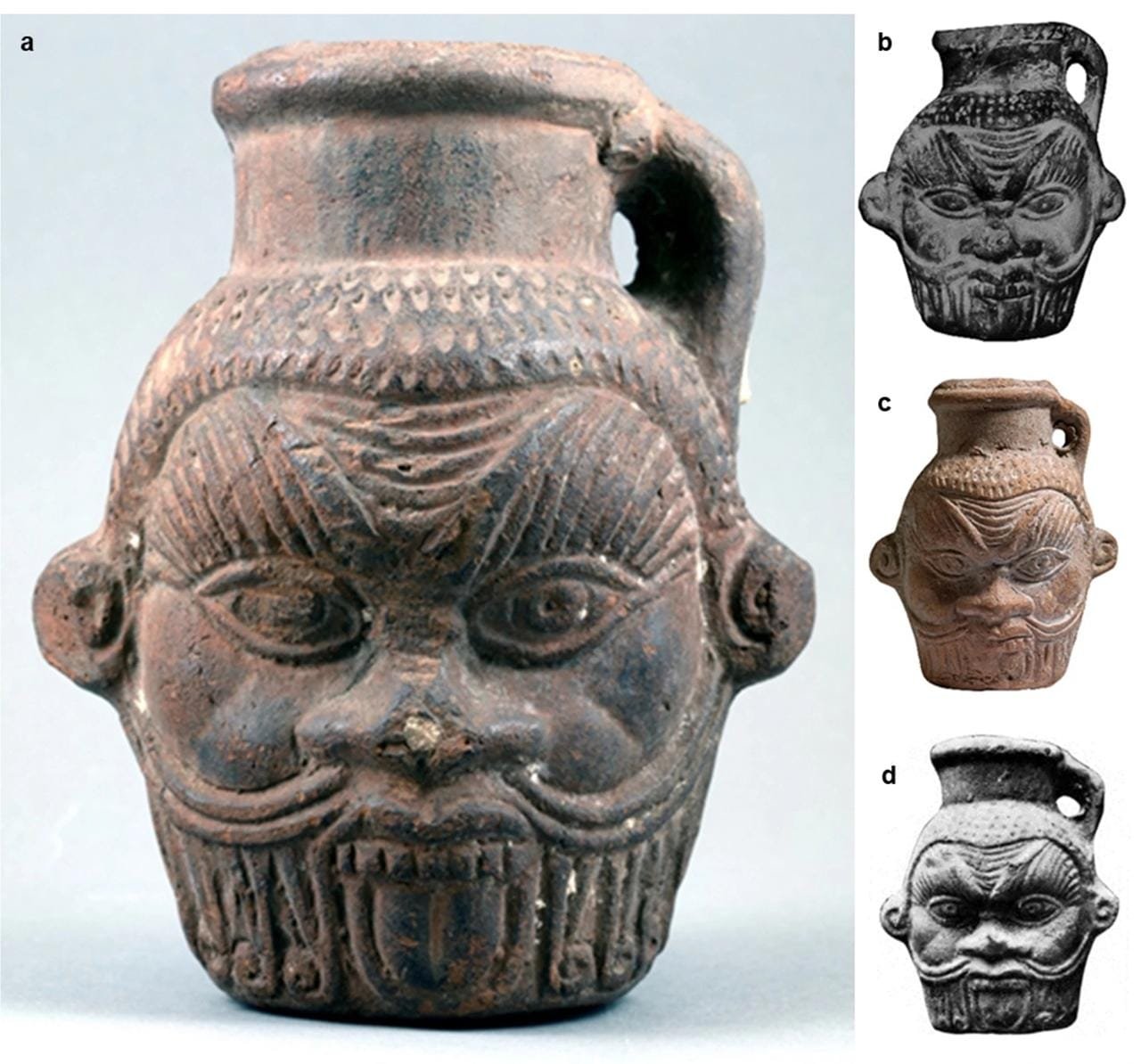
Researchers have uncovered the first physical evidence of hallucinogenic substances in an ancient Egyptian vase, shedding light on mysterious rituals from over 2,000 years ago. The investigation, led by Professor Davide Tanasi of the University of South Florida, focused on a Bes mug housed at the Tampa Museum of Art, which depicts Bes, the ancient Egyptian deity associated with childbirth, protection, and magical purification. The study, published in Scientific Reports, combines cutting-edge chemical, genetic, and spectroscopic analyses to reveal the ingredients of a psychotropic concoction likely used in magical rituals.

The Bes mug was donated to the museum in 1984. Decorated with the face of Bes, the vase’s design connects it to fertility and protective practices. However, its exact use had remained speculative, with theories ranging from holding sacred water to being part of magic rituals.

“For a very long time now, Egyptologists have been speculating what mugs with the head of Bes could have been used for,” said Branko van Oppen, curator of Greek and Roman art at the Tampa Museum of Art and co-author of the study. “This research teaches us about magic rituals in the Greco-Roman period in Egypt.”
2,200-year-old Egyptian hallucinogenic rituals confirmed by vase depicting dwarf god
Drinking vessel in the shape of Bes head; El-Fayūm Oasis, Egypt; Ptolemaic-Roman period (4th century BCE − 3rd century CE), (courtesy of the Tampa Museum of Art, Florida). Credit: D. Tanasi et al. Scientific Reports (2024). [This image is used under the CC BY-NC-ND license for non-commercial and educational purposes. If you are the copyright holder and object to its use, please contact us for immediate removal.]
Using innovative techniques, including metabolomics and synchrotron radiation-based Fourier Transformed Infrared microSpectroscopy (SR µ-FTIR), the team identified a complex mixture of ingredients. The concoction included plants with psychotropic and medicinal properties such as Peganum harmala (wild rue), Egyptian blue lotus (Nymphaea nouchali var. caerulea), and a plant from the Cleome genus. Additionally, honey, sesame seeds, pine nuts, licorice, and grapes were used to flavor and color the liquid, making it resemble blood. The presence of fermented fruit-based liquids, proteins, and metabolites added further complexity to the brew.

The analysis also detected traces of human bodily fluids, such as blood and saliva, suggesting their intentional inclusion in the mixture. According to the researchers, these findings indicate that the vase’s contents were likely consumed as part of a ritual aimed at inducing hallucinations or prophetic dreams.
RelatedStories

Ancient Egyptian tombs, painted coffins, and cat mummies unearthed in Luxor necropolis

Ancient Egyptian tombs, painted coffins, and cat mummies unearthed in Luxor necropolis

May 16, 2026
Ancient bathhouse and Roman villa with mosaics unearthed in Alexandria during rescue excavation

Ancient bathhouse and Roman villa with mosaics unearthed in Alexandria during rescue excavation

May 3, 2026

The study draws connections between the Bes mug’s usage and the “Myth of the Solar Eye,” where Bes calms Hathor, a sky goddess, with a drug-laced alcoholic beverage disguised as blood. This act lulls Hathor into a deep sleep, symbolizing a resolution of conflict. Scholars suggest that rituals involving Bes mugs may have reenacted this myth, combining psychoactive substances and storytelling to deepen spiritual experiences.

Another significant context for the rituals was fertility and childbirth. The Bes Chambers at Saqqara, near the Great Pyramids of Giza, are believed to have been sites where women sought divine assistance during pregnancies, a period fraught with risks in the ancient world. “This combination of ingredients may have been used in a dream-vision inducing magic ritual within the context of this dangerous period of childbirth,” Van Oppen explained. Such rituals could also include oracular practices, where participants sought prophetic dreams about their futures or pregnancies.

The research, part of the Mediterranean Diet Archaeology project, involved collaborations with scientists from the University of Trieste and the University of Milan.
University of South Florida 

More information: Tanasi, D., van Oppen de Ruiter, B.F., Florian, F. et al. (2024). Multianalytical investigation reveals psychotropic substances in a ptolemaic Egyptian vase. Sci Rep 14, 27891. doi:10.1038/s41598-024-78721-8

Share:

Share on Facebook Share on X (Twitter) Share on LinkedIn Share on Pinterest Share on WhatsApp Share on Email

You May Also Like...

Radiocarbon dating confirms Teutonic Knights built Feldioara Fortress in 13th-century Transylvania
Archaeology

Radiocarbon dating confirms Teutonic Knights built Feldioara Fortress in 13th-century Transylvania

May 30, 2026
Ancient shipwreck with 300 amphorae found off Italy could reshape views of Mediterranean wine trade
Archaeology

Ancient shipwreck with 300 amphorae found off Italy could reshape views of Mediterranean wine trade

May 29, 2026
Ancient DNA reveals 700-kilometer migration along Peru’s coast before the Inca Empire
Anthropology

Ancient DNA reveals 700-kilometer migration along Peru’s coast before the Inca Empire

May 29, 2026
6,000-year-old mega-structure unearthed at prehistoric settlement in Romania
Archaeology

6,000-year-old mega-structure unearthed at prehistoric settlement in Romania

May 29, 2026
Medieval bone study identifies microbial communities driving archaeological bone degradation and preservation
Anthropology

Medieval bone study identifies microbial communities driving archaeological bone degradation and preservation

May 28, 2026
A large hidden hydraulic system mapped around the Urartian fortress of Argishtikhinili in Armenia
Archaeology

A large hidden hydraulic system mapped around the Urartian fortress of Argishtikhinili in Armenia

May 28, 2026

Follow us


Instagram
242K

Facebook
117K

Threads
47K

LinkedIn
15K

Twitter
6K

YouTube
1K
Radiocarbon dating confirms Teutonic Knights built Feldioara Fortress in 13th-century Transylvania

Radiocarbon dating confirms Teutonic Knights built Feldioara Fortress in 13th-century Transylvania

May 30, 2026
Ancient shipwreck with 300 amphorae found off Italy could reshape views of Mediterranean wine trade

Ancient shipwreck with 300 amphorae found off Italy could reshape views of Mediterranean wine trade

May 29, 2026
Ancient DNA reveals 700-kilometer migration along Peru’s coast before the Inca Empire

Ancient DNA reveals 700-kilometer migration along Peru’s coast before the Inca Empire

May 29, 2026
6,000-year-old mega-structure unearthed at prehistoric settlement in Romania

6,000-year-old mega-structure unearthed at prehistoric settlement in Romania

May 29, 2026

Archaeology News online magazine

Archaeology News is an international online magazine that covers all aspects of archaeology.


Categories

  • Academics
    • Books
    • Conferences
    • Universities
  • Articles
  • Download
  • Game
  • News
    • Anthropology
    • Archaeology
    • Paleontology
  • Quiz
  • Tours

Subscribe to our newsletter

© 2024 - Archaeology News Online Magazine. All Rights Reserved.

  • About
  • Privacy Policy
  • Terms of Use
  • Donation
  • Contact

Manage Consent
To provide the best experiences, we use technologies like cookies to store and/or access device information. Consenting to these technologies will allow us to process data such as browsing behavior or unique IDs on this site. Not consenting or withdrawing consent, may adversely affect certain features and functions.
Functional Always active
The technical storage or access is strictly necessary for the legitimate purpose of enabling the use of a specific service explicitly requested by the subscriber or user, or for the sole purpose of carrying out the transmission of a communication over an electronic communications network.
Preferences
The technical storage or access is necessary for the legitimate purpose of storing preferences that are not requested by the subscriber or user.
Statistics
The technical storage or access that is used exclusively for statistical purposes. The technical storage or access that is used exclusively for anonymous statistical purposes. Without a subpoena, voluntary compliance on the part of your Internet Service Provider, or additional records from a third party, information stored or retrieved for this purpose alone cannot usually be used to identify you.
Marketing
The technical storage or access is required to create user profiles to send advertising, or to track the user on a website or across several websites for similar marketing purposes.
  • Manage options
  • Manage services
  • Manage {vendor_count} vendors
  • Read more about these purposes
View preferences
  • {title}
  • {title}
  • {title}
  • Home
  • News
    • Archaeology
    • Anthropology
    • Paleontology
  • Academic
    • Books
    • Conferences
    • Universities
  • Articles
  • VR Tours
  • Quiz & Game
  • Download
  • Encyclopedia
  • Forum

About  .  Contact  .  Donation

© 2024 - Archaeology News Online Magazine. All Rights Reserved