• About
  • Privacy Policy
  • Terms of Use
  • Donation
  • Contact
No Result
View All Result
Archaeology News
  • Home
  • News
    • Archaeology
    • Anthropology
    • Paleontology
  • Academic
    • Books
    • Conferences
    • Universities
  • Articles
  • VR Tours
  • Quiz & Game
  • Download
  • Encyclopedia
  • Forum
Archaeology News
No Result
View All Result
Home News Anthropology

Chimpanzees choose stone tools like early human ancestors from 2.5 million years ago

by Dario Radley
January 8, 2025

A new study published in the Journal of Human Evolution has shown remarkable similarities between how modern chimpanzees and early human ancestors pick tools, giving us fresh insights into the evolution of tool use.

Chimpanzees choose stone tools like early human ancestors from 2.5 million years ago
Credit: Klub Boks

An international team of paleobiologists, anthropologists, and behavioral scientists carried out this research. Their work shows that the way chimpanzees choose stones to crack nuts is very similar to the purposeful and practical approach used by Oldowan hominins over 2.5 million years ago.

Scientists watched chimps in Bossou, Guinea, crack nuts using two tools: a hammer to hit the nut and an anvil to hold it steady. The team gave the chimps stones of different hardness, bounce, weight, and shape to see how they chose their tools. The study showed that chimps always picked harder stones for hammers and softer, more stable ones for anvils. They made these choices based on mechanical properties of stones, not how they looked or felt. The way they selected them suggests that they must have had an understanding of their practical utility.

These discoveries resemble how Oldowan hominins used tools. They were some of the first we know about to use stone tools. People started using Oldowan tools about 2.5 million years ago to chop, cut, and scrape. Studies show these early human ancestors picked stones with specific useful features on purpose, getting better at choosing over time. Just like the chimps, they cared more about how well tools worked and their mechanical benefits than how they looked on the surface.
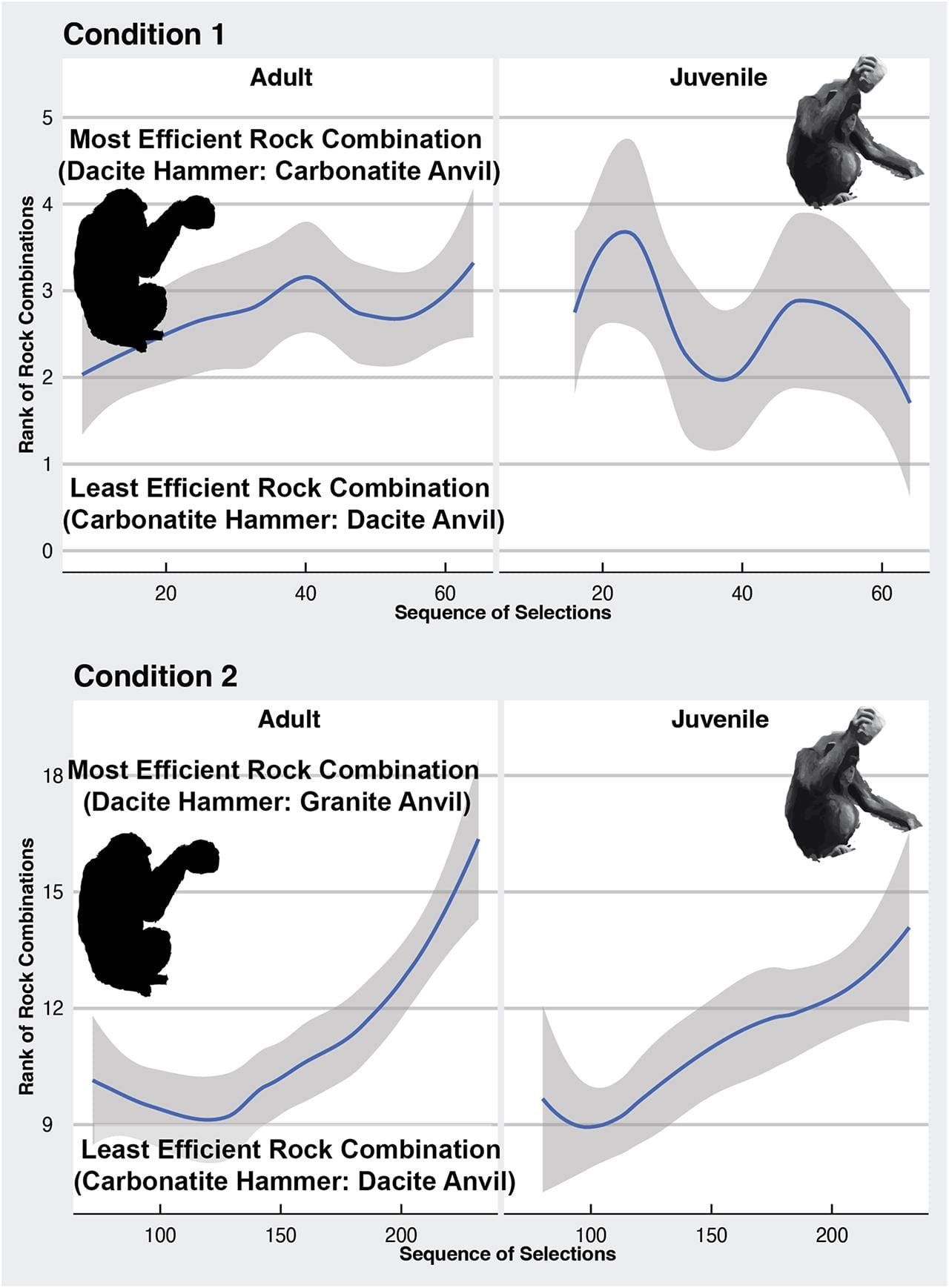
Chimpanzees choose stone tools like early human ancestors from 2.5 million years ago
Plots of the average efficiency rank of rock combinations (hammer:anvil) through the course of the two portions of the experiment (Condition 1, Condition 2). The experiment is divided into a sequence of individual rock selections (defined as an instance where the hammer or anvil is changed) to investigate general patterns through the course of the experiment. Spearman’s rank correlation is conducted on the efficiency rank value through the sequence of selections. Credit: D. R. Braunet al., Journal of Human Evolution (2024)

Notably, Oldowan hominins moved stones long distances so they had a good understanding of material properties.

RelatedStories

Genetic incompatibility between Homo sapiens and Neanderthals may have contributed to Neanderthal extinction

Did Preeclampsia contribute to Neanderthal extinction? new study explores a hidden reproductive risk

February 23, 2026
1.77-million-year-old Homo erectus skulls in China show early humans reached Asia sooner than believed

1.77-million-year-old Homo erectus skulls in China show early humans reached Asia sooner than believed

February 19, 2026

The study also reveals the social dynamics of tool use in chimpanzees. Younger chimps would mimic the tool choices of older, more experienced chimps, forming a type of cultural transmission. This is how early human societies passed down survival skills and tool-making techniques, which were essential for technological advancement and adaptation.

Chimpanzees choose stone tools like early human ancestors from 2.5 million years ago
A new study has shown similarities between how modern chimpanzees and early human ancestors pick stone tools. Credit: Pavel Bak

The findings add to the expanding area of primate archaeology, which connects behavioral research on modern primates with the archaeological evidence of ancient hominins. By examining chimpanzees—our nearest living relatives who have about 98% of our DNA in common—researchers can guess at the social and environmental factors that shaped how early humans started to use tools.

More information: Braun, D. R., Carvalho, S., Kaplan, R. S., Beardmore-Herd, M., Plummer, T., Biro, D., & Matsuzawa, T. (2024). Stone selection by wild chimpanzees shares patterns with Oldowan hominins. Journal of Human Evolution, 199(103625), 103625. doi:10.1016/j.jhevol.2024.103625
Share8Tweet5Share1ShareSend

You May Also Like...

CT scans reveal hidden details of 2,300-year-old Egyptian mummies
Anthropology

CT scans reveal hidden details of 2,300-year-old Egyptian mummies

April 26, 2026
Rare 2,000-year-old Roman bread found at Vindonissa reveals early military life in Switzerland
Archaeology

Rare 2,000-year-old Roman bread found at Vindonissa reveals early military life in Switzerland

April 25, 2026
Over 1,000 archaeological features uncovered along Czech railway
Archaeology

Over 1,000 archaeological features uncovered along Czech railway

April 25, 2026
Ancient ship burial in Norway dates to CE 700, rewriting early Viking Age origins
Archaeology

Ancient ship burial in Norway dates to CE 700, rewriting early Viking Age origins

April 25, 2026
Ramses II statue found in Egypt’s eastern Nile Delta shows ancient reuse of royal monuments
Archaeology

Ramses II statue found in Egypt’s eastern Nile Delta shows ancient reuse of royal monuments

April 24, 2026
Late Bronze Age bronze ring hoard near Dresden reveals ritual practices and social life 1300–1100 BCE
Archaeology

Late Bronze Age bronze ring hoard near Dresden reveals ritual practices and social life 1300–1100 BCE

April 21, 2026

Follow us


Instagram
244K

Facebook
118K

Threads
46K

LinkedIn
14K

Twitter
6K

YouTube
1K
  • Trending
  • Comments
  • Latest
Shipwreck Salvage. Credit: rawpixel.com / Public Domain

2,000-year-old shipwreck discovered off Turkish coast with remarkably preserved stacked ceramics

July 2, 2025
Viking age DNA reveals 9,000-year-old HIV-resistant gene originating near the Black Sea

Viking age DNA reveals 9,000-year-old HIV-resistant gene originating near the Black Sea

May 18, 2025
A new study suggests the mysterious Voynich Manuscript may be a medieval cipher

A new study suggests the mysterious Voynich Manuscript may be a medieval cipher

January 3, 2026
3D analysis reveals Shroud of Turin image likely came from sculpture, not Jesus’ body

3D analysis reveals Shroud of Turin image likely came from sculpture, not Jesus’ body

August 3, 2025
Moses may be named in ancient Egyptian mine inscriptions, sparking debate over earliest biblical references

Moses may be named in ancient Egyptian mine inscriptions, sparking debate over earliest biblical references

July 31, 2025
3D analysis reveals Shroud of Turin image likely came from sculpture, not Jesus’ body

3D analysis reveals Shroud of Turin image likely came from sculpture, not Jesus’ body

Moses may be named in ancient Egyptian mine inscriptions, sparking debate over earliest biblical references

Moses may be named in ancient Egyptian mine inscriptions, sparking debate over earliest biblical references

$1 million prize offered to decipher 5,300-year-old Indus Valley script

$1 million prize offered to decipher 5,300-year-old Indus Valley script

Oldest ever genetic data from a human relative found in 2-million-year-old fossilized teeth

Oldest ever genetic data from a human relative found in 2-million-year-old fossilized teeth

Exceptionally large Roman shoes discovered at Magna fort near Hadrian’s Wall

Exceptionally large Roman shoes discovered at Magna fort near Hadrian’s Wall

CT scans reveal hidden details of 2,300-year-old Egyptian mummies

CT scans reveal hidden details of 2,300-year-old Egyptian mummies

April 26, 2026
Rare 2,000-year-old Roman bread found at Vindonissa reveals early military life in Switzerland

Rare 2,000-year-old Roman bread found at Vindonissa reveals early military life in Switzerland

April 25, 2026
Over 1,000 archaeological features uncovered along Czech railway

Over 1,000 archaeological features uncovered along Czech railway

April 25, 2026
Ancient ship burial in Norway dates to CE 700, rewriting early Viking Age origins

Ancient ship burial in Norway dates to CE 700, rewriting early Viking Age origins

April 25, 2026
Ramses II statue found in Egypt’s eastern Nile Delta shows ancient reuse of royal monuments

Ramses II statue found in Egypt’s eastern Nile Delta shows ancient reuse of royal monuments

April 24, 2026

Archaeology News online magazine

Archaeology News is an international online magazine that covers all aspects of archaeology.


Categories

  • Academics
    • Books
    • Conferences
    • Universities
  • Articles
  • Download
  • Game
  • News
    • Anthropology
    • Archaeology
    • Paleontology
  • Quiz
  • Tours

Subscribe to our newsletter

© 2024 - Archaeology News Online Magazine. All Rights Reserved.

  • About
  • Privacy Policy
  • Terms of Use
  • Donation
  • Contact

Manage Consent
To provide the best experiences, we use technologies like cookies to store and/or access device information. Consenting to these technologies will allow us to process data such as browsing behavior or unique IDs on this site. Not consenting or withdrawing consent, may adversely affect certain features and functions.
Functional Always active
The technical storage or access is strictly necessary for the legitimate purpose of enabling the use of a specific service explicitly requested by the subscriber or user, or for the sole purpose of carrying out the transmission of a communication over an electronic communications network.
Preferences
The technical storage or access is necessary for the legitimate purpose of storing preferences that are not requested by the subscriber or user.
Statistics
The technical storage or access that is used exclusively for statistical purposes. The technical storage or access that is used exclusively for anonymous statistical purposes. Without a subpoena, voluntary compliance on the part of your Internet Service Provider, or additional records from a third party, information stored or retrieved for this purpose alone cannot usually be used to identify you.
Marketing
The technical storage or access is required to create user profiles to send advertising, or to track the user on a website or across several websites for similar marketing purposes.
  • Manage options
  • Manage services
  • Manage {vendor_count} vendors
  • Read more about these purposes
View preferences
  • {title}
  • {title}
  • {title}
  • Home
  • News
    • Archaeology
    • Anthropology
    • Paleontology
  • Academic
    • Books
    • Conferences
    • Universities
  • Articles
  • VR Tours
  • Quiz & Game
  • Download
  • Encyclopedia
  • Forum

About  .  Contact  .  Donation

© 2024 - Archaeology News Online Magazine. All Rights Reserved