• About
  • Privacy Policy
  • Terms of Use
  • Donation
  • Contact
No Result
View All Result
Archaeology News
  • Home
  • News
    • Archaeology
    • Anthropology
    • Paleontology
  • Academic
    • Books
    • Conferences
    • Universities
  • Articles
  • VR Tours
  • Quiz & Game
  • Download
  • Encyclopedia
  • Forum
Archaeology News
No Result
View All Result
Home News Anthropology

CT scans of ancient Egyptian mummies reveal lifespans, health, and daily life of priests

by Dario Radley
February 4, 2026

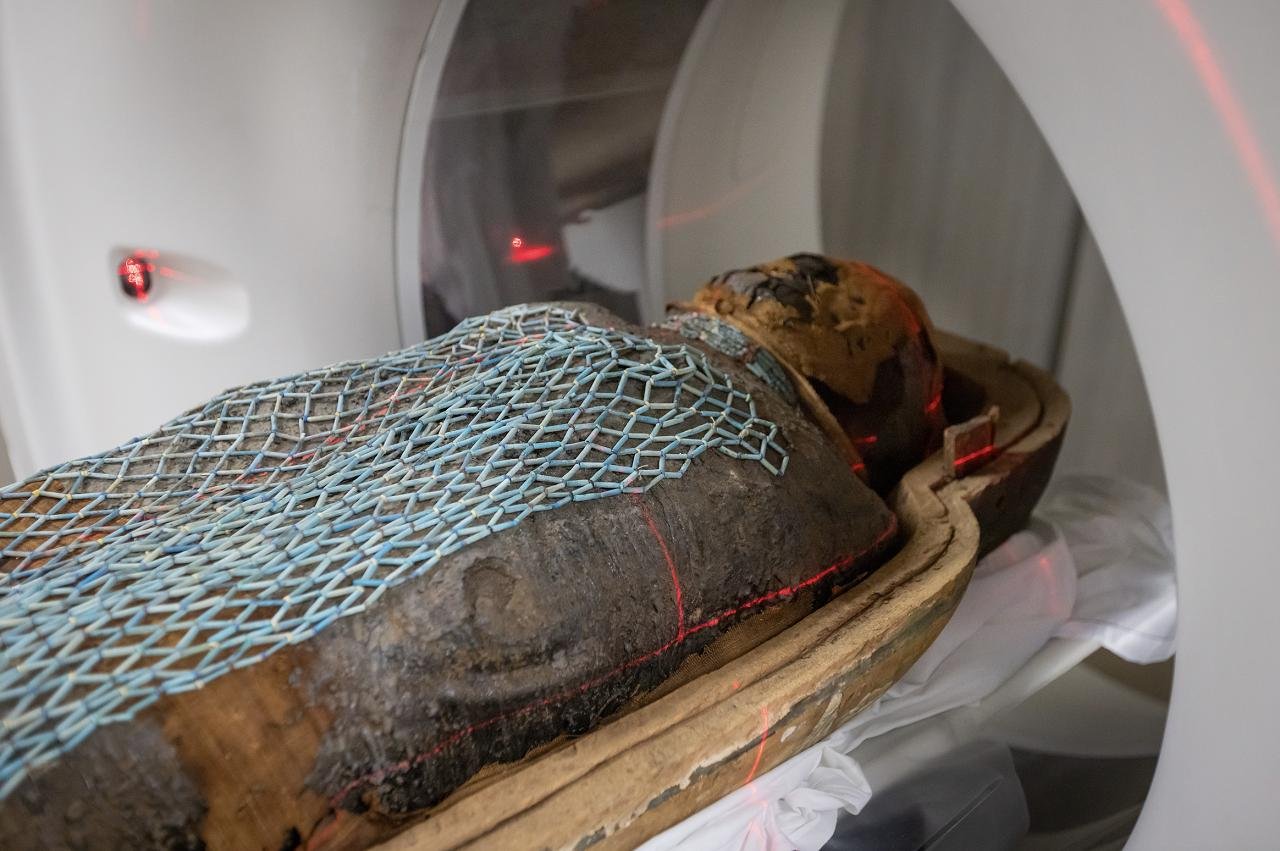
Radiologists at Keck Medicine of USC examined two ancient Egyptian mummies using high-resolution CT scanning, producing detailed views of bodies preserved for more than two millennia. The project focused on two priests, Nes Min from around 330 BCE and Nes Hor from around 190 BCE. Researchers scanned each body while it was still resting inside the lower half of a heavy sarcophagus weighing about 200 pounds.
CT scans of ancient Egyptian mummies reveal lifespans, health, and daily life of priests
Keck Medicine of USC radiologist scans ancient Egyptian mummy Nes-Min. Credit: Ricardo Carrasco III

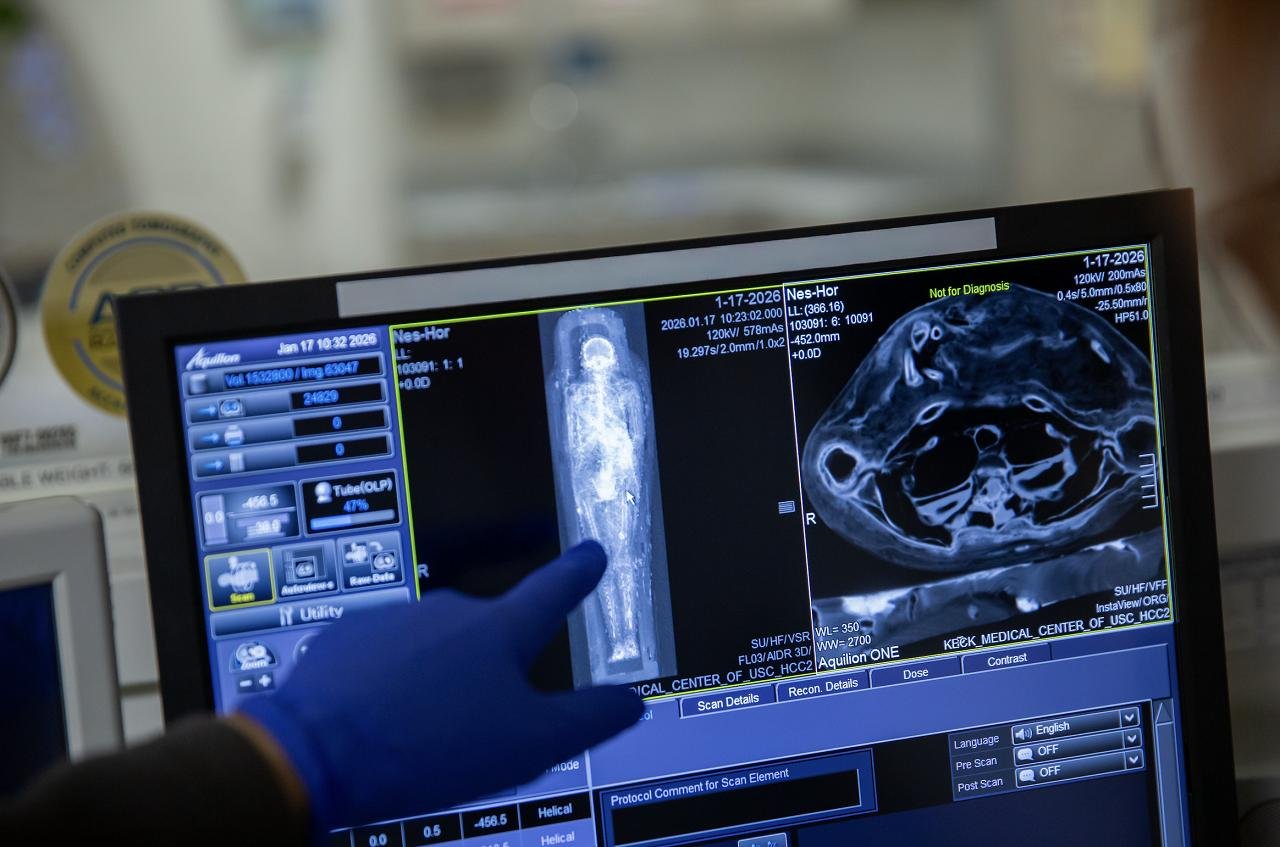
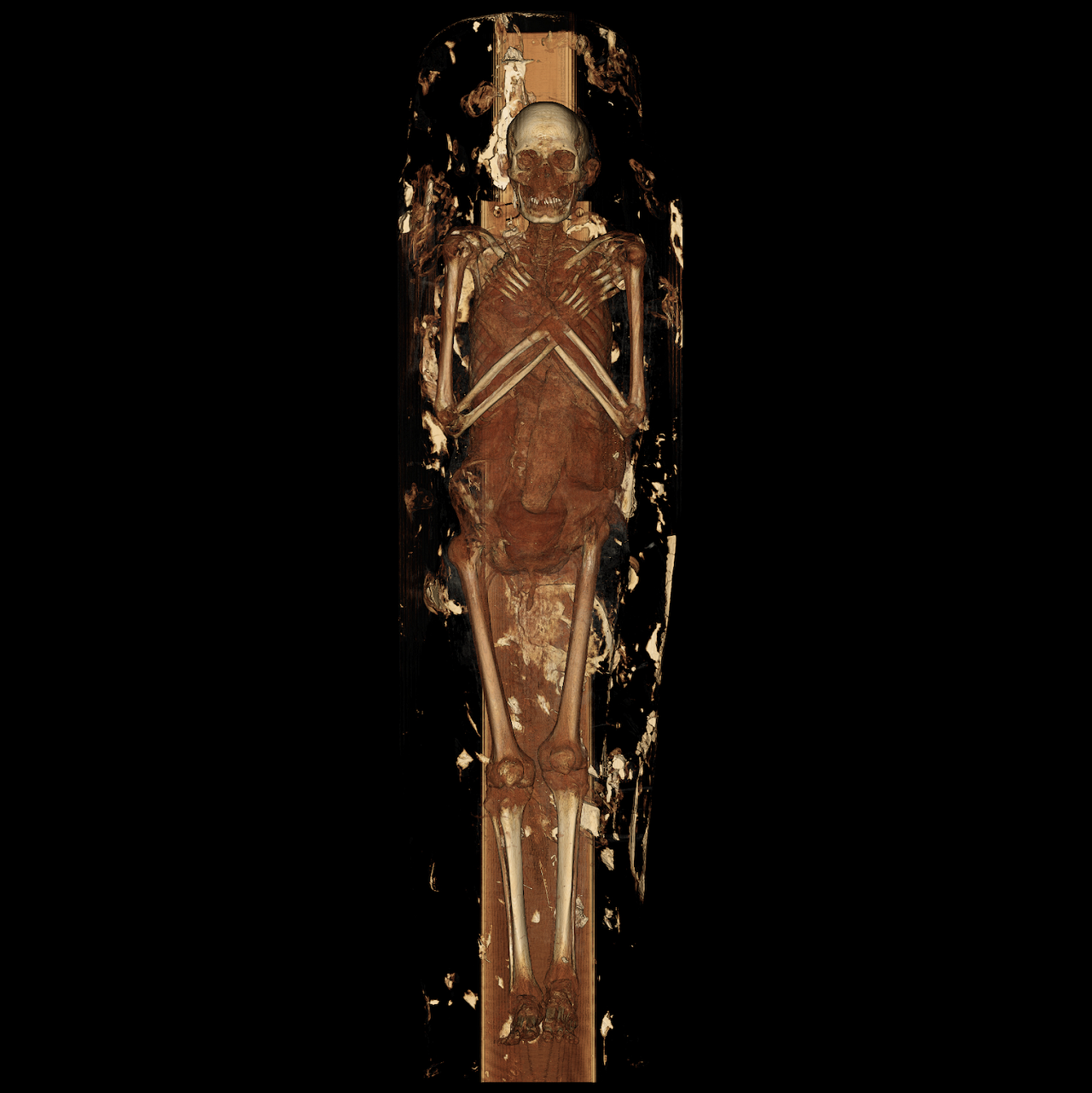
The scanner captured thin cross sections across the entire body. Specialists combined hundreds of slices into three-dimensional digital models. These models revealed fine physical details, including eyelids, lips, and bone structure in the face. Such features provided a clearer sense of individual appearance rather than that of a wrapped figure.

The scans also recorded signs of aging and disease. Nes Min showed damage in the lower spine. One lumbar vertebra had collapsed, a pattern linked with long-term strain and age-related wear. Modern clinics see similar degeneration in older adults with chronic back pain. Nes Hor displayed a different set of problems. Imaging showed advanced decay in several teeth and severe deterioration in one hip joint. Joint damage of this type often leads to limited movement and pain during walking. Bone condition suggested that Nes Hor reached an older age at death than Nes Min.

Burial objects appeared in the images as well. Nes Min rested with small items shaped like scarab beetles and a fish. These objects, placed within the wrappings, had stayed hidden from view for more than 2,000 years. CT data allowed for the measurement and study of those items without disturbing the mummy.
CT scans of ancient Egyptian mummies reveal lifespans, health, and daily life of priests
Ancient Egyptian mummy Nes-Hor is captured on screen during a full body CT scan by Keck Medicine of USC radiologists. Credit: Ricardo Carrasco III

After imaging, visualization experts built digital reconstructions of the skeletons and selected artifacts. The team then produced life-size prints of the skulls, spines, hips, and burial objects using medical-grade 3D printers. Visitors to an exhibition at the California Science Center will see those replicas alongside the mummies and digital displays. The exhibit opens February 7 and presents the material as part of Mummies of the World.


RelatedStories

CT scans reveal hidden details of 2,300-year-old Egyptian mummies

CT scans reveal hidden details of 2,300-year-old Egyptian mummies

April 26, 2026
Ramses II statue found in Egypt’s eastern Nile Delta shows ancient reuse of royal monuments

Ramses II statue found in Egypt’s eastern Nile Delta shows ancient reuse of royal monuments

April 24, 2026

The same imaging and printing workflow serves present-day medicine. Hospitals use CT or MRI scans to create digital 3D models of organs such as the liver, heart, or pelvis. Surgeons study these models before complex operations. Physical prints help with planning incisions, selecting implant sizes, and practicing difficult steps. Access to nearly two dozen printers at the USC Center for Innovation in Medical Visualization supports both clinical care and research projects like the mummy study.
CT scans of ancient Egyptian mummies reveal lifespans, health, and daily life of priests
A Keck Medicine of USC 3D digital model of Nes-Hor’s full body provides a clear view of his skeleton. Photo courtesy of Keck Medicine of USC

Holding a physical model also helps patients understand anatomy and planned procedures. Doctors report clearer discussions when a person handles a replica of a tumor or damaged joint. The mummy project shows how medical imaging tools designed for living patients also support research on ancient people. Detailed scans preserve fragile remains while still allowing close study of health, injury, and daily life in ancient Egypt.

More information: University of Southern California
Share510Tweet319Share89ShareSend

You May Also Like...

Ancient Roman shipwreck reveals hidden secrets of waterproofing and Mediterranean repairs
Archaeology

Ancient Roman shipwreck reveals hidden secrets of waterproofing and Mediterranean repairs

April 27, 2026
42 lost pages of Codex H recovered, revealing early New Testament structure and scribal practices
Archaeology

42 lost pages of Codex H recovered, revealing early New Testament structure and scribal practices

April 26, 2026
CT scans reveal hidden details of 2,300-year-old Egyptian mummies
Anthropology

CT scans reveal hidden details of 2,300-year-old Egyptian mummies

April 26, 2026
Rare 2,000-year-old Roman bread found at Vindonissa reveals early military life in Switzerland
Archaeology

Rare 2,000-year-old Roman bread found at Vindonissa reveals early military life in Switzerland

April 25, 2026
Over 1,000 archaeological features uncovered along Czech railway
Archaeology

Over 1,000 archaeological features uncovered along Czech railway

April 25, 2026
Ancient ship burial in Norway dates to CE 700, rewriting early Viking Age origins
Archaeology

Ancient ship burial in Norway dates to CE 700, rewriting early Viking Age origins

April 25, 2026

Comments 0

  1. Editorial Team says:
    1 second ago

    Disclaimer: This website is a science-focused magazine that welcomes both academic and non-academic audiences. Comments are written by users and may include personal opinions or unverified claims. They do not necessarily reflect the views of our editorial team or rely on scientific evidence.

    Comment Policy: We kindly ask all commenters to engage respectfully. Comments that contain offensive, insulting, degrading, discriminatory, or racist content will be automatically removed.

    Reply

Leave a Reply Cancel reply

Your email address will not be published. Required fields are marked *

Follow us


Instagram
244K

Facebook
118K

Threads
46K

LinkedIn
14K

Twitter
6K

YouTube
1K
  • Trending
  • Comments
  • Latest
Shipwreck Salvage. Credit: rawpixel.com / Public Domain

2,000-year-old shipwreck discovered off Turkish coast with remarkably preserved stacked ceramics

July 2, 2025
Viking age DNA reveals 9,000-year-old HIV-resistant gene originating near the Black Sea

Viking age DNA reveals 9,000-year-old HIV-resistant gene originating near the Black Sea

May 18, 2025
A new study suggests the mysterious Voynich Manuscript may be a medieval cipher

A new study suggests the mysterious Voynich Manuscript may be a medieval cipher

January 3, 2026
3D analysis reveals Shroud of Turin image likely came from sculpture, not Jesus’ body

3D analysis reveals Shroud of Turin image likely came from sculpture, not Jesus’ body

August 3, 2025
Moses may be named in ancient Egyptian mine inscriptions, sparking debate over earliest biblical references

Moses may be named in ancient Egyptian mine inscriptions, sparking debate over earliest biblical references

July 31, 2025
3D analysis reveals Shroud of Turin image likely came from sculpture, not Jesus’ body

3D analysis reveals Shroud of Turin image likely came from sculpture, not Jesus’ body

Moses may be named in ancient Egyptian mine inscriptions, sparking debate over earliest biblical references

Moses may be named in ancient Egyptian mine inscriptions, sparking debate over earliest biblical references

$1 million prize offered to decipher 5,300-year-old Indus Valley script

$1 million prize offered to decipher 5,300-year-old Indus Valley script

Oldest ever genetic data from a human relative found in 2-million-year-old fossilized teeth

Oldest ever genetic data from a human relative found in 2-million-year-old fossilized teeth

Exceptionally large Roman shoes discovered at Magna fort near Hadrian’s Wall

Exceptionally large Roman shoes discovered at Magna fort near Hadrian’s Wall

Ancient Roman shipwreck reveals hidden secrets of waterproofing and Mediterranean repairs

Ancient Roman shipwreck reveals hidden secrets of waterproofing and Mediterranean repairs

April 27, 2026
42 lost pages of Codex H recovered, revealing early New Testament structure and scribal practices

42 lost pages of Codex H recovered, revealing early New Testament structure and scribal practices

April 26, 2026
CT scans reveal hidden details of 2,300-year-old Egyptian mummies

CT scans reveal hidden details of 2,300-year-old Egyptian mummies

April 26, 2026
Rare 2,000-year-old Roman bread found at Vindonissa reveals early military life in Switzerland

Rare 2,000-year-old Roman bread found at Vindonissa reveals early military life in Switzerland

April 25, 2026
Over 1,000 archaeological features uncovered along Czech railway

Over 1,000 archaeological features uncovered along Czech railway

April 25, 2026

Archaeology News online magazine

Archaeology News is an international online magazine that covers all aspects of archaeology.


Categories

  • Academics
    • Books
    • Conferences
    • Universities
  • Articles
  • Download
  • Game
  • News
    • Anthropology
    • Archaeology
    • Paleontology
  • Quiz
  • Tours

Subscribe to our newsletter

© 2024 - Archaeology News Online Magazine. All Rights Reserved.

  • About
  • Privacy Policy
  • Terms of Use
  • Donation
  • Contact

Manage Consent
To provide the best experiences, we use technologies like cookies to store and/or access device information. Consenting to these technologies will allow us to process data such as browsing behavior or unique IDs on this site. Not consenting or withdrawing consent, may adversely affect certain features and functions.
Functional Always active
The technical storage or access is strictly necessary for the legitimate purpose of enabling the use of a specific service explicitly requested by the subscriber or user, or for the sole purpose of carrying out the transmission of a communication over an electronic communications network.
Preferences
The technical storage or access is necessary for the legitimate purpose of storing preferences that are not requested by the subscriber or user.
Statistics
The technical storage or access that is used exclusively for statistical purposes. The technical storage or access that is used exclusively for anonymous statistical purposes. Without a subpoena, voluntary compliance on the part of your Internet Service Provider, or additional records from a third party, information stored or retrieved for this purpose alone cannot usually be used to identify you.
Marketing
The technical storage or access is required to create user profiles to send advertising, or to track the user on a website or across several websites for similar marketing purposes.
  • Manage options
  • Manage services
  • Manage {vendor_count} vendors
  • Read more about these purposes
View preferences
  • {title}
  • {title}
  • {title}
  • Home
  • News
    • Archaeology
    • Anthropology
    • Paleontology
  • Academic
    • Books
    • Conferences
    • Universities
  • Articles
  • VR Tours
  • Quiz & Game
  • Download
  • Encyclopedia
  • Forum

About  .  Contact  .  Donation

© 2024 - Archaeology News Online Magazine. All Rights Reserved