• About
  • Privacy Policy
  • Terms of Use
  • Donation
  • Contact
No Result
View All Result
Archaeology News
  • Home
  • News
    • Archaeology
    • Anthropology
    • Paleontology
  • Academic
    • Books
    • Conferences
    • Universities
  • Articles
  • VR Tours
  • Quiz & Game
  • Download
  • Encyclopedia
  • Forum
Archaeology News
No Result
View All Result
Home News Archaeology

Archaeologists discover largest palaeolithic cave art site in Eastern Iberia

by Dario Radley
September 11, 2023

Archaeologists have uncovered a treasure trove of ancient Paleolithic cave art in the cave known as Cueva Dones, situated in Millares, Spain.

This remarkable find, which has been described as possibly the most important on the Eastern Iberian Coast and even in Europe, sheds light on the rich history of artistic expression during the Paleolithic period.

Cueva Dones, a cave initially discovered in 1821 when an earthquake exposed its entrance, has long been known to locals and has attracted hikers and explorers.

However, it wasn’t until June 2021 that researchers from the universities of Zaragoza and Alicante, in Spain, and their colleagues from the University of Southampton in the UK embarked on a systematic survey of the cave, uncovering a wealth of ancient art hidden within.
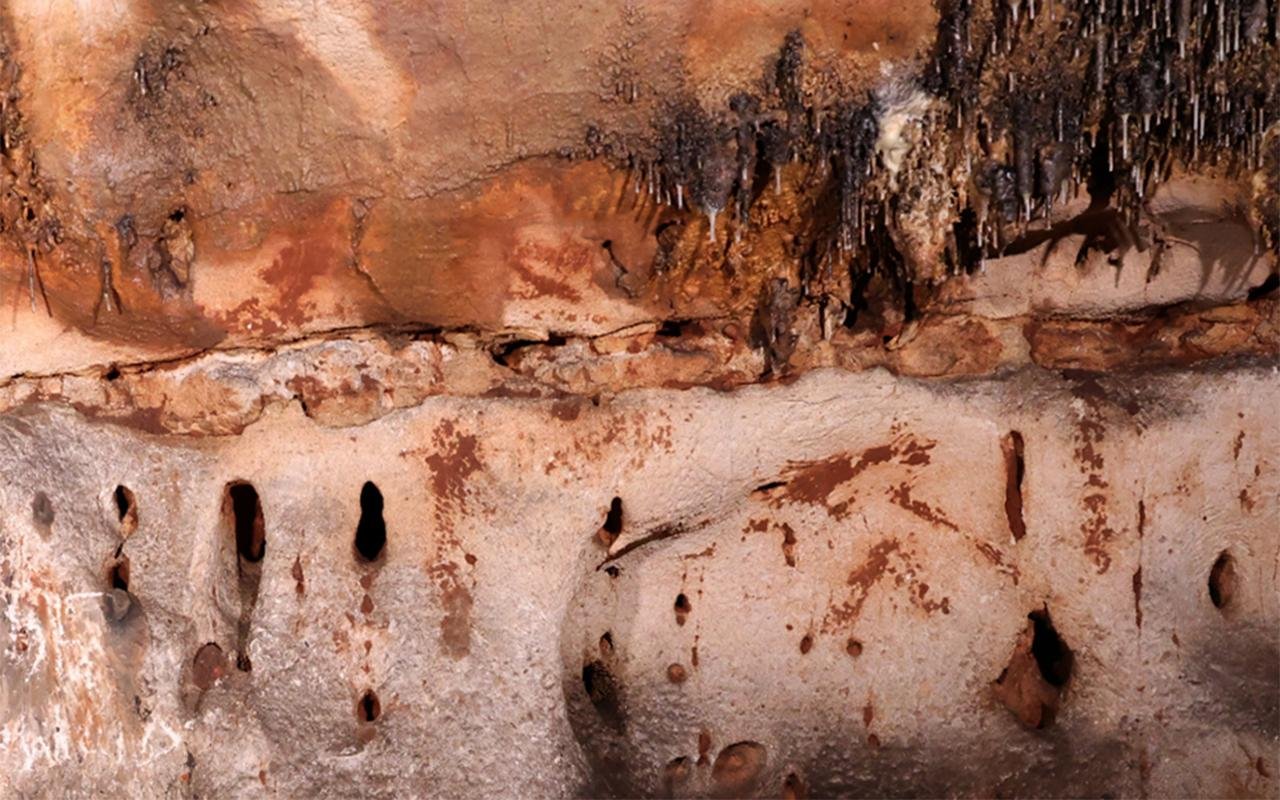
Archaeologists discover largest palaeolithic cave art site in Eastern Iberia
panel with several motifs painted with clay, including animals and signs (some partly covered by calcite layers). Credit: Aitor Ruiz-Redondo et al, Antiquity (2023)

In a recent publication in the journal Antiquity, the scientists detailed their findings, which reveal the existence of more than 100 parietal motifs, including paintings and engravings, dating back approximately 24,000 years to the Paleolithic era.
RelatedStories

40,000-year-old European engravings reveal structured sign systems, study finds

40,000-year-old European engravings reveal structured sign systems, study finds

February 25, 2026
New 3D digital analysis maps Paleolithic engravings at Cova Matutano

New 3D method maps Paleolithic engravings at Cova Matutano

February 8, 2026

This astounding collection of art in Cueva Dones is believed to represent the largest concentration of Paleolithic cave art in Eastern Iberia, and possibly in all of Europe, since the discovery at Atxurra in Bizkaia in 2015.

Among the 110 graphic units identified within the cave, there are at least 19 representations of animals, including horses, hinds (female red deer), aurochs, and stags. The rest of the art consists of various forms of conventional signs, such as rectangles and meanders, several panels of ‘macaroni’ or ‘flutings’ created with fingers or tools dragged across a soft surface, isolated lines, and poorly preserved unidentified paintings.

One of the most remarkable aspects of this discovery is the technique used in creating the majority of the paintings. Unlike most Paleolithic cave art, which is typically rendered using mineral pigments, these ancient artists utilized red clay found on the cave floor. This method, while known in Paleolithic art, is extremely rare, and examples of its usage or preservation are scarce.

The humid cave environment played a crucial role in preserving the clay-based paintings, allowing them to dry slowly and preventing the clay from falling off rapidly. Some parts of the art were even covered by calcite layers, which helped preserve them until today.

Dr. Aitor Ruiz-Redondo, a Senior Lecturer of Prehistory at the University of Zaragoza and a research affiliate at the University of Southampton, expressed the significance of this discovery, stating, “The Cueva Dones rock art is a key discovery in Mediterranean Paleolithic art. While the project is still in its early stages, preliminary results reveal an enormous potential for research at the site and establish this assemblage as arguably the most important for the eastern Iberian coast.”

The research team, led by Dr. Ruiz-Redondo and including Dr. Virginia Barciela-González, Senior Lecturer of Prehistory at the University of Alicante, and Dr. Ximo Martorell-Briz, a research affiliate at the University of Alicante, has meticulously documented the motifs found in Cueva Dones.

Their work has only scratched the surface, and there are still many areas to survey and panels to document, leaving open the possibility of even more significant discoveries in the future.
More information: Aitor Ruiz-Redondo et al, (2023), Cova Dones: a major Palaeolithic cave art site in eastern Iberia, Antiquity. DOI: 10.15184/aqy.2023.133
ShareTweetShareShareSend

You May Also Like...

Cut marks on 1.6-million-year-old bones reveal early humans moved and processed meat in Kenya
Anthropology

Cut marks on 1.6-million-year-old bones reveal early humans moved and processed meat in Kenya

May 13, 2026
280 ancient stone burial monuments found in Sudan reveal lost cattle-herding culture in the Sahara
Archaeology

280 ancient stone burial monuments found in Sudan reveal lost cattle-herding culture in the Sahara

May 13, 2026
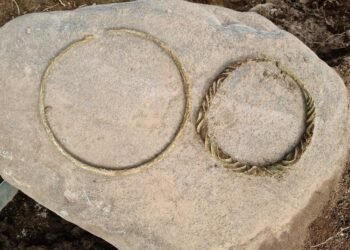
Rare Bronze Age burial in Sweden reveals unusual pair of Wendel neck rings and complex ritual landscape near Norrköping
Archaeology

Rare Bronze Age burial in Sweden reveals unusual pair of Wendel neck rings and complex ritual landscape near Norrköping

May 12, 2026
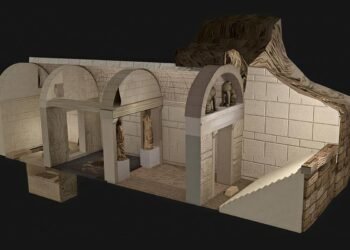
Kasta Tomb in Amphipolis fully revealed as restoration uncovers largest burial mound in Macedonia
Archaeology

Kasta Tomb in Amphipolis fully revealed as restoration uncovers largest burial mound in Macedonia

May 12, 2026
Rare Roman villa threatened by farming damage reveals rare mosaic and bathhouse remains in Devon
Archaeology

Rare Roman villa threatened by farming damage reveals rare mosaic and bathhouse remains in Devon

May 12, 2026
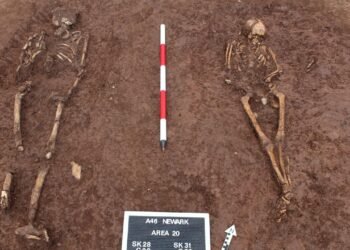
Ancient burials, Roman well, and Anglo-Saxon house uncovered during A46 Newark bypass excavations
Anthropology

Ancient burials, Roman well, and Anglo-Saxon house uncovered during A46 Newark bypass excavations

May 12, 2026

Follow us


Instagram
242K

Facebook
117K

Threads
46K

LinkedIn
14K

Twitter
6K

YouTube
1K
  • Trending
  • Comments
  • Latest
Shipwreck Salvage. Credit: rawpixel.com / Public Domain

2,000-year-old shipwreck discovered off Turkish coast with remarkably preserved stacked ceramics

July 2, 2025
A new study suggests the mysterious Voynich Manuscript may be a medieval cipher

A new study suggests the mysterious Voynich Manuscript may be a medieval cipher

January 3, 2026
Viking age DNA reveals 9,000-year-old HIV-resistant gene originating near the Black Sea

Viking age DNA reveals 9,000-year-old HIV-resistant gene originating near the Black Sea

May 18, 2025
3D analysis reveals Shroud of Turin image likely came from sculpture, not Jesus’ body

3D analysis reveals Shroud of Turin image likely came from sculpture, not Jesus’ body

August 3, 2025
Moses may be named in ancient Egyptian mine inscriptions, sparking debate over earliest biblical references

Moses may be named in ancient Egyptian mine inscriptions, sparking debate over earliest biblical references

July 31, 2025
3D analysis reveals Shroud of Turin image likely came from sculpture, not Jesus’ body

3D analysis reveals Shroud of Turin image likely came from sculpture, not Jesus’ body

Moses may be named in ancient Egyptian mine inscriptions, sparking debate over earliest biblical references

Moses may be named in ancient Egyptian mine inscriptions, sparking debate over earliest biblical references

$1 million prize offered to decipher 5,300-year-old Indus Valley script

$1 million prize offered to decipher 5,300-year-old Indus Valley script

Oldest ever genetic data from a human relative found in 2-million-year-old fossilized teeth

Oldest ever genetic data from a human relative found in 2-million-year-old fossilized teeth

Exceptionally large Roman shoes discovered at Magna fort near Hadrian’s Wall

Exceptionally large Roman shoes discovered at Magna fort near Hadrian’s Wall

Cut marks on 1.6-million-year-old bones reveal early humans moved and processed meat in Kenya

Cut marks on 1.6-million-year-old bones reveal early humans moved and processed meat in Kenya

May 13, 2026
280 ancient stone burial monuments found in Sudan reveal lost cattle-herding culture in the Sahara

280 ancient stone burial monuments found in Sudan reveal lost cattle-herding culture in the Sahara

May 13, 2026
Rare Bronze Age burial in Sweden reveals unusual pair of Wendel neck rings and complex ritual landscape near Norrköping

Rare Bronze Age burial in Sweden reveals unusual pair of Wendel neck rings and complex ritual landscape near Norrköping

May 12, 2026
Kasta Tomb in Amphipolis fully revealed as restoration uncovers largest burial mound in Macedonia

Kasta Tomb in Amphipolis fully revealed as restoration uncovers largest burial mound in Macedonia

May 12, 2026
Rare Roman villa threatened by farming damage reveals rare mosaic and bathhouse remains in Devon

Rare Roman villa threatened by farming damage reveals rare mosaic and bathhouse remains in Devon

May 12, 2026

Archaeology News online magazine

Archaeology News is an international online magazine that covers all aspects of archaeology.


Categories

  • Academics
    • Books
    • Conferences
    • Universities
  • Articles
  • Download
  • Game
  • News
    • Anthropology
    • Archaeology
    • Paleontology
  • Quiz
  • Tours

Subscribe to our newsletter

© 2024 - Archaeology News Online Magazine. All Rights Reserved.

  • About
  • Privacy Policy
  • Terms of Use
  • Donation
  • Contact

Manage Consent
To provide the best experiences, we use technologies like cookies to store and/or access device information. Consenting to these technologies will allow us to process data such as browsing behavior or unique IDs on this site. Not consenting or withdrawing consent, may adversely affect certain features and functions.
Functional Always active
The technical storage or access is strictly necessary for the legitimate purpose of enabling the use of a specific service explicitly requested by the subscriber or user, or for the sole purpose of carrying out the transmission of a communication over an electronic communications network.
Preferences
The technical storage or access is necessary for the legitimate purpose of storing preferences that are not requested by the subscriber or user.
Statistics
The technical storage or access that is used exclusively for statistical purposes. The technical storage or access that is used exclusively for anonymous statistical purposes. Without a subpoena, voluntary compliance on the part of your Internet Service Provider, or additional records from a third party, information stored or retrieved for this purpose alone cannot usually be used to identify you.
Marketing
The technical storage or access is required to create user profiles to send advertising, or to track the user on a website or across several websites for similar marketing purposes.
  • Manage options
  • Manage services
  • Manage {vendor_count} vendors
  • Read more about these purposes
View preferences
  • {title}
  • {title}
  • {title}
  • Home
  • News
    • Archaeology
    • Anthropology
    • Paleontology
  • Academic
    • Books
    • Conferences
    • Universities
  • Articles
  • VR Tours
  • Quiz & Game
  • Download
  • Encyclopedia
  • Forum

About  .  Contact  .  Donation

© 2024 - Archaeology News Online Magazine. All Rights Reserved