• About
  • Privacy Policy
  • Terms of Use
  • Donation
  • Contact
No Result
View All Result
Archaeology News
  • Home
  • News
    • Archaeology
    • Anthropology
    • Paleontology
  • Academics
    • Books
    • Conferences
    • Universities
  • Articles
  • VR Tours
  • Quiz & Game
  • Download
  • Encyclopedia
  • Forum
Archaeology News
No Result
View All Result
Home News Archaeology

Ancient Romans were pioneers of recycling, study reveals

by Dario Radley
October 21, 2023

Recent research conducted by experts from the University of Liverpool and the University of Warwick has unveiled the remarkable recycling practices of the ancient Romans, shedding light on their environmental consciousness.

The study, published in the journal “Archaeological and Anthropological Sciences,” provides intriguing insights into how the Romans ingeniously recycled silver to produce their coins, utilizing two primary clues: gold impurities in silver coins and pollution patterns in Greenland ice.

When silver was extracted from ores and refined at mints, it resulted in significant lead pollution. This pollution, with its far-reaching effects, even crossed the Atlantic Ocean, leaving behind a distinctive “pollution fingerprint” in Greenland’s ice. Despite continued coin production during the late Roman Republic, there was a notable decline in lead pollution levels within the ice.
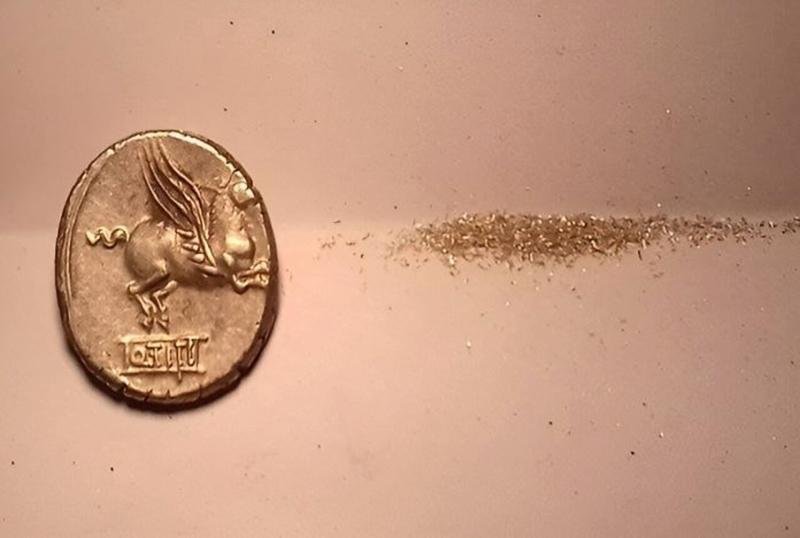
Ancient Romans were pioneers of recycling, study reveals
Sampling a Roman Republican denarius for chemical analysis. Credit: University of Liverpool

The likely explanation for this drop in pollution levels can be traced back to the tumultuous period of the first and second centuries BCE when Rome faced interruptions in its access to silver mines in regions like Iberia (modern-day Spain) and southern France. While it’s true that the Romans intentionally adulterated their predominant silver coin, the denarius, with copper, indicating reduced silver production, this alteration alone doesn’t entirely account for the reduction in lead pollution.

The researchers of this study, Dr. Jonathan Wood and Dr. Matthew Ponting, attribute the Romans’ ability to recycle silver as the key factor. They frequently sourced silver through the recycling of spoils acquired after conflicts in Iberia and southern France for coin production.


RelatedStories

Carthaginian bronze coins seized in Norway highlight ancient trade and modern heritage challenges

Carthaginian bronze coins seized in Norway highlight ancient trade and modern heritage challenges

October 31, 2025
Oldest coin ever found in Saxony: 2,200-year-old Celtic gold “Rainbow Cup” unearthed near Leipzig

Oldest coin ever found in Saxony: 2,200-year-old Celtic gold “Rainbow Cup” unearthed near Leipzig

October 31, 2025

The study provides a timeline of silver’s transformation as an indication of recycling practices. Around 120 BCE, clusters of coins began to appear with notably low levels of gold content. This silver later reappeared in coins from the first half of the first century BCE. In 49 BCE, a sudden influx of silver with high gold content entered circulation, coinciding with Julius Caesar’s return to Rome from his conquests against the Gauls. Researchers speculate that this new silver, rich in gold, was plundered by Caesar’s army.

Dr. Jonathan Wood emphasized, “Debasing silver was one way to cope with fluctuations in the silver supply. Melting down existing silver, whether your own or someone else’s, was another. For the Romans, recycling coins would have been considerably less expensive than extracting new silver, providing financial and environmental benefits.”

This discovery is a part of a larger effort to comprehend how the Romans harnessed currency as a tool for expanding their empire. It underscores the Romans’ resourcefulness, exemplifying how recycling, much like modern practices, not only benefits the environment but also proves cost-effective.

The study represents an important contribution to our understanding of ancient recycling practices, emphasizing the Romans’ pioneering role in an early form of recycling that was both economically savvy and ecologically responsible.
More information: Wood, J.R., Ponting, M. & Butcher, K. (2023). Crisis? What crisis? Recycling of silver for Roman Republican coinage. Archaeol Anthropol Sci 15, 147. https://doi.org/10.1007/s12520-023-01854-w
Share2Tweet1ShareShareSend

You May Also Like...

Misread medieval tale misled generations of historians about the Black Death's spread, study finds
Archaeology

Misread medieval tale misled generations of historians about the Black Death’s spread, study finds

November 7, 2025
Signatures meant more in Mesopotamia than they do now − what cylinder seals say about ancient and modern life
Archaeology

Signatures meant more in Mesopotamia than they do now − what cylinder seals say about ancient and modern life

November 7, 2025
Daily life uncovered in Hellenistic military settlement at Pyla-Vigla, Cyprus
Archaeology

New discoveries reveal daily life in a Hellenistic military settlement at Pyla-Vigla, Cyprus

November 7, 2025
Viking treasures unearthed in Sweden reveal a society in transition
Archaeology

Viking treasures unearthed in Sweden reveal a society in transition

November 6, 2025
Archaeologists unearth 5,000-year-old winepress and Canaanite ritual artifacts near Tel Megiddo
Archaeology

Archaeologists unearth 5,000-year-old winepress and Canaanite ritual artifacts near Tel Megiddo

November 5, 2025
5,000-year-old monumental building in Iraq reveals ties to the world’s first cities
Archaeology

5,000-year-old monumental building in Iraq reveals ties to the world’s first cities

November 3, 2025

Follow us


Instagram
245K

Facebook
117K

Threads
45K

LinkedIn
14K

Twitter
6K

YouTube
1K
  • Trending
  • Comments
  • Latest
Shipwreck Salvage. Credit: rawpixel.com / Public Domain

2,000-year-old shipwreck discovered off Turkish coast with remarkably preserved stacked ceramics

July 2, 2025
Viking age DNA reveals 9,000-year-old HIV-resistant gene originating near the Black Sea

Viking age DNA reveals 9,000-year-old HIV-resistant gene originating near the Black Sea

May 18, 2025
Complete copy of the Canopus Decree unearthed in Egypt after 150 years

Complete copy of the Canopus Decree unearthed in Egypt after 150 years

September 13, 2025
Mystery of Armenia’s 6,000-year-old dragon stones solved

Mystery of Armenia’s 6,000-year-old dragon stones solved

September 23, 2025
Moses may be named in ancient Egyptian mine inscriptions, sparking debate over earliest biblical references

Moses may be named in ancient Egyptian mine inscriptions, sparking debate over earliest biblical references

July 31, 2025
Moses may be named in ancient Egyptian mine inscriptions, sparking debate over earliest biblical references

Moses may be named in ancient Egyptian mine inscriptions, sparking debate over earliest biblical references

3D analysis reveals Shroud of Turin image likely came from sculpture, not Jesus’ body

3D analysis reveals Shroud of Turin image likely came from sculpture, not Jesus’ body

$1 million prize offered to decipher 5,300-year-old Indus Valley script

$1 million prize offered to decipher 5,300-year-old Indus Valley script

Oldest ever genetic data from a human relative found in 2-million-year-old fossilized teeth

Oldest ever genetic data from a human relative found in 2-million-year-old fossilized teeth

Exceptionally large Roman shoes discovered at Magna fort near Hadrian’s Wall

Exceptionally large Roman shoes discovered at Magna fort near Hadrian’s Wall

Misread medieval tale misled generations of historians about the Black Death's spread, study finds

Misread medieval tale misled generations of historians about the Black Death’s spread, study finds

November 7, 2025
Signatures meant more in Mesopotamia than they do now − what cylinder seals say about ancient and modern life

Signatures meant more in Mesopotamia than they do now − what cylinder seals say about ancient and modern life

November 7, 2025
Daily life uncovered in Hellenistic military settlement at Pyla-Vigla, Cyprus

New discoveries reveal daily life in a Hellenistic military settlement at Pyla-Vigla, Cyprus

November 7, 2025
Viking treasures unearthed in Sweden reveal a society in transition

Viking treasures unearthed in Sweden reveal a society in transition

November 6, 2025
Archaeologists unearth 5,000-year-old winepress and Canaanite ritual artifacts near Tel Megiddo

Archaeologists unearth 5,000-year-old winepress and Canaanite ritual artifacts near Tel Megiddo

November 5, 2025

Archaeology News online magazine

Archaeology News is an international online magazine that covers all aspects of archaeology.


Categories

  • Academics
    • Books
    • Conferences
    • Universities
  • Articles
  • Download
  • Game
  • News
    • Anthropology
    • Archaeology
    • Paleontology
  • Quiz
  • Tours

Subscribe to our newsletter

© 2024 - Archaeology News Online Magazine. All Rights Reserved.

  • About
  • Privacy Policy
  • Terms of Use
  • Donation
  • Contact

Welcome Back!

Login to your account below

Forgotten Password? Sign Up

Create New Account!

Fill the forms below to register

All fields are required. Log In

Retrieve your password

Please enter your username or email address to reset your password.

Log In

Add New Playlist

Manage Consent
To provide the best experiences, we use technologies like cookies to store and/or access device information. Consenting to these technologies will allow us to process data such as browsing behavior or unique IDs on this site. Not consenting or withdrawing consent, may adversely affect certain features and functions.
Functional Always active
The technical storage or access is strictly necessary for the legitimate purpose of enabling the use of a specific service explicitly requested by the subscriber or user, or for the sole purpose of carrying out the transmission of a communication over an electronic communications network.
Preferences
The technical storage or access is necessary for the legitimate purpose of storing preferences that are not requested by the subscriber or user.
Statistics
The technical storage or access that is used exclusively for statistical purposes. The technical storage or access that is used exclusively for anonymous statistical purposes. Without a subpoena, voluntary compliance on the part of your Internet Service Provider, or additional records from a third party, information stored or retrieved for this purpose alone cannot usually be used to identify you.
Marketing
The technical storage or access is required to create user profiles to send advertising, or to track the user on a website or across several websites for similar marketing purposes.
Manage options Manage services Manage {vendor_count} vendors Read more about these purposes
View preferences
{title} {title} {title}
  • Home
  • News
    • Archaeology
    • Anthropology
    • Paleontology
  • Academics
    • Books
    • Conferences
    • Universities
  • Articles
  • VR Tours
  • Quiz & Game
  • Download
  • Encyclopedia
  • Forum

About  .  Contact  .  Donation

© 2024 - Archaeology News Online Magazine. All Rights Reserved