• About
  • Privacy Policy
  • Terms of Use
  • Donation
  • Contact
No Result
View All Result
Archaeology News
  • Home
  • News
    • Archaeology
    • Anthropology
    • Paleontology
  • Academic
    • Books
    • Conferences
    • Universities
  • Articles
  • VR Tours
  • Quiz & Game
  • Download
  • Encyclopedia
  • Forum
Archaeology News
No Result
View All Result
Home News Archaeology

Ancient fortifications discovered in Bronze Age village on Ustica island

by Dario Radley
January 16, 2024

Archaeologists have uncovered a sophisticated fortification system beneath the Bronze Age village of Villaggio dei Faraglioni on Ustica, a small island north of Sicily.
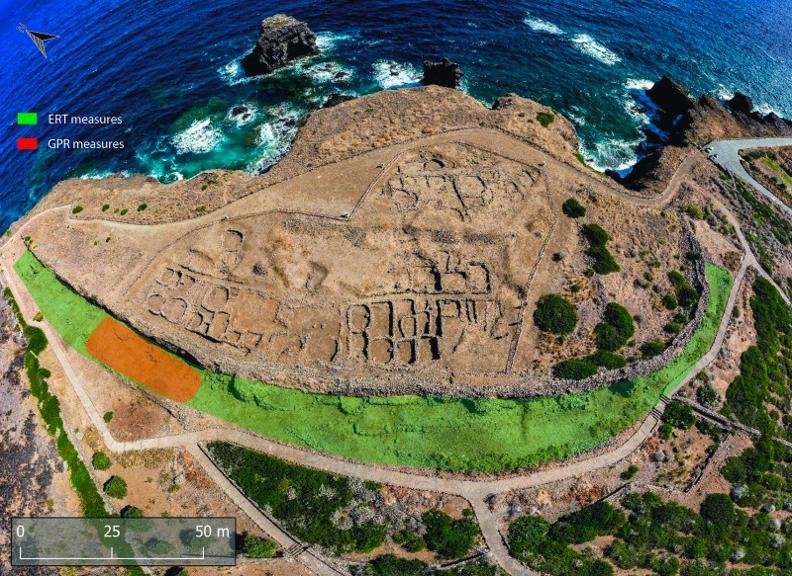
Ancient fortifications discovered in Bronze Age village on Ustica island
An aerial view of Villaggio dei Faraglioni, a Bronze Age settlement located on Ustica island in Italy. Credit: V. Ambrosanio, INGV

The discovery, detailed in a study published in the Journal of Applied Geophysics, offers valuable information about the defensive structures of this ancient settlement, known for its orderly urban plan and considered one of the best-preserved Mediterranean settlements of its time.

The settlement, thriving between 1400 and 1200 BCE, boasts an organized layout featuring huts and narrow roadways along the island’s northern edge. What sets this discovery apart is the identification of a hidden arc-shaped stone fortification system measuring an impressive 820 feet (250 meters) in length and standing 13 to 16 feet (4 to 5 meters) tall. This mighty wall, discovered using ground-penetrating radar and electrical resistivity tomography, acted as the settlement’s primary defensive barrier.

Vincenzo Sapia, an applied geophysicist with Italy’s National Institute of Geophysics and Volcanology (INGV), said: “Thanks to [the instruments], it was possible to locate accurately and in a totally non-invasive way the deep foundations of the [structure] as long as the wall, which performed the functions of the first defensive barrier.”

Ancient fortifications discovered in Bronze Age village on Ustica island
Ruins of prehistoric houses close to the stone wall that surrounds the Middle Bronze Age Village in Ustica. Credit: INGV

The research, a collaborative effort involving the INGV, the Archaeological Park of Himera, Solunto, and Iato, the University of Studies Suor Orsola Benincasa in Naples, the Villaggio Letterario Association of Ustica, the Laboratory Museum of Earth Sciences of Ustica (LABMUST), the University of Studies of Siena, the Department of Mathematics and Geosciences of the University of Trieste, and the Ministry of Culture, brought together experts in various fields. Their multidisciplinary approach aimed to study semi-buried structures outside the defensive wall without invasive excavation.

RelatedStories

Over 1,000 archaeological features uncovered along Czech railway

Over 1,000 archaeological features uncovered along Czech railway

April 25, 2026
Late Bronze Age bronze ring hoard near Dresden reveals ritual practices and social life 1300–1100 BCE

Late Bronze Age bronze ring hoard near Dresden reveals ritual practices and social life 1300–1100 BCE

April 21, 2026

Domenico Targia, director of the Archaeological Park of Himera, Solunto, and Iato, highlighted the village’s significance, describing it as “one of the best-preserved Mediterranean settlements of its time.” The village’s coastal stretch featured dozens of huts, narrow streets, and the imposing 250-meter-long, 4 to 5 meters high defensive wall encircling the settlement to safeguard against attacks and raids.

The recent findings reveal the advanced defensive architecture of the Bronze Age. The external wall, detected through geophysical investigations, complements the still-standing fortified wall on the inland edge of the village. The internal wall, with an arched fish hook-like curve, connected directly to the huts. The newly discovered external wall, positioned approximately 6 meters from the inner wall, showcases an articulated and sophisticated defensive system.
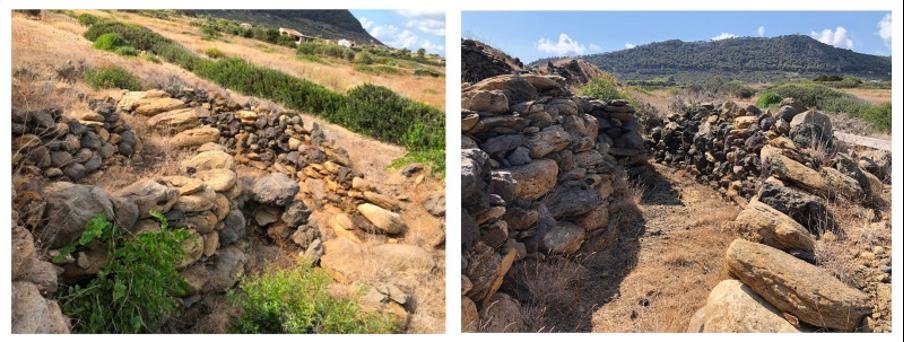
Ancient fortifications discovered in Bronze Age village on Ustica island
Left) external structure and right) internal structure of Tower No. 12. Credit: INGV

Franco Foresta Martin, director of the Laboratory Museum of Earth Sciences of Ustica, said: “Our discovery opens a new window on understanding this ancient village, suggesting a defensive complexity beyond expectations.” Geophysical technology played a crucial role, allowing researchers to unveil hidden layers of history without invasive excavation.

The research campaign not only emphasized the defensive function of the discovered structures but also highlighted their role in delineating the village’s borders and contributing to its social structure. The defensive system served as both protection and a marker, enriching our understanding of Bronze Age defensive architecture and societal organization in the Mediterranean.

Ancient fortifications discovered in Bronze Age village on Ustica island
The island of Ustica (Sicily, Italy) with the indication of the main hills and plains. The colored points mark the phases of the main prehistoric settlements. Credit: INGV

Sandro de Vita, an INGV researcher, underscored the study’s multidisciplinary nature, demonstrating the effectiveness of non-invasive methods in guiding further direct investigations. The application of geophysical prospecting techniques, including electrical resistivity tomography and ground-penetrating radar, proved highly satisfactory, offering precise information about the buried structures without the need for costly and time-consuming excavation operations.


More information: Anna Russolillo, Franco Foresta Martin, et al. (2024). Unveiling a hidden fortification system at “Faraglioni” Middle Bronze Age Village of Ustica Island (Palermo, Italy) through ERT and GPR prospections, Journal of Applied Geophysics, Volume 220, 2024, 105272, doi.org/10.1016/j.jappgeo.2023.105272
Share2Tweet2ShareShareSend

You May Also Like...

Ancient Roman shipwreck reveals hidden secrets of waterproofing and Mediterranean repairs
Archaeology

Ancient Roman shipwreck reveals hidden secrets of waterproofing and Mediterranean repairs

April 27, 2026
42 lost pages of Codex H recovered, revealing early New Testament structure and scribal practices
Archaeology

42 lost pages of Codex H recovered, revealing early New Testament structure and scribal practices

April 26, 2026
CT scans reveal hidden details of 2,300-year-old Egyptian mummies
Anthropology

CT scans reveal hidden details of 2,300-year-old Egyptian mummies

April 26, 2026
Rare 2,000-year-old Roman bread found at Vindonissa reveals early military life in Switzerland
Archaeology

Rare 2,000-year-old Roman bread found at Vindonissa reveals early military life in Switzerland

April 25, 2026
Over 1,000 archaeological features uncovered along Czech railway
Archaeology

Over 1,000 archaeological features uncovered along Czech railway

April 25, 2026
Ancient ship burial in Norway dates to CE 700, rewriting early Viking Age origins
Archaeology

Ancient ship burial in Norway dates to CE 700, rewriting early Viking Age origins

April 25, 2026

Comments 2

  1. Editorial Team says:
    1 second ago

    Disclaimer: This website is a science-focused magazine that welcomes both academic and non-academic audiences. Comments are written by users and may include personal opinions or unverified claims. They do not necessarily reflect the views of our editorial team or rely on scientific evidence.

    Comment Policy: We kindly ask all commenters to engage respectfully. Comments that contain offensive, insulting, degrading, discriminatory, or racist content will be automatically removed.

  2. Jane F Taylor says:
    2 years ago

    I can never remember how to realize the calculation of “BCE”. Is it beyond BC or after AD?

    • Archaeology News says:
      2 years ago

      To obtain complete information on this matter, please watch the video titled “BC vs AD, BCE vs CE; What’s the difference?” on our YouTube channel.
      The address of our YouTube channel is: https://www.youtube.com/@archaeologymag

Follow us


Instagram
244K

Facebook
118K

Threads
46K

LinkedIn
14K

Twitter
6K

YouTube
1K
  • Trending
  • Comments
  • Latest
Shipwreck Salvage. Credit: rawpixel.com / Public Domain

2,000-year-old shipwreck discovered off Turkish coast with remarkably preserved stacked ceramics

July 2, 2025
Viking age DNA reveals 9,000-year-old HIV-resistant gene originating near the Black Sea

Viking age DNA reveals 9,000-year-old HIV-resistant gene originating near the Black Sea

May 18, 2025
A new study suggests the mysterious Voynich Manuscript may be a medieval cipher

A new study suggests the mysterious Voynich Manuscript may be a medieval cipher

January 3, 2026
3D analysis reveals Shroud of Turin image likely came from sculpture, not Jesus’ body

3D analysis reveals Shroud of Turin image likely came from sculpture, not Jesus’ body

August 3, 2025
Moses may be named in ancient Egyptian mine inscriptions, sparking debate over earliest biblical references

Moses may be named in ancient Egyptian mine inscriptions, sparking debate over earliest biblical references

July 31, 2025
3D analysis reveals Shroud of Turin image likely came from sculpture, not Jesus’ body

3D analysis reveals Shroud of Turin image likely came from sculpture, not Jesus’ body

Moses may be named in ancient Egyptian mine inscriptions, sparking debate over earliest biblical references

Moses may be named in ancient Egyptian mine inscriptions, sparking debate over earliest biblical references

$1 million prize offered to decipher 5,300-year-old Indus Valley script

$1 million prize offered to decipher 5,300-year-old Indus Valley script

Oldest ever genetic data from a human relative found in 2-million-year-old fossilized teeth

Oldest ever genetic data from a human relative found in 2-million-year-old fossilized teeth

Exceptionally large Roman shoes discovered at Magna fort near Hadrian’s Wall

Exceptionally large Roman shoes discovered at Magna fort near Hadrian’s Wall

Ancient Roman shipwreck reveals hidden secrets of waterproofing and Mediterranean repairs

Ancient Roman shipwreck reveals hidden secrets of waterproofing and Mediterranean repairs

April 27, 2026
42 lost pages of Codex H recovered, revealing early New Testament structure and scribal practices

42 lost pages of Codex H recovered, revealing early New Testament structure and scribal practices

April 26, 2026
CT scans reveal hidden details of 2,300-year-old Egyptian mummies

CT scans reveal hidden details of 2,300-year-old Egyptian mummies

April 26, 2026
Rare 2,000-year-old Roman bread found at Vindonissa reveals early military life in Switzerland

Rare 2,000-year-old Roman bread found at Vindonissa reveals early military life in Switzerland

April 25, 2026
Over 1,000 archaeological features uncovered along Czech railway

Over 1,000 archaeological features uncovered along Czech railway

April 25, 2026

Archaeology News online magazine

Archaeology News is an international online magazine that covers all aspects of archaeology.


Categories

  • Academics
    • Books
    • Conferences
    • Universities
  • Articles
  • Download
  • Game
  • News
    • Anthropology
    • Archaeology
    • Paleontology
  • Quiz
  • Tours

Subscribe to our newsletter

© 2024 - Archaeology News Online Magazine. All Rights Reserved.

  • About
  • Privacy Policy
  • Terms of Use
  • Donation
  • Contact

Manage Consent
To provide the best experiences, we use technologies like cookies to store and/or access device information. Consenting to these technologies will allow us to process data such as browsing behavior or unique IDs on this site. Not consenting or withdrawing consent, may adversely affect certain features and functions.
Functional Always active
The technical storage or access is strictly necessary for the legitimate purpose of enabling the use of a specific service explicitly requested by the subscriber or user, or for the sole purpose of carrying out the transmission of a communication over an electronic communications network.
Preferences
The technical storage or access is necessary for the legitimate purpose of storing preferences that are not requested by the subscriber or user.
Statistics
The technical storage or access that is used exclusively for statistical purposes. The technical storage or access that is used exclusively for anonymous statistical purposes. Without a subpoena, voluntary compliance on the part of your Internet Service Provider, or additional records from a third party, information stored or retrieved for this purpose alone cannot usually be used to identify you.
Marketing
The technical storage or access is required to create user profiles to send advertising, or to track the user on a website or across several websites for similar marketing purposes.
  • Manage options
  • Manage services
  • Manage {vendor_count} vendors
  • Read more about these purposes
View preferences
  • {title}
  • {title}
  • {title}
  • Home
  • News
    • Archaeology
    • Anthropology
    • Paleontology
  • Academic
    • Books
    • Conferences
    • Universities
  • Articles
  • VR Tours
  • Quiz & Game
  • Download
  • Encyclopedia
  • Forum

About  .  Contact  .  Donation

© 2024 - Archaeology News Online Magazine. All Rights Reserved