• About
  • Privacy Policy
  • Terms of Use
  • Donation
  • Contact
No Result
View All Result
Archaeology News
  • Home
  • News
    • Archaeology
    • Anthropology
    • Paleontology
  • Academic
    • Books
    • Conferences
    • Universities
  • Articles
  • VR Tours
  • Quiz & Game
  • Download
  • Encyclopedia
  • Forum
Archaeology News
No Result
View All Result
Home News Archaeology

Giant armadillo fossil reveals early human presence in Argentina 21,000 years ago

by Dario Radley
July 17, 2024

Recent research reveals that ancient humans may have butchered a giant armadillo-like creature around 21,000 years ago in what is now Argentina. This discovery, detailed in a study published in the journal PLOS One, adds to a growing body of evidence suggesting humans spread across the Americas much earlier than previously believed.

Giant armadillo fossil reveals early human presence in Argentina 21,000 years ago
An artist’s interpretation of ancient humans butchering a glyptodont in South America 21,000 years ago. Credit: Damián Voglino, Museo de Ciencias Naturales A. Scasso (Colegio Don Bosco), San Nicolás de los Arroyos, Provincia de Buenos Aires, CC-BY 4.0)

The fossil remains, identified as belonging to a glyptodont species known as Neosclerocalyptus, were unearthed along the banks of the Reconquista River on the outskirts of Buenos Aires. This extinct armadillo relative, which weighed around 660 pounds and measured nearly six feet in length including its tail, had parts of its pelvis, tail, and carapace—bony plates covering its body—preserved. Radiocarbon dating of a pelvic bone fragment indicated the remains were between 21,090 and 20,811 years old, consistent with the geological dates of the sediment where the bones were found.

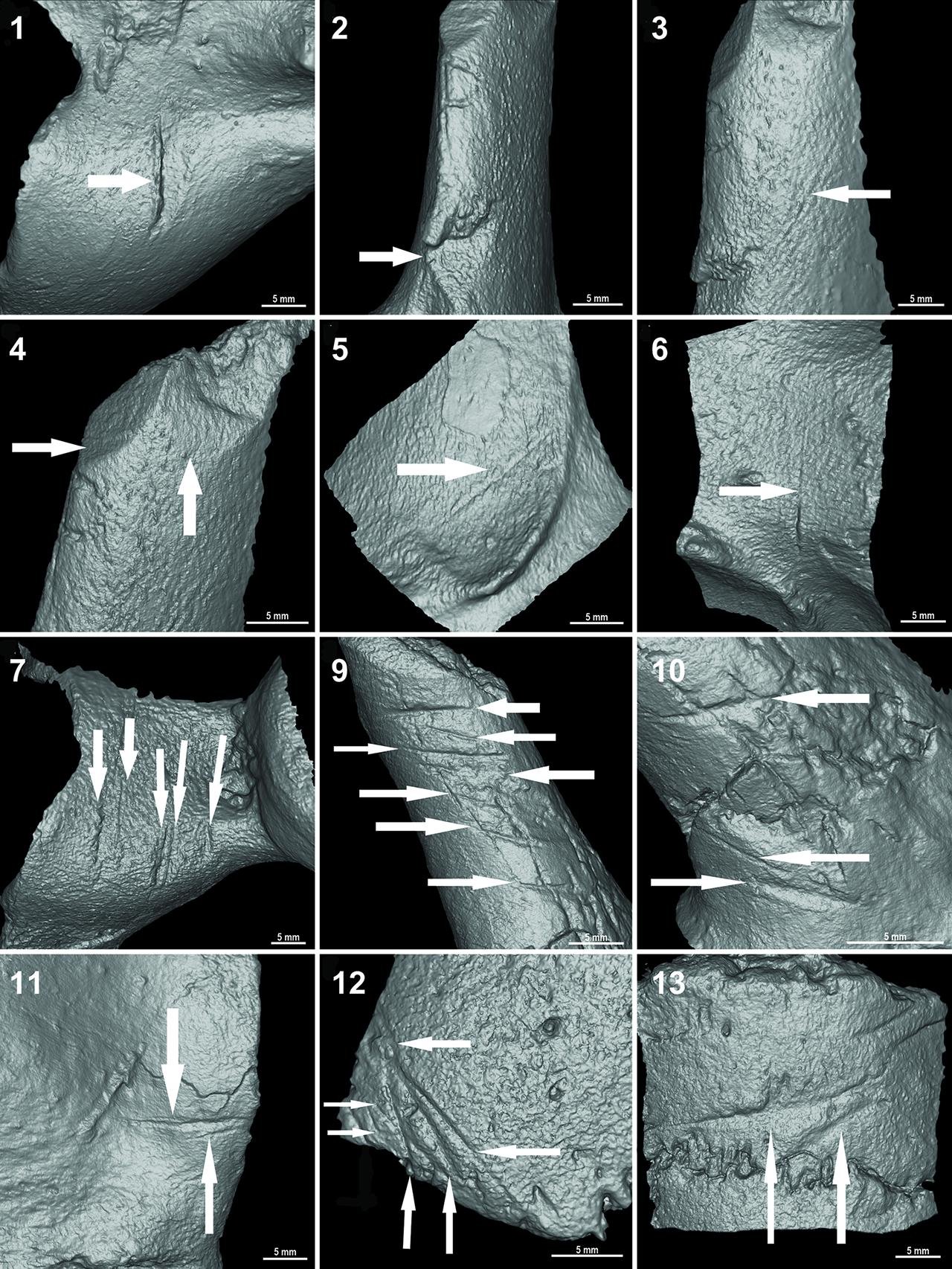
The research team, led by Dr. Mariano Del Papa from the National University of La Plata, conducted detailed analyses of the bones, uncovering 32 linear cut marks. These marks were not immediately visible but were revealed through careful cleaning and 3D scanning. The researchers determined that the V-shaped cross-sections of the marks were indicative of stone tool butchery, as opposed to U-shaped marks typically made by carnivores or other natural processes. This conclusion was supported by statistical techniques used to classify and compare the marks, confirming they were human-made.

“The cut marks were not randomly distributed but focused on those skeletal elements that harbored large muscle packs like the pelvis and the tail,” said Miguel Delgado, a paleoanthropologist at the National University of La Plata and co-author of the study, in an email to Live Science. He suggested that the size and muscle mass of glyptodonts, which could provide a significant amount of meat, made them appealing targets for ancient humans.
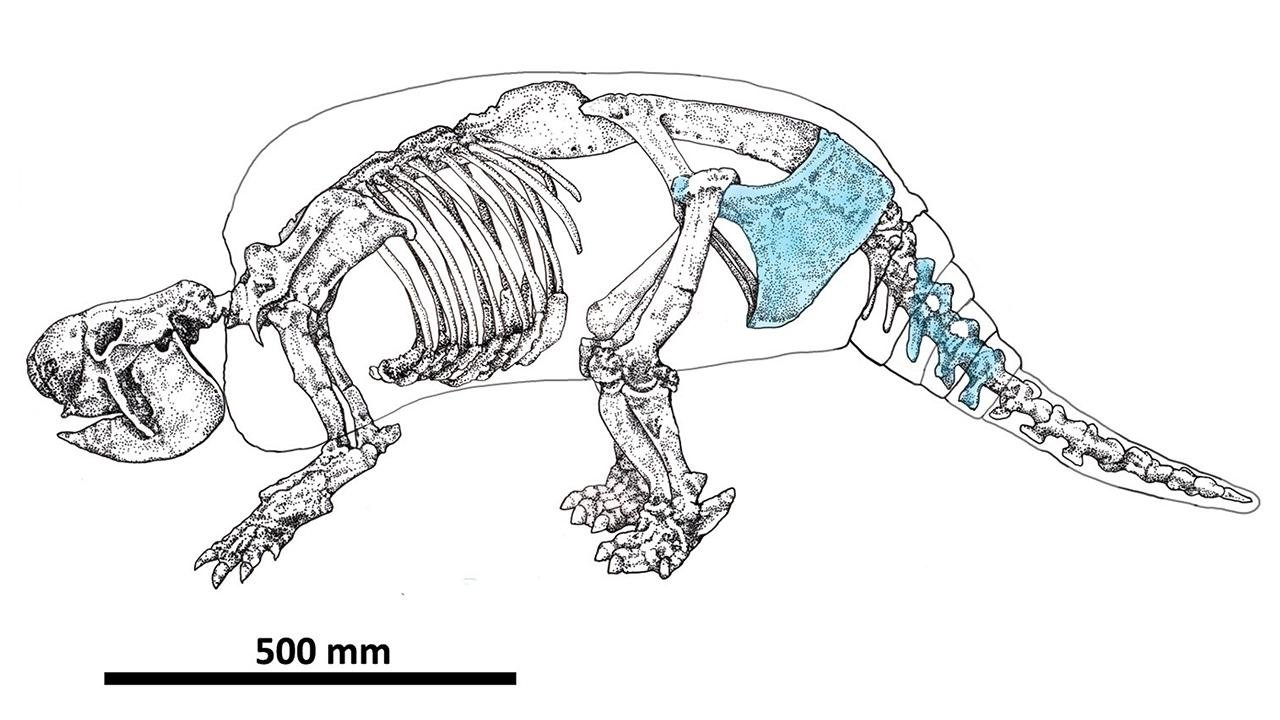
Giant armadillo fossil reveals early human presence in Argentina 21,000 years ago
Drawing of a Neosclerocalyptus skeleton highlighting cut-marked skeletal elements in light blue found at the CRS-10 specimen. Credit: Del Papa et al., PLoS ONE (2024)

The findings are significant as they push back the timeline of human presence and human-megafauna interactions in southern South America by nearly 6,000 years compared to previously recorded sites. This evidence aligns with other recent discoveries indicating early human presence in the Americas over 20,000 years ago.

RelatedStories

Mesolithic burials in Sweden show ancient fur and feather headgear uncovered by new microscopic analysis

Mesolithic burials in Sweden show ancient fur and feather headgear uncovered by new microscopic analysis

February 25, 2026
DNA reveals extended hunter-gatherer family ties in 5,500-year-old Stone Age graves on Gotland

DNA reveals extended hunter-gatherer family ties in 5,500-year-old Stone Age graves on Gotland

February 18, 2026

Despite the lack of human-made tools found at the site, Delgado remains hopeful that additional excavations will uncover more evidence. “While we haven’t found any tools yet, it’s worth noting that we’ve only excavated a small portion of the site, and there may be more evidence, such as lithic tools,” he stated.
Giant armadillo fossil reveals early human presence in Argentina 21,000 years ago
3D reconstructions of cut marks found in the Neosclerocalyptus sp CRS-10 specimen. Credit: Del Papa et al., PLoS ONE (2024)

The study’s results contribute to the ongoing debate about the timing and manner of early human migration to South America. Current estimates for the first inhabitants of the Americas range from 13,000 to over 20,000 years ago, but archaeological evidence has been sparse and often contentious.
More information: Del Papa M, De Los Reyes M, Poiré DG, Rascovan N, Jofré G, Delgado M (2024) Anthropic cut marks in extinct megafauna bones from the Pampean region (Argentina) at the last glacial maximum. PLoS ONE 19(7): e0304956. doi:10.1371/journal.pone.0304956
Share6Tweet4Share1ShareSend

You May Also Like...

CT scans reveal hidden details of 2,300-year-old Egyptian mummies
Anthropology

CT scans reveal hidden details of 2,300-year-old Egyptian mummies

April 26, 2026
Rare 2,000-year-old Roman bread found at Vindonissa reveals early military life in Switzerland
Archaeology

Rare 2,000-year-old Roman bread found at Vindonissa reveals early military life in Switzerland

April 25, 2026
Over 1,000 archaeological features uncovered along Czech railway
Archaeology

Over 1,000 archaeological features uncovered along Czech railway

April 25, 2026
Ancient ship burial in Norway dates to CE 700, rewriting early Viking Age origins
Archaeology

Ancient ship burial in Norway dates to CE 700, rewriting early Viking Age origins

April 25, 2026
Ramses II statue found in Egypt’s eastern Nile Delta shows ancient reuse of royal monuments
Archaeology

Ramses II statue found in Egypt’s eastern Nile Delta shows ancient reuse of royal monuments

April 24, 2026
Late Bronze Age bronze ring hoard near Dresden reveals ritual practices and social life 1300–1100 BCE
Archaeology

Late Bronze Age bronze ring hoard near Dresden reveals ritual practices and social life 1300–1100 BCE

April 21, 2026

Comments 1

  1. Editorial Team says:
    1 second ago

    Disclaimer: This website is a science-focused magazine that welcomes both academic and non-academic audiences. Comments are written by users and may include personal opinions or unverified claims. They do not necessarily reflect the views of our editorial team or rely on scientific evidence.

    Comment Policy: We kindly ask all commenters to engage respectfully. Comments that contain offensive, insulting, degrading, discriminatory, or racist content will be automatically removed.

  2. GRANT J NELSON says:
    2 years ago

    excellent articles

Follow us


Instagram
244K

Facebook
118K

Threads
46K

LinkedIn
14K

Twitter
6K

YouTube
1K
  • Trending
  • Comments
  • Latest
Shipwreck Salvage. Credit: rawpixel.com / Public Domain

2,000-year-old shipwreck discovered off Turkish coast with remarkably preserved stacked ceramics

July 2, 2025
Viking age DNA reveals 9,000-year-old HIV-resistant gene originating near the Black Sea

Viking age DNA reveals 9,000-year-old HIV-resistant gene originating near the Black Sea

May 18, 2025
A new study suggests the mysterious Voynich Manuscript may be a medieval cipher

A new study suggests the mysterious Voynich Manuscript may be a medieval cipher

January 3, 2026
3D analysis reveals Shroud of Turin image likely came from sculpture, not Jesus’ body

3D analysis reveals Shroud of Turin image likely came from sculpture, not Jesus’ body

August 3, 2025
Moses may be named in ancient Egyptian mine inscriptions, sparking debate over earliest biblical references

Moses may be named in ancient Egyptian mine inscriptions, sparking debate over earliest biblical references

July 31, 2025
3D analysis reveals Shroud of Turin image likely came from sculpture, not Jesus’ body

3D analysis reveals Shroud of Turin image likely came from sculpture, not Jesus’ body

Moses may be named in ancient Egyptian mine inscriptions, sparking debate over earliest biblical references

Moses may be named in ancient Egyptian mine inscriptions, sparking debate over earliest biblical references

$1 million prize offered to decipher 5,300-year-old Indus Valley script

$1 million prize offered to decipher 5,300-year-old Indus Valley script

Oldest ever genetic data from a human relative found in 2-million-year-old fossilized teeth

Oldest ever genetic data from a human relative found in 2-million-year-old fossilized teeth

Exceptionally large Roman shoes discovered at Magna fort near Hadrian’s Wall

Exceptionally large Roman shoes discovered at Magna fort near Hadrian’s Wall

CT scans reveal hidden details of 2,300-year-old Egyptian mummies

CT scans reveal hidden details of 2,300-year-old Egyptian mummies

April 26, 2026
Rare 2,000-year-old Roman bread found at Vindonissa reveals early military life in Switzerland

Rare 2,000-year-old Roman bread found at Vindonissa reveals early military life in Switzerland

April 25, 2026
Over 1,000 archaeological features uncovered along Czech railway

Over 1,000 archaeological features uncovered along Czech railway

April 25, 2026
Ancient ship burial in Norway dates to CE 700, rewriting early Viking Age origins

Ancient ship burial in Norway dates to CE 700, rewriting early Viking Age origins

April 25, 2026
Ramses II statue found in Egypt’s eastern Nile Delta shows ancient reuse of royal monuments

Ramses II statue found in Egypt’s eastern Nile Delta shows ancient reuse of royal monuments

April 24, 2026

Archaeology News online magazine

Archaeology News is an international online magazine that covers all aspects of archaeology.


Categories

  • Academics
    • Books
    • Conferences
    • Universities
  • Articles
  • Download
  • Game
  • News
    • Anthropology
    • Archaeology
    • Paleontology
  • Quiz
  • Tours

Subscribe to our newsletter

© 2024 - Archaeology News Online Magazine. All Rights Reserved.

  • About
  • Privacy Policy
  • Terms of Use
  • Donation
  • Contact

Manage Consent
To provide the best experiences, we use technologies like cookies to store and/or access device information. Consenting to these technologies will allow us to process data such as browsing behavior or unique IDs on this site. Not consenting or withdrawing consent, may adversely affect certain features and functions.
Functional Always active
The technical storage or access is strictly necessary for the legitimate purpose of enabling the use of a specific service explicitly requested by the subscriber or user, or for the sole purpose of carrying out the transmission of a communication over an electronic communications network.
Preferences
The technical storage or access is necessary for the legitimate purpose of storing preferences that are not requested by the subscriber or user.
Statistics
The technical storage or access that is used exclusively for statistical purposes. The technical storage or access that is used exclusively for anonymous statistical purposes. Without a subpoena, voluntary compliance on the part of your Internet Service Provider, or additional records from a third party, information stored or retrieved for this purpose alone cannot usually be used to identify you.
Marketing
The technical storage or access is required to create user profiles to send advertising, or to track the user on a website or across several websites for similar marketing purposes.
  • Manage options
  • Manage services
  • Manage {vendor_count} vendors
  • Read more about these purposes
View preferences
  • {title}
  • {title}
  • {title}
  • Home
  • News
    • Archaeology
    • Anthropology
    • Paleontology
  • Academic
    • Books
    • Conferences
    • Universities
  • Articles
  • VR Tours
  • Quiz & Game
  • Download
  • Encyclopedia
  • Forum

About  .  Contact  .  Donation

© 2024 - Archaeology News Online Magazine. All Rights Reserved