• About
  • Privacy Policy
  • Terms of Use
  • Donation
  • Contact
No Result
View All Result
Archaeology News
  • Home
  • News
    • Archaeology
    • Anthropology
    • Paleontology
  • Academics
    • Books
    • Conferences
    • Universities
  • Articles
  • VR Tours
  • Quiz & Game
  • Download
  • Encyclopedia
  • Forum
Archaeology News
No Result
View All Result
Home News Archaeology

Ancient purple tunic discovered in Vergina tomb: could it belong to Alexander the Great?

by Dario Radley
October 30, 2024

A team led by Antonis Bartsiokas of Democritus University of Thrace has presented compelling evidence that a purple and white tunic found in Greece’s Royal Tombs at Vergina might have once belonged to Alexander the Great.

Ancient purple tunic discovered in Vergina tomb: could it belong to Alexander the Great?
Detail of the Alexander Mosaic depicting the Battle of Issus between Alexander the Great & Darius III of Persia, from the House of the Faun in Pompeii, Naples Archaeological Museum. Credit: Carole Raddato (CC BY-SA 2.0)

The tunic, known as a chiton, was located in Tomb II of the Vergina site, which has long been believed to hold the remains and artifacts of Alexander’s father, Philip II. However, Bartsiokas and his team now argue that Tomb II may actually contain items that belonged to Alexander himself, with the remains inside being those of Alexander’s half-brother, Philip III Arrhidaeus, who was crowned king after Alexander’s death.

This finding was detailed in the Journal of Field Archaeology, where the researchers explained their use of modern scientific techniques, including Fourier-transform infrared spectroscopy and gas chromatography, to analyze the tunic’s material composition.

According to Bartsiokas, the purple hue of the chiton is key evidence. This color, derived from the rare Tyrian purple dye, was typically reserved for elites and was especially prized in ancient Persia, which Alexander famously conquered. The tunic’s composition—cotton layers separated by a mineral-based white fabric, likely huntite—also supports an eastern origin, fitting descriptions of Persian royal garments. Additionally, a golden diadem, a scepter, and a gold oak wreath found near the tunic are thought to further symbolize connections to Alexander’s royal regalia and to the cultural influence of the Persian Empire.
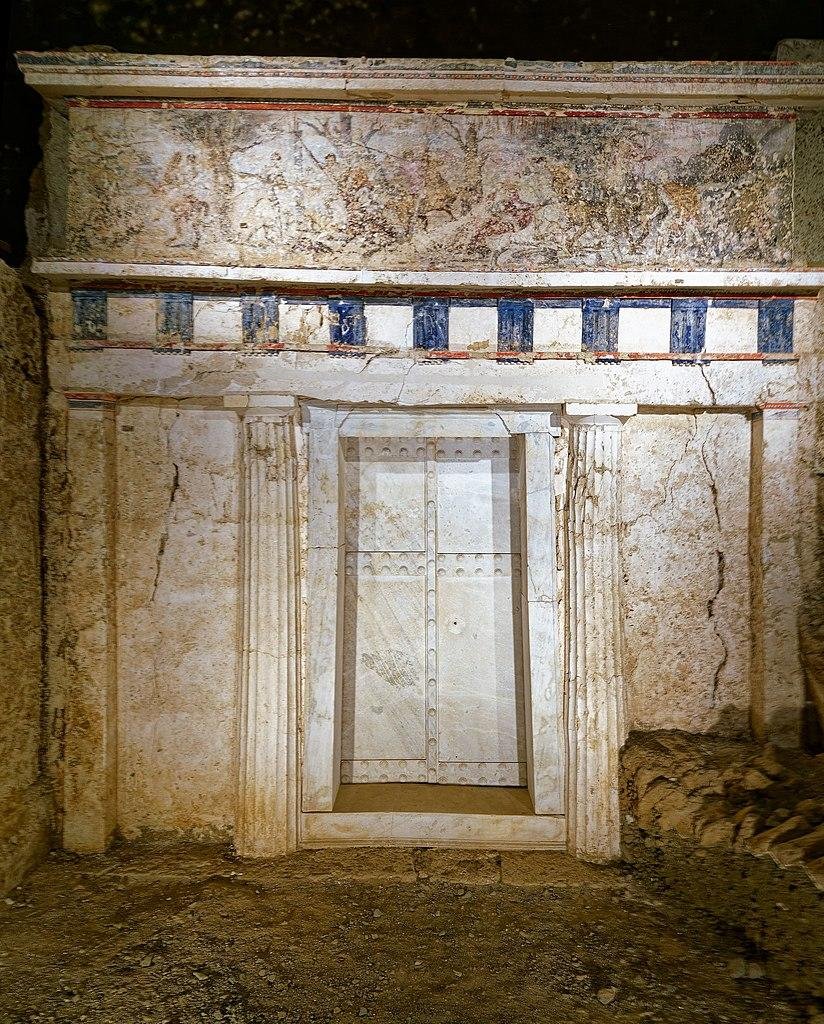
The royal tombs in Vergina.
The royal tombs in Vergina. Credit: Holger Uwe Schmitt/Wikimedia Commons

The debate over the Royal Tombs’ occupants has a long history, intensified after the site’s discovery in 1977 by Greek archaeologist Manolis Andronicos. Andronicos attributed the tomb to Philip II, citing evidence consistent with his known injuries, such as signs of synostosis in a femur, which matched Philip’s limp. However, Bartsiokas argues that the presence of artifacts resembling Alexander’s and Philip III’s raises questions about Andronicos’s conclusions, suggesting that some items in the tombs may belong to different individuals within Alexander’s family.


RelatedStories

Tomb built for Alexander the Great's best friend, Hephaestion, aligned with winter solstice

Tomb built for Alexander the Great’s best friend, Hephaestion, aligned with winter solstice

May 26, 2025
Raiders, Rulers, and Traders: The Horse and the Rise of Empires

Raiders, Rulers, and Traders: The Horse and the Rise of Empires

May 15, 2025

If confirmed, this new interpretation could profoundly impact historical narratives around the Vergina tombs. The presence of Philip III Arrhidaeus in Tomb II, with Alexander’s possessions, may indicate that Alexander’s empire was divided in part by allocating his personal items, which were then brought back to Greece by his half-brother after Alexander’s death in 323 BCE. This theory would also confirm that Alexander’s actual burial site remains undiscovered, adding to the long-standing mystery of his final resting place.

Ancient purple tunic discovered in Vergina tomb: could it belong to Alexander the Great?
Alexander the Great in the Temple of Jerusalem, by Sebastiano Conca (1680–1764). Museo Nacional del Prado, Madrid

The study further proposes that Tomb I at Vergina houses Philip II, his wife Cleopatra, and their newborn child, while Tomb III holds the remains of Alexander IV, Alexander’s teenage son. This arrangement aligns with Bartsiokas’s theory of the tombs as a collective family burial site, showcasing a blend of Macedonian and Persian symbols that reflect Alexander’s ambition to unite both cultures.
More information: Bartsiokas, A. (2024). The identification of the sacred “Chiton” ( sarapis ) of pharaoh Alexander the great in tomb II at Vergina, Macedonia, Greece. Journal of Field Archaeology, 1–13. doi:10.1080/00934690.2024.2409503
Share3Tweet2ShareShareSend

You May Also Like...

Air-filled anomalies in the Menkaure Pyramid may point to a second entrance
Archaeology

Air-filled anomalies in the Menkaure Pyramid may point to a second entrance

November 11, 2025
Scientists uncover purpose of 5,200 mystery holes in Peru, revealing a lost Andean system of trade and record-keeping
Archaeology

Scientists uncover purpose of 5,200 mystery holes in Peru, revealing a lost Andean system of trade and record-keeping

November 10, 2025
Archaeologists uncover oldest and largest Maya monument built to represent the cosmos
Archaeology

Archaeologists uncover oldest and largest Maya monument built to represent the cosmos

November 10, 2025
Roman roads reimagined: new digital map expands the empire’s network to nearly 300,000 km
Archaeology

Roman roads reimagined: new digital map expands the empire’s network to nearly 300,000 km

November 9, 2025
New study debunks myth of Easter Island's ecological collapse
Archaeology

Rats and the fall of Rapa Nui’s forests: invasive species, not humans, drove the island’s deforestation

November 9, 2025
2.75-million-year-old stone tools in Kenya reveal 300,000 years of technological stability
Anthropology

2.75-million-year-old stone tools in Kenya reveal 300,000 years of technological stability

November 9, 2025

Follow us


Instagram
245K

Facebook
117K

Threads
45K

LinkedIn
14K

Twitter
6K

YouTube
1K
  • Trending
  • Comments
  • Latest
Shipwreck Salvage. Credit: rawpixel.com / Public Domain

2,000-year-old shipwreck discovered off Turkish coast with remarkably preserved stacked ceramics

July 2, 2025
Viking age DNA reveals 9,000-year-old HIV-resistant gene originating near the Black Sea

Viking age DNA reveals 9,000-year-old HIV-resistant gene originating near the Black Sea

May 18, 2025
Complete copy of the Canopus Decree unearthed in Egypt after 150 years

Complete copy of the Canopus Decree unearthed in Egypt after 150 years

September 13, 2025
Mystery of Armenia’s 6,000-year-old dragon stones solved

Mystery of Armenia’s 6,000-year-old dragon stones solved

September 23, 2025
Moses may be named in ancient Egyptian mine inscriptions, sparking debate over earliest biblical references

Moses may be named in ancient Egyptian mine inscriptions, sparking debate over earliest biblical references

July 31, 2025
Moses may be named in ancient Egyptian mine inscriptions, sparking debate over earliest biblical references

Moses may be named in ancient Egyptian mine inscriptions, sparking debate over earliest biblical references

3D analysis reveals Shroud of Turin image likely came from sculpture, not Jesus’ body

3D analysis reveals Shroud of Turin image likely came from sculpture, not Jesus’ body

$1 million prize offered to decipher 5,300-year-old Indus Valley script

$1 million prize offered to decipher 5,300-year-old Indus Valley script

Oldest ever genetic data from a human relative found in 2-million-year-old fossilized teeth

Oldest ever genetic data from a human relative found in 2-million-year-old fossilized teeth

Exceptionally large Roman shoes discovered at Magna fort near Hadrian’s Wall

Exceptionally large Roman shoes discovered at Magna fort near Hadrian’s Wall

Air-filled anomalies in the Menkaure Pyramid may point to a second entrance

Air-filled anomalies in the Menkaure Pyramid may point to a second entrance

November 11, 2025
Scientists uncover purpose of 5,200 mystery holes in Peru, revealing a lost Andean system of trade and record-keeping

Scientists uncover purpose of 5,200 mystery holes in Peru, revealing a lost Andean system of trade and record-keeping

November 10, 2025
Archaeologists uncover oldest and largest Maya monument built to represent the cosmos

Archaeologists uncover oldest and largest Maya monument built to represent the cosmos

November 10, 2025
Roman roads reimagined: new digital map expands the empire’s network to nearly 300,000 km

Roman roads reimagined: new digital map expands the empire’s network to nearly 300,000 km

November 9, 2025
New study debunks myth of Easter Island's ecological collapse

Rats and the fall of Rapa Nui’s forests: invasive species, not humans, drove the island’s deforestation

November 9, 2025

Archaeology News online magazine

Archaeology News is an international online magazine that covers all aspects of archaeology.


Categories

  • Academics
    • Books
    • Conferences
    • Universities
  • Articles
  • Download
  • Game
  • News
    • Anthropology
    • Archaeology
    • Paleontology
  • Quiz
  • Tours

Subscribe to our newsletter

© 2024 - Archaeology News Online Magazine. All Rights Reserved.

  • About
  • Privacy Policy
  • Terms of Use
  • Donation
  • Contact

Welcome Back!

Login to your account below

Forgotten Password? Sign Up

Create New Account!

Fill the forms below to register

All fields are required. Log In

Retrieve your password

Please enter your username or email address to reset your password.

Log In

Add New Playlist

Manage Consent
To provide the best experiences, we use technologies like cookies to store and/or access device information. Consenting to these technologies will allow us to process data such as browsing behavior or unique IDs on this site. Not consenting or withdrawing consent, may adversely affect certain features and functions.
Functional Always active
The technical storage or access is strictly necessary for the legitimate purpose of enabling the use of a specific service explicitly requested by the subscriber or user, or for the sole purpose of carrying out the transmission of a communication over an electronic communications network.
Preferences
The technical storage or access is necessary for the legitimate purpose of storing preferences that are not requested by the subscriber or user.
Statistics
The technical storage or access that is used exclusively for statistical purposes. The technical storage or access that is used exclusively for anonymous statistical purposes. Without a subpoena, voluntary compliance on the part of your Internet Service Provider, or additional records from a third party, information stored or retrieved for this purpose alone cannot usually be used to identify you.
Marketing
The technical storage or access is required to create user profiles to send advertising, or to track the user on a website or across several websites for similar marketing purposes.
Manage options Manage services Manage {vendor_count} vendors Read more about these purposes
View preferences
{title} {title} {title}
  • Home
  • News
    • Archaeology
    • Anthropology
    • Paleontology
  • Academics
    • Books
    • Conferences
    • Universities
  • Articles
  • VR Tours
  • Quiz & Game
  • Download
  • Encyclopedia
  • Forum

About  .  Contact  .  Donation

© 2024 - Archaeology News Online Magazine. All Rights Reserved