• About
  • Privacy Policy
  • Terms of Use
  • Donation
  • Contact
No Result
View All Result
Archaeology News
  • Home
  • News
    • Archaeology
    • Anthropology
    • Paleontology
  • Academic
    • Books
    • Conferences
    • Universities
  • Articles
  • VR Tours
  • Quiz & Game
  • Download
  • Encyclopedia
  • Forum
Archaeology News
No Result
View All Result
Home News Archaeology

Archaeologists identify site of al-Qadisiyyah battle in Iraq

by Dario Radley
November 12, 2024

Archaeologists from Durham University in the UK and the University of Al-Qadisiyah in Iraq have successfully identified the site of the pivotal 7th-century Battle of al-Qadisiyyah. By cross-referencing declassified Cold War-era satellite images with historical texts, the researchers believe they have located the battlefield approximately 30 kilometers south of Kufa, in Iraq’s Najaf Governorate. This battle, dating to 636 or 637 CE, played a central role in the early Islamic expansion, leading to a decisive Arab Muslim victory over the Sasanian Empire and clearing the way for Islam’s spread into Persia and beyond.
Archaeologists identify site of historic 7th-century battle in Iraq
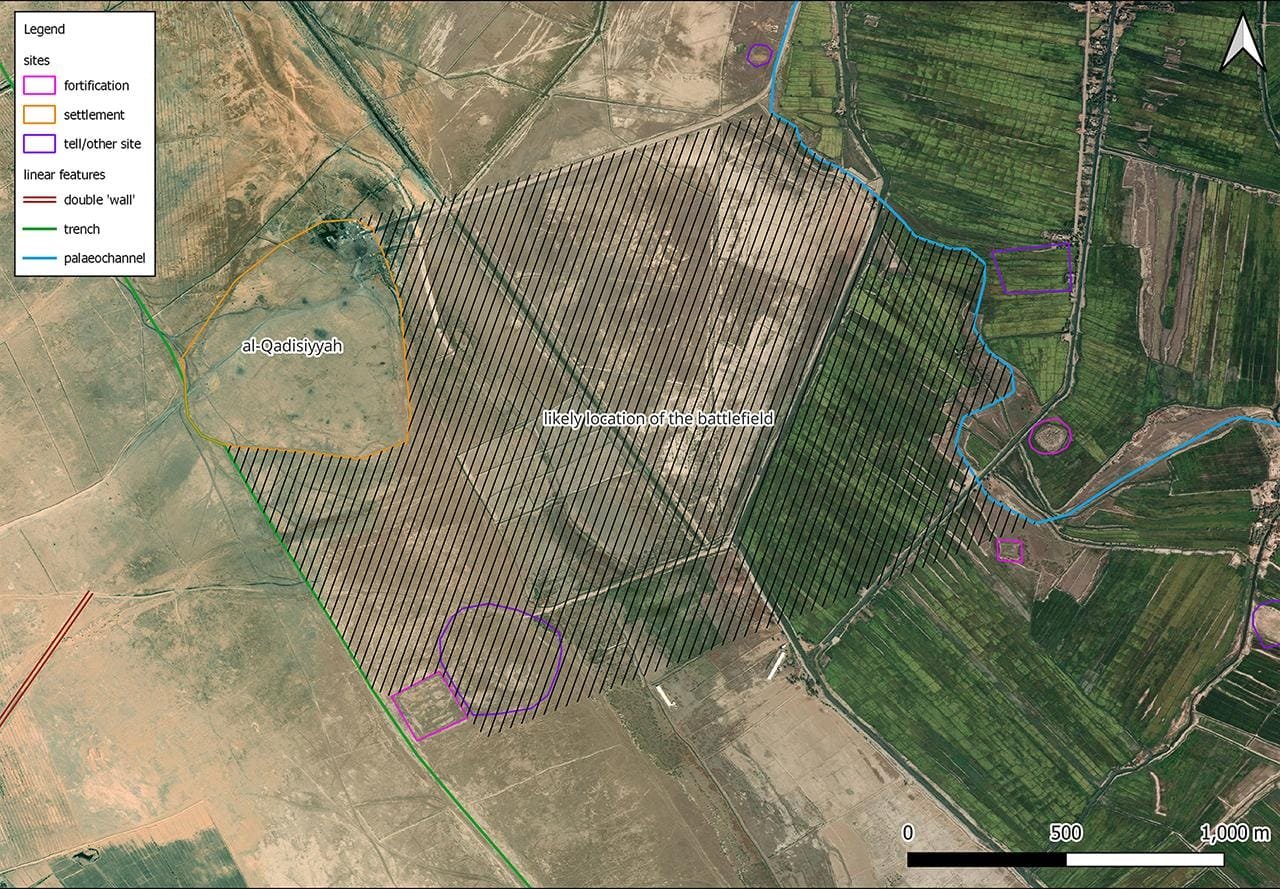
Probable location of the battle of al-Qadisiyyah. Credit: (Bing imagery © 2024 Microsoft, figure by W.M Deadman). Credit: W.M Deadman et al., Antiquity (2024)

The discovery arose from an ambitious archaeological survey led by Dr. William Deadman, an expert in archaeological remote sensing at Durham University. Initially, Deadman’s team aimed to map the Darb Zubaydah, a historic pilgrimage route running from Kufa to Mecca, using both 1970s U.S. spy satellite images and modern photos. During the analysis, Deadman noted structural features on the satellite images that appeared to match descriptions in ancient texts of the al-Qadisiyyah battlefield. “I thought this was a good chance at having a crack at trying to find it,” he told CNN.

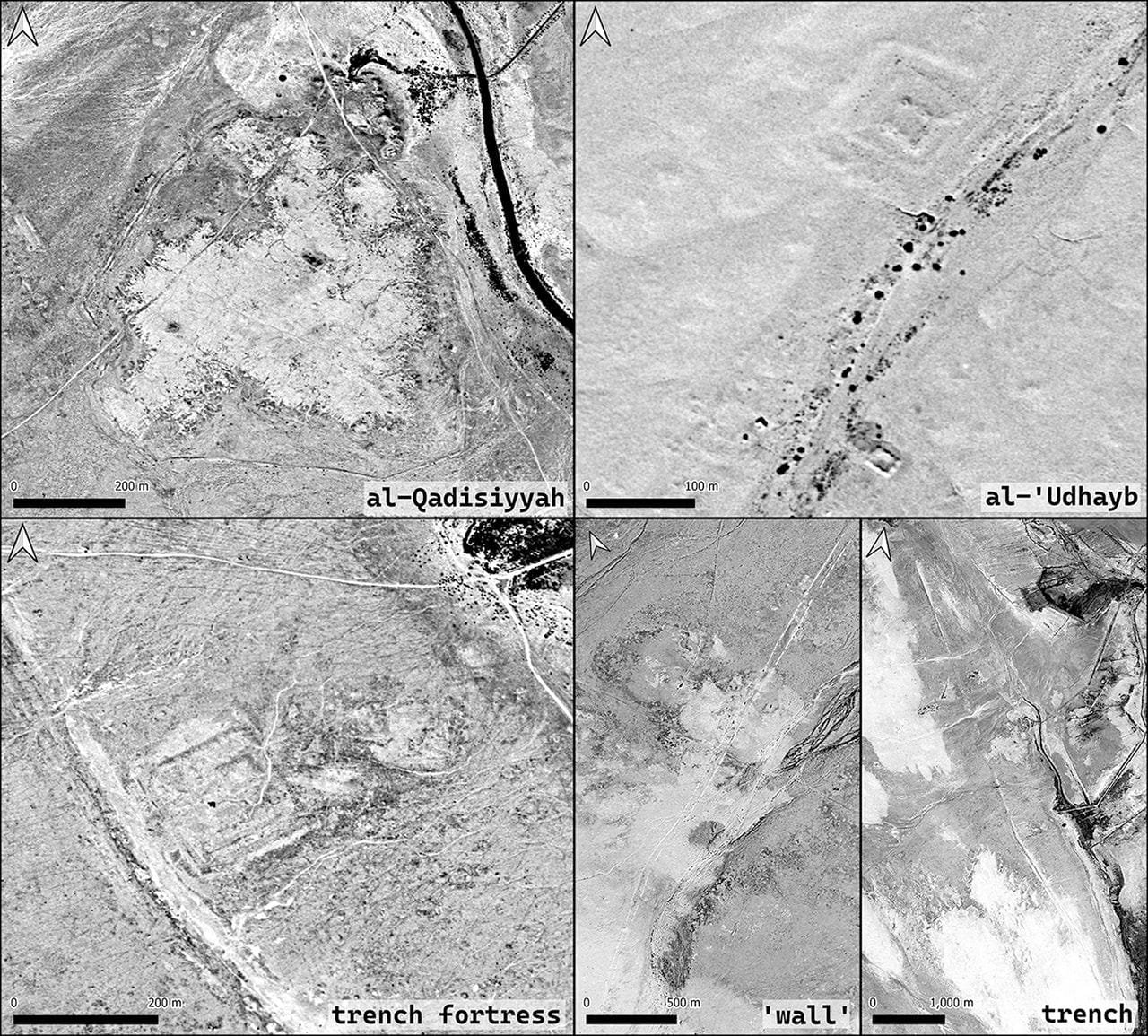
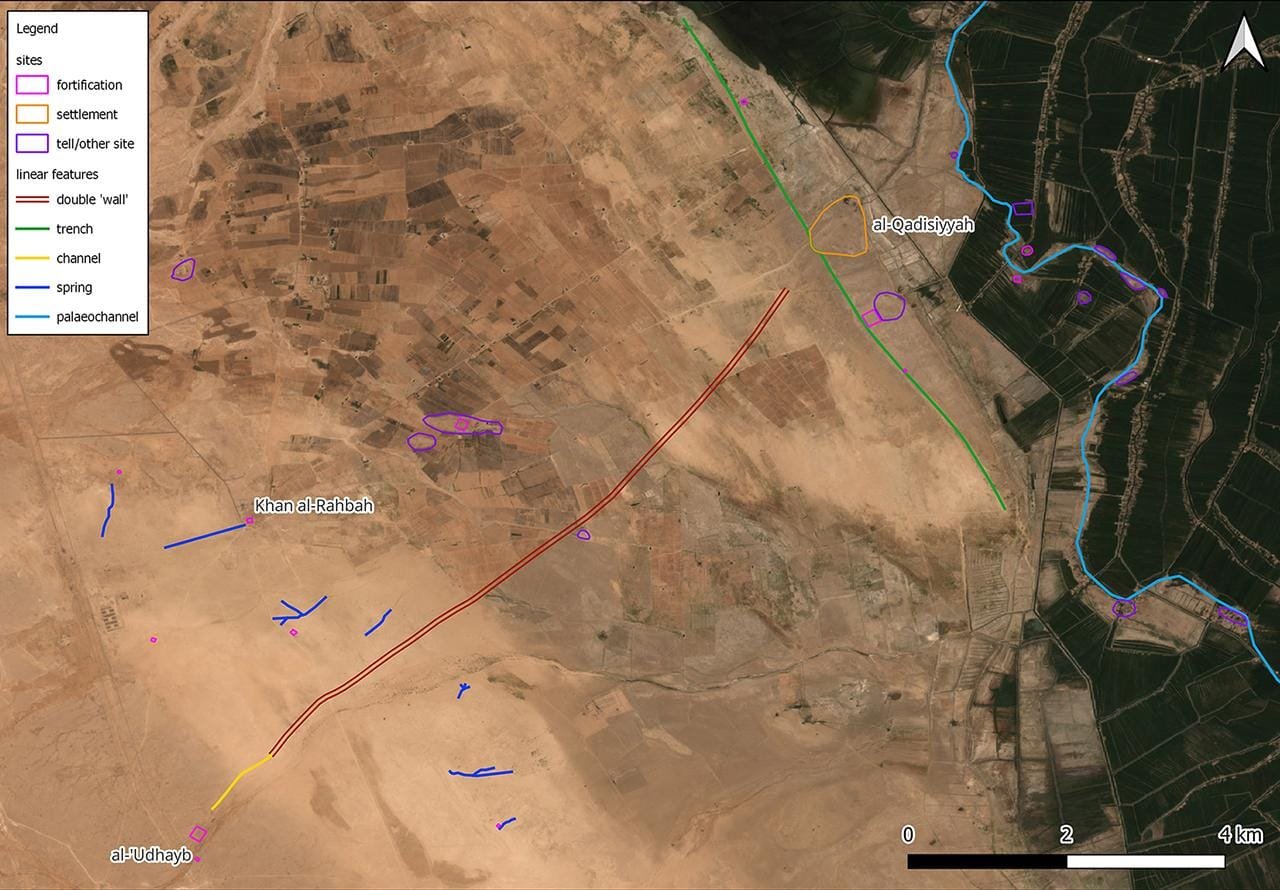
The team’s findings centered on a unique six-mile double wall feature, which they believe was instrumental during the battle. This structure linked a desert military outpost with a settlement on the edge of Mesopotamia’s southern floodplain, closely corresponding to historical descriptions of the battle site. Dr. Deadman described his reaction to the discovery as “gobsmacked,” adding that he was “extremely confident” that the site matched historical records.

On-the-ground investigations conducted by archaeologists from the University of Al-Qadisiyah provided additional confirmation, uncovering pottery shards and other artifacts consistent with the era of the battle. These artifacts, along with features such as a deep trench, fortresses, and remnants of an ancient river ford once traversed by elephant-mounted Persian troops, offer a tangible link to the historical accounts.
Archaeologists identify site of historic 7th-century battle in Iraq
1973 KH9 imagery of the main features discovered. Credit: W.M Deadman / United States Geological Survey

The Battle of al-Qadisiyyah marked a crucial turning point in Islamic history, leading to the eventual fall of the Sasanian Empire. “The decisive battle heralded the end of the Sasanian Empire into the abyss and the expansion of Muslim territory into Mesopotamia, Persia, and beyond,” commented Mustafa Baig, a lecturer in Islamic Studies at the University of Exeter, to CNN.
RelatedStories

Greek inscription found in Syria’s Great Mosque of Homs may reveal lost Temple of the Sun in ancient Emesa

Greek inscription found in Syria’s Great Mosque of Homs may reveal lost Temple of the Sun in ancient Emesa

February 25, 2026
Christians and Zoroastrians lived side by side in 5th-century Iraq, archaeologists find

Christians and Zoroastrians coexisted peacefully in 5th-century Iraq, archaeologists find

December 19, 2025

The research team’s use of Cold War-era satellite imagery—technology typically employed to view terrain now hidden by modern agricultural and urban developments—highlights the critical role of remote sensing in archaeology. Deadman noted, “The amazing thing about this spy imagery is that it allows us to wind back the clock 50 years,” making previously obscured features accessible to modern archaeologists.
Archaeologists identify site of historic 7th-century battle in Iraq
Features recorded during the survey (Sentinel-2 imagery courtesy of the European Space Agency). Credit: W.M Deadman et al., Antiquity (2024)

The findings also enhance understanding of the Darb Zubaydah pilgrimage route. The team successfully identified two significant waypoints along the route, al-Qadisiyyah and al-‘Udhayb, used by armies and pilgrims alike. These stopping points not only aided Muslim forces but also later provided logistical support for pilgrims journeying from Iraq to Mecca.

The findings were published in the journal Antiquity.
More information: Deadman WM, Jotheri J, Hopper K, Almayali R, al-Luhaibi AA, Crane A. (2024). Locating al-Qadisiyyah: mapping Iraq’s most famous early Islamic conquest site. Antiquity:1-8. doi:10.15184/aqy.2024.185
Share14Tweet9Share3ShareSend

You May Also Like...

7,000-year-old beaver bone pit discovered in Germany reveals Neolithic fur hunting practices
Archaeology

7,000-year-old beaver bone pit discovered in Germany reveals Neolithic fur hunting practices

May 1, 2026
Ancient DNA study rewrites fall of Rome, reveals small migrations shaped Central Europe
Anthropology

Ancient DNA study rewrites fall of Rome, reveals small migrations shaped Central Europe

May 1, 2026
New copy of earliest known English poem discovered in Rome manuscript
Archaeology

New copy of earliest known English poem discovered in Rome manuscript

April 30, 2026
How coral buildings are helping archaeologists date colonial-era sites in French Polynesia
Archaeology

How coral buildings are helping archaeologists date colonial-era sites in French Polynesia

April 30, 2026
Ancient cremation pyre uncovered at Sizewell site in England reveals rare prehistoric burial ritual
Archaeology

Ancient cremation pyre uncovered at Sizewell site in England reveals rare prehistoric burial ritual

April 30, 2026
Ancient mass grave in Jordan confirms victims of Justinian Plague pandemic
Anthropology

Ancient mass grave in Jordan confirms victims of Justinian Plague pandemic

April 29, 2026

Follow us


Instagram
244K

Facebook
118K

Threads
46K

LinkedIn
14K

Twitter
6K

YouTube
1K
  • Trending
  • Comments
  • Latest
Shipwreck Salvage. Credit: rawpixel.com / Public Domain

2,000-year-old shipwreck discovered off Turkish coast with remarkably preserved stacked ceramics

July 2, 2025
A new study suggests the mysterious Voynich Manuscript may be a medieval cipher

A new study suggests the mysterious Voynich Manuscript may be a medieval cipher

January 3, 2026
Viking age DNA reveals 9,000-year-old HIV-resistant gene originating near the Black Sea

Viking age DNA reveals 9,000-year-old HIV-resistant gene originating near the Black Sea

May 18, 2025
3D analysis reveals Shroud of Turin image likely came from sculpture, not Jesus’ body

3D analysis reveals Shroud of Turin image likely came from sculpture, not Jesus’ body

August 3, 2025
Moses may be named in ancient Egyptian mine inscriptions, sparking debate over earliest biblical references

Moses may be named in ancient Egyptian mine inscriptions, sparking debate over earliest biblical references

July 31, 2025
3D analysis reveals Shroud of Turin image likely came from sculpture, not Jesus’ body

3D analysis reveals Shroud of Turin image likely came from sculpture, not Jesus’ body

Moses may be named in ancient Egyptian mine inscriptions, sparking debate over earliest biblical references

Moses may be named in ancient Egyptian mine inscriptions, sparking debate over earliest biblical references

$1 million prize offered to decipher 5,300-year-old Indus Valley script

$1 million prize offered to decipher 5,300-year-old Indus Valley script

Oldest ever genetic data from a human relative found in 2-million-year-old fossilized teeth

Oldest ever genetic data from a human relative found in 2-million-year-old fossilized teeth

Exceptionally large Roman shoes discovered at Magna fort near Hadrian’s Wall

Exceptionally large Roman shoes discovered at Magna fort near Hadrian’s Wall

7,000-year-old beaver bone pit discovered in Germany reveals Neolithic fur hunting practices

7,000-year-old beaver bone pit discovered in Germany reveals Neolithic fur hunting practices

May 1, 2026
Ancient DNA study rewrites fall of Rome, reveals small migrations shaped Central Europe

Ancient DNA study rewrites fall of Rome, reveals small migrations shaped Central Europe

May 1, 2026
New copy of earliest known English poem discovered in Rome manuscript

New copy of earliest known English poem discovered in Rome manuscript

April 30, 2026
How coral buildings are helping archaeologists date colonial-era sites in French Polynesia

How coral buildings are helping archaeologists date colonial-era sites in French Polynesia

April 30, 2026
Ancient cremation pyre uncovered at Sizewell site in England reveals rare prehistoric burial ritual

Ancient cremation pyre uncovered at Sizewell site in England reveals rare prehistoric burial ritual

April 30, 2026

Archaeology News online magazine

Archaeology News is an international online magazine that covers all aspects of archaeology.


Categories

  • Academics
    • Books
    • Conferences
    • Universities
  • Articles
  • Download
  • Game
  • News
    • Anthropology
    • Archaeology
    • Paleontology
  • Quiz
  • Tours

Subscribe to our newsletter

© 2024 - Archaeology News Online Magazine. All Rights Reserved.

  • About
  • Privacy Policy
  • Terms of Use
  • Donation
  • Contact

Manage Consent
To provide the best experiences, we use technologies like cookies to store and/or access device information. Consenting to these technologies will allow us to process data such as browsing behavior or unique IDs on this site. Not consenting or withdrawing consent, may adversely affect certain features and functions.
Functional Always active
The technical storage or access is strictly necessary for the legitimate purpose of enabling the use of a specific service explicitly requested by the subscriber or user, or for the sole purpose of carrying out the transmission of a communication over an electronic communications network.
Preferences
The technical storage or access is necessary for the legitimate purpose of storing preferences that are not requested by the subscriber or user.
Statistics
The technical storage or access that is used exclusively for statistical purposes. The technical storage or access that is used exclusively for anonymous statistical purposes. Without a subpoena, voluntary compliance on the part of your Internet Service Provider, or additional records from a third party, information stored or retrieved for this purpose alone cannot usually be used to identify you.
Marketing
The technical storage or access is required to create user profiles to send advertising, or to track the user on a website or across several websites for similar marketing purposes.
  • Manage options
  • Manage services
  • Manage {vendor_count} vendors
  • Read more about these purposes
View preferences
  • {title}
  • {title}
  • {title}
  • Home
  • News
    • Archaeology
    • Anthropology
    • Paleontology
  • Academic
    • Books
    • Conferences
    • Universities
  • Articles
  • VR Tours
  • Quiz & Game
  • Download
  • Encyclopedia
  • Forum

About  .  Contact  .  Donation

© 2024 - Archaeology News Online Magazine. All Rights Reserved