• About
  • Privacy Policy
  • Terms of Use
  • Donation
  • Contact
No Result
View All Result
Archaeology News
  • Home
  • News
    • Archaeology
    • Anthropology
    • Paleontology
  • Academic
    • Books
    • Conferences
    • Universities
  • Articles
  • VR Tours
  • Quiz & Game
  • Download
  • Encyclopedia
  • Forum
Archaeology News
No Result
View All Result
Home News Archaeology

Anglo-Saxon gold-and-garnet hoard discovered in England reveals early medieval jewelry and ritual practices

by Dario Radley
December 17, 2025

A set of striking Anglo-Saxon gold-and-garnet ornaments discovered on a hillside in eastern England is providing archaeologists with new views on the circulation, reuse, and sometimes deliberate removal from use of high-status jewelry during the early medieval period.
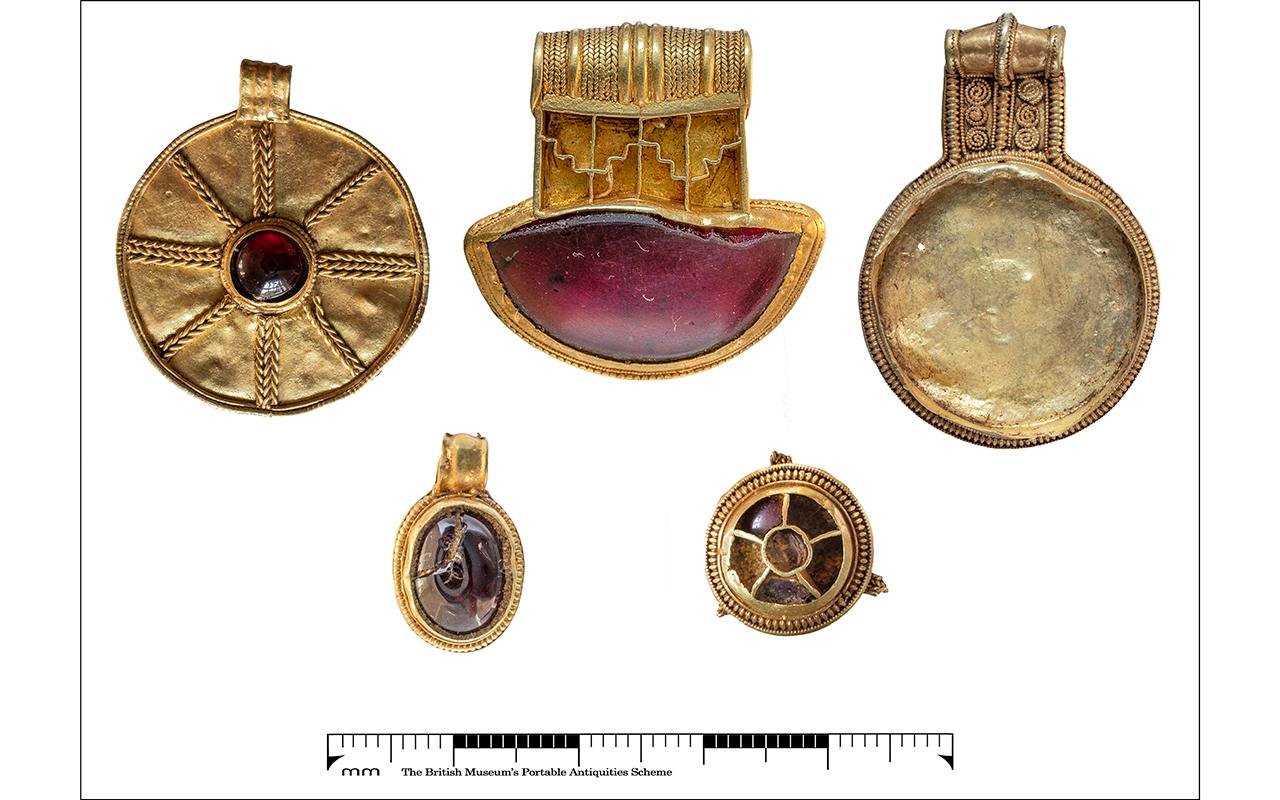
Anglo-Saxon gold-and-garnet hoard discovered in England reveals early medieval jewelry practices
Four gold pendants and a gold-and-garnet brooch from the seventh century were discovered in Lincolnshire, England. Credit: The Portable Antiquities Scheme / CC BY 2.0

The hoard was found in spring 2023 by two metal detectorists on a slope near the village of Donington-on-Bain in Lincolnshire, about 125 miles north of London. The objects, consisting of four pendants and a part of a gold brooch, date to the seventh century, as reported under the U.K.’s Portable Antiquities Scheme. After detailed study, the collection was declared Treasure and was purchased by the Lincoln Museum in 2025.

Gold-and-garnet pendants were common among elite women in Anglo-Saxon England, yet they are usually recovered from graves. The finding of several together on a hillside, without human remains or associated grave goods, makes the Donington group unusual. Analysis shows that the items had already seen long use before burial: they display wear, damage, and modifications suggesting that they may have been at least several decades old at the time they were deposited.

The most important piece is a D-shaped pendant set with a large garnet in a scallop-shaped gold mount, a form often associated with fertility symbolism and, perhaps, early Christian connotations. The other objects are circular pieces decorated with stars and beaded designs. Three are pendants, while the fourth is the central dome of a brooch that had been removed for reuse, a rare practice known from only a few comparable discoveries.

The absence of beads and spacers eliminates the possibility that the pieces formed a complete necklace from a grave, and researchers have proposed several different explanations. One such possibility is that they were assembled as a smith’s hoard. Supplies of garnets became scarce by the seventh century, and itinerant goldsmiths may have collected older jewelry to recycle into new pieces. Some of these items might have been obtained by robbing graves, a practice that is known to have targeted richly furnished women’s burials.

RelatedStories

800-year-old medieval notebook found in German latrine still contains readable Latin writing

800-year-old medieval notebook found in German latrine still contains readable Latin writing

May 16, 2026
Rare Bronze Age burial in Sweden reveals unusual pair of Wendel neck rings and complex ritual landscape near Norrköping

Rare Bronze Age burial in Sweden reveals unusual pair of Wendel neck rings and complex ritual landscape near Norrköping

May 12, 2026

Another view is that the burial is ritual in nature. Intentional damaging or removing valuable objects from circulation—what has been described as “ritual killing”—may have transformed symbols of individual status into offerings holding another social or spiritual meaning. Alternatively, one or more of the women might have concealed valuable jewelry for safekeeping during a time of instability.

That uncertainty reflects broader changes in seventh-century England: Lindsey, the region where the hoard was found, shifted between the control of rival kingdoms like Northumbria and Mercia, while the spread of Christianity was reshaping social and political life.


More information: Brundle, L. (2025). Hoard or grave? Interpreting the seventh‐century jewellery assemblage from Donington‐on‐Bain, Lincolnshire. Oxford Journal of Archaeology. doi:10.1111/ojoa.70010
Share111Tweet69Share19ShareSend

You May Also Like...

Ancient settlement with weaving workshop and longhouses uncovered in Germany gravel pit
Archaeology

Ancient settlement with weaving workshop and longhouses uncovered in Germany gravel pit

May 17, 2026
Pompeii victim identified as Roman physician killed while fleeing Vesuvius eruption
Anthropology

Pompeii victim identified as Roman physician killed while fleeing Vesuvius eruption

May 17, 2026
Archaeologists uncover hidden whisky smuggler bothy in Scottish Highlands with rare copper still piece
Archaeology

Archaeologists uncover hidden whisky smuggler bothy in Scottish Highlands with rare copper still piece

May 16, 2026
Ancient Egyptian tombs, painted coffins, and cat mummies unearthed in Luxor necropolis
Archaeology

Ancient Egyptian tombs, painted coffins, and cat mummies unearthed in Luxor necropolis

May 16, 2026
800-year-old medieval notebook found in German latrine still contains readable Latin writing
Archaeology

800-year-old medieval notebook found in German latrine still contains readable Latin writing

May 16, 2026
Mysterious ancient tunnel discovered in Jerusalem puzzles archaeologists
Archaeology

Mysterious ancient tunnel discovered in Jerusalem puzzles archaeologists

May 15, 2026

Comments 1

  1. Editorial Team says:
    1 second ago

    Disclaimer: This website is a science-focused magazine that welcomes both academic and non-academic audiences. Comments are written by users and may include personal opinions or unverified claims. They do not necessarily reflect the views of our editorial team or rely on scientific evidence.

    Comment Policy: We kindly ask all commenters to engage respectfully. Comments that contain offensive, insulting, degrading, discriminatory, or racist content will be automatically removed.

    Reply
  2. Kisah Sukses says:
    5 months ago

    This interpretation highlights how burial practices can function as active social statements, where the deliberate destruction or deposition of valuable objects reflects a collective effort to redefine personal wealth into shared spiritual or communal value, rather than mere displays of individual status.

    Reply

Leave a Reply Cancel reply

Your email address will not be published. Required fields are marked *

Follow us


Instagram
242K

Facebook
117K

Threads
46K

LinkedIn
14K

Twitter
6K

YouTube
1K
  • Trending
  • Comments
  • Latest
Shipwreck Salvage. Credit: rawpixel.com / Public Domain

2,000-year-old shipwreck discovered off Turkish coast with remarkably preserved stacked ceramics

July 2, 2025
A new study suggests the mysterious Voynich Manuscript may be a medieval cipher

A new study suggests the mysterious Voynich Manuscript may be a medieval cipher

January 3, 2026
Viking age DNA reveals 9,000-year-old HIV-resistant gene originating near the Black Sea

Viking age DNA reveals 9,000-year-old HIV-resistant gene originating near the Black Sea

May 18, 2025
3D analysis reveals Shroud of Turin image likely came from sculpture, not Jesus’ body

3D analysis reveals Shroud of Turin image likely came from sculpture, not Jesus’ body

August 3, 2025
Moses may be named in ancient Egyptian mine inscriptions, sparking debate over earliest biblical references

Moses may be named in ancient Egyptian mine inscriptions, sparking debate over earliest biblical references

July 31, 2025
3D analysis reveals Shroud of Turin image likely came from sculpture, not Jesus’ body

3D analysis reveals Shroud of Turin image likely came from sculpture, not Jesus’ body

Moses may be named in ancient Egyptian mine inscriptions, sparking debate over earliest biblical references

Moses may be named in ancient Egyptian mine inscriptions, sparking debate over earliest biblical references

$1 million prize offered to decipher 5,300-year-old Indus Valley script

$1 million prize offered to decipher 5,300-year-old Indus Valley script

Oldest ever genetic data from a human relative found in 2-million-year-old fossilized teeth

Oldest ever genetic data from a human relative found in 2-million-year-old fossilized teeth

Exceptionally large Roman shoes discovered at Magna fort near Hadrian’s Wall

Exceptionally large Roman shoes discovered at Magna fort near Hadrian’s Wall

Ancient settlement with weaving workshop and longhouses uncovered in Germany gravel pit

Ancient settlement with weaving workshop and longhouses uncovered in Germany gravel pit

May 17, 2026
Pompeii victim identified as Roman physician killed while fleeing Vesuvius eruption

Pompeii victim identified as Roman physician killed while fleeing Vesuvius eruption

May 17, 2026
Archaeologists uncover hidden whisky smuggler bothy in Scottish Highlands with rare copper still piece

Archaeologists uncover hidden whisky smuggler bothy in Scottish Highlands with rare copper still piece

May 16, 2026
Ancient Egyptian tombs, painted coffins, and cat mummies unearthed in Luxor necropolis

Ancient Egyptian tombs, painted coffins, and cat mummies unearthed in Luxor necropolis

May 16, 2026
800-year-old medieval notebook found in German latrine still contains readable Latin writing

800-year-old medieval notebook found in German latrine still contains readable Latin writing

May 16, 2026

Archaeology News online magazine

Archaeology News is an international online magazine that covers all aspects of archaeology.


Categories

  • Academics
    • Books
    • Conferences
    • Universities
  • Articles
  • Download
  • Game
  • News
    • Anthropology
    • Archaeology
    • Paleontology
  • Quiz
  • Tours

Subscribe to our newsletter

© 2024 - Archaeology News Online Magazine. All Rights Reserved.

  • About
  • Privacy Policy
  • Terms of Use
  • Donation
  • Contact

Manage Consent
To provide the best experiences, we use technologies like cookies to store and/or access device information. Consenting to these technologies will allow us to process data such as browsing behavior or unique IDs on this site. Not consenting or withdrawing consent, may adversely affect certain features and functions.
Functional Always active
The technical storage or access is strictly necessary for the legitimate purpose of enabling the use of a specific service explicitly requested by the subscriber or user, or for the sole purpose of carrying out the transmission of a communication over an electronic communications network.
Preferences
The technical storage or access is necessary for the legitimate purpose of storing preferences that are not requested by the subscriber or user.
Statistics
The technical storage or access that is used exclusively for statistical purposes. The technical storage or access that is used exclusively for anonymous statistical purposes. Without a subpoena, voluntary compliance on the part of your Internet Service Provider, or additional records from a third party, information stored or retrieved for this purpose alone cannot usually be used to identify you.
Marketing
The technical storage or access is required to create user profiles to send advertising, or to track the user on a website or across several websites for similar marketing purposes.
  • Manage options
  • Manage services
  • Manage {vendor_count} vendors
  • Read more about these purposes
View preferences
  • {title}
  • {title}
  • {title}
  • Home
  • News
    • Archaeology
    • Anthropology
    • Paleontology
  • Academic
    • Books
    • Conferences
    • Universities
  • Articles
  • VR Tours
  • Quiz & Game
  • Download
  • Encyclopedia
  • Forum

About  .  Contact  .  Donation

© 2024 - Archaeology News Online Magazine. All Rights Reserved