• About
  • Privacy Policy
  • Terms of Use
  • Donation
  • Contact
No Result
View All Result
Archaeology News
  • Home
  • News
    • Archaeology
    • Anthropology
    • Paleontology
  • Academic
    • Books
    • Conferences
    • Universities
  • Articles
  • VR Tours
  • Quiz & Game
  • Download
  • Encyclopedia
  • Forum
Archaeology News
No Result
View All Result
Home News Archaeology

Massive Iron Age hoard in England reveals rare four-wheeled wagons and ritual destruction

by Dario Radley
March 24, 2026

Archaeologists in northern England have uncovered one of the largest Iron Age metal hoards ever found in Britain, and the find is changing long-held ideas about transport, wealth, and elite life before the Roman conquest.
Massive Iron Age hoard in England reveals rare four-wheeled wagons and ritual destruction
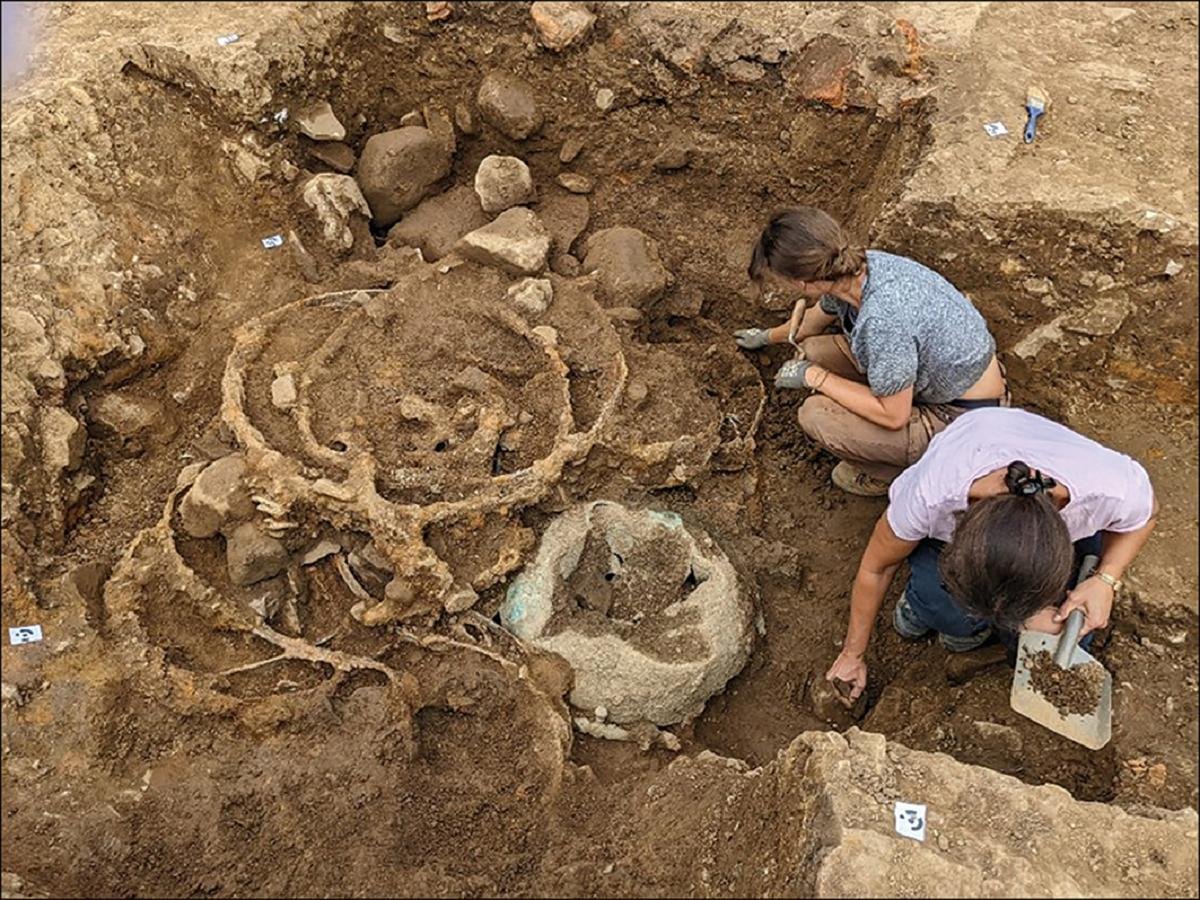
The deposit of iron tyres in Trench 1 shortly after being uncovered. Credit: Durham University / Adams et al., Antiquity (2026)

The discovery was made near Melsonby in North Yorkshire, close to the major Late Iron Age center of Stanwick. Researchers recovered nearly 950 metal fragments representing at least 300 original objects from two deposits buried in ditches and dated to the first century AD. The material includes horse harness fittings, weapons, cauldrons, vehicle parts, and 28 iron wheel tires, all found in tightly packed deposits. The study was published in the journal Antiquity.

What makes the hoard unusual is the clear evidence for large four-wheeled vehicles. Iron Age Britain is already known for two-wheeled chariots, mostly from earlier burials in Yorkshire. Until now, archaeologists had not found convincing evidence for four-wheeled wagons in Britain from this period.

Several clues pointed researchers in this direction. The team identified kingpins, parts needed for steering four-wheeled wagons, along with oversized iron tires, large cylindrical hub fittings, and dozens of unusual U-shaped iron brackets. Together, these parts suggest the remains of at least seven wagons, though the true number could be higher if some vehicle parts came from separate dismantled carts.
Massive Iron Age hoard in England reveals rare four-wheeled wagons and ritual destruction
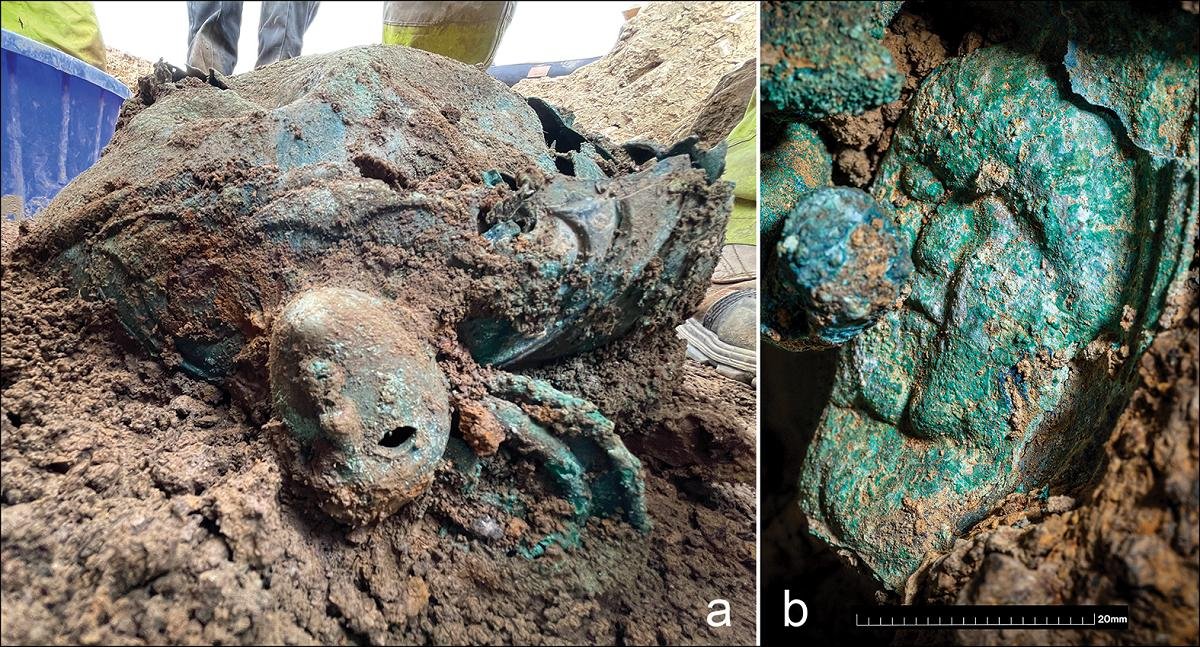
a) The second vessel from Hoard 1 during excavation (photograph: Durham University); b) the repoussé face in Hoard 2 block. Credit: Alexander Jansen, Durham University / Adams et al., Antiquity (2026)

The objects were not placed in the ground as intact valuables. Many had been deliberately bent, crushed, broken, or burned before burial. The 28 iron tires had been stacked after deformation. In one deposit, a large rock had been thrown onto a bronze cauldron hard enough to crush its base.


RelatedStories

Ancient burials, Roman well, and Anglo-Saxon house uncovered during A46 Newark bypass excavations

Ancient burials, Roman well, and Anglo-Saxon house uncovered during A46 Newark bypass excavations

May 12, 2026
Rare 1,500-year-old gold sword fitting found by hiker in Norway during morning walk

Rare 1,500-year-old gold sword fitting found by hiker in Norway during morning walk

May 9, 2026

This pattern does not look like ordinary disposal or metal recycling. Researchers argue the destruction was intentional and likely symbolic. The deposits appear to record a carefully staged event involving the dismantling and burial of high-status objects, including vehicles, horse gear, spears, vessels, and an iron mirror. The absence of everyday items such as pottery or personal ornaments supports this interpretation.

The hoard also strengthens the case for wealthy and well-connected elites in northern Britain during the Late Iron Age. Some of the metalwork resembles finds from an earlier nineteenth-century hoard discovered nearby, and decorative details suggest links with continental Europe and growing contact with the Roman world.

Researchers believe the finds date to a time when Stanwick was an important political center with access to imported goods and long-distance exchange networks. The large wagons, ornate horse harnesses, and ceremonial objects suggest transport was tied not only to movement, but also to status and display.

No other known Late Iron Age find in Britain combines the remains of multiple vehicles, horse equipment, weapons, cauldrons, and ritual destruction on this scale. For archaeologists, the Melsonby hoards offer a rare view into how powerful communities in northern Britain expressed wealth and social identity about 2,000 years ago.

More information: Adams, S., Armstrong, J., Bayliss, A., Moore, T., & Williams, E. (2026). Vehicles of change: two exceptional deposits of destroyed chariots or wagons from Late Iron Age Britain. Antiquity, 1–21. doi:10.15184/aqy.2026.10311
ShareTweetShareShareSend

You May Also Like...

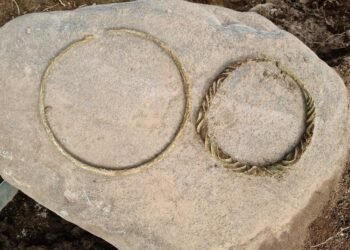
Rare Bronze Age burial in Sweden reveals unusual pair of Wendel neck rings and complex ritual landscape near Norrköping
Archaeology

Rare Bronze Age burial in Sweden reveals unusual pair of Wendel neck rings and complex ritual landscape near Norrköping

May 12, 2026
Kasta Tomb in Amphipolis fully revealed as restoration uncovers largest burial mound in Macedonia
Archaeology

Kasta Tomb in Amphipolis fully revealed as restoration uncovers largest burial mound in Macedonia

May 12, 2026
Rare Roman villa threatened by farming damage reveals rare mosaic and bathhouse remains in Devon
Archaeology

Rare Roman villa threatened by farming damage reveals rare mosaic and bathhouse remains in Devon

May 12, 2026
Ancient burials, Roman well, and Anglo-Saxon house uncovered during A46 Newark bypass excavations
Anthropology

Ancient burials, Roman well, and Anglo-Saxon house uncovered during A46 Newark bypass excavations

May 12, 2026
8-year-old boy finds 1,700-year-old Roman statuette fragment in Ramon Crater
Archaeology

8-year-old boy finds 1,700-year-old Roman statuette fragment in Ramon Crater

May 11, 2026
Slag from Paleopolis on Andros points to iron weapon and tool making during Macedonian rule in the 4th–3rd century BCE
Archaeology

Slag from Paleopolis on Andros points to iron weapon and tool making during Macedonian rule in the 4th–3rd century BCE

May 11, 2026

Comments 0

  1. Editorial Team says:
    1 second ago

    Disclaimer: This website is a science-focused magazine that welcomes both academic and non-academic audiences. Comments are written by users and may include personal opinions or unverified claims. They do not necessarily reflect the views of our editorial team or rely on scientific evidence.

    Comment Policy: We kindly ask all commenters to engage respectfully. Comments that contain offensive, insulting, degrading, discriminatory, or racist content will be automatically removed.

    Reply

Leave a Reply Cancel reply

Your email address will not be published. Required fields are marked *

Follow us


Instagram
242K

Facebook
117K

Threads
46K

LinkedIn
14K

Twitter
6K

YouTube
1K
  • Trending
  • Comments
  • Latest
Shipwreck Salvage. Credit: rawpixel.com / Public Domain

2,000-year-old shipwreck discovered off Turkish coast with remarkably preserved stacked ceramics

July 2, 2025
A new study suggests the mysterious Voynich Manuscript may be a medieval cipher

A new study suggests the mysterious Voynich Manuscript may be a medieval cipher

January 3, 2026
Viking age DNA reveals 9,000-year-old HIV-resistant gene originating near the Black Sea

Viking age DNA reveals 9,000-year-old HIV-resistant gene originating near the Black Sea

May 18, 2025
3D analysis reveals Shroud of Turin image likely came from sculpture, not Jesus’ body

3D analysis reveals Shroud of Turin image likely came from sculpture, not Jesus’ body

August 3, 2025
Moses may be named in ancient Egyptian mine inscriptions, sparking debate over earliest biblical references

Moses may be named in ancient Egyptian mine inscriptions, sparking debate over earliest biblical references

July 31, 2025
3D analysis reveals Shroud of Turin image likely came from sculpture, not Jesus’ body

3D analysis reveals Shroud of Turin image likely came from sculpture, not Jesus’ body

Moses may be named in ancient Egyptian mine inscriptions, sparking debate over earliest biblical references

Moses may be named in ancient Egyptian mine inscriptions, sparking debate over earliest biblical references

$1 million prize offered to decipher 5,300-year-old Indus Valley script

$1 million prize offered to decipher 5,300-year-old Indus Valley script

Oldest ever genetic data from a human relative found in 2-million-year-old fossilized teeth

Oldest ever genetic data from a human relative found in 2-million-year-old fossilized teeth

Exceptionally large Roman shoes discovered at Magna fort near Hadrian’s Wall

Exceptionally large Roman shoes discovered at Magna fort near Hadrian’s Wall

Rare Bronze Age burial in Sweden reveals unusual pair of Wendel neck rings and complex ritual landscape near Norrköping

Rare Bronze Age burial in Sweden reveals unusual pair of Wendel neck rings and complex ritual landscape near Norrköping

May 12, 2026
Kasta Tomb in Amphipolis fully revealed as restoration uncovers largest burial mound in Macedonia

Kasta Tomb in Amphipolis fully revealed as restoration uncovers largest burial mound in Macedonia

May 12, 2026
Rare Roman villa threatened by farming damage reveals rare mosaic and bathhouse remains in Devon

Rare Roman villa threatened by farming damage reveals rare mosaic and bathhouse remains in Devon

May 12, 2026
Ancient burials, Roman well, and Anglo-Saxon house uncovered during A46 Newark bypass excavations

Ancient burials, Roman well, and Anglo-Saxon house uncovered during A46 Newark bypass excavations

May 12, 2026
8-year-old boy finds 1,700-year-old Roman statuette fragment in Ramon Crater

8-year-old boy finds 1,700-year-old Roman statuette fragment in Ramon Crater

May 11, 2026

Archaeology News online magazine

Archaeology News is an international online magazine that covers all aspects of archaeology.


Categories

  • Academics
    • Books
    • Conferences
    • Universities
  • Articles
  • Download
  • Game
  • News
    • Anthropology
    • Archaeology
    • Paleontology
  • Quiz
  • Tours

Subscribe to our newsletter

© 2024 - Archaeology News Online Magazine. All Rights Reserved.

  • About
  • Privacy Policy
  • Terms of Use
  • Donation
  • Contact

Manage Consent
To provide the best experiences, we use technologies like cookies to store and/or access device information. Consenting to these technologies will allow us to process data such as browsing behavior or unique IDs on this site. Not consenting or withdrawing consent, may adversely affect certain features and functions.
Functional Always active
The technical storage or access is strictly necessary for the legitimate purpose of enabling the use of a specific service explicitly requested by the subscriber or user, or for the sole purpose of carrying out the transmission of a communication over an electronic communications network.
Preferences
The technical storage or access is necessary for the legitimate purpose of storing preferences that are not requested by the subscriber or user.
Statistics
The technical storage or access that is used exclusively for statistical purposes. The technical storage or access that is used exclusively for anonymous statistical purposes. Without a subpoena, voluntary compliance on the part of your Internet Service Provider, or additional records from a third party, information stored or retrieved for this purpose alone cannot usually be used to identify you.
Marketing
The technical storage or access is required to create user profiles to send advertising, or to track the user on a website or across several websites for similar marketing purposes.
  • Manage options
  • Manage services
  • Manage {vendor_count} vendors
  • Read more about these purposes
View preferences
  • {title}
  • {title}
  • {title}
  • Home
  • News
    • Archaeology
    • Anthropology
    • Paleontology
  • Academic
    • Books
    • Conferences
    • Universities
  • Articles
  • VR Tours
  • Quiz & Game
  • Download
  • Encyclopedia
  • Forum

About  .  Contact  .  Donation

© 2024 - Archaeology News Online Magazine. All Rights Reserved