• About
  • Privacy Policy
  • Terms of Use
  • Donation
  • Contact
No Result
View All Result
Archaeology News
  • Home
  • News
    • Archaeology
    • Anthropology
    • Paleontology
  • Academic
    • Books
    • Conferences
    • Universities
  • Articles
  • VR Tours
  • Quiz & Game
  • Download
  • Encyclopedia
  • Forum
Archaeology News
No Result
View All Result
Home News Archaeology

Researchers uncover complete Neolithic cursus on Isle of Arran

by Dario Radley
September 6, 2023

Archaeologists on the Isle of Arran’s southwest coast have unearthed what is believed to be the only complete Neolithic cursus monument in Britain. This ancient structure, dating back to between 4000 and 3000 BCE, represents a significant piece of history, shedding light on the ceremonial and social practices of Neolithic farmers.

Researchers uncover complete Neolithic cursus on Isle of Arran
Credit: University of Reading

Cursus monuments, vast rectangular enclosures, served as spaces for processions, ceremonies, and gatherings. They were deliberately distinct from everyday settlements and agricultural lands.

These monumental constructions ranged in size from 200 meters to an astounding 10 kilometers in length, often bordered by ditches, banks, or large oak posts. The Arran cursus, measuring approximately 1.1 kilometers, is situated near the stone circles of Machrie Moor, a site of great significance for ancient peoples.

The monumental scale of the Arran cursus is awe-inspiring. Constructing such a massive monument involved an astonishing amount of labor, and researchers estimate it could date as early as 3500 BCE. Kenny Brophy, a senior lecturer in archaeology at Glasgow University and a cursus specialist, notes the incredible preservation of this monument, largely due to its upland location, away from intensive farming, and the presence of a peat bog.
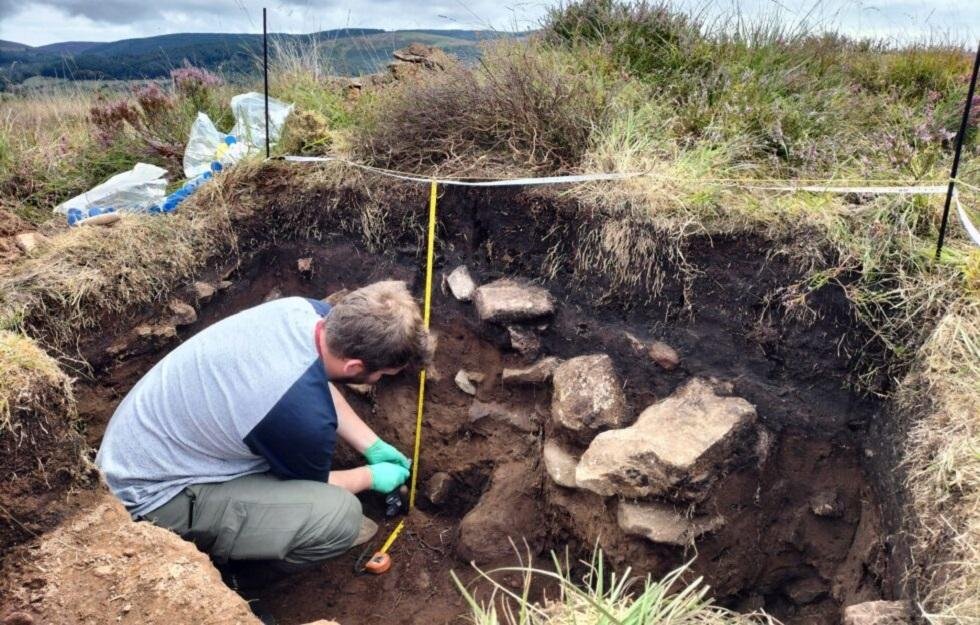
Researchers uncover complete Neolithic cursus on Isle of Arran
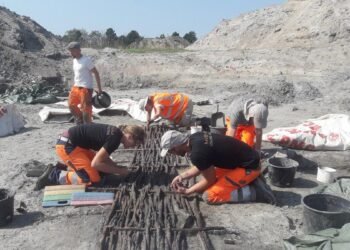
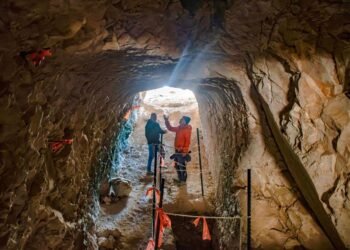
Dr Sam Hudson, University of Southampton, taking samples. Credit: Nicki Whitehouse

The discovery of the Arran cursus was made possible through a Lidar survey conducted by Historic Environment Scotland five years ago, revealing a highly unusual combination of ceremonial and farming landscapes. The cursus is defined by a large stone, earth, and turf bank encircling its perimeter, providing a rare opportunity for investigation. Prehistoric field boundaries, clearance cairns, and round houses have also been found in the same peatland landscape, sealing the archaeological layers.
RelatedStories

Ancient DNA reveals male lineage and family ties in Neolithic Scotland tombs

Ancient DNA reveals male lineage and family ties in Neolithic Scotland tombs

April 16, 2026
How ancient communities adapted their diets and farming strategies in prehistoric Poland

How ancient communities adapted their diets and farming strategies in prehistoric Poland

February 26, 2026

A team of archaeologists, including members from the Universities of Glasgow, Reading, Birkbeck, Bournemouth, Coventry, Birmingham, and Southampton, as well as Archaeology Scotland and Historic Environment Scotland, has been diligently working to understand this unique discovery. They employ various cutting-edge techniques, including ancient DNA analysis, to unravel the mysteries of how this landscape was constructed and used.

The Arran cursus’s significance extends beyond its historical value. It offers insights into early Neolithic farming practices and social organization. The landscape also sheds light on how people interacted with the cursus monument and how early farmers transformed the region. This information contributes to broader initiatives, such as the Rewilding strategy and research conducted by Arran Geopark.

Dr. Darko Maričević from the University of Reading, a specialist in archaeological geophysics, highlights the complexity of this site, stating, “Different geophysical techniques employed as part of the Awakening Sleeping Giants Project are revealing further complexity, making it a truly wonderful archaeological resource to explore and protect.”

Professor Nicki Whitehouse, Professor of Archaeological Science at the University of Glasgow, who led the landscape prospection and environmental science work, emphasizes the significance of the cursus within the broader context. “It is part of a continuum that likely linked to the ritual site at Machrie Moor, probably forming part of something much more extensive,” she states.

Local community involvement has been a key aspect of the excavation process. Dr. Gavin MacGregor, the Director of Archaeology Scotland, notes the enthusiasm generated among local volunteers and artists who joined the project. He describes the excavation as a form of “theatre of excavation,” where people come together to explore and understand the ancient site, mirroring the sense of wonder that may have existed when the cursus was first constructed.

Share1Tweet1ShareShareSend

You May Also Like...

Ramses II statue found in Egypt’s eastern Nile Delta shows ancient reuse of royal monuments
Archaeology

Ramses II statue found in Egypt’s eastern Nile Delta shows ancient reuse of royal monuments

April 24, 2026
Late Bronze Age bronze ring hoard near Dresden reveals ritual practices and social life 1300–1100 BCE
Archaeology

Late Bronze Age bronze ring hoard near Dresden reveals ritual practices and social life 1300–1100 BCE

April 21, 2026
Roman cemetery in Egypt reveals golden tongues, mummies, and rare Iliad papyrus
Anthropology

Roman cemetery in Egypt reveals golden tongues, mummies, and rare Iliad papyrus

April 19, 2026
Basel plague study finds young workers had highest death rates in 17th century outbreak
Anthropology

Basel plague study finds young workers had highest death rates in 17th century outbreak

April 17, 2026
Ancient DNA reveals male lineage and family ties in Neolithic Scotland tombs
Anthropology

Ancient DNA reveals male lineage and family ties in Neolithic Scotland tombs

April 16, 2026
Council houses reveal shift from royal rule to collective governance in Terminal Classic Maya society
Archaeology

Council houses reveal shift from royal rule to collective governance in Terminal Classic Maya society

April 11, 2026

Follow us


Instagram
244K

Facebook
118K

Threads
46K

LinkedIn
14K

Twitter
6K

YouTube
1K
  • Trending
  • Comments
  • Latest
Shipwreck Salvage. Credit: rawpixel.com / Public Domain

2,000-year-old shipwreck discovered off Turkish coast with remarkably preserved stacked ceramics

July 2, 2025
Viking age DNA reveals 9,000-year-old HIV-resistant gene originating near the Black Sea

Viking age DNA reveals 9,000-year-old HIV-resistant gene originating near the Black Sea

May 18, 2025
A new study suggests the mysterious Voynich Manuscript may be a medieval cipher

A new study suggests the mysterious Voynich Manuscript may be a medieval cipher

January 3, 2026
3D analysis reveals Shroud of Turin image likely came from sculpture, not Jesus’ body

3D analysis reveals Shroud of Turin image likely came from sculpture, not Jesus’ body

August 3, 2025
Moses may be named in ancient Egyptian mine inscriptions, sparking debate over earliest biblical references

Moses may be named in ancient Egyptian mine inscriptions, sparking debate over earliest biblical references

July 31, 2025
3D analysis reveals Shroud of Turin image likely came from sculpture, not Jesus’ body

3D analysis reveals Shroud of Turin image likely came from sculpture, not Jesus’ body

Moses may be named in ancient Egyptian mine inscriptions, sparking debate over earliest biblical references

Moses may be named in ancient Egyptian mine inscriptions, sparking debate over earliest biblical references

$1 million prize offered to decipher 5,300-year-old Indus Valley script

$1 million prize offered to decipher 5,300-year-old Indus Valley script

Oldest ever genetic data from a human relative found in 2-million-year-old fossilized teeth

Oldest ever genetic data from a human relative found in 2-million-year-old fossilized teeth

Exceptionally large Roman shoes discovered at Magna fort near Hadrian’s Wall

Exceptionally large Roman shoes discovered at Magna fort near Hadrian’s Wall

Ramses II statue found in Egypt’s eastern Nile Delta shows ancient reuse of royal monuments

Ramses II statue found in Egypt’s eastern Nile Delta shows ancient reuse of royal monuments

April 24, 2026
Late Bronze Age bronze ring hoard near Dresden reveals ritual practices and social life 1300–1100 BCE

Late Bronze Age bronze ring hoard near Dresden reveals ritual practices and social life 1300–1100 BCE

April 21, 2026
Roman cemetery in Egypt reveals golden tongues, mummies, and rare Iliad papyrus

Roman cemetery in Egypt reveals golden tongues, mummies, and rare Iliad papyrus

April 19, 2026
Basel plague study finds young workers had highest death rates in 17th century outbreak

Basel plague study finds young workers had highest death rates in 17th century outbreak

April 17, 2026
Ancient DNA reveals male lineage and family ties in Neolithic Scotland tombs

Ancient DNA reveals male lineage and family ties in Neolithic Scotland tombs

April 16, 2026

Archaeology News online magazine

Archaeology News is an international online magazine that covers all aspects of archaeology.


Categories

  • Academics
    • Books
    • Conferences
    • Universities
  • Articles
  • Download
  • Game
  • News
    • Anthropology
    • Archaeology
    • Paleontology
  • Quiz
  • Tours

Subscribe to our newsletter

© 2024 - Archaeology News Online Magazine. All Rights Reserved.

  • About
  • Privacy Policy
  • Terms of Use
  • Donation
  • Contact

Manage Consent
To provide the best experiences, we use technologies like cookies to store and/or access device information. Consenting to these technologies will allow us to process data such as browsing behavior or unique IDs on this site. Not consenting or withdrawing consent, may adversely affect certain features and functions.
Functional Always active
The technical storage or access is strictly necessary for the legitimate purpose of enabling the use of a specific service explicitly requested by the subscriber or user, or for the sole purpose of carrying out the transmission of a communication over an electronic communications network.
Preferences
The technical storage or access is necessary for the legitimate purpose of storing preferences that are not requested by the subscriber or user.
Statistics
The technical storage or access that is used exclusively for statistical purposes. The technical storage or access that is used exclusively for anonymous statistical purposes. Without a subpoena, voluntary compliance on the part of your Internet Service Provider, or additional records from a third party, information stored or retrieved for this purpose alone cannot usually be used to identify you.
Marketing
The technical storage or access is required to create user profiles to send advertising, or to track the user on a website or across several websites for similar marketing purposes.
  • Manage options
  • Manage services
  • Manage {vendor_count} vendors
  • Read more about these purposes
View preferences
  • {title}
  • {title}
  • {title}
  • Home
  • News
    • Archaeology
    • Anthropology
    • Paleontology
  • Academic
    • Books
    • Conferences
    • Universities
  • Articles
  • VR Tours
  • Quiz & Game
  • Download
  • Encyclopedia
  • Forum

About  .  Contact  .  Donation

© 2024 - Archaeology News Online Magazine. All Rights Reserved