• About
  • Privacy Policy
  • Terms of Use
  • Donation
  • Contact
No Result
View All Result
Archaeology News
  • Home
  • News
    • Archaeology
    • Anthropology
    • Paleontology
  • Academic
    • Books
    • Conferences
    • Universities
  • Articles
  • VR Tours
  • Quiz & Game
  • Download
  • Encyclopedia
  • Forum
Archaeology News
No Result
View All Result
Home News Archaeology

Massive 4,000-year-old fortification discovered surrounding Khaybar Oasis in northwestern Arabia

by Dario Radley
January 10, 2024

Archaeologists have recently uncovered a colossal Bronze Age fortification surrounding the Khaybar Oasis in the North Arabian Desert, making it one of the two largest walled oases in Saudi Arabia. The discovery was made by a team of scientists from the Centre National de la Recherche Scientifique (CNRS) and the Royal Commission for AlUla (RCU).
Massive 4,000-year-old fortification discovered surrounding Khaybar Oasis in northwestern Arabia
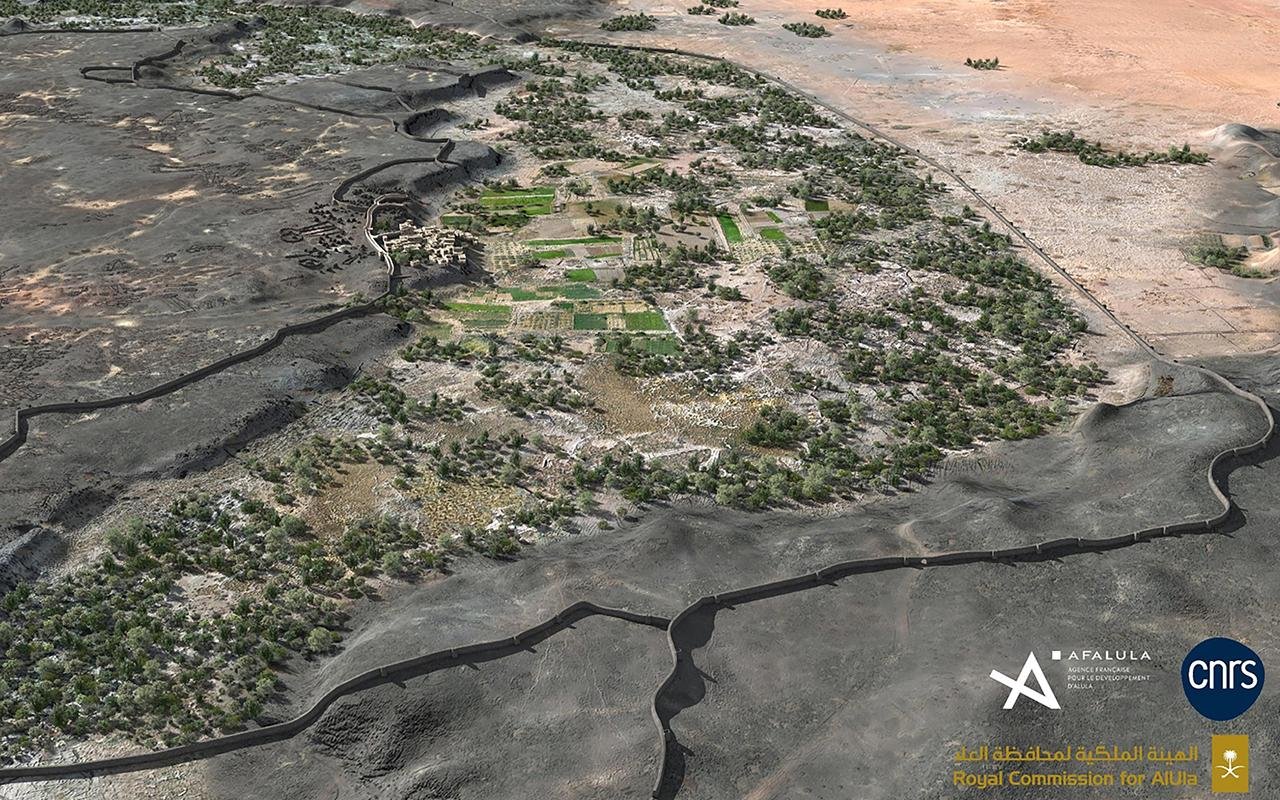
Digital reconstruction of the northern part of the walled oasis of Khaybar around 2000 BCE. Credit: Khaybar Longue Durée Archaeological Project, M. Bussy & G. Charloux / CNRS

The immense wall, dating back approximately 4,000 years, stretches over 14.5 kilometers, with original dimensions estimated at 1.7 to 2.4 meters in thickness and approximately 5 meters in height. Preserving only 41% of its original length (5.9 km and 74 bastions), the fortification enclosed a vast territory of nearly 1,100 hectares.

The fortification’s construction, determined through radiocarbon dating of samples collected during excavations, is estimated to have occurred between 2250 and 1950 BCE. Despite being a well-preserved relic of the past, the Khaybar Oasis wall had remained hidden for centuries, a fact attributed to the extensive transformation of the desert landscape over the millennia.

Archaeological studies have revealed that Khaybar Oasis, alongside Tayma, played a pivotal role in the network of fortified settlements in northwestern Arabia during the Bronze Age.

“Dating from the Late third millennium BCE, the ramparts of Khaybar were probably built by Indigenous populations as they settled down and ostentatiously demarcated their oasis territory,” the researchers write in their new study. This monumental construction, lasting for several centuries before being replaced, serves as a crucial landmark in the architectural and social heritage of northern Arabia.

RelatedStories

Scientists uncover Ireland’s largest prehistoric hillfort settlement, reshaping views of Bronze Age society

Scientists uncover Ireland’s largest prehistoric hillfort settlement, reshaping views of Bronze Age society

January 1, 2026
A 4,000-year-old sheep may reveal how the Bronze Age plague spread across Eurasia

A 4,000-year-old sheep may reveal how the Bronze Age plague spread across Eurasia

December 28, 2025

The researchers propose three main reasons for the construction of these massive desert defenses. Firstly, the walls served as physical protection against mobile desert groups, a known danger for sedentary groups during the ancient and early Islamic periods. Secondly, the fortifications helped control erosion, soil salinization, and flash flooding – constant threats to agricultural lands. Lastly, the walls acted as visible markers, emphasizing group cohesion while establishing territorial and social identity.

Advanced methods, such as remote sensing and 3D scanning, are being employed to meticulously map, document, and analyze the fortifications, ensuring their preservation and accurate interpretation. This technological approach allows for the creation of intricate digital models.

While the study confirms the Khaybar Oasis’s connection to a network of walled oases in northwestern Arabia, questions regarding why it was built and the nature of the populations involved persist.

More information: Charloux, G., Shabo, S., Chung-To, G., Depreux, B., Guermont, F., Guadagnini, K., … AlMushawh, M. (2024). The ramparts of Khaybar. Multiproxy investigation for reconstructing a Bronze Age walled oasis in Northwest Arabia. Journal of Archaeological Science: Reports, 104355. doi:10.1016/j.jasrep.2023.104355
Share2Tweet1ShareShareSend

You May Also Like...

5,500-year-old human skeleton in Colombia reveals earliest evidence of syphilis in the Americas
Anthropology

5,500-year-old human skeleton in Colombia reveals earliest evidence of syphilis in the Americas

January 23, 2026
Republican-era tombs and a Hercules shrine unearthed in eastern Rome reveal centuries of suburban life
Archaeology

Republican-era tombs and a Hercules shrine unearthed in eastern Rome reveal centuries of suburban life

January 23, 2026
Oldest known rock art dated to 67,800 years discovered in Sulawesi cave
Archaeology

Oldest known rock art dated to 67,800 years discovered in Sulawesi cave

January 20, 2026
Elite Anglo-Saxon sand burials and sacrificed horse grave found near Sizewell nuclear site in England
Anthropology

Elite Anglo-Saxon sand burials and sacrificed horse grave found near Sizewell nuclear site in England

January 19, 2026
Roman marching camps discovered in Saxony-Anhalt reveal early military advances deep into Germania
Archaeology

Roman marching camps discovered in Saxony-Anhalt reveal early military advances deep into Germania

January 15, 2026
Casablanca fossils dated 773,000 years back reveal African origin of last common ancestor of humans and Neanderthals
Anthropology

Casablanca fossils dated 773,000 years back reveal African origin of last common ancestor of humans and Neanderthals

January 10, 2026

Follow us


Instagram
244K

Facebook
118K

Threads
45K

LinkedIn
14K

Twitter
6K

YouTube
1K
  • Trending
  • Comments
  • Latest
Shipwreck Salvage. Credit: rawpixel.com / Public Domain

2,000-year-old shipwreck discovered off Turkish coast with remarkably preserved stacked ceramics

July 2, 2025
Viking age DNA reveals 9,000-year-old HIV-resistant gene originating near the Black Sea

Viking age DNA reveals 9,000-year-old HIV-resistant gene originating near the Black Sea

May 18, 2025
A new study suggests the mysterious Voynich Manuscript may be a medieval cipher

A new study suggests the mysterious Voynich Manuscript may be a medieval cipher

January 3, 2026
Moses may be named in ancient Egyptian mine inscriptions, sparking debate over earliest biblical references

Moses may be named in ancient Egyptian mine inscriptions, sparking debate over earliest biblical references

July 31, 2025
Mystery of Armenia’s 6,000-year-old dragon stones solved

Mystery of Armenia’s 6,000-year-old dragon stones solved

September 23, 2025
3D analysis reveals Shroud of Turin image likely came from sculpture, not Jesus’ body

3D analysis reveals Shroud of Turin image likely came from sculpture, not Jesus’ body

Moses may be named in ancient Egyptian mine inscriptions, sparking debate over earliest biblical references

Moses may be named in ancient Egyptian mine inscriptions, sparking debate over earliest biblical references

$1 million prize offered to decipher 5,300-year-old Indus Valley script

$1 million prize offered to decipher 5,300-year-old Indus Valley script

Oldest ever genetic data from a human relative found in 2-million-year-old fossilized teeth

Oldest ever genetic data from a human relative found in 2-million-year-old fossilized teeth

Exceptionally large Roman shoes discovered at Magna fort near Hadrian’s Wall

Exceptionally large Roman shoes discovered at Magna fort near Hadrian’s Wall

5,500-year-old human skeleton in Colombia reveals earliest evidence of syphilis in the Americas

5,500-year-old human skeleton in Colombia reveals earliest evidence of syphilis in the Americas

January 23, 2026
Republican-era tombs and a Hercules shrine unearthed in eastern Rome reveal centuries of suburban life

Republican-era tombs and a Hercules shrine unearthed in eastern Rome reveal centuries of suburban life

January 23, 2026
Oldest known rock art dated to 67,800 years discovered in Sulawesi cave

Oldest known rock art dated to 67,800 years discovered in Sulawesi cave

January 20, 2026
Elite Anglo-Saxon sand burials and sacrificed horse grave found near Sizewell nuclear site in England

Elite Anglo-Saxon sand burials and sacrificed horse grave found near Sizewell nuclear site in England

January 19, 2026
Roman marching camps discovered in Saxony-Anhalt reveal early military advances deep into Germania

Roman marching camps discovered in Saxony-Anhalt reveal early military advances deep into Germania

January 15, 2026

Archaeology News online magazine

Archaeology News is an international online magazine that covers all aspects of archaeology.


Categories

  • Academics
    • Books
    • Conferences
    • Universities
  • Articles
  • Download
  • Game
  • News
    • Anthropology
    • Archaeology
    • Paleontology
  • Quiz
  • Tours

Subscribe to our newsletter

© 2024 - Archaeology News Online Magazine. All Rights Reserved.

  • About
  • Privacy Policy
  • Terms of Use
  • Donation
  • Contact

Welcome Back!

Login to your account below

Forgotten Password? Sign Up

Create New Account!

Fill the forms below to register

All fields are required. Log In

Retrieve your password

Please enter your username or email address to reset your password.

Log In

Add New Playlist

Manage Consent
To provide the best experiences, we use technologies like cookies to store and/or access device information. Consenting to these technologies will allow us to process data such as browsing behavior or unique IDs on this site. Not consenting or withdrawing consent, may adversely affect certain features and functions.
Functional Always active
The technical storage or access is strictly necessary for the legitimate purpose of enabling the use of a specific service explicitly requested by the subscriber or user, or for the sole purpose of carrying out the transmission of a communication over an electronic communications network.
Preferences
The technical storage or access is necessary for the legitimate purpose of storing preferences that are not requested by the subscriber or user.
Statistics
The technical storage or access that is used exclusively for statistical purposes. The technical storage or access that is used exclusively for anonymous statistical purposes. Without a subpoena, voluntary compliance on the part of your Internet Service Provider, or additional records from a third party, information stored or retrieved for this purpose alone cannot usually be used to identify you.
Marketing
The technical storage or access is required to create user profiles to send advertising, or to track the user on a website or across several websites for similar marketing purposes.
  • Manage options
  • Manage services
  • Manage {vendor_count} vendors
  • Read more about these purposes
View preferences
  • {title}
  • {title}
  • {title}
  • Home
  • News
    • Archaeology
    • Anthropology
    • Paleontology
  • Academic
    • Books
    • Conferences
    • Universities
  • Articles
  • VR Tours
  • Quiz & Game
  • Download
  • Encyclopedia
  • Forum

About  .  Contact  .  Donation

© 2024 - Archaeology News Online Magazine. All Rights Reserved