• About
  • Privacy Policy
  • Terms of Use
  • Donation
  • Contact
No Result
View All Result
Archaeology News
  • Home
  • News
    • Archaeology
    • Anthropology
    • Paleontology
  • Academic
    • Books
    • Conferences
    • Universities
  • Articles
  • VR Tours
  • Quiz & Game
  • Download
  • Encyclopedia
  • Forum
Archaeology News
No Result
View All Result
Home News Archaeology

The first Americans may have arrived by a sea ice highway as early as 24,000 years ago

by Dario Radley
January 9, 2024

In a recent study presented at the American Geophysical Union Annual Meeting, researchers propose a new perspective on how and when humans first arrived in North America.

The first Americans may have arrived by a sea ice highway as early as 24,000 years ago
The first Americans may have arrived by a sea ice highway as early as 24,000 years ago. Credit: Archaeology News Online Magazine

The research, led by Summer Praetorius from the United States Geological Survey (USGS), suggests that sea ice may have served as a vital route for human migration thousands of years ago, offering an alternative to the widely debated ice-free corridor theory.

Traditionally, archaeologists argued that approximately 13,000 years ago, stone age hunters crossed a land bridge connecting eastern Siberia and western Alaska. Subsequently, they walked through an ice-free corridor that opened briefly between ice sheets during that period. However, recent discoveries, such as human footprints in New Mexico dating back to 23,000 years ago, have ignited debates by proposing an earlier human presence on the continent.

The study emphasizes two main migration scenarios. The first suggests a journey through Beringia when it was relatively free of ice, while the second proposes a coastal route along the Pacific, known as the “kelp highway.” The latter theory gained traction as evidence of coastal settlements in western Canada dating back to 14,000 years ago surfaced. However, challenges arose in 2020 when researchers suggested that strong currents, caused by freshwater from melting glaciers, could have hindered coastal travel.
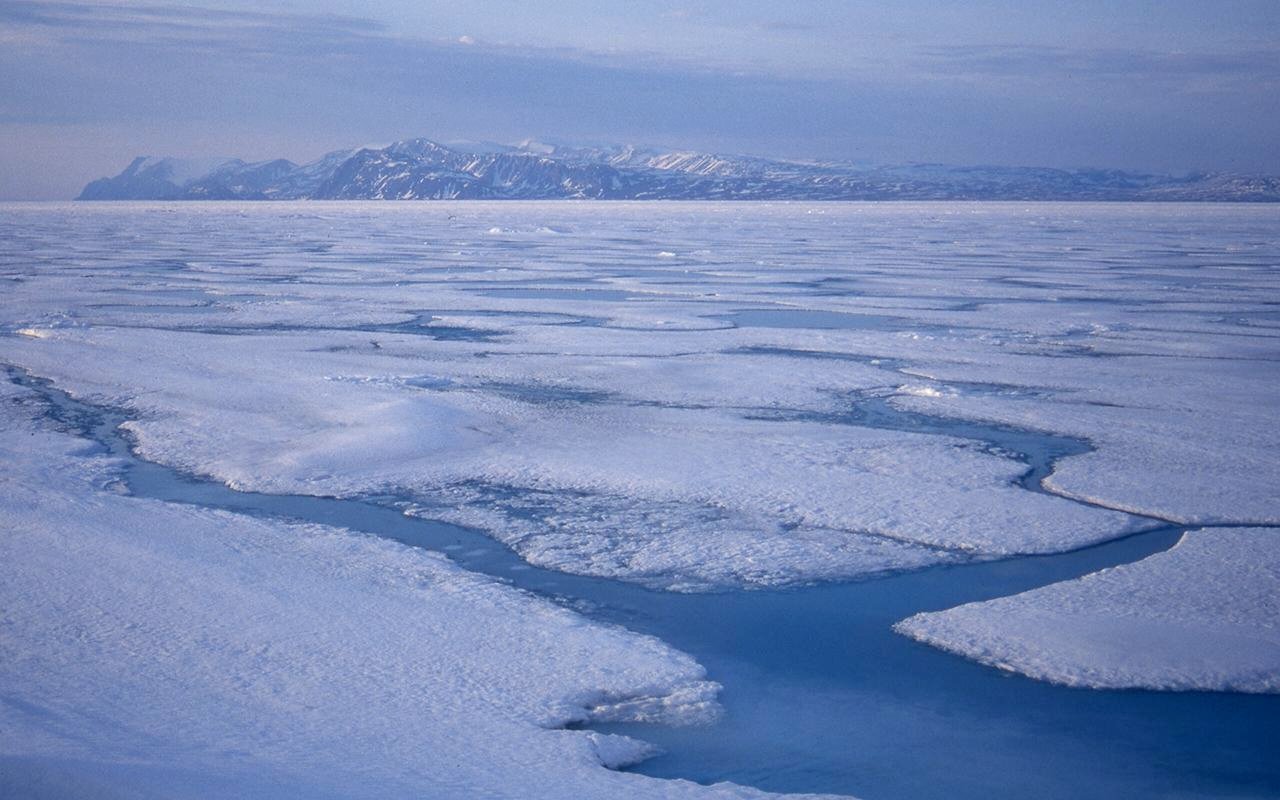
The first Americans may have arrived by a sea ice highway as early as 24,000 years ago
Sea ice at Nunavut, Canada. Credit: AGU/Grid-Arendel CC-BY-NC-SA

To address these challenges, Praetorius and her team delved into paleoclimate reconstructions of the Pacific Northwest, focusing on the potential role of sea ice in facilitating human movement. Utilizing climate proxies in ocean sediment from the coast, the researchers reconstructed ocean temperatures, salinity, and sea ice cover, employing data from tiny, fossilized plankton.


RelatedStories

Earliest known burial in Northern Britain identified as young girl through DNA analysis

Earliest known burial in Northern Britain identified as young girl through DNA analysis

February 14, 2026
Why bison hunters abandoned a long-used site 1,100 years ago due to severe droughts

Why bison hunters abandoned a long-used site 1,100 years ago due to severe droughts

February 11, 2026

Their findings indicate that 20,000 years ago, ocean currents were more than twice as strong as today, making boat travel challenging. However, the region was home to sea ice until around 15,000 years ago. Praetorius suggests that early Americans, adept at cold conditions, might have used the sea ice as a platform, creating a ‘sea ice highway’ to navigate and hunt marine mammals, gradually making their way into North America.

Modern-day Arctic people navigate sea ice using dog sleds and snowmobiles, providing a parallel to how early migrants might have utilized this natural infrastructure. Praetorius acknowledges the difficulty of proving this theory due to many archaeological sites being underwater but emphasizes that it offers a new framework for understanding early human migration.

The climate data also suggests favorable conditions for migration between 24,500 and 22,000 years ago and 16,400-14,800 years ago, possibly aided by the presence of winter sea ice. Praetorius notes that the sea ice highway theory does not exclude other later human migrations, as their models indicate the Alaskan current had become more manageable by 14,000 years ago, allowing for easier coastal travel by boat.

As the archaeological community grapples with the age-old question of when, how, and why humans moved from Asia to North America, Praetorius’s research offers a new perspective on ancient human migration through the utilization of a sea ice highway.

More information: Did a “Sea-ice Highway” facilitate early human migration from Beringia into North America along the coastal route?
Share4Tweet3Share1ShareSend

You May Also Like...

Roman cemetery in Egypt reveals golden tongues, mummies, and rare Iliad papyrus
Anthropology

Roman cemetery in Egypt reveals golden tongues, mummies, and rare Iliad papyrus

April 19, 2026
Basel plague study finds young workers had highest death rates in 17th century outbreak
Anthropology

Basel plague study finds young workers had highest death rates in 17th century outbreak

April 17, 2026
Ancient DNA reveals male lineage and family ties in Neolithic Scotland tombs
Anthropology

Ancient DNA reveals male lineage and family ties in Neolithic Scotland tombs

April 16, 2026
Council houses reveal shift from royal rule to collective governance in Terminal Classic Maya society
Archaeology

Council houses reveal shift from royal rule to collective governance in Terminal Classic Maya society

April 11, 2026
Bronze Age loom found inside ancient Spanish home reveals early textile production
Archaeology

Bronze Age loom found inside ancient Spanish home reveals early textile production

April 8, 2026
Pompeii ash analysis reveals Romans burned wine and imported frankincense in household rituals
Archaeology

Pompeii ash analysis reveals Romans burned wine and imported frankincense in household rituals

April 3, 2026

Follow us


Instagram
244K

Facebook
118K

Threads
46K

LinkedIn
14K

Twitter
6K

YouTube
1K
  • Trending
  • Comments
  • Latest
Shipwreck Salvage. Credit: rawpixel.com / Public Domain

2,000-year-old shipwreck discovered off Turkish coast with remarkably preserved stacked ceramics

July 2, 2025
Viking age DNA reveals 9,000-year-old HIV-resistant gene originating near the Black Sea

Viking age DNA reveals 9,000-year-old HIV-resistant gene originating near the Black Sea

May 18, 2025
A new study suggests the mysterious Voynich Manuscript may be a medieval cipher

A new study suggests the mysterious Voynich Manuscript may be a medieval cipher

January 3, 2026
3D analysis reveals Shroud of Turin image likely came from sculpture, not Jesus’ body

3D analysis reveals Shroud of Turin image likely came from sculpture, not Jesus’ body

August 3, 2025
Moses may be named in ancient Egyptian mine inscriptions, sparking debate over earliest biblical references

Moses may be named in ancient Egyptian mine inscriptions, sparking debate over earliest biblical references

July 31, 2025
3D analysis reveals Shroud of Turin image likely came from sculpture, not Jesus’ body

3D analysis reveals Shroud of Turin image likely came from sculpture, not Jesus’ body

Moses may be named in ancient Egyptian mine inscriptions, sparking debate over earliest biblical references

Moses may be named in ancient Egyptian mine inscriptions, sparking debate over earliest biblical references

$1 million prize offered to decipher 5,300-year-old Indus Valley script

$1 million prize offered to decipher 5,300-year-old Indus Valley script

Oldest ever genetic data from a human relative found in 2-million-year-old fossilized teeth

Oldest ever genetic data from a human relative found in 2-million-year-old fossilized teeth

Exceptionally large Roman shoes discovered at Magna fort near Hadrian’s Wall

Exceptionally large Roman shoes discovered at Magna fort near Hadrian’s Wall

Roman cemetery in Egypt reveals golden tongues, mummies, and rare Iliad papyrus

Roman cemetery in Egypt reveals golden tongues, mummies, and rare Iliad papyrus

April 19, 2026
Basel plague study finds young workers had highest death rates in 17th century outbreak

Basel plague study finds young workers had highest death rates in 17th century outbreak

April 17, 2026
Ancient DNA reveals male lineage and family ties in Neolithic Scotland tombs

Ancient DNA reveals male lineage and family ties in Neolithic Scotland tombs

April 16, 2026
Council houses reveal shift from royal rule to collective governance in Terminal Classic Maya society

Council houses reveal shift from royal rule to collective governance in Terminal Classic Maya society

April 11, 2026
Bronze Age loom found inside ancient Spanish home reveals early textile production

Bronze Age loom found inside ancient Spanish home reveals early textile production

April 8, 2026

Archaeology News online magazine

Archaeology News is an international online magazine that covers all aspects of archaeology.


Categories

  • Academics
    • Books
    • Conferences
    • Universities
  • Articles
  • Download
  • Game
  • News
    • Anthropology
    • Archaeology
    • Paleontology
  • Quiz
  • Tours

Subscribe to our newsletter

© 2024 - Archaeology News Online Magazine. All Rights Reserved.

  • About
  • Privacy Policy
  • Terms of Use
  • Donation
  • Contact

Manage Consent
To provide the best experiences, we use technologies like cookies to store and/or access device information. Consenting to these technologies will allow us to process data such as browsing behavior or unique IDs on this site. Not consenting or withdrawing consent, may adversely affect certain features and functions.
Functional Always active
The technical storage or access is strictly necessary for the legitimate purpose of enabling the use of a specific service explicitly requested by the subscriber or user, or for the sole purpose of carrying out the transmission of a communication over an electronic communications network.
Preferences
The technical storage or access is necessary for the legitimate purpose of storing preferences that are not requested by the subscriber or user.
Statistics
The technical storage or access that is used exclusively for statistical purposes. The technical storage or access that is used exclusively for anonymous statistical purposes. Without a subpoena, voluntary compliance on the part of your Internet Service Provider, or additional records from a third party, information stored or retrieved for this purpose alone cannot usually be used to identify you.
Marketing
The technical storage or access is required to create user profiles to send advertising, or to track the user on a website or across several websites for similar marketing purposes.
  • Manage options
  • Manage services
  • Manage {vendor_count} vendors
  • Read more about these purposes
View preferences
  • {title}
  • {title}
  • {title}
  • Home
  • News
    • Archaeology
    • Anthropology
    • Paleontology
  • Academic
    • Books
    • Conferences
    • Universities
  • Articles
  • VR Tours
  • Quiz & Game
  • Download
  • Encyclopedia
  • Forum

About  .  Contact  .  Donation

© 2024 - Archaeology News Online Magazine. All Rights Reserved