• About
  • Privacy Policy
  • Terms of Use
  • Donation
  • Contact
No Result
View All Result
Archaeology News
  • Home
  • News
    • Archaeology
    • Anthropology
    • Paleontology
  • Academic
    • Books
    • Conferences
    • Universities
  • Articles
  • VR Tours
  • Quiz & Game
  • Download
  • Encyclopedia
  • Forum
Archaeology News
No Result
View All Result
Home News Archaeology

Archaeologists unearth stunning Maya murals and reliefs at Dzibanché

by Dario Radley
October 31, 2024

Archaeologists with Mexico’s National Institute of Anthropology and History (INAH) at the ancient Maya city of Dzibanché have unearthed three stucco reliefs that depict scenes of the powerful Kaanu’l (or Snake) dynasty. Located in Quintana Roo, Mexico, Dzibanché—an early center for the Maya civilization dating back to 300 BCE—served as the initial stronghold of the Kaanu’l rulers, who later expanded their influence to vast regions in present-day Mexico, Belize, and Guatemala.

Archaeologists unearth stunning Maya murals and reliefs at Dzibanché
Illustrative image: Dzibanche, Quintana Roo, Mexico: building of the lintel. Credit: HJPD / CC BY 3.0

The new findings, which date to the Early Classic period (500-600 CE), were discovered on two platforms west of the site’s Ball Game II court, a ceremonial space for the Maya ballgame, an activity combining athleticism and ritual devotion. These platforms, each approximately 10 by 5 feet, display the first stucco reliefs ever uncovered on Dzibanché’s ballcourt, which archaeologists believe were meant to reinforce the dynasty’s authority.

Sandra Balanzario Granados, head of the INAH’s Archaeological Site Improvement Program (Promeza) at Dzibanché, described the discovery as a breakthrough: “Although we had found stucco reliefs on larger buildings, we would never have thought of finding such decorated façades on a ball court with such profound meanings as these ones apparently have,” she explained.

Each of the three relief scenes offers a glimpse into the mythological and celestial beliefs of the Kaanu’l dynasty. The first relief features two figures standing guard beside a pedestal, originally intended to support a sculpture, with symbols referencing a Kaanu’l ruler. The second scene depicts ancestral figures in a cosmic setting, surrounded by stars and intertwining serpents—motifs that reflect the Kaanu’l’s divine connection as rulers.

Epigrapher Alexander Tokovinine noted the striking blend of Maya and Teotihuacán iconography, particularly the serpent symbolism, which underscored the dynasty’s claim to a godly lineage. The third panel portrays a series of mythological animals linked to constellations, further emphasizing the rulers’ divine right and their cosmological power.


RelatedStories

Ancient Maya traded live dogs across hundreds of miles, isotope study finds

Ancient Maya traded live dogs across hundreds of miles, isotope study finds

May 9, 2026
Council houses reveal shift from royal rule to collective governance in Terminal Classic Maya society

Council houses reveal shift from royal rule to collective governance in Terminal Classic Maya society

April 11, 2026

The prominence of intertwined snakes—a recurring theme across the reliefs—is especially significant, as it represents the “Snake” lineage of the Kaanu’l dynasty, affirming their place as divine intermediaries between the gods and the people. In pre-Hispanic Maya culture, rulers were often regarded as earthly representatives of the gods, and the Kaanu’l rulers viewed themselves as descendants of celestial beings. According to INAH, “This representation of intertwined snakes indicates that we are looking at images with which the rulers of Dzibanché sought to reaffirm their ancestry or lineage.”

The stucco reliefs, crafted from a mixture called sascab (a lime-based mortar common in Maya construction), still retain traces of red, blue, yellow, and black paint. However, centuries of exposure to the elements have eroded much of their vibrant colors. To preserve these artifacts, the archaeological team is employing advanced photogrammetry to create detailed models, ensuring that these intricate designs are documented accurately for future research.

This discovery is part of a broader research effort funded by the INAH and the ongoing Mayan Train project, an initiative aimed at connecting archaeological sites across the Yucatán Peninsula. Since 2023, a 100-person team has worked extensively at Dzibanché, uncovering relics of Maya civilization and restoring important structures, including the Temple of the Owl, the Temple of the Cormorants, and sections of the acropolis.

More information: INAH

Share5Tweet3Share1ShareSend

You May Also Like...

Horse domestication began centuries earlier than thought, study reveals early riding and management in 4th millennium BCE
Archaeology

Horse domestication began centuries earlier than thought, study reveals early riding and management in 4th millennium BCE

May 15, 2026
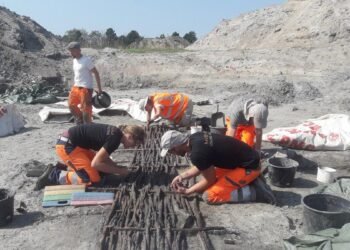
Ancient Danes kept fishing for millennia after farming arrived, study finds
Archaeology

Ancient Danes kept fishing for millennia after farming arrived, study finds

May 14, 2026
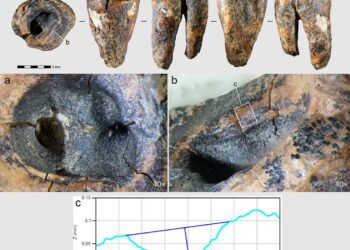
Oldest known dental treatment found in 59,000-year-old Neanderthal tooth from Siberia
Anthropology

Oldest known dental treatment found in 59,000-year-old Neanderthal tooth from Siberia

May 14, 2026
Homo erectus in Java: 140,000-year-old fossils found in submerged river valley
Anthropology

400,000-year-old Homo erectus proteins reveal genetic links to Denisovans and modern humans

May 14, 2026
Cut marks on 1.6-million-year-old bones reveal early humans moved and processed meat in Kenya
Anthropology

Cut marks on 1.6-million-year-old bones reveal early humans moved and processed meat in Kenya

May 13, 2026
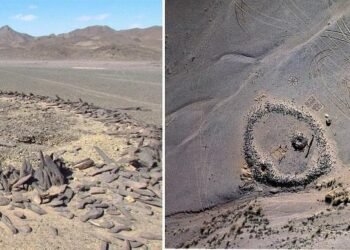
280 ancient stone burial monuments found in Sudan reveal lost cattle-herding culture in the Sahara
Archaeology

280 ancient stone burial monuments found in Sudan reveal lost cattle-herding culture in the Sahara

May 13, 2026

Follow us


Instagram
242K

Facebook
117K

Threads
46K

LinkedIn
14K

Twitter
6K

YouTube
1K
  • Trending
  • Comments
  • Latest
Shipwreck Salvage. Credit: rawpixel.com / Public Domain

2,000-year-old shipwreck discovered off Turkish coast with remarkably preserved stacked ceramics

July 2, 2025
A new study suggests the mysterious Voynich Manuscript may be a medieval cipher

A new study suggests the mysterious Voynich Manuscript may be a medieval cipher

January 3, 2026
Viking age DNA reveals 9,000-year-old HIV-resistant gene originating near the Black Sea

Viking age DNA reveals 9,000-year-old HIV-resistant gene originating near the Black Sea

May 18, 2025
3D analysis reveals Shroud of Turin image likely came from sculpture, not Jesus’ body

3D analysis reveals Shroud of Turin image likely came from sculpture, not Jesus’ body

August 3, 2025
Moses may be named in ancient Egyptian mine inscriptions, sparking debate over earliest biblical references

Moses may be named in ancient Egyptian mine inscriptions, sparking debate over earliest biblical references

July 31, 2025
3D analysis reveals Shroud of Turin image likely came from sculpture, not Jesus’ body

3D analysis reveals Shroud of Turin image likely came from sculpture, not Jesus’ body

Moses may be named in ancient Egyptian mine inscriptions, sparking debate over earliest biblical references

Moses may be named in ancient Egyptian mine inscriptions, sparking debate over earliest biblical references

$1 million prize offered to decipher 5,300-year-old Indus Valley script

$1 million prize offered to decipher 5,300-year-old Indus Valley script

Oldest ever genetic data from a human relative found in 2-million-year-old fossilized teeth

Oldest ever genetic data from a human relative found in 2-million-year-old fossilized teeth

Exceptionally large Roman shoes discovered at Magna fort near Hadrian’s Wall

Exceptionally large Roman shoes discovered at Magna fort near Hadrian’s Wall

Horse domestication began centuries earlier than thought, study reveals early riding and management in 4th millennium BCE

Horse domestication began centuries earlier than thought, study reveals early riding and management in 4th millennium BCE

May 15, 2026
Ancient Danes kept fishing for millennia after farming arrived, study finds

Ancient Danes kept fishing for millennia after farming arrived, study finds

May 14, 2026
Oldest known dental treatment found in 59,000-year-old Neanderthal tooth from Siberia

Oldest known dental treatment found in 59,000-year-old Neanderthal tooth from Siberia

May 14, 2026
Homo erectus in Java: 140,000-year-old fossils found in submerged river valley

400,000-year-old Homo erectus proteins reveal genetic links to Denisovans and modern humans

May 14, 2026
Cut marks on 1.6-million-year-old bones reveal early humans moved and processed meat in Kenya

Cut marks on 1.6-million-year-old bones reveal early humans moved and processed meat in Kenya

May 13, 2026

Archaeology News online magazine

Archaeology News is an international online magazine that covers all aspects of archaeology.


Categories

  • Academics
    • Books
    • Conferences
    • Universities
  • Articles
  • Download
  • Game
  • News
    • Anthropology
    • Archaeology
    • Paleontology
  • Quiz
  • Tours

Subscribe to our newsletter

© 2024 - Archaeology News Online Magazine. All Rights Reserved.

  • About
  • Privacy Policy
  • Terms of Use
  • Donation
  • Contact

Manage Consent
To provide the best experiences, we use technologies like cookies to store and/or access device information. Consenting to these technologies will allow us to process data such as browsing behavior or unique IDs on this site. Not consenting or withdrawing consent, may adversely affect certain features and functions.
Functional Always active
The technical storage or access is strictly necessary for the legitimate purpose of enabling the use of a specific service explicitly requested by the subscriber or user, or for the sole purpose of carrying out the transmission of a communication over an electronic communications network.
Preferences
The technical storage or access is necessary for the legitimate purpose of storing preferences that are not requested by the subscriber or user.
Statistics
The technical storage or access that is used exclusively for statistical purposes. The technical storage or access that is used exclusively for anonymous statistical purposes. Without a subpoena, voluntary compliance on the part of your Internet Service Provider, or additional records from a third party, information stored or retrieved for this purpose alone cannot usually be used to identify you.
Marketing
The technical storage or access is required to create user profiles to send advertising, or to track the user on a website or across several websites for similar marketing purposes.
  • Manage options
  • Manage services
  • Manage {vendor_count} vendors
  • Read more about these purposes
View preferences
  • {title}
  • {title}
  • {title}
  • Home
  • News
    • Archaeology
    • Anthropology
    • Paleontology
  • Academic
    • Books
    • Conferences
    • Universities
  • Articles
  • VR Tours
  • Quiz & Game
  • Download
  • Encyclopedia
  • Forum

About  .  Contact  .  Donation

© 2024 - Archaeology News Online Magazine. All Rights Reserved