• About
  • Privacy Policy
  • Terms of Use
  • Donation
  • Contact
No Result
View All Result
Archaeology News
  • Home
  • News
    • Archaeology
    • Anthropology
    • Paleontology
  • Academic
    • Books
    • Conferences
    • Universities
  • Articles
  • VR Tours
  • Quiz & Game
  • Download
  • Encyclopedia
  • Forum
Archaeology News
No Result
View All Result
Home News Archaeology

Archaeologists discover strangely modified sheep horns from 3700 BCE in Egypt’s Hierakonpolis

by Dario Radley
November 10, 2024

Archaeologists have uncovered evidence of an ancient Egyptian practice involving the modification of sheep horns at the mortuary complex of Hierakonpolis in Upper Egypt, dating back to approximately 3700 BCE.

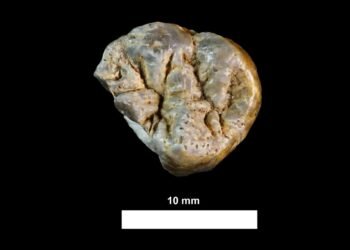
This discovery represents the oldest known case of intentional horn modification in livestock, according to a study published in the Journal of Archaeological Science. The find comprises six large, castrated male sheep whose skulls displayed deformed horn structures. Unlike naturally grown lateral horns, these sheep had horns that were directed upwards, with some completely removed. The deformations are believed to have been achieved by fracturing and tying the horn bases, an approach that directed the horns to grow in parallel, upright positions.

In describing the findings, Professor Wim Van Neer of the Royal Belgian Institute of Natural Sciences explained that these modifications were deliberate: “The sheep were deliberately made ‘special’ by castration. In addition, their horns were directed upward, and in one case, the horns were removed.” The discovery of this practice at Hierakonpolis provides the earliest physical evidence of horn modification applied to sheep, a tradition later observed with cattle across various African cultures, including the pastoralist communities of Nubia in the third millennium BCE.

Archaeologists discover strangely modified sheep horns from 3700 BCE in Egypt's Hierakonpolis
Skull of a ram. Credit: Tymur Khakimov

The modification of livestock horns has long been practiced globally to reduce the risk of injury to handlers and animals. Archaeologists found signs of pathological changes on the horn cores of the Hierakonpolis sheep, suggesting a structured and deliberate technique to alter the horns’ growth patterns. Researchers propose that these sheep might have been raised for ceremonial or ritualistic purposes, given that they were discovered in the elite cemetery of the ancient mortuary complex. Further analysis revealed constrictions and fractures on the horn cores and deformities in the skulls, which indicate intentional physical manipulation.

The agrarian society of ancient Egypt relied heavily on domesticated animals for nutritional support, including cattle and sheep, as these provided essential resources such as meat, fat, and dairy. While cattle horn modifications are commonly depicted in Egyptian tomb art dating to the Old Kingdom (circa 2686–2160 BCE), these sheep skulls from Hierakonpolis predate those depictions by nearly a thousand years. The findings suggest that the Egyptians not only utilized sheep and cattle but also engaged in practices to control and manage these animals, contributing to the cultural and symbolic importance of livestock in early Egyptian society.


RelatedStories

4,400-year-old sun temple of King Nyuserre uncovered at Abusir necropolis in Egypt

4,400-year-old sun temple of King Nyuserre uncovered at Abusir necropolis in Egypt

December 16, 2025
5,000-year-old dog skeleton and dagger buried in a Swedish bog reveal Stone Age ritual practices among fishing communities

5,000-year-old dog skeleton and dagger buried in a Swedish bog reveal Stone Age ritual practices among fishing communities

December 16, 2025

Iconographic evidence from later periods, including the First Dynasty (circa 3500 BCE) onwards, shows increasing representations of sheep in Egyptian art, as well as their incorporation into the religious system as embodiments of deities, notably ram gods. Hieroglyphic symbols of sheep also emerged, underscoring the animal’s growing significance in Egypt’s socio-religious landscape. By the Middle Kingdom (circa 1991 BCE), depictions in tomb art and archaeological remains, such as those found at Tell el-Dab’a, reflect the symbolic and economic roles of various sheep breeds, including those with back-curving horns like the ammon-type.

The Hierakonpolis study not only expands our understanding of early Egyptian animal husbandry but also illustrates an enduring Nile Valley tradition of livestock modification.

More information: Van Neer, W., De Cupere, B., & Friedman, R. (2024). The earliest evidence for deformation of livestock horns: The case of Predynastic sheep from Hierakonpolis, Egypt. Journal of Archaeological Science, 172(106104), 106104. doi:10.1016/j.jas.2024.106104
Share1Tweet1ShareShareSend

You May Also Like...

Inscription on important Roman sitella found in Cartagena reveals unknown governor and casting-lot use
Archaeology

Inscription on Roman sitella in Cartagena reveals unknown governor and casting-lot use

December 21, 2025
Should archaeology rethink its reliance on the concept of “culture”?
Archaeology

Should archaeology rethink its reliance on the concept of “culture”?

December 21, 2025
Unusual 3,000-year-old Bronze Age mass burial reveals ancient crisis in Scotland
Anthropology

Unusual 3,000-year-old Bronze Age mass burial reveals ancient crisis in Scotland

December 20, 2025
Roman soldiers at Vindolanda suffered persistent parasite infections, researchers discover
Anthropology

Roman soldiers at Vindolanda suffered persistent parasite infections, researchers discover

December 20, 2025
Christians and Zoroastrians lived side by side in 5th-century Iraq, archaeologists find
Archaeology

Christians and Zoroastrians coexisted peacefully in 5th-century Iraq, archaeologists find

December 19, 2025
New study searches for hidden chambers inside El Castillo pyramid in Chichén Itzá
Archaeology

New study searches for hidden chambers inside El Castillo pyramid in Chichén Itzá

December 19, 2025

Follow us


Instagram
245K

Facebook
117K

Threads
45K

LinkedIn
14K

Twitter
6K

YouTube
1K
  • Trending
  • Comments
  • Latest
Shipwreck Salvage. Credit: rawpixel.com / Public Domain

2,000-year-old shipwreck discovered off Turkish coast with remarkably preserved stacked ceramics

July 2, 2025
Viking age DNA reveals 9,000-year-old HIV-resistant gene originating near the Black Sea

Viking age DNA reveals 9,000-year-old HIV-resistant gene originating near the Black Sea

May 18, 2025
Complete copy of the Canopus Decree unearthed in Egypt after 150 years

Complete copy of the Canopus Decree unearthed in Egypt after 150 years

September 13, 2025
Mystery of Armenia’s 6,000-year-old dragon stones solved

Mystery of Armenia’s 6,000-year-old dragon stones solved

September 23, 2025
Moses may be named in ancient Egyptian mine inscriptions, sparking debate over earliest biblical references

Moses may be named in ancient Egyptian mine inscriptions, sparking debate over earliest biblical references

July 31, 2025
3D analysis reveals Shroud of Turin image likely came from sculpture, not Jesus’ body

3D analysis reveals Shroud of Turin image likely came from sculpture, not Jesus’ body

Moses may be named in ancient Egyptian mine inscriptions, sparking debate over earliest biblical references

Moses may be named in ancient Egyptian mine inscriptions, sparking debate over earliest biblical references

$1 million prize offered to decipher 5,300-year-old Indus Valley script

$1 million prize offered to decipher 5,300-year-old Indus Valley script

Oldest ever genetic data from a human relative found in 2-million-year-old fossilized teeth

Oldest ever genetic data from a human relative found in 2-million-year-old fossilized teeth

Exceptionally large Roman shoes discovered at Magna fort near Hadrian’s Wall

Exceptionally large Roman shoes discovered at Magna fort near Hadrian’s Wall

Inscription on important Roman sitella found in Cartagena reveals unknown governor and casting-lot use

Inscription on Roman sitella in Cartagena reveals unknown governor and casting-lot use

December 21, 2025
Should archaeology rethink its reliance on the concept of “culture”?

Should archaeology rethink its reliance on the concept of “culture”?

December 21, 2025
Unusual 3,000-year-old Bronze Age mass burial reveals ancient crisis in Scotland

Unusual 3,000-year-old Bronze Age mass burial reveals ancient crisis in Scotland

December 20, 2025
Roman soldiers at Vindolanda suffered persistent parasite infections, researchers discover

Roman soldiers at Vindolanda suffered persistent parasite infections, researchers discover

December 20, 2025
Christians and Zoroastrians lived side by side in 5th-century Iraq, archaeologists find

Christians and Zoroastrians coexisted peacefully in 5th-century Iraq, archaeologists find

December 19, 2025

Archaeology News online magazine

Archaeology News is an international online magazine that covers all aspects of archaeology.


Categories

  • Academics
    • Books
    • Conferences
    • Universities
  • Articles
  • Download
  • Game
  • News
    • Anthropology
    • Archaeology
    • Paleontology
  • Quiz
  • Tours

Subscribe to our newsletter

© 2024 - Archaeology News Online Magazine. All Rights Reserved.

  • About
  • Privacy Policy
  • Terms of Use
  • Donation
  • Contact

Welcome Back!

Login to your account below

Forgotten Password? Sign Up

Create New Account!

Fill the forms below to register

All fields are required. Log In

Retrieve your password

Please enter your username or email address to reset your password.

Log In

Add New Playlist

Manage Consent
To provide the best experiences, we use technologies like cookies to store and/or access device information. Consenting to these technologies will allow us to process data such as browsing behavior or unique IDs on this site. Not consenting or withdrawing consent, may adversely affect certain features and functions.
Functional Always active
The technical storage or access is strictly necessary for the legitimate purpose of enabling the use of a specific service explicitly requested by the subscriber or user, or for the sole purpose of carrying out the transmission of a communication over an electronic communications network.
Preferences
The technical storage or access is necessary for the legitimate purpose of storing preferences that are not requested by the subscriber or user.
Statistics
The technical storage or access that is used exclusively for statistical purposes. The technical storage or access that is used exclusively for anonymous statistical purposes. Without a subpoena, voluntary compliance on the part of your Internet Service Provider, or additional records from a third party, information stored or retrieved for this purpose alone cannot usually be used to identify you.
Marketing
The technical storage or access is required to create user profiles to send advertising, or to track the user on a website or across several websites for similar marketing purposes.
  • Manage options
  • Manage services
  • Manage {vendor_count} vendors
  • Read more about these purposes
View preferences
  • {title}
  • {title}
  • {title}
  • Home
  • News
    • Archaeology
    • Anthropology
    • Paleontology
  • Academic
    • Books
    • Conferences
    • Universities
  • Articles
  • VR Tours
  • Quiz & Game
  • Download
  • Encyclopedia
  • Forum

About  .  Contact  .  Donation

© 2024 - Archaeology News Online Magazine. All Rights Reserved