• About
  • Privacy Policy
  • Terms of Use
  • Donation
  • Contact
No Result
View All Result
Archaeology News
  • Home
  • News
    • Archaeology
    • Anthropology
    • Paleontology
  • Academic
    • Books
    • Conferences
    • Universities
  • Articles
  • VR Tours
  • Quiz & Game
  • Download
  • Encyclopedia
  • Forum
Archaeology News
No Result
View All Result
Home News Anthropology

Ancient Finnish graves reveal how ochre signaled identity and social networks

by Dario Radley
January 28, 2026

About 5,500 to 6,000 years ago, hunter-fisher-gatherers lived across what is now Finland. These communities, known to archaeologists as the Typical Comb Ware culture, built semi-subterranean houses, traveled along waterways, and relied on fishing, hunting, and small-scale plant use. They buried their dead in graves marked by bright red ochre, an iron-rich earth pigment with clear ritual value.
Ancient Finnish graves reveal how ochre signaled identity and social networks
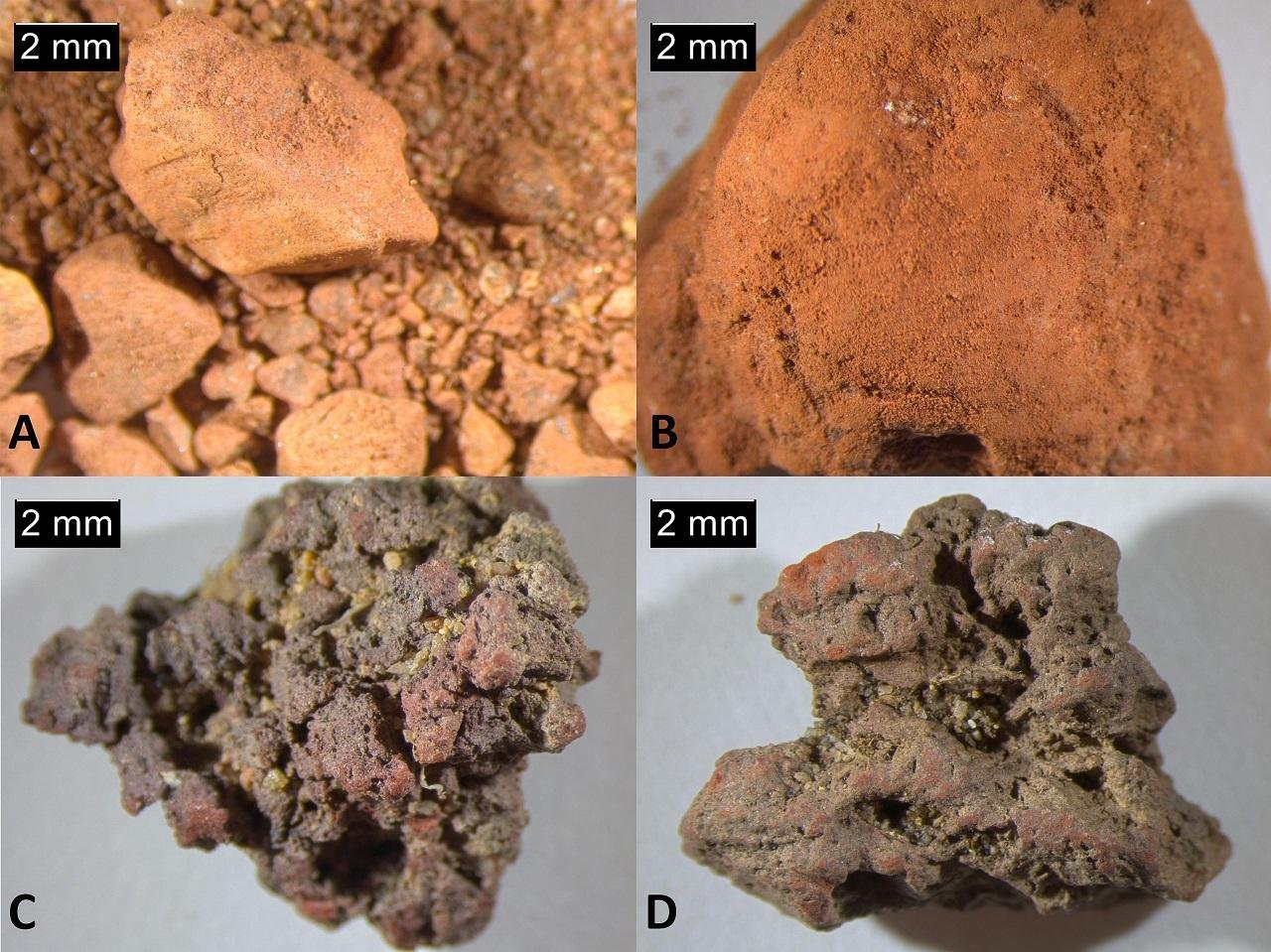
Stereomicroscope images of ochre samples A) KM11873:24 from Kolmhaara (Gr 1c); B) 15512:149 from Kolmhaara (Gr 1b); C) KM37849:3122 from Vaateranta (Gr 2); and D) KM37849:3144 from Vaateranta (Gr 2). Credit: E. Holmqvist, Journal of Archaeological Science: Reports (2026)

A new study in the Journal of Archaeological Science Reports examines how these groups selected and moved ochre. Researchers analyzed samples from eight archaeological sites across Finland, taken from both graves and settlement areas. The team used non-invasive energy dispersive X-ray fluorescence and scanning electron microscopy with energy dispersive spectrometry. These methods preserved the original material while measuring elemental composition.

The results show three main chemical groups of ochre rather than a unique signature at each site. Some chemically similar samples appear at locations up to 500 kilometers apart. This pattern points to long-distance movement of the pigment. Such distances match known exchange routes that moved other materials, including Baltic amber and slate ornaments from the Lake Onega region. Ochre formed part of the same social and exchange networks that linked distant communities.

The study also compared ochre from domestic spaces and burial contexts. At several sites, the chemical makeup of ochre from graves differed from samples found in living areas. This pattern suggests deliberate choices tied to funerary practice rather than random use of local soil. In some cemeteries, individuals buried close together received ochre from different chemical groups. Even within a single grave, separate objects or body areas sometimes carried pigment from distinct sources.

Ancient Finnish graves reveal how ochre signaled identity and social networks
Examples of analyzed ochre samples. A) Ochre-stained soil from Hartikka grave 1 (KM 23591:6); B) Ochre piece from Vaateranta settlement (NM 37849:3122). Credit: M. Ahola, Journal of Archaeological Science: Reports (2026)

These patterns show that color alone did not drive selection. Communities placed value on where the pigment came from and how people obtained it. Transport over long distances required planning, travel, and social ties. The presence of non-local ochre in graves signals links between groups and shared ritual traditions.

RelatedStories
Ancient ship burial in Norway dates to CE 700, rewriting early Viking Age origins

Ancient ship burial in Norway dates to CE 700, rewriting early Viking Age origins

April 25, 2026
Mesolithic burials in Sweden show ancient fur and feather headgear uncovered by new microscopic analysis

Mesolithic burials in Sweden show ancient fur and feather headgear uncovered by new microscopic analysis

February 25, 2026

The research also highlights regional procurement. Some ochre groups cluster around certain parts of Finland, which points to preferred sources known to nearby communities. Other pigments moved between regions in both directions. Exchange worked as a network rather than a one way flow.

By combining chemical data with archaeological context, the study reveals how early forager societies organized materials, memory, and identity. Ochre served as more than decoration. People selected specific types for specific individuals and settings, which tied the dead to places and relationships that stretched far beyond a single village.

More information: Holmqvist, E., Lahtinen, M., & Ahola, M. (2026). Non-invasive chemical characterisation of archaeological ochres from the early 4th millennium BCE forager graves and settlements in Finland. Journal of Archaeological Science, Reports, 70(105584). doi:10.1016/j.jasrep.2026.105584
Share9Tweet6Share2ShareSend

You May Also Like...

Ancient ship burial in Norway dates to CE 700, rewriting early Viking Age origins
Archaeology

Ancient ship burial in Norway dates to CE 700, rewriting early Viking Age origins

April 25, 2026
Ramses II statue found in Egypt’s eastern Nile Delta shows ancient reuse of royal monuments
Archaeology

Ramses II statue found in Egypt’s eastern Nile Delta shows ancient reuse of royal monuments

April 24, 2026
Late Bronze Age bronze ring hoard near Dresden reveals ritual practices and social life 1300–1100 BCE
Archaeology

Late Bronze Age bronze ring hoard near Dresden reveals ritual practices and social life 1300–1100 BCE

April 21, 2026
Roman cemetery in Egypt reveals golden tongues, mummies, and rare Iliad papyrus
Anthropology

Roman cemetery in Egypt reveals golden tongues, mummies, and rare Iliad papyrus

April 19, 2026
Basel plague study finds young workers had highest death rates in 17th century outbreak
Anthropology

Basel plague study finds young workers had highest death rates in 17th century outbreak

April 17, 2026
Ancient DNA reveals male lineage and family ties in Neolithic Scotland tombs
Anthropology

Ancient DNA reveals male lineage and family ties in Neolithic Scotland tombs

April 16, 2026

Comments 0

  1. Editorial Team says:
    1 second ago

    Disclaimer: This website is a science-focused magazine that welcomes both academic and non-academic audiences. Comments are written by users and may include personal opinions or unverified claims. They do not necessarily reflect the views of our editorial team or rely on scientific evidence.

    Comment Policy: We kindly ask all commenters to engage respectfully. Comments that contain offensive, insulting, degrading, discriminatory, or racist content will be automatically removed.

    Reply

Leave a Reply Cancel reply

Your email address will not be published. Required fields are marked *

Follow us


Instagram
244K

Facebook
118K

Threads
46K

LinkedIn
14K

Twitter
6K

YouTube
1K
  • Trending
  • Comments
  • Latest
Shipwreck Salvage. Credit: rawpixel.com / Public Domain

2,000-year-old shipwreck discovered off Turkish coast with remarkably preserved stacked ceramics

July 2, 2025
Viking age DNA reveals 9,000-year-old HIV-resistant gene originating near the Black Sea

Viking age DNA reveals 9,000-year-old HIV-resistant gene originating near the Black Sea

May 18, 2025
A new study suggests the mysterious Voynich Manuscript may be a medieval cipher

A new study suggests the mysterious Voynich Manuscript may be a medieval cipher

January 3, 2026
3D analysis reveals Shroud of Turin image likely came from sculpture, not Jesus’ body

3D analysis reveals Shroud of Turin image likely came from sculpture, not Jesus’ body

August 3, 2025
Moses may be named in ancient Egyptian mine inscriptions, sparking debate over earliest biblical references

Moses may be named in ancient Egyptian mine inscriptions, sparking debate over earliest biblical references

July 31, 2025
3D analysis reveals Shroud of Turin image likely came from sculpture, not Jesus’ body

3D analysis reveals Shroud of Turin image likely came from sculpture, not Jesus’ body

Moses may be named in ancient Egyptian mine inscriptions, sparking debate over earliest biblical references

Moses may be named in ancient Egyptian mine inscriptions, sparking debate over earliest biblical references

$1 million prize offered to decipher 5,300-year-old Indus Valley script

$1 million prize offered to decipher 5,300-year-old Indus Valley script

Oldest ever genetic data from a human relative found in 2-million-year-old fossilized teeth

Oldest ever genetic data from a human relative found in 2-million-year-old fossilized teeth

Exceptionally large Roman shoes discovered at Magna fort near Hadrian’s Wall

Exceptionally large Roman shoes discovered at Magna fort near Hadrian’s Wall

Ancient ship burial in Norway dates to CE 700, rewriting early Viking Age origins

Ancient ship burial in Norway dates to CE 700, rewriting early Viking Age origins

April 25, 2026
Ramses II statue found in Egypt’s eastern Nile Delta shows ancient reuse of royal monuments

Ramses II statue found in Egypt’s eastern Nile Delta shows ancient reuse of royal monuments

April 24, 2026
Late Bronze Age bronze ring hoard near Dresden reveals ritual practices and social life 1300–1100 BCE

Late Bronze Age bronze ring hoard near Dresden reveals ritual practices and social life 1300–1100 BCE

April 21, 2026
Roman cemetery in Egypt reveals golden tongues, mummies, and rare Iliad papyrus

Roman cemetery in Egypt reveals golden tongues, mummies, and rare Iliad papyrus

April 19, 2026
Basel plague study finds young workers had highest death rates in 17th century outbreak

Basel plague study finds young workers had highest death rates in 17th century outbreak

April 17, 2026

Archaeology News online magazine

Archaeology News is an international online magazine that covers all aspects of archaeology.


Categories

  • Academics
    • Books
    • Conferences
    • Universities
  • Articles
  • Download
  • Game
  • News
    • Anthropology
    • Archaeology
    • Paleontology
  • Quiz
  • Tours

Subscribe to our newsletter

© 2024 - Archaeology News Online Magazine. All Rights Reserved.

  • About
  • Privacy Policy
  • Terms of Use
  • Donation
  • Contact

Manage Consent
To provide the best experiences, we use technologies like cookies to store and/or access device information. Consenting to these technologies will allow us to process data such as browsing behavior or unique IDs on this site. Not consenting or withdrawing consent, may adversely affect certain features and functions.
Functional Always active
The technical storage or access is strictly necessary for the legitimate purpose of enabling the use of a specific service explicitly requested by the subscriber or user, or for the sole purpose of carrying out the transmission of a communication over an electronic communications network.
Preferences
The technical storage or access is necessary for the legitimate purpose of storing preferences that are not requested by the subscriber or user.
Statistics
The technical storage or access that is used exclusively for statistical purposes. The technical storage or access that is used exclusively for anonymous statistical purposes. Without a subpoena, voluntary compliance on the part of your Internet Service Provider, or additional records from a third party, information stored or retrieved for this purpose alone cannot usually be used to identify you.
Marketing
The technical storage or access is required to create user profiles to send advertising, or to track the user on a website or across several websites for similar marketing purposes.
  • Manage options
  • Manage services
  • Manage {vendor_count} vendors
  • Read more about these purposes
View preferences
  • {title}
  • {title}
  • {title}
  • Home
  • News
    • Archaeology
    • Anthropology
    • Paleontology
  • Academic
    • Books
    • Conferences
    • Universities
  • Articles
  • VR Tours
  • Quiz & Game
  • Download
  • Encyclopedia
  • Forum

About  .  Contact  .  Donation

© 2024 - Archaeology News Online Magazine. All Rights Reserved