• About
  • Privacy Policy
  • Terms of Use
  • Donation
  • Contact
No Result
View All Result
Archaeology News
  • Home
  • News
    • Archaeology
    • Anthropology
    • Paleontology
  • Academic
    • Books
    • Conferences
    • Universities
  • Articles
  • VR Tours
  • Quiz & Game
  • Download
  • Encyclopedia
  • Forum
Archaeology News
No Result
View All Result
Home News Archaeology

Rare deer skull headdress discovered in Germany highlights exchange between hunter-gatherers and Europe’s first farmers

by Dario Radley
February 7, 2026

Archaeologists working at the Early Neolithic settlement of Eilsleben in Saxony-Anhalt have uncovered evidence of close contact between Europe’s first farming communities and local hunter-gatherers. Finds from recent fieldwork, combined with material recovered in earlier excavations, show shared technologies and symbolic objects within a village founded by members of the Linear Pottery culture around 5375 BCE.
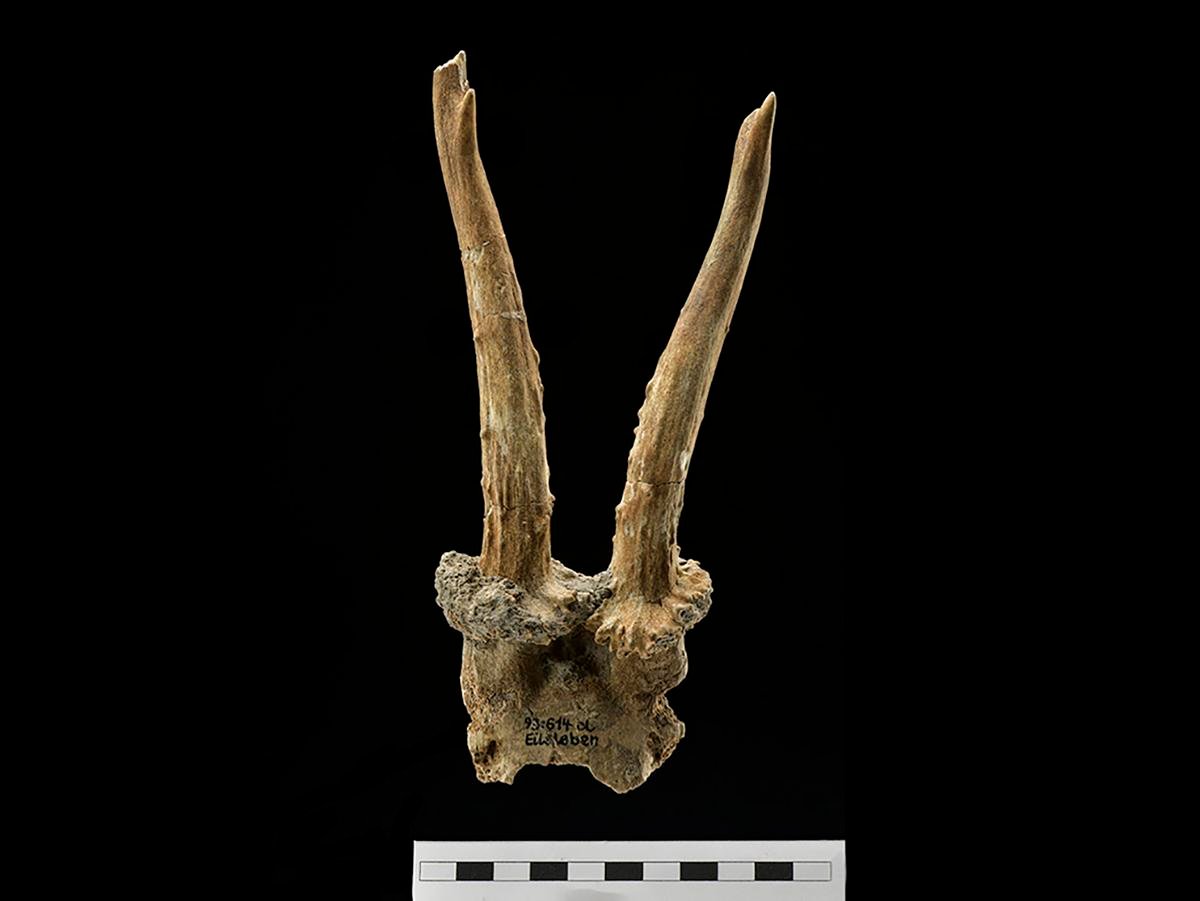
Rare deer skull headdress discovered in Germany highlights exchange between hunter-gatherers and Europe's first farmers
7,500-year-old deer skull headdress discovered in a pit of the early Neolithic settlement. Scale = 110mm. Credit: Landesamt für Denkmalpflege und Archäologie Sachsen-Anhalt, J. Lipták / L. Dietrich et al., Antiquity (2026); CC BY-NC-SA 4.0

Eilsleben lies in a fertile loess region and marks the northern edge of early Neolithic expansion into Central Europe. Surveys and excavations since the 1970s have revealed a large settlement that covered about 20 acres. Geomagnetic data outline rows of longhouses, pits, and ditches linked with LBK traditions. At least nine burials belong to this farming group, along with unusual deposits of isolated skulls and articulated body parts placed in settlement features.

Excavations in 2024 exposed well-preserved occupation layers in a shallow depression protected from later plowing. Burnt daub, house debris, plant remains, and soil layers now allow detailed study of daily activities. Researchers use archaeobotany, micromorphology, soil chemistry, and radiocarbon dating to reconstruct house locations, work areas, and the sequence of enclosure construction. The team also studies about 70,000 artifacts from earlier digs, stored by the regional heritage office.

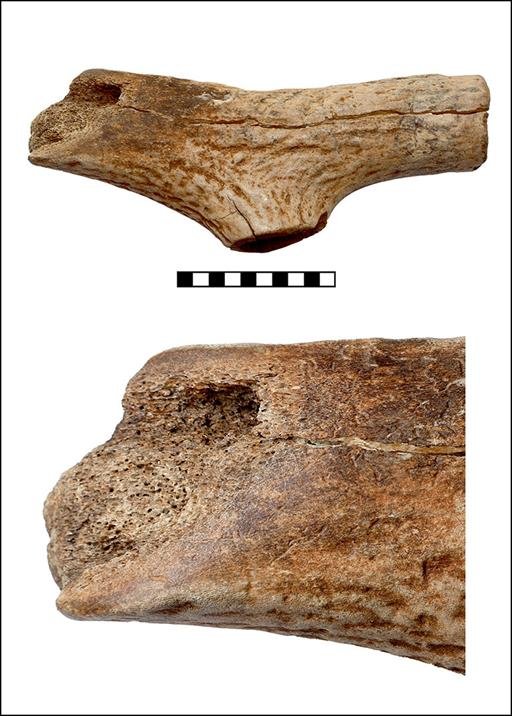
Among typical LBK pottery, stone tools, and animal bones, archaeologists identified a group of objects linked with Mesolithic traditions. These include numerous antler tools and production waste, showing on site manufacture. Several T-shaped antler axes match forms known from Late Mesolithic and early farmer contact zones in other parts of Europe. Antler punches and transverse flint arrowheads also fit hunting technologies used by foraging groups.
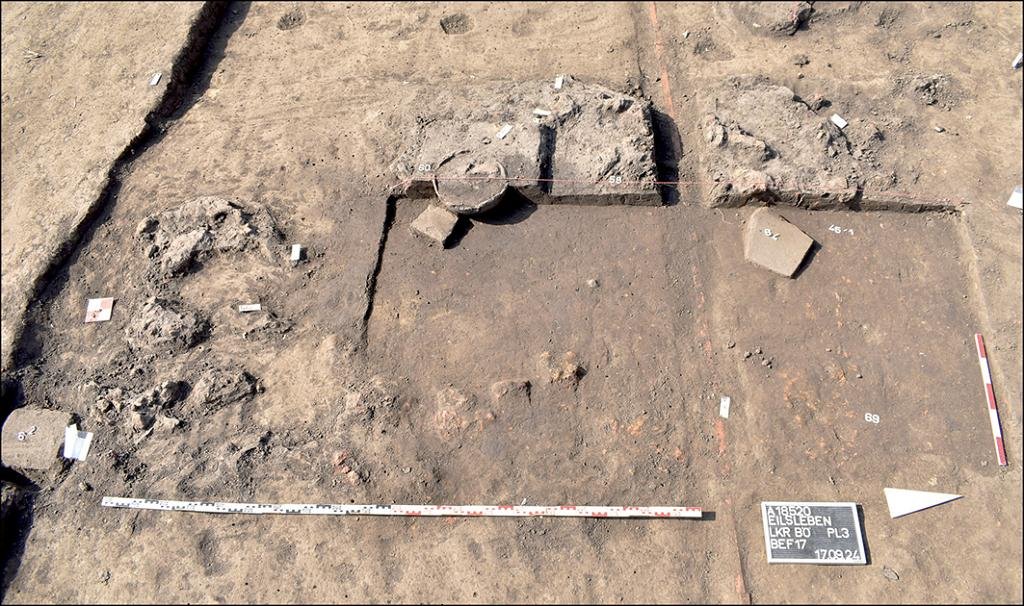
Rare deer skull headdress discovered in Germany highlights exchange between hunter-gatherers and Europe's first farmers
Activity area with in situ ceramic vessel and grinding stones and concentrations of burnt daub from a destruction horizon. Credit: Martin-Luther University Halle, F. Becker / L. Dietrich et al., Antiquity (2026); CC BY-NC-SA 4.0

The most striking object is a roe deer skull with antlers modified into a headdress or mask. Similar items appear in Mesolithic ritual contexts, including the famous burial at Bad Dürrenberg dated to about 7000 BCE. Such objects hold strong symbolic meaning in hunter-gatherer societies. Their presence inside an LBK farming village points to more than trade in raw materials. Shared practices and ideas likely moved between groups.
RelatedStories

Cut marks on 1.6-million-year-old bones reveal early humans moved and processed meat in Kenya

Cut marks on 1.6-million-year-old bones reveal early humans moved and processed meat in Kenya

May 13, 2026
Neanderthals used rhinoceros teeth as tools for making stone implements, study finds

Neanderthals used rhinoceros teeth as tools for making stone implements, study finds

May 9, 2026

Antler rarely served as a main raw material in LBK toolkits. Its frequent use at Eilsleben suggests local adoption of forager techniques. This pattern supports a model of technology transfer in which farmers learned selected skills from neighboring hunter-gatherers. Exchange did not replace core farming lifeways, since most artifacts still follow Neolithic traditions. Instead, the site shows a blended material culture in a frontier zone.
Rare deer skull headdress discovered in Germany highlights exchange between hunter-gatherers and Europe's first farmers
T-shaped antler axe with broken and polished edge. Possibly used as hoe. Scale = 100mm. Credit: Martin-Luther University Halle, L. Dietrich / L. Dietrich et al., Antiquity (2026); CC BY-NC-SA 4.0

Defensive features add another layer to the story. Ditches and ramparts surrounded parts of the settlement during several phases. Radiocarbon dates from these enclosures will clarify whether construction relates to conflict, social display, or other forms of boundary marking in a landscape shared by different communities.

Genetic studies from other regions indicate limited intermarriage between early farmers and Mesolithic groups. Eilsleben offers archaeological evidence for regular contact without large scale population mixing. Material exchange, shared rituals, and selective adoption of tools formed part of everyday life along this cultural boundary. Ongoing analysis of human remains and settlement deposits will refine understanding of how these neighboring societies shaped each other during the first spread of agriculture in Europe.
More information: Dietrich, L., Knoll, F., Piezonka, H., Orschiedt, J., Heikkinen, M., Becker, F., … Meller, H. (2026). LBK outpost of Eilsleben: hunter-farmer encounters in the borderlands of Early Neolithic Central Europe. Antiquity, 1–7. doi:10.15184/aqy.2025.10270
Share25Tweet16Share4ShareSend

You May Also Like...

Cut marks on 1.6-million-year-old bones reveal early humans moved and processed meat in Kenya
Anthropology

Cut marks on 1.6-million-year-old bones reveal early humans moved and processed meat in Kenya

May 13, 2026
280 ancient stone burial monuments found in Sudan reveal lost cattle-herding culture in the Sahara
Archaeology

280 ancient stone burial monuments found in Sudan reveal lost cattle-herding culture in the Sahara

May 13, 2026
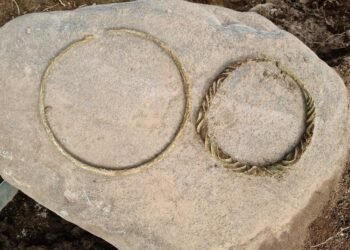
Rare Bronze Age burial in Sweden reveals unusual pair of Wendel neck rings and complex ritual landscape near Norrköping
Archaeology

Rare Bronze Age burial in Sweden reveals unusual pair of Wendel neck rings and complex ritual landscape near Norrköping

May 12, 2026
Kasta Tomb in Amphipolis fully revealed as restoration uncovers largest burial mound in Macedonia
Archaeology

Kasta Tomb in Amphipolis fully revealed as restoration uncovers largest burial mound in Macedonia

May 12, 2026
Rare Roman villa threatened by farming damage reveals rare mosaic and bathhouse remains in Devon
Archaeology

Rare Roman villa threatened by farming damage reveals rare mosaic and bathhouse remains in Devon

May 12, 2026
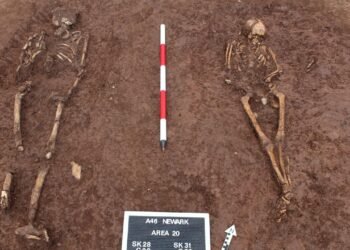
Ancient burials, Roman well, and Anglo-Saxon house uncovered during A46 Newark bypass excavations
Anthropology

Ancient burials, Roman well, and Anglo-Saxon house uncovered during A46 Newark bypass excavations

May 12, 2026

Comments 0

  1. Editorial Team says:
    1 second ago

    Disclaimer: This website is a science-focused magazine that welcomes both academic and non-academic audiences. Comments are written by users and may include personal opinions or unverified claims. They do not necessarily reflect the views of our editorial team or rely on scientific evidence.

    Comment Policy: We kindly ask all commenters to engage respectfully. Comments that contain offensive, insulting, degrading, discriminatory, or racist content will be automatically removed.

    Reply

Leave a Reply Cancel reply

Your email address will not be published. Required fields are marked *

Follow us


Instagram
242K

Facebook
117K

Threads
46K

LinkedIn
14K

Twitter
6K

YouTube
1K
  • Trending
  • Comments
  • Latest
Shipwreck Salvage. Credit: rawpixel.com / Public Domain

2,000-year-old shipwreck discovered off Turkish coast with remarkably preserved stacked ceramics

July 2, 2025
A new study suggests the mysterious Voynich Manuscript may be a medieval cipher

A new study suggests the mysterious Voynich Manuscript may be a medieval cipher

January 3, 2026
Viking age DNA reveals 9,000-year-old HIV-resistant gene originating near the Black Sea

Viking age DNA reveals 9,000-year-old HIV-resistant gene originating near the Black Sea

May 18, 2025
3D analysis reveals Shroud of Turin image likely came from sculpture, not Jesus’ body

3D analysis reveals Shroud of Turin image likely came from sculpture, not Jesus’ body

August 3, 2025
Moses may be named in ancient Egyptian mine inscriptions, sparking debate over earliest biblical references

Moses may be named in ancient Egyptian mine inscriptions, sparking debate over earliest biblical references

July 31, 2025
3D analysis reveals Shroud of Turin image likely came from sculpture, not Jesus’ body

3D analysis reveals Shroud of Turin image likely came from sculpture, not Jesus’ body

Moses may be named in ancient Egyptian mine inscriptions, sparking debate over earliest biblical references

Moses may be named in ancient Egyptian mine inscriptions, sparking debate over earliest biblical references

$1 million prize offered to decipher 5,300-year-old Indus Valley script

$1 million prize offered to decipher 5,300-year-old Indus Valley script

Oldest ever genetic data from a human relative found in 2-million-year-old fossilized teeth

Oldest ever genetic data from a human relative found in 2-million-year-old fossilized teeth

Exceptionally large Roman shoes discovered at Magna fort near Hadrian’s Wall

Exceptionally large Roman shoes discovered at Magna fort near Hadrian’s Wall

Cut marks on 1.6-million-year-old bones reveal early humans moved and processed meat in Kenya

Cut marks on 1.6-million-year-old bones reveal early humans moved and processed meat in Kenya

May 13, 2026
280 ancient stone burial monuments found in Sudan reveal lost cattle-herding culture in the Sahara

280 ancient stone burial monuments found in Sudan reveal lost cattle-herding culture in the Sahara

May 13, 2026
Rare Bronze Age burial in Sweden reveals unusual pair of Wendel neck rings and complex ritual landscape near Norrköping

Rare Bronze Age burial in Sweden reveals unusual pair of Wendel neck rings and complex ritual landscape near Norrköping

May 12, 2026
Kasta Tomb in Amphipolis fully revealed as restoration uncovers largest burial mound in Macedonia

Kasta Tomb in Amphipolis fully revealed as restoration uncovers largest burial mound in Macedonia

May 12, 2026
Rare Roman villa threatened by farming damage reveals rare mosaic and bathhouse remains in Devon

Rare Roman villa threatened by farming damage reveals rare mosaic and bathhouse remains in Devon

May 12, 2026

Archaeology News online magazine

Archaeology News is an international online magazine that covers all aspects of archaeology.


Categories

  • Academics
    • Books
    • Conferences
    • Universities
  • Articles
  • Download
  • Game
  • News
    • Anthropology
    • Archaeology
    • Paleontology
  • Quiz
  • Tours

Subscribe to our newsletter

© 2024 - Archaeology News Online Magazine. All Rights Reserved.

  • About
  • Privacy Policy
  • Terms of Use
  • Donation
  • Contact

Manage Consent
To provide the best experiences, we use technologies like cookies to store and/or access device information. Consenting to these technologies will allow us to process data such as browsing behavior or unique IDs on this site. Not consenting or withdrawing consent, may adversely affect certain features and functions.
Functional Always active
The technical storage or access is strictly necessary for the legitimate purpose of enabling the use of a specific service explicitly requested by the subscriber or user, or for the sole purpose of carrying out the transmission of a communication over an electronic communications network.
Preferences
The technical storage or access is necessary for the legitimate purpose of storing preferences that are not requested by the subscriber or user.
Statistics
The technical storage or access that is used exclusively for statistical purposes. The technical storage or access that is used exclusively for anonymous statistical purposes. Without a subpoena, voluntary compliance on the part of your Internet Service Provider, or additional records from a third party, information stored or retrieved for this purpose alone cannot usually be used to identify you.
Marketing
The technical storage or access is required to create user profiles to send advertising, or to track the user on a website or across several websites for similar marketing purposes.
  • Manage options
  • Manage services
  • Manage {vendor_count} vendors
  • Read more about these purposes
View preferences
  • {title}
  • {title}
  • {title}
  • Home
  • News
    • Archaeology
    • Anthropology
    • Paleontology
  • Academic
    • Books
    • Conferences
    • Universities
  • Articles
  • VR Tours
  • Quiz & Game
  • Download
  • Encyclopedia
  • Forum

About  .  Contact  .  Donation

© 2024 - Archaeology News Online Magazine. All Rights Reserved