• About
  • Privacy Policy
  • Terms of Use
  • Donation
  • Contact
No Result
View All Result
Archaeology News
  • Home
  • News
    • Archaeology
    • Anthropology
    • Paleontology
  • Academic
    • Books
    • Conferences
    • Universities
  • Articles
  • VR Tours
  • Quiz & Game
  • Download
  • Encyclopedia
  • Forum
Archaeology News
No Result
View All Result
Home News Anthropology

Iron Age decapitation ritual identified among new Iberian groups in Spain

by Dario Radley
February 10, 2026

Archaeologists studying Iron Age skull fragments from two sites in northeastern Iberia have expanded the known range of a ritual once linked only to coastal communities north of the Llobregat River. New analysis connects the practice with inland groups known as the Cessetani and the Ilergetes. The remains come from Olèrdola in Barcelona province and El Molí d’Espígol in Lleida province. Both settlements date between the sixth and second centuries BCE, a period when several Iberian societies displayed human heads in public spaces.
Iron Age severed head ritual identified among new Iberian groups in Spain
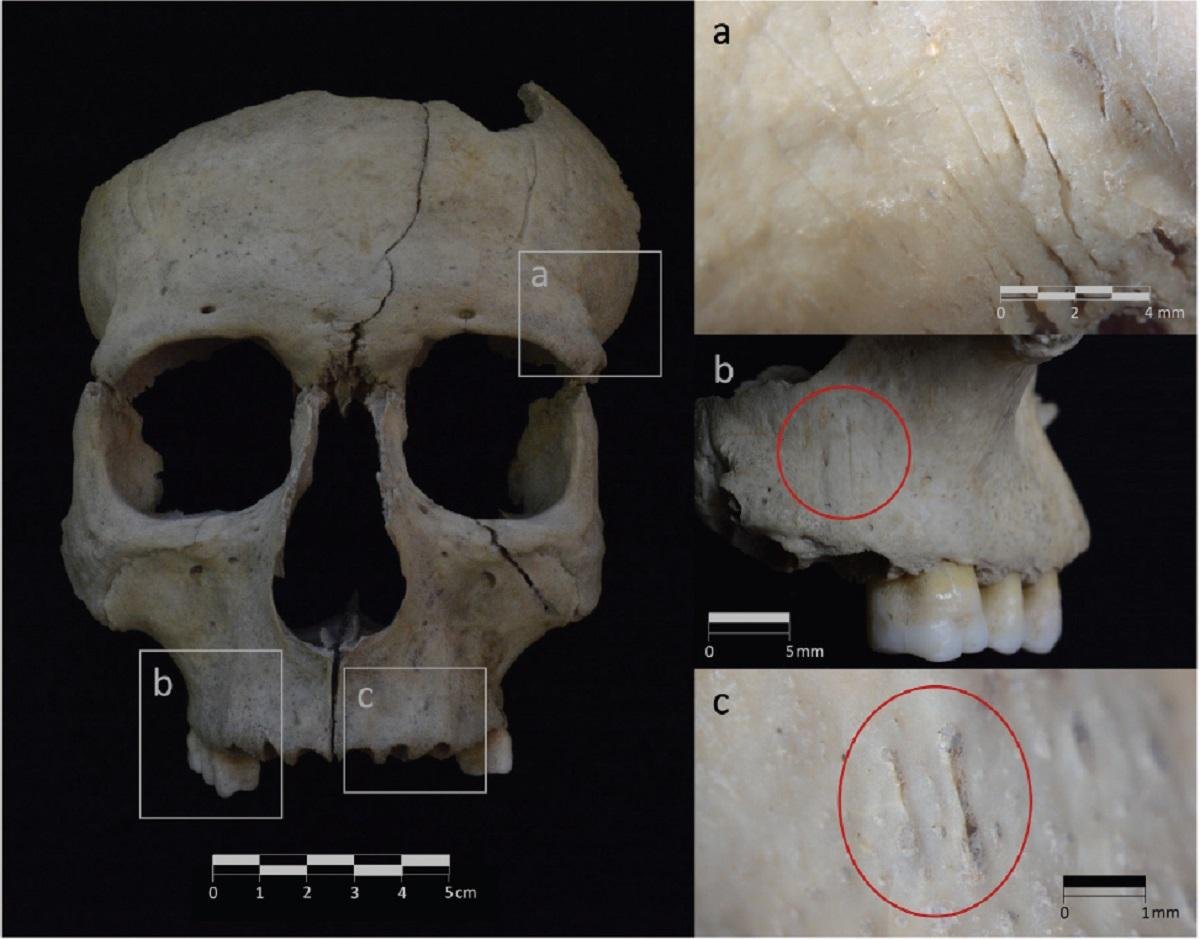
Left, frontal view of the skull with the areas enlarged in the images on the right marked. A, cut and vascular marks located on the left frontal half. B, mark observed on the back part of the right maxilla. C, magnified view of image B with a binocular microscope. Credit: Photograph and layout by Marta Riba Vidal / De la Fuente Seoane et al., Trabajos de Prehistoria (2025)

Researchers examined five cranial pieces from Olèrdola and ten fragments from El Molí d’Espígol. The Olèrdola bones belong to one young male between eight and fifteen years old. The Molí d’Espígol material represents three people, including another young male. Cremation served as the main burial rite across Iberian territory, so preserved skulls form a rare source of biological data.

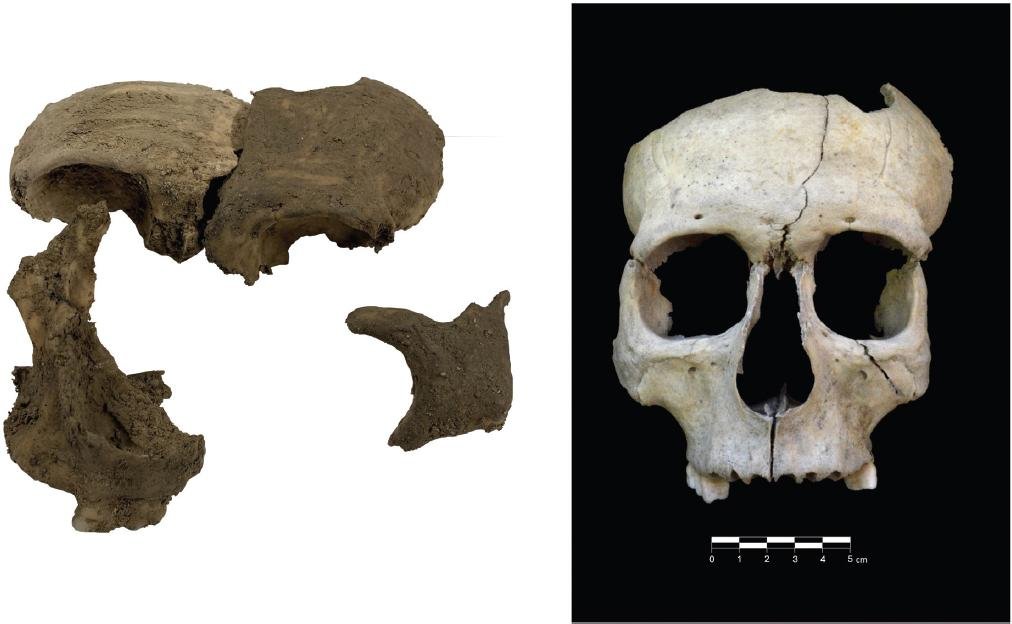
Microscopic study recorded cut marks formed close to the time of death. Many injuries match blows from sharp tools with a straight edge. On the Olèrdola skull, deeper cuts on the left frontal bone contrast with angled marks on the right side, which overlap in several places. Such variation suggests more than one strike and possibly more than one person involved. The lower rear skull did not survive, so clear proof of decapitation remains out of reach. Even so, trauma patterns support removal and later handling of the head.

Fine incisions appear around the forehead and jaw. Their size matches thin metal tools similar to needles recovered from other Iberian sites linked with head display. These marks show removal of soft tissue, including parts of the face. Comparable treatment appears in Iron Age contexts in France and Britain, which strengthens interpretation of ritual preparation rather than random violence alone.
Iron Age severed head ritual identified among new Iberian groups in Spain
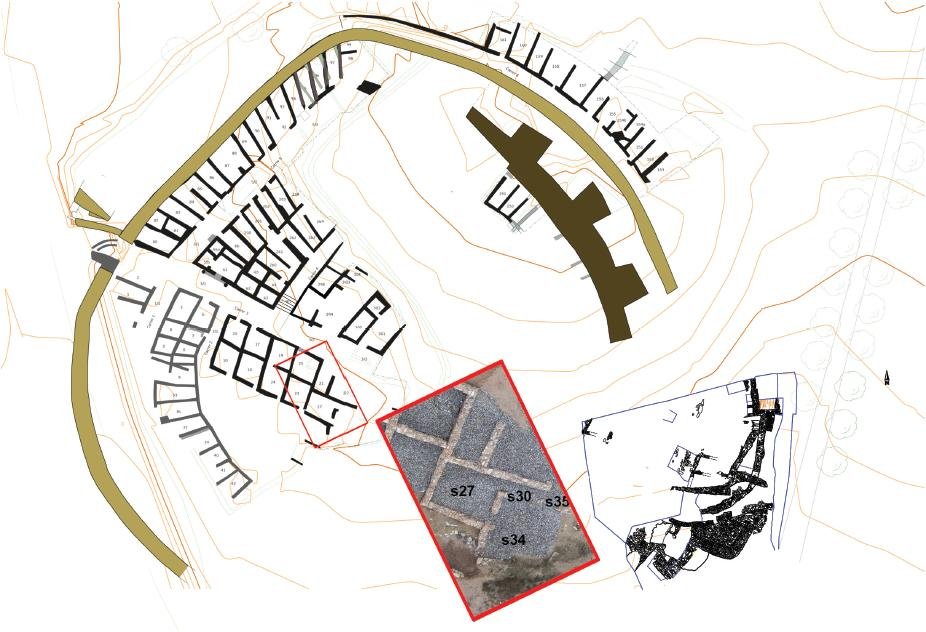
Plan of the El Molí d’Espígol site. Credit: Jordi Principal / De la Fuente Seoane et al., Trabajos de Prehistoria (2025)

Chemical testing of residues stuck to the Olèrdola bone identified plant resins from pine, along with oils and waxes of plant or animal origin. Such substances suit preservation or preparation for exhibition. The head likely received coating before placement in a visible location.
RelatedStories

Ancient burials, Roman well, and Anglo-Saxon house uncovered during A46 Newark bypass excavations

Ancient burials, Roman well, and Anglo-Saxon house uncovered during A46 Newark bypass excavations

May 12, 2026
Earliest known dental bridge in Scotland found in medieval Aberdeen burial

Earliest known dental bridge in Scotland found in medieval Aberdeen burial

May 6, 2026

Isotope study adds another layer. Strontium values from teeth and bone do not match local geology near Olèrdola. Results point to childhood spent in a region with older rock formations. Movement during adolescence or transport of the head after death both fit the data. Similar mobility patterns appear in other Iberian cases linked with displayed skulls.
Iron Age severed head ritual identified among new Iberian groups in Spain
Olèrdola skull. Left, remains recovered in the field. Archive MAC Olèrdola. Right, cleaned and reconstructed skull. Credit: Photograph by Marta Riba Vidal / De la Fuente Seoane et al., Trabajos de Prehistoria (2025)

Context within each settlement strengthens the argument for public display. At Olèrdola, fragments came from the base of a tower flanking the main entrance. A head set above a gateway would send a strong message to visitors and rivals. At El Molí d’Espígol, remains clustered inside a large building near an open square. Architecture and location mark the area as socially important.

Earlier finds tied the custom mainly to the Indigetes and Laietani along the coast. The new evidence pushes the southern boundary inland and broadens the list of participating groups. Archaeologists have also identified female skulls in other sites, which raises questions about gender roles in warfare, punishment, or ritual selection.

Across Europe, display of enemy heads often signaled power and victory. Iberian material shows local variation in how communities prepared, placed, and later discarded skulls. Many ended up on floors, near walls, or inside filled storage pits after wooden supports decayed.

Work on these fragments combines bioanthropology, residue chemistry, and isotope science. Together, results build a clearer picture of a practice once known from scattered finds and classical descriptions. Each new case adds detail to social behavior, mobility, and symbolic acts among Iron Age groups in northeastern Iberia.
More information: De la Fuente Seoane, R., Molist, N., Principal, J., Riba-Vidal, M., Tarifa-Mateo, N., & Subirà, M. E. (2025). ‘Cabezas cortadas’ iberas en contextos cosetanos e ilergetes. Nuevas aportaciones bioantropológicas en El Molí d’Espígol (Tornabous, Lleida) y Olèrdola (Olèrdola, Barcelona). Trabajos de Prehistoria, 82(2), 1049. doi:10.3989/tp.2025.1049
Share47Tweet30Share8ShareSend

You May Also Like...

280 ancient stone burial monuments found in Sudan reveal lost cattle-herding culture in the Sahara
Archaeology

280 ancient stone burial monuments found in Sudan reveal lost cattle-herding culture in the Sahara

May 13, 2026
Rare Bronze Age burial in Sweden reveals unusual pair of Wendel neck rings and complex ritual landscape near Norrköping
Archaeology

Rare Bronze Age burial in Sweden reveals unusual pair of Wendel neck rings and complex ritual landscape near Norrköping

May 12, 2026
Kasta Tomb in Amphipolis fully revealed as restoration uncovers largest burial mound in Macedonia
Archaeology

Kasta Tomb in Amphipolis fully revealed as restoration uncovers largest burial mound in Macedonia

May 12, 2026
Rare Roman villa threatened by farming damage reveals rare mosaic and bathhouse remains in Devon
Archaeology

Rare Roman villa threatened by farming damage reveals rare mosaic and bathhouse remains in Devon

May 12, 2026
Ancient burials, Roman well, and Anglo-Saxon house uncovered during A46 Newark bypass excavations
Anthropology

Ancient burials, Roman well, and Anglo-Saxon house uncovered during A46 Newark bypass excavations

May 12, 2026
8-year-old boy finds 1,700-year-old Roman statuette fragment in Ramon Crater
Archaeology

8-year-old boy finds 1,700-year-old Roman statuette fragment in Ramon Crater

May 11, 2026

Comments 0

  1. Editorial Team says:
    1 second ago

    Disclaimer: This website is a science-focused magazine that welcomes both academic and non-academic audiences. Comments are written by users and may include personal opinions or unverified claims. They do not necessarily reflect the views of our editorial team or rely on scientific evidence.

    Comment Policy: We kindly ask all commenters to engage respectfully. Comments that contain offensive, insulting, degrading, discriminatory, or racist content will be automatically removed.

    Reply

Leave a Reply Cancel reply

Your email address will not be published. Required fields are marked *

Follow us


Instagram
242K

Facebook
117K

Threads
46K

LinkedIn
14K

Twitter
6K

YouTube
1K
  • Trending
  • Comments
  • Latest
Shipwreck Salvage. Credit: rawpixel.com / Public Domain

2,000-year-old shipwreck discovered off Turkish coast with remarkably preserved stacked ceramics

July 2, 2025
A new study suggests the mysterious Voynich Manuscript may be a medieval cipher

A new study suggests the mysterious Voynich Manuscript may be a medieval cipher

January 3, 2026
Viking age DNA reveals 9,000-year-old HIV-resistant gene originating near the Black Sea

Viking age DNA reveals 9,000-year-old HIV-resistant gene originating near the Black Sea

May 18, 2025
3D analysis reveals Shroud of Turin image likely came from sculpture, not Jesus’ body

3D analysis reveals Shroud of Turin image likely came from sculpture, not Jesus’ body

August 3, 2025
Moses may be named in ancient Egyptian mine inscriptions, sparking debate over earliest biblical references

Moses may be named in ancient Egyptian mine inscriptions, sparking debate over earliest biblical references

July 31, 2025
3D analysis reveals Shroud of Turin image likely came from sculpture, not Jesus’ body

3D analysis reveals Shroud of Turin image likely came from sculpture, not Jesus’ body

Moses may be named in ancient Egyptian mine inscriptions, sparking debate over earliest biblical references

Moses may be named in ancient Egyptian mine inscriptions, sparking debate over earliest biblical references

$1 million prize offered to decipher 5,300-year-old Indus Valley script

$1 million prize offered to decipher 5,300-year-old Indus Valley script

Oldest ever genetic data from a human relative found in 2-million-year-old fossilized teeth

Oldest ever genetic data from a human relative found in 2-million-year-old fossilized teeth

Exceptionally large Roman shoes discovered at Magna fort near Hadrian’s Wall

Exceptionally large Roman shoes discovered at Magna fort near Hadrian’s Wall

280 ancient stone burial monuments found in Sudan reveal lost cattle-herding culture in the Sahara

280 ancient stone burial monuments found in Sudan reveal lost cattle-herding culture in the Sahara

May 13, 2026
Rare Bronze Age burial in Sweden reveals unusual pair of Wendel neck rings and complex ritual landscape near Norrköping

Rare Bronze Age burial in Sweden reveals unusual pair of Wendel neck rings and complex ritual landscape near Norrköping

May 12, 2026
Kasta Tomb in Amphipolis fully revealed as restoration uncovers largest burial mound in Macedonia

Kasta Tomb in Amphipolis fully revealed as restoration uncovers largest burial mound in Macedonia

May 12, 2026
Rare Roman villa threatened by farming damage reveals rare mosaic and bathhouse remains in Devon

Rare Roman villa threatened by farming damage reveals rare mosaic and bathhouse remains in Devon

May 12, 2026
Ancient burials, Roman well, and Anglo-Saxon house uncovered during A46 Newark bypass excavations

Ancient burials, Roman well, and Anglo-Saxon house uncovered during A46 Newark bypass excavations

May 12, 2026

Archaeology News online magazine

Archaeology News is an international online magazine that covers all aspects of archaeology.


Categories

  • Academics
    • Books
    • Conferences
    • Universities
  • Articles
  • Download
  • Game
  • News
    • Anthropology
    • Archaeology
    • Paleontology
  • Quiz
  • Tours

Subscribe to our newsletter

© 2024 - Archaeology News Online Magazine. All Rights Reserved.

  • About
  • Privacy Policy
  • Terms of Use
  • Donation
  • Contact

Manage Consent
To provide the best experiences, we use technologies like cookies to store and/or access device information. Consenting to these technologies will allow us to process data such as browsing behavior or unique IDs on this site. Not consenting or withdrawing consent, may adversely affect certain features and functions.
Functional Always active
The technical storage or access is strictly necessary for the legitimate purpose of enabling the use of a specific service explicitly requested by the subscriber or user, or for the sole purpose of carrying out the transmission of a communication over an electronic communications network.
Preferences
The technical storage or access is necessary for the legitimate purpose of storing preferences that are not requested by the subscriber or user.
Statistics
The technical storage or access that is used exclusively for statistical purposes. The technical storage or access that is used exclusively for anonymous statistical purposes. Without a subpoena, voluntary compliance on the part of your Internet Service Provider, or additional records from a third party, information stored or retrieved for this purpose alone cannot usually be used to identify you.
Marketing
The technical storage or access is required to create user profiles to send advertising, or to track the user on a website or across several websites for similar marketing purposes.
  • Manage options
  • Manage services
  • Manage {vendor_count} vendors
  • Read more about these purposes
View preferences
  • {title}
  • {title}
  • {title}
  • Home
  • News
    • Archaeology
    • Anthropology
    • Paleontology
  • Academic
    • Books
    • Conferences
    • Universities
  • Articles
  • VR Tours
  • Quiz & Game
  • Download
  • Encyclopedia
  • Forum

About  .  Contact  .  Donation

© 2024 - Archaeology News Online Magazine. All Rights Reserved