• About
  • Privacy Policy
  • Terms of Use
  • Donation
  • Contact
No Result
View All Result
Archaeology News
  • Home
  • News
    • Archaeology
    • Anthropology
    • Paleontology
  • Academic
    • Books
    • Conferences
    • Universities
  • Articles
  • VR Tours
  • Quiz & Game
  • Download
  • Encyclopedia
  • Forum
Archaeology News
No Result
View All Result
Home News Archaeology

5,000-year-old artificial island hidden in Scottish loch predates Stonehenge

by Dario Radley
May 5, 2026

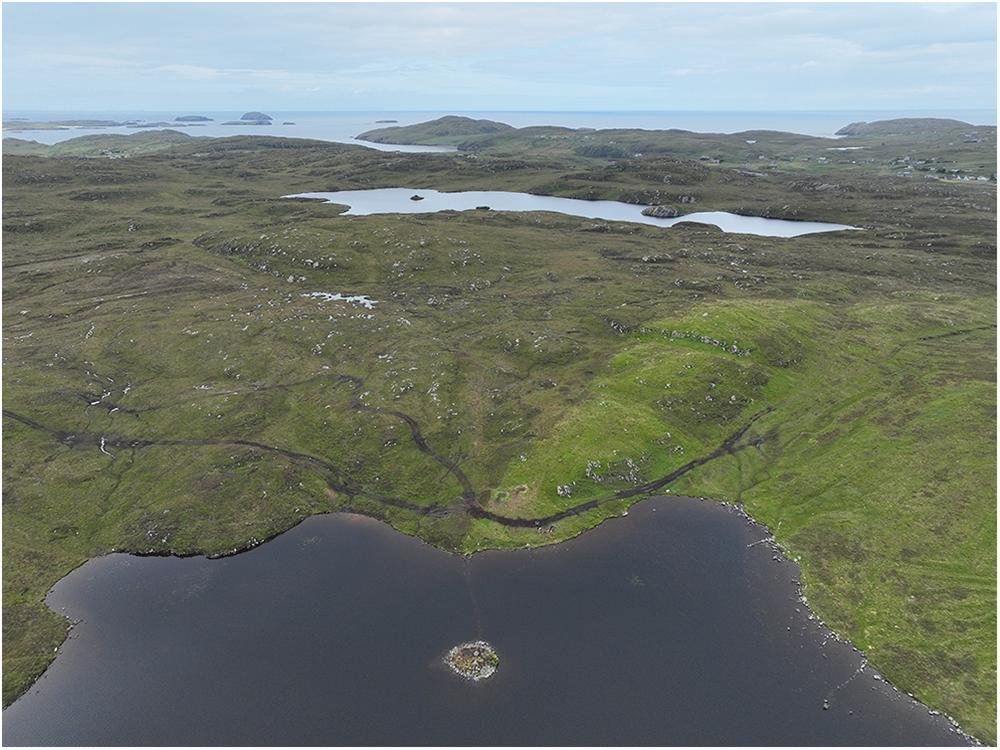
Archaeologists working in Scotland have uncovered new details about a 5,000-year-old artificial island hidden beneath the waters of Loch Bhorgastail on the Isle of Lewis. What looks today like a small stone island was once a carefully built timber platform dating back to the Neolithic period, making the site older than Stonehenge.
5,000-year-old artificial island hidden in Scottish loch predates Stonehenge
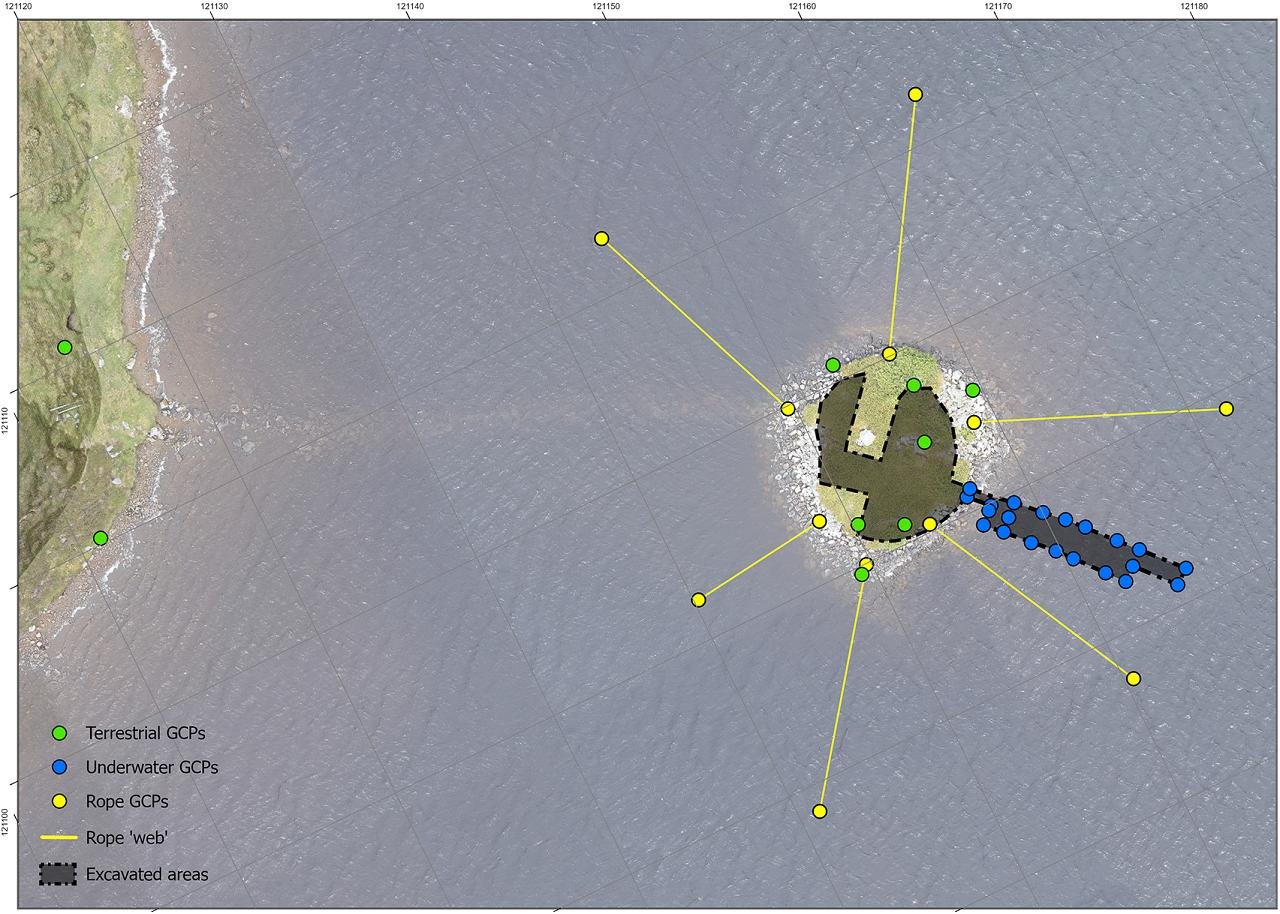
Ground control points used for UAS and underwater surveys at Loch Bhorgastail, showing the distribution of terrestrial, underwater, and rope-mounted control points across the land–water interface. Credit: Blankshein et al., Advances in Archaeological Practice (2026)

The research team from the University of Southampton, working with colleagues from the University of Reading, studied the crannog, a type of small human-made island found in Scottish lochs. Crannogs were long linked mostly to the Iron Age and later periods, but growing evidence shows some began much earlier, between 3800 and 3300 BCE.

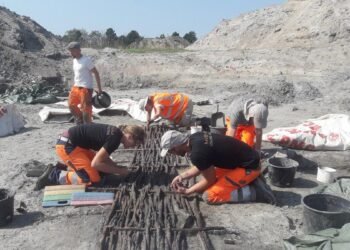
Excavations and underwater surveys revealed that the Loch Bhorgastail crannog started as a circular wooden platform about 23 meters, or 75 feet, wide. Builders placed layers of timber and brushwood to create the base. Around 2,000 years later, during the Middle Bronze Age, people added more brushwood and covered parts of the structure with stone. Another building phase followed in the Iron Age roughly 1,000 years later.

Researchers also identified a submerged stone causeway linking the island to the shore, showing the site was once easier to access before water levels changed.
5,000-year-old artificial island hidden in Scottish loch predates Stonehenge
Aerial view of the Loch Bhorgastail crannog, illustrating the site context and land–water interface in which integrated terrestrial and underwater survey methods are applied. Credit: Blankshein et al., Advances in Archaeological Practice (2026)

The waters around the island contained hundreds of fragments of Neolithic pottery, including pieces from jars and bowls. Some vessels still held traces of food residue. Archaeologists think these finds point to repeated communal activity, likely involving cooking, food preparation, and gatherings. The amount of labor needed to construct such islands suggests organized communities with enough planning and manpower to build in a lake environment.

RelatedStories

Ancient Danes kept fishing for millennia after farming arrived, study finds

Ancient Danes kept fishing for millennia after farming arrived, study finds

May 14, 2026
Rare Bronze Age burial in Sweden reveals unusual pair of Wendel neck rings and complex ritual landscape near Norrköping

Rare Bronze Age burial in Sweden reveals unusual pair of Wendel neck rings and complex ritual landscape near Norrköping

May 12, 2026

Studying sites like this has always been difficult because traditional archaeological methods work well either on land or in deeper water, but not in the narrow zone between them. This shallow area, often less than one meter deep, creates what researchers call a “white ribbon” of missing data, where neither terrestrial survey tools nor marine geophysical equipment performs well.

To solve this problem, the team developed a new workflow using stereophotogrammetry in shallow water. Photogrammetry creates detailed 3D digital models by combining many overlapping photographs. In this case, archaeologists used two waterproof cameras mounted a fixed distance apart on a frame. A diver moved the system through the water while carefully controlling position with centimeter-level accuracy.

The method also combined underwater imagery with drone surveys taken above the site. Ground control points, artificial scale bars, and RTK-GNSS positioning data helped merge land and underwater records into one continuous 3D model.
5,000-year-old artificial island hidden in Scottish loch predates Stonehenge
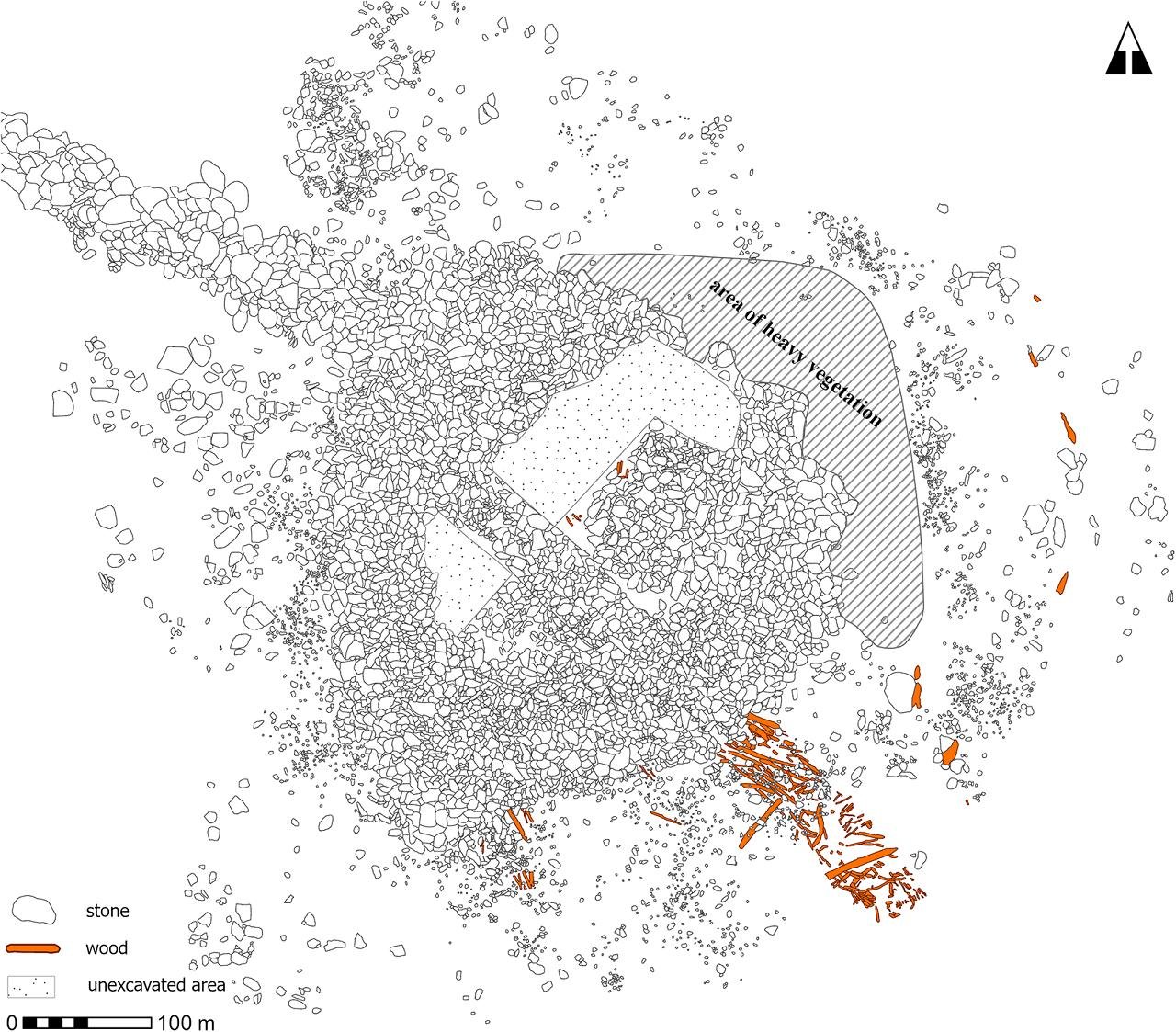
Plan view of stone and timber elements above and below the waterline, digitized from multiple integrated photogrammetry survey datasets. Credit: Blankshein et al., Advances in Archaeological Practice (2026)

This produced high-resolution digital models, elevation maps, and orthomosaics covering both the visible stone island and the submerged archaeological remains. Researchers said the system reached accuracy levels comparable to drone surveys on land, while remaining portable and relatively low cost.

Shallow-water imaging usually faces several problems. Fine sediment clouds the water, vegetation blocks visibility, and reflected sunlight distorts images. These issues have made archaeological recording in extreme shallows frustrating for years. The new workflow reduced many of these obstacles and created a repeatable method for future fieldwork.

Beyond Loch Bhorgastail, the technique offers archaeologists a practical way to document the difficult boundary between land and water, an area where evidence of ancient settlements, ritual sites, and coastal activity often survives.

The work not only adds another early Neolithic crannog to Scotland’s growing list, but also gives archaeologists a better tool for studying sites once hidden in this overlooked zone. With hundreds of crannogs still unexplored across Scotland, the method could help reveal more early human activity preserved beneath shallow waters.

More information: Blankshein, S., Pedrotti, F., Sturt, F., & Garrow, D. (2026). At the water’s edge: Photogrammetry in extreme Shallow-Water environments. Advances in Archaeological Practice, 1–16. doi:10.1017/aap.2025.10145
Share893Tweet558Share156ShareSend

You May Also Like...

Horse domestication began centuries earlier than thought, study reveals early riding and management in 4th millennium BCE
Archaeology

Horse domestication began centuries earlier than thought, study reveals early riding and management in 4th millennium BCE

May 15, 2026
Ancient Danes kept fishing for millennia after farming arrived, study finds
Archaeology

Ancient Danes kept fishing for millennia after farming arrived, study finds

May 14, 2026
Oldest known dental treatment found in 59,000-year-old Neanderthal tooth from Siberia
Anthropology

Oldest known dental treatment found in 59,000-year-old Neanderthal tooth from Siberia

May 14, 2026
Homo erectus in Java: 140,000-year-old fossils found in submerged river valley
Anthropology

400,000-year-old Homo erectus proteins reveal genetic links to Denisovans and modern humans

May 14, 2026
Cut marks on 1.6-million-year-old bones reveal early humans moved and processed meat in Kenya
Anthropology

Cut marks on 1.6-million-year-old bones reveal early humans moved and processed meat in Kenya

May 13, 2026
280 ancient stone burial monuments found in Sudan reveal lost cattle-herding culture in the Sahara
Archaeology

280 ancient stone burial monuments found in Sudan reveal lost cattle-herding culture in the Sahara

May 13, 2026

Comments 0

  1. Editorial Team says:
    1 second ago

    Disclaimer: This website is a science-focused magazine that welcomes both academic and non-academic audiences. Comments are written by users and may include personal opinions or unverified claims. They do not necessarily reflect the views of our editorial team or rely on scientific evidence.

    Comment Policy: We kindly ask all commenters to engage respectfully. Comments that contain offensive, insulting, degrading, discriminatory, or racist content will be automatically removed.

    Reply

Leave a Reply Cancel reply

Your email address will not be published. Required fields are marked *

Follow us


Instagram
242K

Facebook
117K

Threads
46K

LinkedIn
14K

Twitter
6K

YouTube
1K
  • Trending
  • Comments
  • Latest
Shipwreck Salvage. Credit: rawpixel.com / Public Domain

2,000-year-old shipwreck discovered off Turkish coast with remarkably preserved stacked ceramics

July 2, 2025
A new study suggests the mysterious Voynich Manuscript may be a medieval cipher

A new study suggests the mysterious Voynich Manuscript may be a medieval cipher

January 3, 2026
Viking age DNA reveals 9,000-year-old HIV-resistant gene originating near the Black Sea

Viking age DNA reveals 9,000-year-old HIV-resistant gene originating near the Black Sea

May 18, 2025
3D analysis reveals Shroud of Turin image likely came from sculpture, not Jesus’ body

3D analysis reveals Shroud of Turin image likely came from sculpture, not Jesus’ body

August 3, 2025
Moses may be named in ancient Egyptian mine inscriptions, sparking debate over earliest biblical references

Moses may be named in ancient Egyptian mine inscriptions, sparking debate over earliest biblical references

July 31, 2025
3D analysis reveals Shroud of Turin image likely came from sculpture, not Jesus’ body

3D analysis reveals Shroud of Turin image likely came from sculpture, not Jesus’ body

Moses may be named in ancient Egyptian mine inscriptions, sparking debate over earliest biblical references

Moses may be named in ancient Egyptian mine inscriptions, sparking debate over earliest biblical references

$1 million prize offered to decipher 5,300-year-old Indus Valley script

$1 million prize offered to decipher 5,300-year-old Indus Valley script

Oldest ever genetic data from a human relative found in 2-million-year-old fossilized teeth

Oldest ever genetic data from a human relative found in 2-million-year-old fossilized teeth

Exceptionally large Roman shoes discovered at Magna fort near Hadrian’s Wall

Exceptionally large Roman shoes discovered at Magna fort near Hadrian’s Wall

Horse domestication began centuries earlier than thought, study reveals early riding and management in 4th millennium BCE

Horse domestication began centuries earlier than thought, study reveals early riding and management in 4th millennium BCE

May 15, 2026
Ancient Danes kept fishing for millennia after farming arrived, study finds

Ancient Danes kept fishing for millennia after farming arrived, study finds

May 14, 2026
Oldest known dental treatment found in 59,000-year-old Neanderthal tooth from Siberia

Oldest known dental treatment found in 59,000-year-old Neanderthal tooth from Siberia

May 14, 2026
Homo erectus in Java: 140,000-year-old fossils found in submerged river valley

400,000-year-old Homo erectus proteins reveal genetic links to Denisovans and modern humans

May 14, 2026
Cut marks on 1.6-million-year-old bones reveal early humans moved and processed meat in Kenya

Cut marks on 1.6-million-year-old bones reveal early humans moved and processed meat in Kenya

May 13, 2026

Archaeology News online magazine

Archaeology News is an international online magazine that covers all aspects of archaeology.


Categories

  • Academics
    • Books
    • Conferences
    • Universities
  • Articles
  • Download
  • Game
  • News
    • Anthropology
    • Archaeology
    • Paleontology
  • Quiz
  • Tours

Subscribe to our newsletter

© 2024 - Archaeology News Online Magazine. All Rights Reserved.

  • About
  • Privacy Policy
  • Terms of Use
  • Donation
  • Contact

Manage Consent
To provide the best experiences, we use technologies like cookies to store and/or access device information. Consenting to these technologies will allow us to process data such as browsing behavior or unique IDs on this site. Not consenting or withdrawing consent, may adversely affect certain features and functions.
Functional Always active
The technical storage or access is strictly necessary for the legitimate purpose of enabling the use of a specific service explicitly requested by the subscriber or user, or for the sole purpose of carrying out the transmission of a communication over an electronic communications network.
Preferences
The technical storage or access is necessary for the legitimate purpose of storing preferences that are not requested by the subscriber or user.
Statistics
The technical storage or access that is used exclusively for statistical purposes. The technical storage or access that is used exclusively for anonymous statistical purposes. Without a subpoena, voluntary compliance on the part of your Internet Service Provider, or additional records from a third party, information stored or retrieved for this purpose alone cannot usually be used to identify you.
Marketing
The technical storage or access is required to create user profiles to send advertising, or to track the user on a website or across several websites for similar marketing purposes.
  • Manage options
  • Manage services
  • Manage {vendor_count} vendors
  • Read more about these purposes
View preferences
  • {title}
  • {title}
  • {title}
  • Home
  • News
    • Archaeology
    • Anthropology
    • Paleontology
  • Academic
    • Books
    • Conferences
    • Universities
  • Articles
  • VR Tours
  • Quiz & Game
  • Download
  • Encyclopedia
  • Forum

About  .  Contact  .  Donation

© 2024 - Archaeology News Online Magazine. All Rights Reserved