• About
  • Privacy Policy
  • Terms of Use
  • Donation
  • Contact
No Result
View All Result
Archaeology News
  • Home
  • News
    • Archaeology
    • Anthropology
    • Paleontology
  • Academics
    • Books
    • Conferences
    • Universities
  • Articles
  • VR Tours
  • Quiz & Game
  • Download
  • Encyclopedia
  • Forum
Archaeology News
No Result
View All Result
Home News Archaeology

Early stone tools were not rocket science

by Dario Radley
July 6, 2022

Research conducted by scholars from the University of Tübingen challenges long-standing assumptions regarding the origins of human culture through stone tools.
Early stone tools were not rocket science
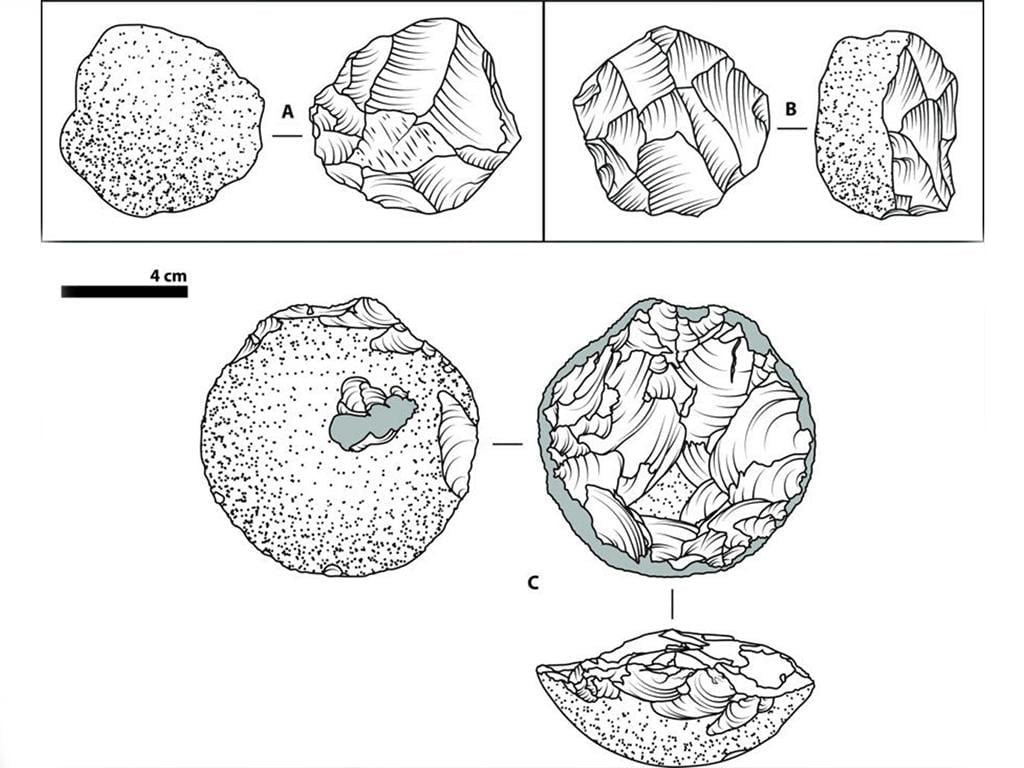
2.6 million years old (A) and 1.7 million years old stone tools and an example of a result of the current experiment with subjects without prior knowledge (artifact C). Credit: William D. Snyder et. al.

Stone tools unearthed through archaeological excavations, some dating back as far as 2.6 million years, have been regarded as evidence of early cultural development in human evolution.

However, Dr. Claudio Tennie and William Snyder from the Department of Early Prehistory and Quaternary Ecology at the University of Tübingen have undertaken a study, supported by the European Research Council, that questions this conventional interpretation.

Through experimental investigations, they have arrived at a different conclusion: the earliest techniques for crafting stone tools can be spontaneously reinvented without the need for cultural transmission.

Consequently, these tools do not necessarily indicate the emergence of human culture, which might have potentially commenced at a later stage, as suggested by the researchers. The study has been published in Science Advances.


RelatedStories

42,000-year-old ochre crayons reveal Neanderthals engaged in symbolic behavior

42,000-year-old ochre crayons reveal Neanderthals engaged in symbolic behavior

October 30, 2025
Ancient stone tools show Europe’s early humans innovated independently from the Near East 42,000 years ago

Ancient stone tools show Europe’s early humans innovated independently from the Near East 42,000 years ago

October 15, 2025


Tools made from scratch

In this experiment, the researchers recruited 28 local adults who were not experts in archaeology. These participants were given a task to open a box that contained monetary rewards.

They were provided with raw materials including a painted glass hemisphere, a medium-sized river pebble, and a large granite block.

The participants were given complete freedom to use these materials in any way they saw fit to break a rope that secured the box. They received no prior information or demonstrations about the techniques used in early stone tool production.

Through post-test questionnaires, it was determined that 25 participants had no prior knowledge of early stone tool production techniques at the beginning of the test. Despite their lack of knowledge, the majority of participants demonstrated innovation by developing at least one of these techniques and effectively used the resulting tools to cut the rope and open the puzzle box.

The authors observed that all the production techniques of early stone tools were spontaneously re-invented by the participants, even without prior knowledge, thus highlighting their capacity for on-the-spot innovation.
Early stone tools were not rocket science
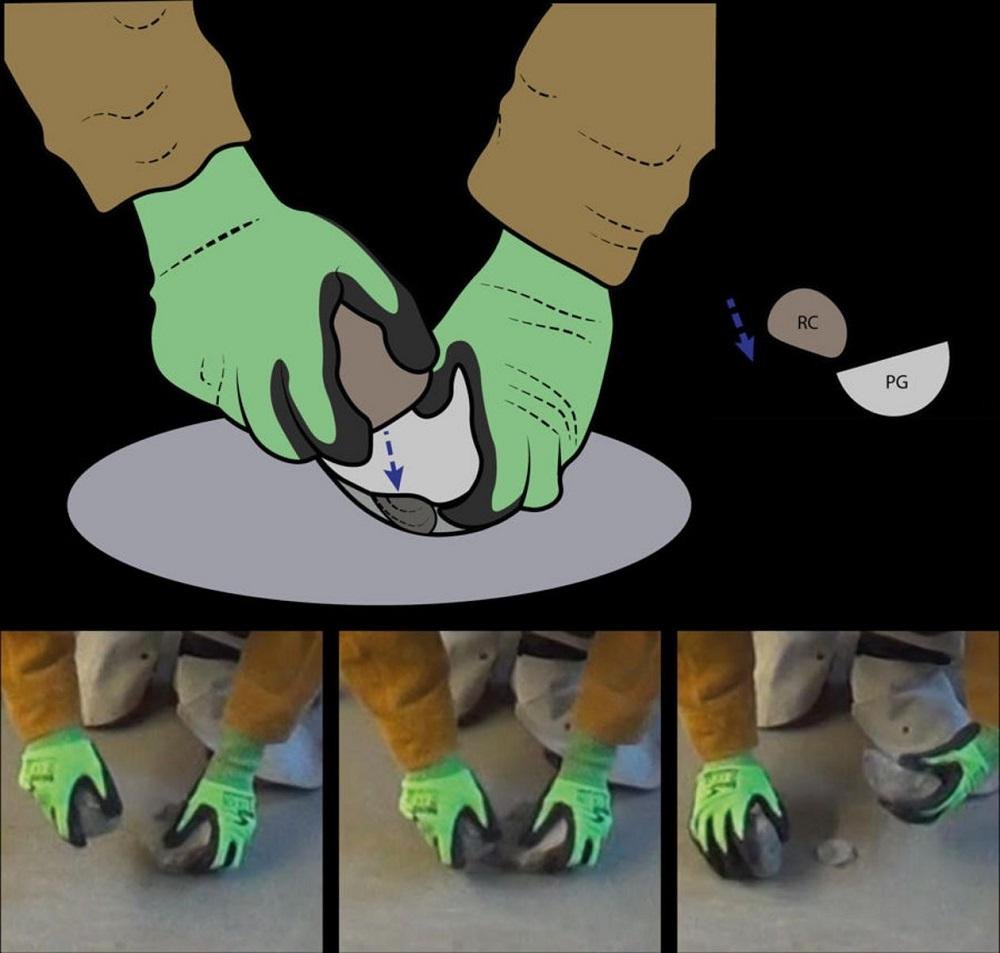
One participant of the study—who was naive to stone tools as well as any of their production techniques—uses the so-called bipolar technique. The resulting tool is seen centrally in the lower right. Credit: William D. Snyder et. al.

According to Claudio Tennie, these findings challenge previous assertions that the process of learning to make stone tools must inherently be difficult and impossible without models to imitate.

Tennie states, “If the earliest stone tools in the human record really had been the first cases of human culture, then they should resist spontaneous innovation – they should not come about anew ‘from scratch’, in the absence of cultural transmission.”

Prior to revealing their results, Tennie mentions that when discussing this matter with other researchers, most did not anticipate this outcome. The prevailing belief was that all stone tool production required copying, which this study disproves.

William Snyder summarizes that the existence of stone tools 2.6 million years ago can no longer be considered definitive evidence that our early Stone Age ancestors possessed culture similar to our own. “We must now look at much later time periods for the origin of modern human culture.”

Publication: William D. Snyder et al, (2022), Early knapping techniques do not necessitate cultural transmission, Science Advances. DOI: 10.1126/sciadv.abo2894

Share2Tweet1ShareShareSend

You May Also Like...

Misread medieval tale misled generations of historians about the Black Death's spread, study finds
Archaeology

Misread medieval tale misled generations of historians about the Black Death’s spread, study finds

November 7, 2025
Signatures meant more in Mesopotamia than they do now − what cylinder seals say about ancient and modern life
Archaeology

Signatures meant more in Mesopotamia than they do now − what cylinder seals say about ancient and modern life

November 7, 2025
Daily life uncovered in Hellenistic military settlement at Pyla-Vigla, Cyprus
Archaeology

New discoveries reveal daily life in a Hellenistic military settlement at Pyla-Vigla, Cyprus

November 7, 2025
Viking treasures unearthed in Sweden reveal a society in transition
Archaeology

Viking treasures unearthed in Sweden reveal a society in transition

November 6, 2025
Archaeologists unearth 5,000-year-old winepress and Canaanite ritual artifacts near Tel Megiddo
Archaeology

Archaeologists unearth 5,000-year-old winepress and Canaanite ritual artifacts near Tel Megiddo

November 5, 2025
5,000-year-old monumental building in Iraq reveals ties to the world’s first cities
Archaeology

5,000-year-old monumental building in Iraq reveals ties to the world’s first cities

November 3, 2025

Follow us


Instagram
245K

Facebook
117K

Threads
45K

LinkedIn
14K

Twitter
6K

YouTube
1K
  • Trending
  • Comments
  • Latest
Shipwreck Salvage. Credit: rawpixel.com / Public Domain

2,000-year-old shipwreck discovered off Turkish coast with remarkably preserved stacked ceramics

July 2, 2025
Viking age DNA reveals 9,000-year-old HIV-resistant gene originating near the Black Sea

Viking age DNA reveals 9,000-year-old HIV-resistant gene originating near the Black Sea

May 18, 2025
Complete copy of the Canopus Decree unearthed in Egypt after 150 years

Complete copy of the Canopus Decree unearthed in Egypt after 150 years

September 13, 2025
Mystery of Armenia’s 6,000-year-old dragon stones solved

Mystery of Armenia’s 6,000-year-old dragon stones solved

September 23, 2025
Moses may be named in ancient Egyptian mine inscriptions, sparking debate over earliest biblical references

Moses may be named in ancient Egyptian mine inscriptions, sparking debate over earliest biblical references

July 31, 2025
Moses may be named in ancient Egyptian mine inscriptions, sparking debate over earliest biblical references

Moses may be named in ancient Egyptian mine inscriptions, sparking debate over earliest biblical references

3D analysis reveals Shroud of Turin image likely came from sculpture, not Jesus’ body

3D analysis reveals Shroud of Turin image likely came from sculpture, not Jesus’ body

$1 million prize offered to decipher 5,300-year-old Indus Valley script

$1 million prize offered to decipher 5,300-year-old Indus Valley script

Oldest ever genetic data from a human relative found in 2-million-year-old fossilized teeth

Oldest ever genetic data from a human relative found in 2-million-year-old fossilized teeth

Exceptionally large Roman shoes discovered at Magna fort near Hadrian’s Wall

Exceptionally large Roman shoes discovered at Magna fort near Hadrian’s Wall

Misread medieval tale misled generations of historians about the Black Death's spread, study finds

Misread medieval tale misled generations of historians about the Black Death’s spread, study finds

November 7, 2025
Signatures meant more in Mesopotamia than they do now − what cylinder seals say about ancient and modern life

Signatures meant more in Mesopotamia than they do now − what cylinder seals say about ancient and modern life

November 7, 2025
Daily life uncovered in Hellenistic military settlement at Pyla-Vigla, Cyprus

New discoveries reveal daily life in a Hellenistic military settlement at Pyla-Vigla, Cyprus

November 7, 2025
Viking treasures unearthed in Sweden reveal a society in transition

Viking treasures unearthed in Sweden reveal a society in transition

November 6, 2025
Archaeologists unearth 5,000-year-old winepress and Canaanite ritual artifacts near Tel Megiddo

Archaeologists unearth 5,000-year-old winepress and Canaanite ritual artifacts near Tel Megiddo

November 5, 2025

Archaeology News online magazine

Archaeology News is an international online magazine that covers all aspects of archaeology.


Categories

  • Academics
    • Books
    • Conferences
    • Universities
  • Articles
  • Download
  • Game
  • News
    • Anthropology
    • Archaeology
    • Paleontology
  • Quiz
  • Tours

Subscribe to our newsletter

© 2024 - Archaeology News Online Magazine. All Rights Reserved.

  • About
  • Privacy Policy
  • Terms of Use
  • Donation
  • Contact

Welcome Back!

Login to your account below

Forgotten Password? Sign Up

Create New Account!

Fill the forms below to register

All fields are required. Log In

Retrieve your password

Please enter your username or email address to reset your password.

Log In

Add New Playlist

Manage Consent
To provide the best experiences, we use technologies like cookies to store and/or access device information. Consenting to these technologies will allow us to process data such as browsing behavior or unique IDs on this site. Not consenting or withdrawing consent, may adversely affect certain features and functions.
Functional Always active
The technical storage or access is strictly necessary for the legitimate purpose of enabling the use of a specific service explicitly requested by the subscriber or user, or for the sole purpose of carrying out the transmission of a communication over an electronic communications network.
Preferences
The technical storage or access is necessary for the legitimate purpose of storing preferences that are not requested by the subscriber or user.
Statistics
The technical storage or access that is used exclusively for statistical purposes. The technical storage or access that is used exclusively for anonymous statistical purposes. Without a subpoena, voluntary compliance on the part of your Internet Service Provider, or additional records from a third party, information stored or retrieved for this purpose alone cannot usually be used to identify you.
Marketing
The technical storage or access is required to create user profiles to send advertising, or to track the user on a website or across several websites for similar marketing purposes.
Manage options Manage services Manage {vendor_count} vendors Read more about these purposes
View preferences
{title} {title} {title}
  • Home
  • News
    • Archaeology
    • Anthropology
    • Paleontology
  • Academics
    • Books
    • Conferences
    • Universities
  • Articles
  • VR Tours
  • Quiz & Game
  • Download
  • Encyclopedia
  • Forum

About  .  Contact  .  Donation

© 2024 - Archaeology News Online Magazine. All Rights Reserved