• About
  • Privacy Policy
  • Terms of Use
  • Donation
  • Contact
No Result
View All Result
Archaeology News
  • Home
  • News
    • Archaeology
    • Anthropology
    • Paleontology
  • Academics
    • Books
    • Conferences
    • Universities
  • Articles
  • VR Tours
  • Quiz & Game
  • Download
  • Encyclopedia
  • Forum
Archaeology News
No Result
View All Result
Home News Anthropology

2,000-year-old tomb of Roman soldier unearthed in Netherlands

by Dario Radley
December 7, 2024

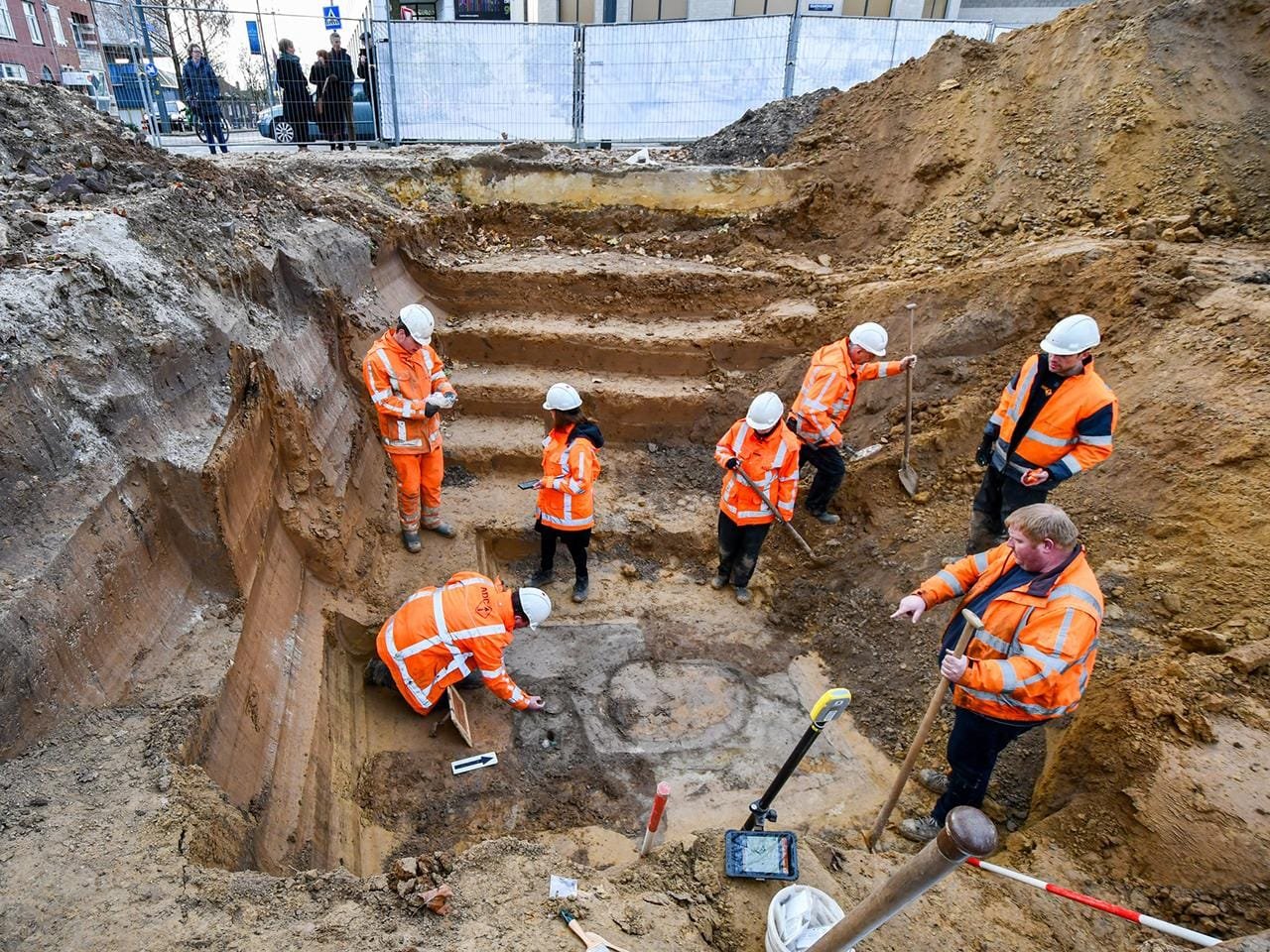
Archaeologists have uncovered the earliest evidence of Roman settlement in Heerlen, Netherlands, with the discovery of a 2,000-year-old burial belonging to a Roman soldier named Flaccus.
2,000-year-old tomb of Roman soldier unearthed in Netherlands
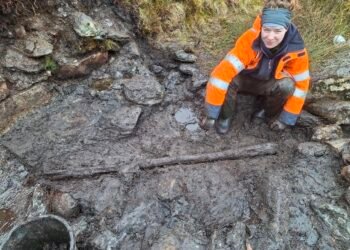
Excavation of the grave of Roman soldier Flaccus in Heerlen. Credit: Municipality of Heerlen

The find, made during ongoing excavations at the Raadhuisplein (Town Hall Square), offers new insights into Heerlen’s history as Coriovallum, a Roman settlement strategically located at the crossroads of major Roman roads.

The grave was identified in late November 2024 by archaeologists from ADC ArcheoProjecten during a redevelopment project at the Raadhuisplein. Initially thought to be a cellar pit due to its rectangular shape and soil discoloration, the pit’s purpose became clear with the discovery of cremation remains. Artifacts in the grave included a bronze strigil, pottery shards, and a set of terra sigillata plates. One of these plates bore the abbreviation “FLAC,” a nickname for Flaccus, carved into its surface.

Jordy Clemens, Heerlen’s councilmember for culture and heritage, said: “Today, evidence was found of Roman habitation in the time of Emperor Augustus. A unique discovery that not only teaches us more about our past, but also shows how unique the story of Roman Heerlen is for the Netherlands.”

The burial of Flaccus predates other known Roman graves in Heerlen and represents the oldest named individual in the city’s history. Previous finds, such as pottery fragments from the first half of the 1st century CE, were insufficient to confirm habitation, as they could have been lost or discarded along the road. Flaccus’ grave provides unequivocal evidence of early Roman presence.
RelatedStories

Bremenium Fort excavation uncovers remarkable Roman artifacts and structures in Northumberland

Bremenium Fort excavation uncovers remarkable Roman artifacts and structures in Northumberland

October 21, 2025
Rare Roman-era circular stone monument unearthed near Nassenfels, Germany

Rare Roman-era circular stone monument unearthed near Nassenfels, Germany

October 18, 2025

The artifacts in the grave, including four matching plates and a personalized bowl, were made in Italy and date to around the year 0. These items suggest that Flaccus was a Roman soldier stationed at Coriovallum during the early Roman expansion into the region. The bronze strigil, used for personal hygiene, reflects the soldier’s daily life.

Archaeologists highlight the rarity of identifying non-elite individuals by name in ancient contexts, making Flaccus’ burial a significant discovery. The presence of the name on a funerary object indicates the personal and cultural practices of the time.

During the early 1st century CE, Coriovallum was established at the junction of the Via Belgica and Via Traiana, connecting Cologne (Germany) to Boulogne-sur-Mer (France) and Xanten (Germany) to Trèves (France). Initially a military settlement, Coriovallum evolved into a flourishing civilian town by the mid-1st century CE. Its public baths, built around 50-70 CE, remain the largest visible Roman ruins in the Netherlands.

Excavations at the Raadhuisplein will continue into December. The artifacts from Flaccus’ grave will be cleaned, conserved, and displayed at the new Roman Museum of Heerlen. Clemens noted: “This find not only teaches us more about our past but also demonstrates the unique story of Roman Heerlen for the Netherlands.”

More information: Municipality of Heerlen
Share4Tweet2Share1ShareSend

You May Also Like...

Misread medieval tale misled generations of historians about the Black Death's spread, study finds
Archaeology

Misread medieval tale misled generations of historians about the Black Death’s spread, study finds

November 7, 2025
Signatures meant more in Mesopotamia than they do now − what cylinder seals say about ancient and modern life
Archaeology

Signatures meant more in Mesopotamia than they do now − what cylinder seals say about ancient and modern life

November 7, 2025
Daily life uncovered in Hellenistic military settlement at Pyla-Vigla, Cyprus
Archaeology

New discoveries reveal daily life in a Hellenistic military settlement at Pyla-Vigla, Cyprus

November 7, 2025
Viking treasures unearthed in Sweden reveal a society in transition
Archaeology

Viking treasures unearthed in Sweden reveal a society in transition

November 6, 2025
Archaeologists unearth 5,000-year-old winepress and Canaanite ritual artifacts near Tel Megiddo
Archaeology

Archaeologists unearth 5,000-year-old winepress and Canaanite ritual artifacts near Tel Megiddo

November 5, 2025
5,000-year-old monumental building in Iraq reveals ties to the world’s first cities
Archaeology

5,000-year-old monumental building in Iraq reveals ties to the world’s first cities

November 3, 2025

Comments 4

  1. Editorial Team says:
    1 second ago
    Disclaimer: This website is a science-focused magazine that welcomes both academic and non-academic audiences. Comments are written by users and may include personal opinions or unverified claims. They do not necessarily reflect the views of our editorial team or rely on scientific evidence.
  2. Rod Macleod says:
    11 months ago

    Very interesting feature; no clues I suppose as to which Legion he belonged.
    My interest really has to do with the disappearence of the IX legion which
    Was thought to be in the Netherlands at around AD120.

  3. Lorraine Byrne says:
    11 months ago

    Interesting

  4. Lance Layne Ball says:
    10 months ago

    I read in other articles and postings that Flaccus was a Roman soldier or auxiliary in Legio XXX.

  5. Robert E7 says:
    8 months ago

    Flaccus: Latin, “flabby, flaccid, or hanging down” – often used as a cognomen (a nickname or family name); his contubernium mates (tent mates) would laugh that he of all legionaries should be remembered through all time …

Follow us


Instagram
245K

Facebook
117K

Threads
45K

LinkedIn
14K

Twitter
6K

YouTube
1K
  • Trending
  • Comments
  • Latest
Shipwreck Salvage. Credit: rawpixel.com / Public Domain

2,000-year-old shipwreck discovered off Turkish coast with remarkably preserved stacked ceramics

July 2, 2025
Viking age DNA reveals 9,000-year-old HIV-resistant gene originating near the Black Sea

Viking age DNA reveals 9,000-year-old HIV-resistant gene originating near the Black Sea

May 18, 2025
Complete copy of the Canopus Decree unearthed in Egypt after 150 years

Complete copy of the Canopus Decree unearthed in Egypt after 150 years

September 13, 2025
Mystery of Armenia’s 6,000-year-old dragon stones solved

Mystery of Armenia’s 6,000-year-old dragon stones solved

September 23, 2025
Moses may be named in ancient Egyptian mine inscriptions, sparking debate over earliest biblical references

Moses may be named in ancient Egyptian mine inscriptions, sparking debate over earliest biblical references

July 31, 2025
Moses may be named in ancient Egyptian mine inscriptions, sparking debate over earliest biblical references

Moses may be named in ancient Egyptian mine inscriptions, sparking debate over earliest biblical references

3D analysis reveals Shroud of Turin image likely came from sculpture, not Jesus’ body

3D analysis reveals Shroud of Turin image likely came from sculpture, not Jesus’ body

$1 million prize offered to decipher 5,300-year-old Indus Valley script

$1 million prize offered to decipher 5,300-year-old Indus Valley script

Oldest ever genetic data from a human relative found in 2-million-year-old fossilized teeth

Oldest ever genetic data from a human relative found in 2-million-year-old fossilized teeth

Exceptionally large Roman shoes discovered at Magna fort near Hadrian’s Wall

Exceptionally large Roman shoes discovered at Magna fort near Hadrian’s Wall

Misread medieval tale misled generations of historians about the Black Death's spread, study finds

Misread medieval tale misled generations of historians about the Black Death’s spread, study finds

November 7, 2025
Signatures meant more in Mesopotamia than they do now − what cylinder seals say about ancient and modern life

Signatures meant more in Mesopotamia than they do now − what cylinder seals say about ancient and modern life

November 7, 2025
Daily life uncovered in Hellenistic military settlement at Pyla-Vigla, Cyprus

New discoveries reveal daily life in a Hellenistic military settlement at Pyla-Vigla, Cyprus

November 7, 2025
Viking treasures unearthed in Sweden reveal a society in transition

Viking treasures unearthed in Sweden reveal a society in transition

November 6, 2025
Archaeologists unearth 5,000-year-old winepress and Canaanite ritual artifacts near Tel Megiddo

Archaeologists unearth 5,000-year-old winepress and Canaanite ritual artifacts near Tel Megiddo

November 5, 2025

Archaeology News online magazine

Archaeology News is an international online magazine that covers all aspects of archaeology.


Categories

  • Academics
    • Books
    • Conferences
    • Universities
  • Articles
  • Download
  • Game
  • News
    • Anthropology
    • Archaeology
    • Paleontology
  • Quiz
  • Tours

Subscribe to our newsletter

© 2024 - Archaeology News Online Magazine. All Rights Reserved.

  • About
  • Privacy Policy
  • Terms of Use
  • Donation
  • Contact

Welcome Back!

Login to your account below

Forgotten Password? Sign Up

Create New Account!

Fill the forms below to register

All fields are required. Log In

Retrieve your password

Please enter your username or email address to reset your password.

Log In

Add New Playlist

Manage Consent
To provide the best experiences, we use technologies like cookies to store and/or access device information. Consenting to these technologies will allow us to process data such as browsing behavior or unique IDs on this site. Not consenting or withdrawing consent, may adversely affect certain features and functions.
Functional Always active
The technical storage or access is strictly necessary for the legitimate purpose of enabling the use of a specific service explicitly requested by the subscriber or user, or for the sole purpose of carrying out the transmission of a communication over an electronic communications network.
Preferences
The technical storage or access is necessary for the legitimate purpose of storing preferences that are not requested by the subscriber or user.
Statistics
The technical storage or access that is used exclusively for statistical purposes. The technical storage or access that is used exclusively for anonymous statistical purposes. Without a subpoena, voluntary compliance on the part of your Internet Service Provider, or additional records from a third party, information stored or retrieved for this purpose alone cannot usually be used to identify you.
Marketing
The technical storage or access is required to create user profiles to send advertising, or to track the user on a website or across several websites for similar marketing purposes.
Manage options Manage services Manage {vendor_count} vendors Read more about these purposes
View preferences
{title} {title} {title}
  • Home
  • News
    • Archaeology
    • Anthropology
    • Paleontology
  • Academics
    • Books
    • Conferences
    • Universities
  • Articles
  • VR Tours
  • Quiz & Game
  • Download
  • Encyclopedia
  • Forum

About  .  Contact  .  Donation

© 2024 - Archaeology News Online Magazine. All Rights Reserved