• About
  • Privacy Policy
  • Terms of Use
  • Donation
  • Contact
No Result
View All Result
Archaeology News
  • Home
  • News
    • Archaeology
    • Anthropology
    • Paleontology
  • Academic
    • Books
    • Conferences
    • Universities
  • Articles
  • VR Tours
  • Quiz & Game
  • Download
  • Encyclopedia
  • Forum
Archaeology News
No Result
View All Result
Home News Archaeology

Archaeologists uncover mysterious mask and advanced water system in ancient Libyan city of Ptolemais

by Dario Radley
January 18, 2025

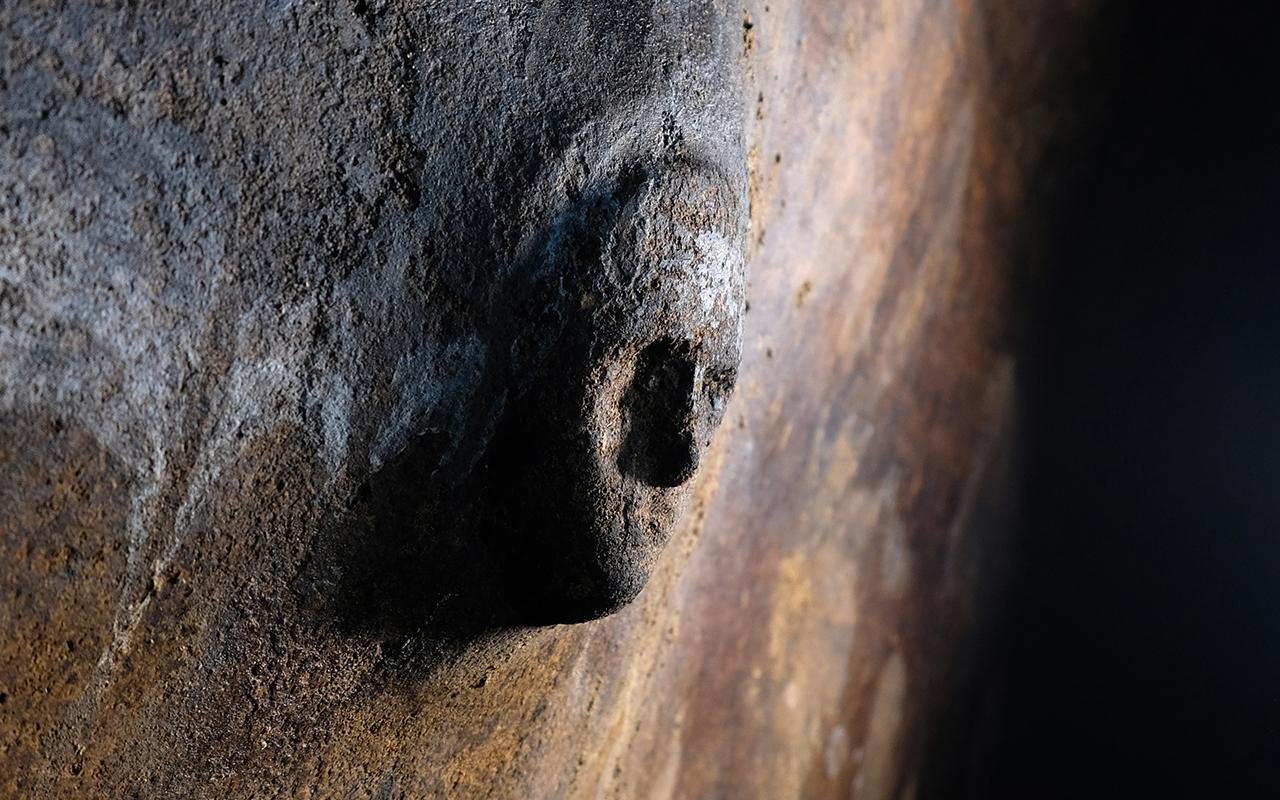
The Mediterranean Libyan city of Ptolemais continues to reveal fantastic secrets about its glorious Hellenistic and Roman past. Founded during either the 4th or 3rd century BCE by the Ptolemaic dynasty, it went on to prosper for almost a millennium until its abandonment after the Arab invasion in the 7th century CE. Several stunning discoveries have been unearthed in excavations recently led by Polish archaeologists from Warsaw University, including a sophisticated water system and an enigmatic face carved in hydraulic mortar.
Archaeologists uncover mysterious mask and advanced water system in ancient Libyan city of Ptolemais
The mask found in the ancient city of Ptolemais. Credit: Anna Tomkowska / University of Warsaw

Founded as a port city for the inland settlement of Barca, Ptolemais was thriving under the Ptolemies, expanding to become an important urban center under the Romans. From the late 3rd century CE onward, it held the rank of a provincial capital in Libya Superior, a status established by the administrative reforms of Emperor Diocletian. Its status was based on an impregnable location supported by marvelous works of engineering; it had, of course, been persistently beset throughout those centuries, suffering several natural disasters and the eventual Arab conquest.

Excavations started in 2001 under Professor Tomasz Mikocki but were stopped in 2010 because of the civil war in Libya. In 2023, the researchers came back after years to reassume this work, using far more sophisticated, non-invasive methods such as 3D mapping and orthophotographic surveys.

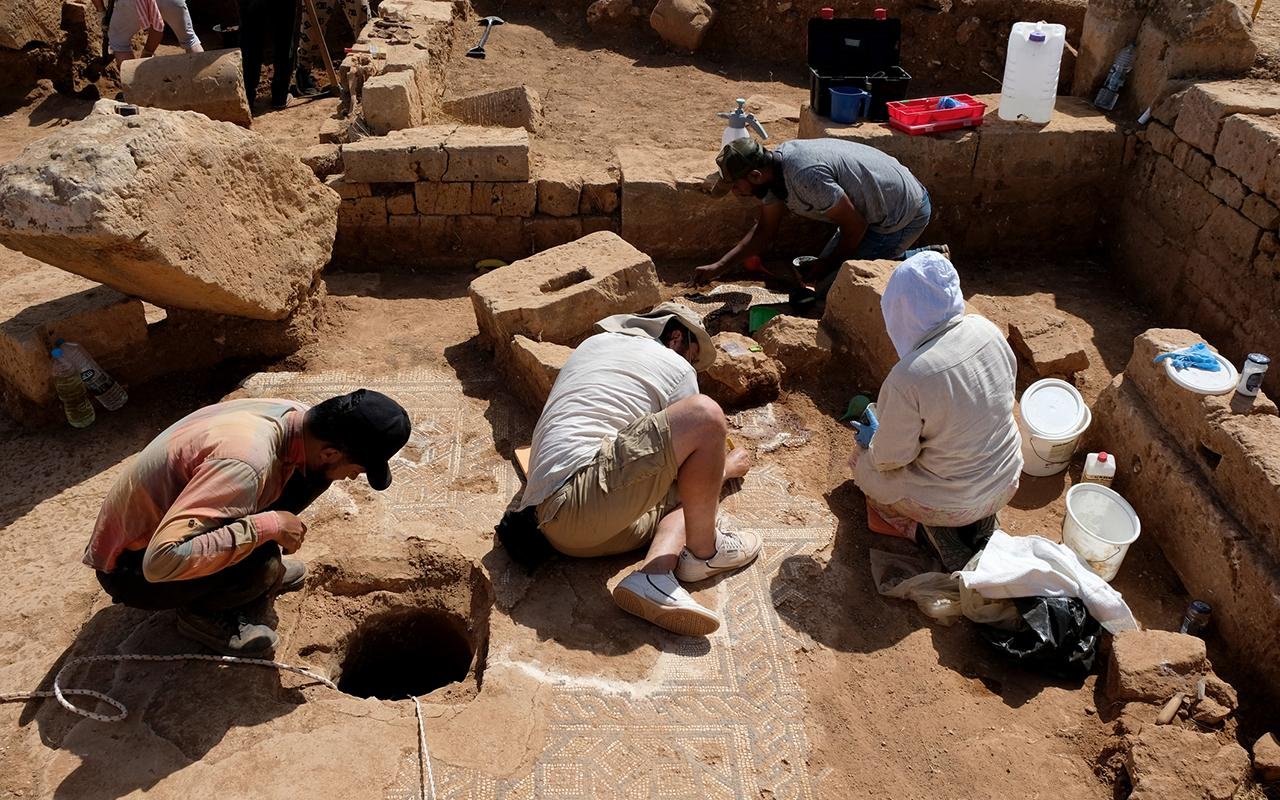
During the summer of 2024, archaeologists found the remains of a residence belonging to one of the locals who was a person of significant rank. The house had been built around a small peristyle court lined by rooms serving purposes like the kitchen, staircase, and a chamber with a mosaic. The mosaic, though several times repaired, testifies to the importance of this house. Stone containers near the entrance may indicate a public function—perhaps as a place where taxes or tribute were stored during the late Roman period.
Archaeologists uncover mysterious mask and advanced water system in ancient Libyan city of Ptolemais
Excavation and conservation of the ruins of a house in Ptolemais. Credit: Piotr Jaworski / University of Warsaw

The most remarkable feature of the house was a sophisticated water management system, where rain falling into the impluvium of the central pool in the peristyle was directed into two underground cisterns. This evidence highlights the resourceful engineering skills of the citizens of Ptolemais. The house sustained serious damage in the earthquakes at the end of the 3rd century CE but was later rebuilt to serve various functions according to changing needs.
RelatedStories

Rare Roman villa threatened by farming damage reveals rare mosaic and bathhouse remains in Devon

Rare Roman villa threatened by farming damage reveals rare mosaic and bathhouse remains in Devon

May 12, 2026
Ancient bathhouse and Roman villa with mosaics unearthed in Alexandria during rescue excavation

Ancient bathhouse and Roman villa with mosaics unearthed in Alexandria during rescue excavation

May 3, 2026

One of the most interesting discoveries was a human face carved into hydraulic mortar on the wall of one cistern. Lacking any distinctive features, the face served only to spark the imagination of the archaeologists. Dr. Piotr Jaworski, head of the Polish Archaeological Mission to Ptolemais, drew parallels with the carvings in the Libyan sanctuary in Slonta south of Cyrene. “It cannot be ruled out that the house’s owner, or at least those involved in creating the image, were of Libyan origin. Epigraphic evidence indicates that from at least the 1st century BCE, Libyan elites, who quickly assimilated, were granted citizenship in Greek cities of Cyrenaica. However, he noted that this remains speculative.”

In December 2024, the team shifted their attention to Ptolemais’ acropolis, a fortified hill with strategic advantages that contains an assortment of buildings. The acropolis rises 285 meters above sea level and is surrounded by robust fortification walls, defensive towers, and an independent water supply system comprising wells and cisterns. A theater on the northern slope and a hippodrome at the foot further stress the multifunctionality of the area.

Project leader Dr. Szymon Lenarczyk emphasized the significance of these preliminary surveys: “Our orthophotomap of the Ptolemais acropolis reveals numerous architectural structures that are not necessarily part of its defense system.” These structures will be studied during future seasons to determine whether they served residential, religious, or other purposes.

More information: University of Warsaw / Nauka w Polsce Service

Share4Tweet2Share1ShareSend

You May Also Like...

Horse domestication began centuries earlier than thought, study reveals early riding and management in 4th millennium BCE
Archaeology

Horse domestication began centuries earlier than thought, study reveals early riding and management in 4th millennium BCE

May 15, 2026
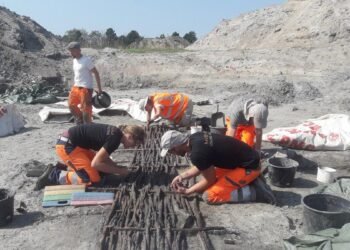
Ancient Danes kept fishing for millennia after farming arrived, study finds
Archaeology

Ancient Danes kept fishing for millennia after farming arrived, study finds

May 14, 2026
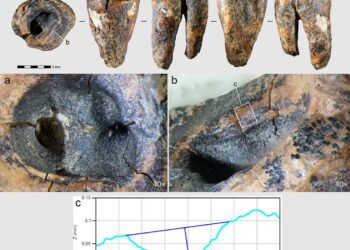
Oldest known dental treatment found in 59,000-year-old Neanderthal tooth from Siberia
Anthropology

Oldest known dental treatment found in 59,000-year-old Neanderthal tooth from Siberia

May 14, 2026
Homo erectus in Java: 140,000-year-old fossils found in submerged river valley
Anthropology

400,000-year-old Homo erectus proteins reveal genetic links to Denisovans and modern humans

May 14, 2026
Cut marks on 1.6-million-year-old bones reveal early humans moved and processed meat in Kenya
Anthropology

Cut marks on 1.6-million-year-old bones reveal early humans moved and processed meat in Kenya

May 13, 2026
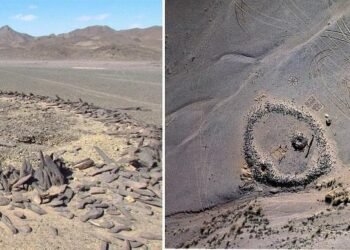
280 ancient stone burial monuments found in Sudan reveal lost cattle-herding culture in the Sahara
Archaeology

280 ancient stone burial monuments found in Sudan reveal lost cattle-herding culture in the Sahara

May 13, 2026

Comments 2

  1. Editorial Team says:
    1 second ago

    Disclaimer: This website is a science-focused magazine that welcomes both academic and non-academic audiences. Comments are written by users and may include personal opinions or unverified claims. They do not necessarily reflect the views of our editorial team or rely on scientific evidence.

    Comment Policy: We kindly ask all commenters to engage respectfully. Comments that contain offensive, insulting, degrading, discriminatory, or racist content will be automatically removed.

  2. Lacey says:
    1 year ago

    This is so cool! I’m actually looking forward to hearing more of their later excavations of the site. Thanks

  3. Mary Bellipanni says:
    1 year ago

    Fantastic!

Follow us


Instagram
242K

Facebook
117K

Threads
46K

LinkedIn
14K

Twitter
6K

YouTube
1K
  • Trending
  • Comments
  • Latest
Shipwreck Salvage. Credit: rawpixel.com / Public Domain

2,000-year-old shipwreck discovered off Turkish coast with remarkably preserved stacked ceramics

July 2, 2025
A new study suggests the mysterious Voynich Manuscript may be a medieval cipher

A new study suggests the mysterious Voynich Manuscript may be a medieval cipher

January 3, 2026
Viking age DNA reveals 9,000-year-old HIV-resistant gene originating near the Black Sea

Viking age DNA reveals 9,000-year-old HIV-resistant gene originating near the Black Sea

May 18, 2025
3D analysis reveals Shroud of Turin image likely came from sculpture, not Jesus’ body

3D analysis reveals Shroud of Turin image likely came from sculpture, not Jesus’ body

August 3, 2025
Moses may be named in ancient Egyptian mine inscriptions, sparking debate over earliest biblical references

Moses may be named in ancient Egyptian mine inscriptions, sparking debate over earliest biblical references

July 31, 2025
3D analysis reveals Shroud of Turin image likely came from sculpture, not Jesus’ body

3D analysis reveals Shroud of Turin image likely came from sculpture, not Jesus’ body

Moses may be named in ancient Egyptian mine inscriptions, sparking debate over earliest biblical references

Moses may be named in ancient Egyptian mine inscriptions, sparking debate over earliest biblical references

$1 million prize offered to decipher 5,300-year-old Indus Valley script

$1 million prize offered to decipher 5,300-year-old Indus Valley script

Oldest ever genetic data from a human relative found in 2-million-year-old fossilized teeth

Oldest ever genetic data from a human relative found in 2-million-year-old fossilized teeth

Exceptionally large Roman shoes discovered at Magna fort near Hadrian’s Wall

Exceptionally large Roman shoes discovered at Magna fort near Hadrian’s Wall

Horse domestication began centuries earlier than thought, study reveals early riding and management in 4th millennium BCE

Horse domestication began centuries earlier than thought, study reveals early riding and management in 4th millennium BCE

May 15, 2026
Ancient Danes kept fishing for millennia after farming arrived, study finds

Ancient Danes kept fishing for millennia after farming arrived, study finds

May 14, 2026
Oldest known dental treatment found in 59,000-year-old Neanderthal tooth from Siberia

Oldest known dental treatment found in 59,000-year-old Neanderthal tooth from Siberia

May 14, 2026
Homo erectus in Java: 140,000-year-old fossils found in submerged river valley

400,000-year-old Homo erectus proteins reveal genetic links to Denisovans and modern humans

May 14, 2026
Cut marks on 1.6-million-year-old bones reveal early humans moved and processed meat in Kenya

Cut marks on 1.6-million-year-old bones reveal early humans moved and processed meat in Kenya

May 13, 2026

Archaeology News online magazine

Archaeology News is an international online magazine that covers all aspects of archaeology.


Categories

  • Academics
    • Books
    • Conferences
    • Universities
  • Articles
  • Download
  • Game
  • News
    • Anthropology
    • Archaeology
    • Paleontology
  • Quiz
  • Tours

Subscribe to our newsletter

© 2024 - Archaeology News Online Magazine. All Rights Reserved.

  • About
  • Privacy Policy
  • Terms of Use
  • Donation
  • Contact

Manage Consent
To provide the best experiences, we use technologies like cookies to store and/or access device information. Consenting to these technologies will allow us to process data such as browsing behavior or unique IDs on this site. Not consenting or withdrawing consent, may adversely affect certain features and functions.
Functional Always active
The technical storage or access is strictly necessary for the legitimate purpose of enabling the use of a specific service explicitly requested by the subscriber or user, or for the sole purpose of carrying out the transmission of a communication over an electronic communications network.
Preferences
The technical storage or access is necessary for the legitimate purpose of storing preferences that are not requested by the subscriber or user.
Statistics
The technical storage or access that is used exclusively for statistical purposes. The technical storage or access that is used exclusively for anonymous statistical purposes. Without a subpoena, voluntary compliance on the part of your Internet Service Provider, or additional records from a third party, information stored or retrieved for this purpose alone cannot usually be used to identify you.
Marketing
The technical storage or access is required to create user profiles to send advertising, or to track the user on a website or across several websites for similar marketing purposes.
  • Manage options
  • Manage services
  • Manage {vendor_count} vendors
  • Read more about these purposes
View preferences
  • {title}
  • {title}
  • {title}
  • Home
  • News
    • Archaeology
    • Anthropology
    • Paleontology
  • Academic
    • Books
    • Conferences
    • Universities
  • Articles
  • VR Tours
  • Quiz & Game
  • Download
  • Encyclopedia
  • Forum

About  .  Contact  .  Donation

© 2024 - Archaeology News Online Magazine. All Rights Reserved