• About
  • Privacy Policy
  • Terms of Use
  • Donation
  • Contact
No Result
View All Result
Archaeology News
  • Home
  • News
    • Archaeology
    • Anthropology
    • Paleontology
  • Academics
    • Books
    • Conferences
    • Universities
  • Articles
  • VR Tours
  • Quiz & Game
  • Download
  • Encyclopedia
  • Forum
Archaeology News
No Result
View All Result
Home News Archaeology

Archaeologists uncover 7th-century pagan cult site with ritual offerings in the Netherlands

by Dario Radley
February 8, 2025

A team of archaeologists has uncovered a unique early medieval cult site in the eastern Netherlands, near the hamlet of Hezingen, providing new insight into pre-Christian rites. The discovery, detailed in the journal Medieval Archaeology, offers crucial insights into the religious practices of the local elites during a time of cultural transformation.
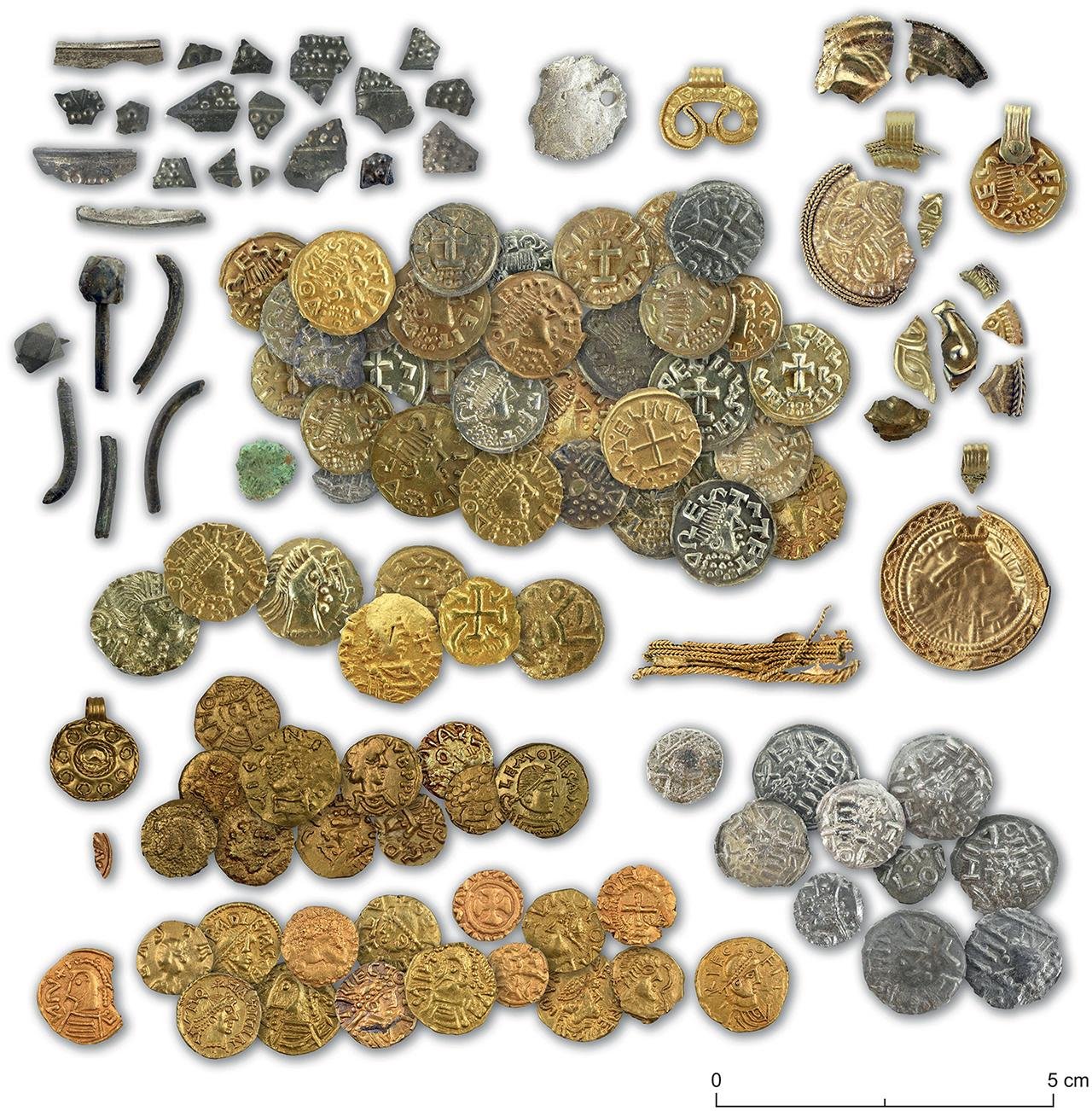
Archaeologists uncover 7th-century pagan cult site with ritual offerings in the Netherlands
a selection of finds. Credit: Jan-Willem de Kort, Mario van IJzendoorn and Archeocare / Jan-Willem De Kort et al., Medieval Archaeology (2024). (This image is used under the terms of the CC BY-NC-ND license for non-commercial, educational, and informational purposes. If you are the copyright holder and have any concerns regarding its use, please contact us for prompt removal.)

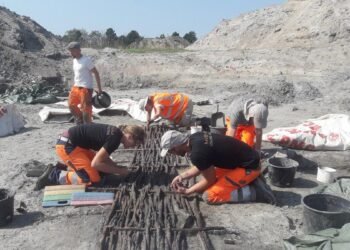
The site first came to light about five years ago following the discovery of gold and silver coins by metal detectorists, after which a full-scale excavation commenced from 2020 to 2021. More than 190 finds were reported, including gold tremisses (small gold coins), silver earrings, and a gold pendant, concentrated around wooden pillars and a large rock. These findings suggest that Hezingen was an important worship center where ritual offerings were made.

Excavations suggest that Hezingen consisted of a large circular structure made up of wooden posts surrounding an unusually shaped building, possibly a Herrenhof—an elite leader’s residence—dating back to the 6th century. Seventeen postholes were identified, with wooden pillars aligned in an east-west direction. This direction likely suggests that the site was used for seasonal rituals during the spring and autumn equinoxes, possibly linked to sowing and harvesting ceremonies.

Artifacts were found in three key locations within the site. One contained a single gold coin, while the second had almost two dozen fragmented and complete tremisses, a gold pendant, and a silver earring. A third site held other fragments of gold coins and a small pendant. Chemical analysis of the soil indicated the presence of bones, which suggests that animal sacrifices were part of the rituals practiced at Hezingen.

Researchers believe that Hezingen was primarily used by local elites, who left high-value offerings to emphasize their social and religious status. The presence of gold and silver offerings aligns with medieval missionary texts that describe how pre-Christian communities practiced rituals involving the gifting of valuable items. These texts refer to such offerings as diobolgeldæ, or “devil’s money,” and note that individuals seeking to convert to Christianity had to renounce these practices.
RelatedStories

Misread medieval tale misled generations of historians about the Black Death's spread, study finds

Misread medieval tale misled generations of historians about the Black Death’s spread, study finds

November 7, 2025
Viking silver treasures from the Burray Hoard go on display at Orkney Museum

Viking silver treasures from the Burray Hoard go on display at Orkney Museum

October 30, 2025

This cult site was in use for some 100 years before it was abandoned in the late 7th or early 8th century. The reason for its abandonment is still a puzzle, but researchers have suggested several possibilities. One theory posits that the local elite, who held control over the site, may have converted to Christianity earlier than the rest, thus ceasing their paganism. Another possibility is that Christian missionaries such as Plechelmus and Lebuinus, who were known to be active in the region around 760 CE, may have desecrated or repurposed the site.

Pre-Christian cult sites in the Netherlands, northern Germany, and Britain are far less studied compared to those in the Nordic world, where more extensive research has been conducted on pagan rituals. This makes Hezingen an exceptionally valuable discovery, offering a rare glimpse into a society on the cusp of religious transformation.

More information: De Kort, J.-W., Brinkkemper, O., Van Doesburg, J., Groenewoudt, B., Heeren, S., Kars, M., … Pol, A. (2024). diobolgeldæ (the devil’s money): The early-medieval cult site of hezingen, the Netherlands. Medieval Archaeology, 68(2), 306–330. doi:10.1080/00766097.2024.2419198
Share4Tweet3Share1ShareSend

You May Also Like...

Misread medieval tale misled generations of historians about the Black Death's spread, study finds
Archaeology

Misread medieval tale misled generations of historians about the Black Death’s spread, study finds

November 7, 2025
Signatures meant more in Mesopotamia than they do now − what cylinder seals say about ancient and modern life
Archaeology

Signatures meant more in Mesopotamia than they do now − what cylinder seals say about ancient and modern life

November 7, 2025
Daily life uncovered in Hellenistic military settlement at Pyla-Vigla, Cyprus
Archaeology

New discoveries reveal daily life in a Hellenistic military settlement at Pyla-Vigla, Cyprus

November 7, 2025
Viking treasures unearthed in Sweden reveal a society in transition
Archaeology

Viking treasures unearthed in Sweden reveal a society in transition

November 6, 2025
Archaeologists unearth 5,000-year-old winepress and Canaanite ritual artifacts near Tel Megiddo
Archaeology

Archaeologists unearth 5,000-year-old winepress and Canaanite ritual artifacts near Tel Megiddo

November 5, 2025
5,000-year-old monumental building in Iraq reveals ties to the world’s first cities
Archaeology

5,000-year-old monumental building in Iraq reveals ties to the world’s first cities

November 3, 2025

Follow us


Instagram
245K

Facebook
117K

Threads
45K

LinkedIn
14K

Twitter
6K

YouTube
1K
  • Trending
  • Comments
  • Latest
Shipwreck Salvage. Credit: rawpixel.com / Public Domain

2,000-year-old shipwreck discovered off Turkish coast with remarkably preserved stacked ceramics

July 2, 2025
Viking age DNA reveals 9,000-year-old HIV-resistant gene originating near the Black Sea

Viking age DNA reveals 9,000-year-old HIV-resistant gene originating near the Black Sea

May 18, 2025
Complete copy of the Canopus Decree unearthed in Egypt after 150 years

Complete copy of the Canopus Decree unearthed in Egypt after 150 years

September 13, 2025
Mystery of Armenia’s 6,000-year-old dragon stones solved

Mystery of Armenia’s 6,000-year-old dragon stones solved

September 23, 2025
Moses may be named in ancient Egyptian mine inscriptions, sparking debate over earliest biblical references

Moses may be named in ancient Egyptian mine inscriptions, sparking debate over earliest biblical references

July 31, 2025
Moses may be named in ancient Egyptian mine inscriptions, sparking debate over earliest biblical references

Moses may be named in ancient Egyptian mine inscriptions, sparking debate over earliest biblical references

3D analysis reveals Shroud of Turin image likely came from sculpture, not Jesus’ body

3D analysis reveals Shroud of Turin image likely came from sculpture, not Jesus’ body

$1 million prize offered to decipher 5,300-year-old Indus Valley script

$1 million prize offered to decipher 5,300-year-old Indus Valley script

Oldest ever genetic data from a human relative found in 2-million-year-old fossilized teeth

Oldest ever genetic data from a human relative found in 2-million-year-old fossilized teeth

Exceptionally large Roman shoes discovered at Magna fort near Hadrian’s Wall

Exceptionally large Roman shoes discovered at Magna fort near Hadrian’s Wall

Misread medieval tale misled generations of historians about the Black Death's spread, study finds

Misread medieval tale misled generations of historians about the Black Death’s spread, study finds

November 7, 2025
Signatures meant more in Mesopotamia than they do now − what cylinder seals say about ancient and modern life

Signatures meant more in Mesopotamia than they do now − what cylinder seals say about ancient and modern life

November 7, 2025
Daily life uncovered in Hellenistic military settlement at Pyla-Vigla, Cyprus

New discoveries reveal daily life in a Hellenistic military settlement at Pyla-Vigla, Cyprus

November 7, 2025
Viking treasures unearthed in Sweden reveal a society in transition

Viking treasures unearthed in Sweden reveal a society in transition

November 6, 2025
Archaeologists unearth 5,000-year-old winepress and Canaanite ritual artifacts near Tel Megiddo

Archaeologists unearth 5,000-year-old winepress and Canaanite ritual artifacts near Tel Megiddo

November 5, 2025

Archaeology News online magazine

Archaeology News is an international online magazine that covers all aspects of archaeology.


Categories

  • Academics
    • Books
    • Conferences
    • Universities
  • Articles
  • Download
  • Game
  • News
    • Anthropology
    • Archaeology
    • Paleontology
  • Quiz
  • Tours

Subscribe to our newsletter

© 2024 - Archaeology News Online Magazine. All Rights Reserved.

  • About
  • Privacy Policy
  • Terms of Use
  • Donation
  • Contact

Welcome Back!

Login to your account below

Forgotten Password? Sign Up

Create New Account!

Fill the forms below to register

All fields are required. Log In

Retrieve your password

Please enter your username or email address to reset your password.

Log In

Add New Playlist

Manage Consent
To provide the best experiences, we use technologies like cookies to store and/or access device information. Consenting to these technologies will allow us to process data such as browsing behavior or unique IDs on this site. Not consenting or withdrawing consent, may adversely affect certain features and functions.
Functional Always active
The technical storage or access is strictly necessary for the legitimate purpose of enabling the use of a specific service explicitly requested by the subscriber or user, or for the sole purpose of carrying out the transmission of a communication over an electronic communications network.
Preferences
The technical storage or access is necessary for the legitimate purpose of storing preferences that are not requested by the subscriber or user.
Statistics
The technical storage or access that is used exclusively for statistical purposes. The technical storage or access that is used exclusively for anonymous statistical purposes. Without a subpoena, voluntary compliance on the part of your Internet Service Provider, or additional records from a third party, information stored or retrieved for this purpose alone cannot usually be used to identify you.
Marketing
The technical storage or access is required to create user profiles to send advertising, or to track the user on a website or across several websites for similar marketing purposes.
Manage options Manage services Manage {vendor_count} vendors Read more about these purposes
View preferences
{title} {title} {title}
  • Home
  • News
    • Archaeology
    • Anthropology
    • Paleontology
  • Academics
    • Books
    • Conferences
    • Universities
  • Articles
  • VR Tours
  • Quiz & Game
  • Download
  • Encyclopedia
  • Forum

About  .  Contact  .  Donation

© 2024 - Archaeology News Online Magazine. All Rights Reserved