• About
  • Privacy Policy
  • Terms of Use
  • Donation
  • Contact
No Result
View All Result
Archaeology News
  • Home
  • News
    • Archaeology
    • Anthropology
    • Paleontology
  • Academic
    • Books
    • Conferences
    • Universities
  • Articles
  • VR Tours
  • Quiz & Game
  • Download
  • Encyclopedia
  • Forum
Archaeology News
No Result
View All Result
Home News Archaeology

The role of children in Paleolithic cave art: creators, apprentices, or spiritual mediators?

by Dario Radley
April 1, 2025

A recent study from Tel Aviv University has put forth a new hypothesis regarding the presence of children in prehistoric cave art sites. Earlier, it was believed by scholars that children accompanied adults into deep caves to learn cultural traditions. But according to a team of archaeologists, these children could have played a more spiritual role as mediators between the human and supernatural realms.

The role of children in Paleolithic cave art: creators, apprentices, or spiritual mediators?
Replica of a horse painting from a cave in Lascaux. Credit: Patrick Janicek, CC BY 2.0

Archaeological records hold evidence of the presence of children as young as two years old in the labyrinthine depths of caves, which were full of prehistoric art. Dr. Ella Assaf, Dr. Yafit Kedar, and Prof. Ran Barkai of Tel Aviv University, whose research was published in the journal Arts, point to the existence of children’s footprints, handprints, and even finger paintings alongside adult hand and footprints in caves throughout Europe, primarily in France and Spain. This is seen at sites such as Basura Cave in Italy, where 14,000-year-old footprints of at least two children were discovered deep within the cave, and Rouffignac Cave in France, where a child younger than five appears to have drawn part of the saiga antelope painting.

These findings pose a basic question: Why were young children brought into such dangerous and oxygen-depleted environments? Venturing into these caves meant crawling through tight spaces, descending shafts, and enduring almost complete darkness. The conventional explanation has been that these experiences formed part of an educational process, enabling children to learn about the art and culture of their community. However, researchers at Tel Aviv University offer another explanation.

According to this study, many ancient societies viewed caves as sacred portals to the underworld. These deep places were considered locations for shamanic rituals where early humans tried to communicate with cosmic entities or spirits of their ancestors. In this regard, children were viewed as liminal beings—entities that straddled the boundary between the human world and the spiritual world.

The role of children in Paleolithic cave art: creators, apprentices, or spiritual mediators?
Children’s fluting examples from G4 panel from Rouffignac cave. Courtesy of Dr. Van Gelder. Credit: Assaf, E., Kedar, Y., & Barkai, R., Arts (2025)

“Many indigenous cultures worldwide, throughout history and prehistory, have viewed children as ‘active agents’—mediators between this world and the entities inhabiting the natural world, the underworld, and the cosmos as a whole,” explains Dr. Assaf.


RelatedStories

40,000-year-old European engravings reveal structured sign systems, study finds

40,000-year-old European engravings reveal structured sign systems, study finds

February 25, 2026
New 3D digital analysis maps Paleolithic engravings at Cova Matutano

New 3D method maps Paleolithic engravings at Cova Matutano

February 8, 2026

According to the researchers, similar practices were followed by indigenous societies in Australia, the San culture of the Kalahari Desert, and among the Maya and Inca civilizations, where children were an integral part of spiritual communication rituals.

This theory aligns with evidence from indigenous societies where children take part in vision quests, trance-healing ceremonies, and rites of passage. In some traditions, they are seen to have a natural ability to perceive and interact with spiritual forces more readily than adults.

Another possible contributor to the mystical experience of prehistoric cave people could have been hypoxia—low oxygen levels caused by torches and poor ventilation deep underground. Some researchers propose that hallucinations and altered states of consciousness caused by oxygen deprivation may have influenced the perceptions of early humans and made them feel closer to supernatural entities.

The study highlights that most Paleolithic cave paintings contain geometric patterns and depictions of animals, while plant or landscape paintings are rare. This focus on symbolic imagery reflects a ritualistic purpose rather than purely artistic expression.

The findings of Assaf, Kedar, and Barkai contrast with the conventional theories of childhood during the Paleolithic era. If their hypothesis is correct, then children were not merely passive learners but were actively engaged and played an important role in their societies’ cosmology. Their presence in the caves might have served a dual purpose: ensuring spiritual harmony while also training them for future leadership positions in their communities.
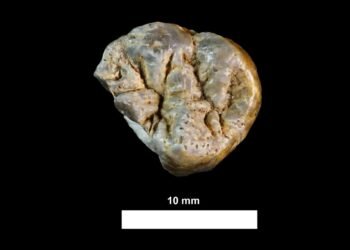
Tel-Aviv University

More information: Assaf, E., Kedar, Y., & Barkai, R. (2025). Child in time: Children as liminal agents in Upper Paleolithic decorated caves. Arts, 14(2), 27. doi:10.3390/arts14020027
Share14Tweet9Share2ShareSend

You May Also Like...

Roman cemetery in Egypt reveals golden tongues, mummies, and rare Iliad papyrus
Anthropology

Roman cemetery in Egypt reveals golden tongues, mummies, and rare Iliad papyrus

April 19, 2026
Basel plague study finds young workers had highest death rates in 17th century outbreak
Anthropology

Basel plague study finds young workers had highest death rates in 17th century outbreak

April 17, 2026
Ancient DNA reveals male lineage and family ties in Neolithic Scotland tombs
Anthropology

Ancient DNA reveals male lineage and family ties in Neolithic Scotland tombs

April 16, 2026
Council houses reveal shift from royal rule to collective governance in Terminal Classic Maya society
Archaeology

Council houses reveal shift from royal rule to collective governance in Terminal Classic Maya society

April 11, 2026
Bronze Age loom found inside ancient Spanish home reveals early textile production
Archaeology

Bronze Age loom found inside ancient Spanish home reveals early textile production

April 8, 2026
Pompeii ash analysis reveals Romans burned wine and imported frankincense in household rituals
Archaeology

Pompeii ash analysis reveals Romans burned wine and imported frankincense in household rituals

April 3, 2026

Follow us


Instagram
244K

Facebook
118K

Threads
46K

LinkedIn
14K

Twitter
6K

YouTube
1K
  • Trending
  • Comments
  • Latest
Shipwreck Salvage. Credit: rawpixel.com / Public Domain

2,000-year-old shipwreck discovered off Turkish coast with remarkably preserved stacked ceramics

July 2, 2025
Viking age DNA reveals 9,000-year-old HIV-resistant gene originating near the Black Sea

Viking age DNA reveals 9,000-year-old HIV-resistant gene originating near the Black Sea

May 18, 2025
A new study suggests the mysterious Voynich Manuscript may be a medieval cipher

A new study suggests the mysterious Voynich Manuscript may be a medieval cipher

January 3, 2026
3D analysis reveals Shroud of Turin image likely came from sculpture, not Jesus’ body

3D analysis reveals Shroud of Turin image likely came from sculpture, not Jesus’ body

August 3, 2025
Moses may be named in ancient Egyptian mine inscriptions, sparking debate over earliest biblical references

Moses may be named in ancient Egyptian mine inscriptions, sparking debate over earliest biblical references

July 31, 2025
3D analysis reveals Shroud of Turin image likely came from sculpture, not Jesus’ body

3D analysis reveals Shroud of Turin image likely came from sculpture, not Jesus’ body

Moses may be named in ancient Egyptian mine inscriptions, sparking debate over earliest biblical references

Moses may be named in ancient Egyptian mine inscriptions, sparking debate over earliest biblical references

$1 million prize offered to decipher 5,300-year-old Indus Valley script

$1 million prize offered to decipher 5,300-year-old Indus Valley script

Oldest ever genetic data from a human relative found in 2-million-year-old fossilized teeth

Oldest ever genetic data from a human relative found in 2-million-year-old fossilized teeth

Exceptionally large Roman shoes discovered at Magna fort near Hadrian’s Wall

Exceptionally large Roman shoes discovered at Magna fort near Hadrian’s Wall

Roman cemetery in Egypt reveals golden tongues, mummies, and rare Iliad papyrus

Roman cemetery in Egypt reveals golden tongues, mummies, and rare Iliad papyrus

April 19, 2026
Basel plague study finds young workers had highest death rates in 17th century outbreak

Basel plague study finds young workers had highest death rates in 17th century outbreak

April 17, 2026
Ancient DNA reveals male lineage and family ties in Neolithic Scotland tombs

Ancient DNA reveals male lineage and family ties in Neolithic Scotland tombs

April 16, 2026
Council houses reveal shift from royal rule to collective governance in Terminal Classic Maya society

Council houses reveal shift from royal rule to collective governance in Terminal Classic Maya society

April 11, 2026
Bronze Age loom found inside ancient Spanish home reveals early textile production

Bronze Age loom found inside ancient Spanish home reveals early textile production

April 8, 2026

Archaeology News online magazine

Archaeology News is an international online magazine that covers all aspects of archaeology.


Categories

  • Academics
    • Books
    • Conferences
    • Universities
  • Articles
  • Download
  • Game
  • News
    • Anthropology
    • Archaeology
    • Paleontology
  • Quiz
  • Tours

Subscribe to our newsletter

© 2024 - Archaeology News Online Magazine. All Rights Reserved.

  • About
  • Privacy Policy
  • Terms of Use
  • Donation
  • Contact

Manage Consent
To provide the best experiences, we use technologies like cookies to store and/or access device information. Consenting to these technologies will allow us to process data such as browsing behavior or unique IDs on this site. Not consenting or withdrawing consent, may adversely affect certain features and functions.
Functional Always active
The technical storage or access is strictly necessary for the legitimate purpose of enabling the use of a specific service explicitly requested by the subscriber or user, or for the sole purpose of carrying out the transmission of a communication over an electronic communications network.
Preferences
The technical storage or access is necessary for the legitimate purpose of storing preferences that are not requested by the subscriber or user.
Statistics
The technical storage or access that is used exclusively for statistical purposes. The technical storage or access that is used exclusively for anonymous statistical purposes. Without a subpoena, voluntary compliance on the part of your Internet Service Provider, or additional records from a third party, information stored or retrieved for this purpose alone cannot usually be used to identify you.
Marketing
The technical storage or access is required to create user profiles to send advertising, or to track the user on a website or across several websites for similar marketing purposes.
  • Manage options
  • Manage services
  • Manage {vendor_count} vendors
  • Read more about these purposes
View preferences
  • {title}
  • {title}
  • {title}
  • Home
  • News
    • Archaeology
    • Anthropology
    • Paleontology
  • Academic
    • Books
    • Conferences
    • Universities
  • Articles
  • VR Tours
  • Quiz & Game
  • Download
  • Encyclopedia
  • Forum

About  .  Contact  .  Donation

© 2024 - Archaeology News Online Magazine. All Rights Reserved