• About
  • Privacy Policy
  • Terms of Use
  • Donation
  • Contact
No Result
View All Result
Archaeology News
  • Home
  • News
    • Archaeology
    • Anthropology
    • Paleontology
  • Academic
    • Books
    • Conferences
    • Universities
  • Articles
  • VR Tours
  • Quiz & Game
  • Download
  • Encyclopedia
  • Forum
Archaeology News
No Result
View All Result
Home News Anthropology

Copper Age infant discovered in Italian well reveals rare genetic origins

by Dario Radley
July 6, 2025

Archaeologists in northeastern Italy have discovered a remarkable find in a well near Faenza, close to Ravenna: the highly degraded remains of an infant who lived 4,000 to 5,000 years ago and belonged to the Copper Age. Although the skeleton had been reduced to just a few dental crowns and tiny pieces of bone, a team led by researchers from the University of Bologna managed to reconstruct important aspects of the infant’s life, health, and ancestry using advanced scientific methods.

Copper Age infant discovered in Italian well reveals rare genetic origins
Close-up of the Copper Age infant’s remains in situ. Credit: Ministry of Culture – Superintendence of Archaeology, Fine Arts, and Landscape for the provinces of Ravenna, Forlì-Cesena, and Rimini

The excavation was carried out during a routine archaeological survey before a construction project. Traditional osteological analysis yielded little data due to the severely degraded state of the remains. Scientists therefore resorted to an interdisciplinary approach and employed dental histology, radiocarbon dating, biogeochemistry, paleoproteomics, and ancient DNA (aDNA) techniques to determine as much as they could.

Lead author Owen Alexander Higgins, a research fellow at the Department of Cultural Heritage at the University of Bologna, highlighted the significance of even the most degraded remains. He said “Our research shows that even highly degraded osteological materials hold important information if examined using advanced methods.”

Using microscopic analysis of two teeth—a baby molar and a developing permanent molar—scientists were able to estimate that the child had passed away at around 17 months of age. Histological analysis revealed no sign of malnutrition or stress in early development, indicating that the child had enjoyed a relatively good start to life.

Copper Age infant discovered in Italian well reveals rare genetic origins
Overview of the excavation unit with associated artifacts visible. Credit: Ministry of Culture – Superintendence of Archaeology, Fine Arts, and Landscape for the provinces of Ravenna, Forlì-Cesena, and Rimini

It was hard to determine the sex of the child due to the fragmentary nature of the remains. However, both proteomic analysis of the dental enamel and genomic examination of the bone fragments confirmed that the infant was male. According to the researchers, the analysis of ancient DNA identified a rare mitochondrial haplogroup, V+@72, which has been discovered in only one other ancient sample from the Eneolithic necropolis of Serra Cabriles in northwestern Sardinia.

RelatedStories

Neanderthal infants grew twice as fast as modern humans, study finds

Neanderthal infants grew twice as fast as modern humans, study finds

May 2, 2026
Roman York infants buried in rare purple and gold cloth linked to elite families, study finds

Roman York infants buried in rare purple and gold cloth linked to elite families, study finds

May 2, 2026

This maternally derived haplogroup is extremely rare in modern European populations and is predominantly associated with the Saami of northern Europe and populations along the Cantabrian coast in Spain. Its presence in Copper Age Italy signals possible long-distance maternal connections and suggests undocumented prehistoric migrations or cultural interactions in prehistoric Europe.

Copper Age infant discovered in Italian well reveals rare genetic origins
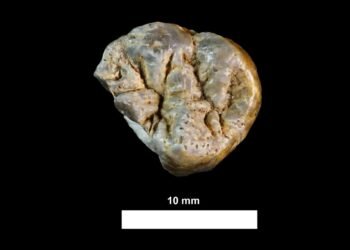
Views of the deciduous upper right first molar (URdm1) and the permanent lower right first molar (LRM1) selected for histological analysis. Credit: O. A. Higgins et al., Journal of Archaeological Science (2025)

The research, published in the Journal of Archaeological Science, was conducted by researchers from nine institutions, including the Max Planck Institute for Evolutionary Anthropology and Columbia University’s Lamont-Doherty Earth Observatory. The researchers unveiled how poorly preserved remains could uncover information about ancient life and the movement and connections of prehistoric Europeans.

Far from being merely another forgotten burial, the baby from Faenza is now a strong testament to the ways in which science can breathe life into tales from the distant past.
More information: Higgins, O. A., Fontani, F., Lugli, F., Silvestrini, S., Vazzana, A., Latorre, A., … Benazzi, S. (2025). Reconstructing life history and ancestry from poorly preserved skeletal remains: A bioanthropological study of a Copper Age infant from Faenza (RA, Italy). Journal of Archaeological Science, 180(106291), 106291. doi:10.1016/j.jas.2025.106291
Share196Tweet123Share34ShareSend

You May Also Like...

Cut marks on 1.6-million-year-old bones reveal early humans moved and processed meat in Kenya
Anthropology

Cut marks on 1.6-million-year-old bones reveal early humans moved and processed meat in Kenya

May 13, 2026
280 ancient stone burial monuments found in Sudan reveal lost cattle-herding culture in the Sahara
Archaeology

280 ancient stone burial monuments found in Sudan reveal lost cattle-herding culture in the Sahara

May 13, 2026
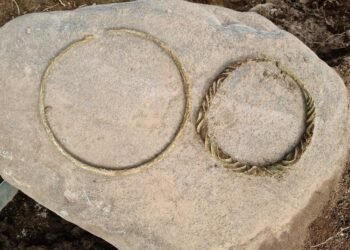
Rare Bronze Age burial in Sweden reveals unusual pair of Wendel neck rings and complex ritual landscape near Norrköping
Archaeology

Rare Bronze Age burial in Sweden reveals unusual pair of Wendel neck rings and complex ritual landscape near Norrköping

May 12, 2026
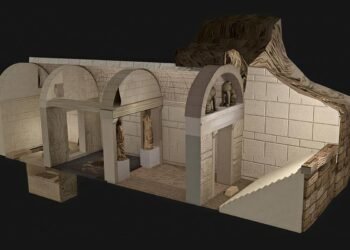
Kasta Tomb in Amphipolis fully revealed as restoration uncovers largest burial mound in Macedonia
Archaeology

Kasta Tomb in Amphipolis fully revealed as restoration uncovers largest burial mound in Macedonia

May 12, 2026
Rare Roman villa threatened by farming damage reveals rare mosaic and bathhouse remains in Devon
Archaeology

Rare Roman villa threatened by farming damage reveals rare mosaic and bathhouse remains in Devon

May 12, 2026
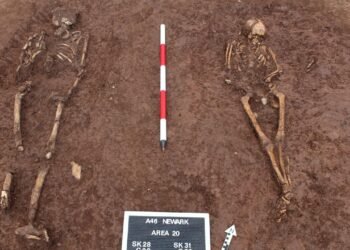
Ancient burials, Roman well, and Anglo-Saxon house uncovered during A46 Newark bypass excavations
Anthropology

Ancient burials, Roman well, and Anglo-Saxon house uncovered during A46 Newark bypass excavations

May 12, 2026

Follow us


Instagram
242K

Facebook
117K

Threads
46K

LinkedIn
14K

Twitter
6K

YouTube
1K
  • Trending
  • Comments
  • Latest
Shipwreck Salvage. Credit: rawpixel.com / Public Domain

2,000-year-old shipwreck discovered off Turkish coast with remarkably preserved stacked ceramics

July 2, 2025
A new study suggests the mysterious Voynich Manuscript may be a medieval cipher

A new study suggests the mysterious Voynich Manuscript may be a medieval cipher

January 3, 2026
Viking age DNA reveals 9,000-year-old HIV-resistant gene originating near the Black Sea

Viking age DNA reveals 9,000-year-old HIV-resistant gene originating near the Black Sea

May 18, 2025
3D analysis reveals Shroud of Turin image likely came from sculpture, not Jesus’ body

3D analysis reveals Shroud of Turin image likely came from sculpture, not Jesus’ body

August 3, 2025
Moses may be named in ancient Egyptian mine inscriptions, sparking debate over earliest biblical references

Moses may be named in ancient Egyptian mine inscriptions, sparking debate over earliest biblical references

July 31, 2025
3D analysis reveals Shroud of Turin image likely came from sculpture, not Jesus’ body

3D analysis reveals Shroud of Turin image likely came from sculpture, not Jesus’ body

Moses may be named in ancient Egyptian mine inscriptions, sparking debate over earliest biblical references

Moses may be named in ancient Egyptian mine inscriptions, sparking debate over earliest biblical references

$1 million prize offered to decipher 5,300-year-old Indus Valley script

$1 million prize offered to decipher 5,300-year-old Indus Valley script

Oldest ever genetic data from a human relative found in 2-million-year-old fossilized teeth

Oldest ever genetic data from a human relative found in 2-million-year-old fossilized teeth

Exceptionally large Roman shoes discovered at Magna fort near Hadrian’s Wall

Exceptionally large Roman shoes discovered at Magna fort near Hadrian’s Wall

Cut marks on 1.6-million-year-old bones reveal early humans moved and processed meat in Kenya

Cut marks on 1.6-million-year-old bones reveal early humans moved and processed meat in Kenya

May 13, 2026
280 ancient stone burial monuments found in Sudan reveal lost cattle-herding culture in the Sahara

280 ancient stone burial monuments found in Sudan reveal lost cattle-herding culture in the Sahara

May 13, 2026
Rare Bronze Age burial in Sweden reveals unusual pair of Wendel neck rings and complex ritual landscape near Norrköping

Rare Bronze Age burial in Sweden reveals unusual pair of Wendel neck rings and complex ritual landscape near Norrköping

May 12, 2026
Kasta Tomb in Amphipolis fully revealed as restoration uncovers largest burial mound in Macedonia

Kasta Tomb in Amphipolis fully revealed as restoration uncovers largest burial mound in Macedonia

May 12, 2026
Rare Roman villa threatened by farming damage reveals rare mosaic and bathhouse remains in Devon

Rare Roman villa threatened by farming damage reveals rare mosaic and bathhouse remains in Devon

May 12, 2026

Archaeology News online magazine

Archaeology News is an international online magazine that covers all aspects of archaeology.


Categories

  • Academics
    • Books
    • Conferences
    • Universities
  • Articles
  • Download
  • Game
  • News
    • Anthropology
    • Archaeology
    • Paleontology
  • Quiz
  • Tours

Subscribe to our newsletter

© 2024 - Archaeology News Online Magazine. All Rights Reserved.

  • About
  • Privacy Policy
  • Terms of Use
  • Donation
  • Contact

Manage Consent
To provide the best experiences, we use technologies like cookies to store and/or access device information. Consenting to these technologies will allow us to process data such as browsing behavior or unique IDs on this site. Not consenting or withdrawing consent, may adversely affect certain features and functions.
Functional Always active
The technical storage or access is strictly necessary for the legitimate purpose of enabling the use of a specific service explicitly requested by the subscriber or user, or for the sole purpose of carrying out the transmission of a communication over an electronic communications network.
Preferences
The technical storage or access is necessary for the legitimate purpose of storing preferences that are not requested by the subscriber or user.
Statistics
The technical storage or access that is used exclusively for statistical purposes. The technical storage or access that is used exclusively for anonymous statistical purposes. Without a subpoena, voluntary compliance on the part of your Internet Service Provider, or additional records from a third party, information stored or retrieved for this purpose alone cannot usually be used to identify you.
Marketing
The technical storage or access is required to create user profiles to send advertising, or to track the user on a website or across several websites for similar marketing purposes.
  • Manage options
  • Manage services
  • Manage {vendor_count} vendors
  • Read more about these purposes
View preferences
  • {title}
  • {title}
  • {title}
  • Home
  • News
    • Archaeology
    • Anthropology
    • Paleontology
  • Academic
    • Books
    • Conferences
    • Universities
  • Articles
  • VR Tours
  • Quiz & Game
  • Download
  • Encyclopedia
  • Forum

About  .  Contact  .  Donation

© 2024 - Archaeology News Online Magazine. All Rights Reserved