• About
  • Privacy Policy
  • Terms of Use
  • Donation
  • Contact
No Result
View All Result
Archaeology News
  • Home
  • News
    • Archaeology
    • Anthropology
    • Paleontology
  • Academic
    • Books
    • Conferences
    • Universities
  • Articles
  • VR Tours
  • Quiz & Game
  • Download
  • Encyclopedia
  • Forum
Archaeology News
No Result
View All Result
Home News Anthropology

Rural rituals and astral burials shaped ancient Egyptian religion and the myths of Isis and Osiris

by Dario Radley
July 15, 2025

In southern Egypt’s Nile Valley, a new study of the ancient Adaïma cemetery is reshaping the tale of Egyptian religion and state ideology’s origins. Against long-standing presumptions that the sacred order of Egypt was one imposed from above by kings and priests, archaeologists now believe that many of the key features of royal religion emerged from the funerary traditions of ordinary individuals in rural communities.

Rural rituals and astral burials shaped ancient Egyptian religion and the myths of Isis and Osiris
Burial S874. a: View of the burial before excavation. b: View after excavation and exposure of the individual. Credit: A. Alcouffe et al., J. Archaeol. Method Theory (2025) / CC BY 4.0

The study, published in the Journal of Archaeological Method and Theory, is based on the excavation and analysis of more than 500 tombs at Adaïma, a 30-hectare site used between 3300 and 2700 BCE—centuries before the pyramids were built. Led by Ameline Alcouffe from the University of Toulouse, the research team examined how local funerary practices—especially those involving celestial alignments and symbolic ritual—gradually evolved into core features of pharaonic ideology.

One particularly unusual burial, Tomb S166, contained the body of a teenage girl whose left arm had been ritually severed and placed over her chest. Her body was oriented in the direction of the setting sun at the winter solstice, and her sarcophagus aligned with the heliacal rising of Sirius—the brightest star in the sky, which heralded the flooding of the Nile. According to the researchers, this ritual was not merely symbolic; it was an early intersection of agricultural cycles, celestial observation, and beliefs about death.

Two other tombs were also conspicuous. Tomb S837, in which a woman was buried with some fine jewelry and a broken ceramic vessel, had themes later reflected in the Pyramid Texts. Tomb S874 contained a woman buried with a staff and a fiber wig and was aligned to the summer solstice—a shift in celestial focus.

Rural rituals and astral burials shaped ancient Egyptian religion and the myths of Isis and Osiris
Burial S166. Adolescent female with the right arm severed at the distal third of both the humerus and forearm (artistic reconstruction by N. Sénégas). Credit: A. Alcouffe et al., J. Archaeol. Method Theory (2025) / CC BY 4.0

Using artificial intelligence and network analysis, the researchers determined that these “innovative” tombs were less connected to traditional burial practices and may have been cultural tipping points. Subsequent burial clusters around them show they must have come to be honored over time, as a kind of shrine.


RelatedStories

Ancient bathhouse and Roman villa with mosaics unearthed in Alexandria during rescue excavation

Ancient bathhouse and Roman villa with mosaics unearthed in Alexandria during rescue excavation

May 3, 2026
CT scans reveal hidden details of 2,300-year-old Egyptian mummies

CT scans reveal hidden details of 2,300-year-old Egyptian mummies

April 26, 2026

The study argues that rituals like symbolic dismemberment, originally performed in rural cemeteries, were later mythologized in stories such as that of Isis and Osiris. The rising of Sirius—formerly a cue for farmers—became a divine portent tied to fertility, rebirth, and royal legitimacy. When the state emerged, it did not create religion from scratch. Instead, it absorbed these long-standing practices and reworked them into royal narratives, transforming popular memory and mourning into instruments of centralized power.

The Adaïma cemetery teaches us this profound lesson: before pharaohs existed to govern Egypt, the populace had already founded the religious groundwork. Their everyday funerals, timed by stars and seasons, became the seeds of state religion.

More information: Alcouffe, A., Duchesne, S., Tupikova, I. et al. (2025). From Stars to State: Astral Patterns and the Rise of Pharaonic Egypt at Adaïma (Upper Egypt). J Archaeol Method Theory 32, 53. doi:10.1007/s10816-025-09724-6
Share20Tweet12Share3ShareSend

You May Also Like...

Horse domestication began centuries earlier than thought, study reveals early riding and management in 4th millennium BCE
Archaeology

Horse domestication began centuries earlier than thought, study reveals early riding and management in 4th millennium BCE

May 15, 2026
Ancient Danes kept fishing for millennia after farming arrived, study finds
Archaeology

Ancient Danes kept fishing for millennia after farming arrived, study finds

May 14, 2026
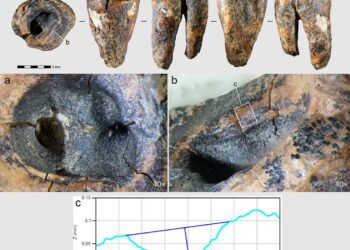
Oldest known dental treatment found in 59,000-year-old Neanderthal tooth from Siberia
Anthropology

Oldest known dental treatment found in 59,000-year-old Neanderthal tooth from Siberia

May 14, 2026
Homo erectus in Java: 140,000-year-old fossils found in submerged river valley
Anthropology

400,000-year-old Homo erectus proteins reveal genetic links to Denisovans and modern humans

May 14, 2026
Cut marks on 1.6-million-year-old bones reveal early humans moved and processed meat in Kenya
Anthropology

Cut marks on 1.6-million-year-old bones reveal early humans moved and processed meat in Kenya

May 13, 2026
280 ancient stone burial monuments found in Sudan reveal lost cattle-herding culture in the Sahara
Archaeology

280 ancient stone burial monuments found in Sudan reveal lost cattle-herding culture in the Sahara

May 13, 2026

Follow us


Instagram
242K

Facebook
117K

Threads
46K

LinkedIn
14K

Twitter
6K

YouTube
1K
  • Trending
  • Comments
  • Latest
Shipwreck Salvage. Credit: rawpixel.com / Public Domain

2,000-year-old shipwreck discovered off Turkish coast with remarkably preserved stacked ceramics

July 2, 2025
A new study suggests the mysterious Voynich Manuscript may be a medieval cipher

A new study suggests the mysterious Voynich Manuscript may be a medieval cipher

January 3, 2026
Viking age DNA reveals 9,000-year-old HIV-resistant gene originating near the Black Sea

Viking age DNA reveals 9,000-year-old HIV-resistant gene originating near the Black Sea

May 18, 2025
3D analysis reveals Shroud of Turin image likely came from sculpture, not Jesus’ body

3D analysis reveals Shroud of Turin image likely came from sculpture, not Jesus’ body

August 3, 2025
Moses may be named in ancient Egyptian mine inscriptions, sparking debate over earliest biblical references

Moses may be named in ancient Egyptian mine inscriptions, sparking debate over earliest biblical references

July 31, 2025
3D analysis reveals Shroud of Turin image likely came from sculpture, not Jesus’ body

3D analysis reveals Shroud of Turin image likely came from sculpture, not Jesus’ body

Moses may be named in ancient Egyptian mine inscriptions, sparking debate over earliest biblical references

Moses may be named in ancient Egyptian mine inscriptions, sparking debate over earliest biblical references

$1 million prize offered to decipher 5,300-year-old Indus Valley script

$1 million prize offered to decipher 5,300-year-old Indus Valley script

Oldest ever genetic data from a human relative found in 2-million-year-old fossilized teeth

Oldest ever genetic data from a human relative found in 2-million-year-old fossilized teeth

Exceptionally large Roman shoes discovered at Magna fort near Hadrian’s Wall

Exceptionally large Roman shoes discovered at Magna fort near Hadrian’s Wall

Horse domestication began centuries earlier than thought, study reveals early riding and management in 4th millennium BCE

Horse domestication began centuries earlier than thought, study reveals early riding and management in 4th millennium BCE

May 15, 2026
Ancient Danes kept fishing for millennia after farming arrived, study finds

Ancient Danes kept fishing for millennia after farming arrived, study finds

May 14, 2026
Oldest known dental treatment found in 59,000-year-old Neanderthal tooth from Siberia

Oldest known dental treatment found in 59,000-year-old Neanderthal tooth from Siberia

May 14, 2026
Homo erectus in Java: 140,000-year-old fossils found in submerged river valley

400,000-year-old Homo erectus proteins reveal genetic links to Denisovans and modern humans

May 14, 2026
Cut marks on 1.6-million-year-old bones reveal early humans moved and processed meat in Kenya

Cut marks on 1.6-million-year-old bones reveal early humans moved and processed meat in Kenya

May 13, 2026

Archaeology News online magazine

Archaeology News is an international online magazine that covers all aspects of archaeology.


Categories

  • Academics
    • Books
    • Conferences
    • Universities
  • Articles
  • Download
  • Game
  • News
    • Anthropology
    • Archaeology
    • Paleontology
  • Quiz
  • Tours

Subscribe to our newsletter

© 2024 - Archaeology News Online Magazine. All Rights Reserved.

  • About
  • Privacy Policy
  • Terms of Use
  • Donation
  • Contact

Manage Consent
To provide the best experiences, we use technologies like cookies to store and/or access device information. Consenting to these technologies will allow us to process data such as browsing behavior or unique IDs on this site. Not consenting or withdrawing consent, may adversely affect certain features and functions.
Functional Always active
The technical storage or access is strictly necessary for the legitimate purpose of enabling the use of a specific service explicitly requested by the subscriber or user, or for the sole purpose of carrying out the transmission of a communication over an electronic communications network.
Preferences
The technical storage or access is necessary for the legitimate purpose of storing preferences that are not requested by the subscriber or user.
Statistics
The technical storage or access that is used exclusively for statistical purposes. The technical storage or access that is used exclusively for anonymous statistical purposes. Without a subpoena, voluntary compliance on the part of your Internet Service Provider, or additional records from a third party, information stored or retrieved for this purpose alone cannot usually be used to identify you.
Marketing
The technical storage or access is required to create user profiles to send advertising, or to track the user on a website or across several websites for similar marketing purposes.
  • Manage options
  • Manage services
  • Manage {vendor_count} vendors
  • Read more about these purposes
View preferences
  • {title}
  • {title}
  • {title}
  • Home
  • News
    • Archaeology
    • Anthropology
    • Paleontology
  • Academic
    • Books
    • Conferences
    • Universities
  • Articles
  • VR Tours
  • Quiz & Game
  • Download
  • Encyclopedia
  • Forum

About  .  Contact  .  Donation

© 2024 - Archaeology News Online Magazine. All Rights Reserved