• About
  • Privacy Policy
  • Terms of Use
  • Donation
  • Contact
No Result
View All Result
Archaeology News
  • Home
  • News
    • Archaeology
    • Anthropology
    • Paleontology
  • Academic
    • Books
    • Conferences
    • Universities
  • Articles
  • VR Tours
  • Quiz & Game
  • Download
  • Encyclopedia
  • Forum
Archaeology News
No Result
View All Result
Home News Anthropology

Study reveals Akhetaten plague may never have happened

by Dario Radley
October 18, 2025

Researchers have long suspected that a deadly epidemic compelled the sudden abandonment of Akhetaten, the short-lived capital built by Pharaoh Akhenaten. However, a new study by Dr. Gretchen Dabbs and Dr. Anna Stevens, published in the American Journal of Archaeology, challenges this assumption, suggesting that the city was never plagued.

Study reveals Akhetaten plague may never have happened
Ruins of the smaller Aten Temple at Amarna, located in the brief Egyptian capital, where archaeologists found no traces of the alleged plague. Credit: Institute for the Study of the Ancient World / CC BY 2.0

Akhetaten, today known as Amarna, was founded in the midst of Akhenaten’s radical religious reforms, when he promoted the worship of the sun god Aten over Egypt’s traditional pantheon. The city was largely abandoned within about 20 years, raising suspicions that disease had been the reason behind its people’s departure.

Much of this theory relies on external textual sources: Hittite plague prayers mention an epidemic caused by Egyptian prisoners, and the Amarna Letters mention outbreaks in cities like Megiddo, Byblos, and Sumur. However, none of these texts mention Akhetaten itself.

To test the epidemic hypothesis, Dabbs and Stevens conducted a comprehensive bioarchaeological and archaeological analysis of Amarna and its cemeteries. Excavation work between 2005 and 2022 analyzed 889 burials in four large cemeteries, representing an estimated 11,350–12,950 total burials. The researchers compared patterns in burial practice, demography, and health indicators at Amarna with those found at known epidemic sites to identify evidence of crisis mortality.
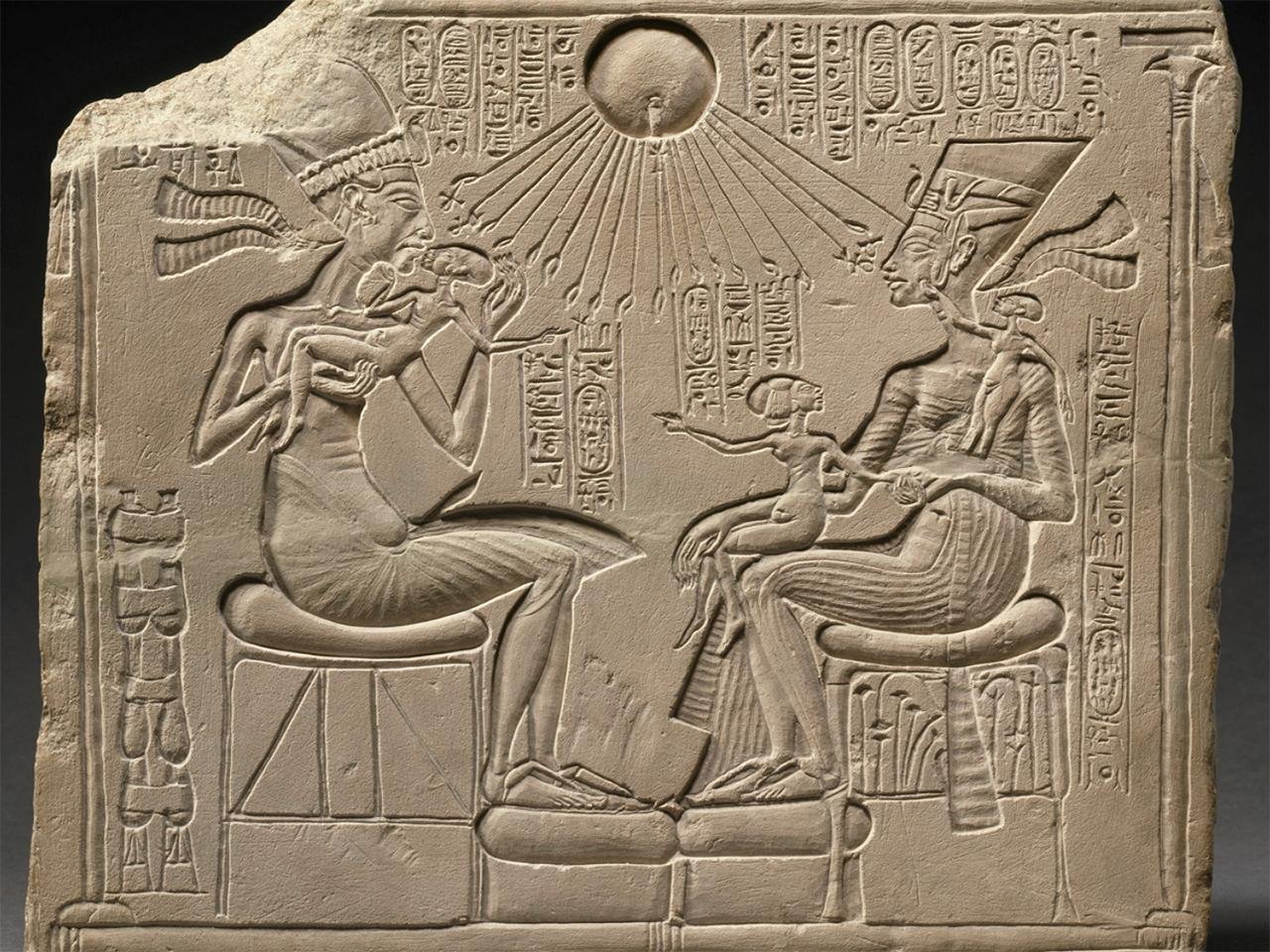
A small stele, depicts Akhenaten and Queen Nefertiti with their three eldest daughters. Aten is represented as a sun-disc. Amarna period, c1340 BCE.
A small stele, depicts Akhenaten and Queen Nefertiti with their three eldest daughters. Aten is represented as a sun-disc. Amarna period, c1340 BCE. Credit: Staatliche Museen zu Berlin, Ägyptisches Museum und Papyrussammlung / Margarete Büsing; CC BY-SA 4.0

The findings indicate that the skeletal remains predominantly reflect social and economic stress rather than disease. Stunted growth, spinal trauma, and joint degeneration were prevalent, while evidence for infectious disease was rare—only seven individuals showed signs of tuberculosis. Most of the burial contexts were orderly: the deceased were covered with textiles or placed in mat coffins and accompanied by grave goods, and no emergency interments were identified.

RelatedStories

Malaria influenced early human migration and settlement in Africa long before farming, study finds

Malaria influenced early human migration and settlement in Africa long before farming, study finds

May 9, 2026
Earliest known dental bridge in Scotland found in medieval Aberdeen burial

Earliest known dental bridge in Scotland found in medieval Aberdeen burial

May 6, 2026

Whereas some communal burials occurred, demographic analysis reflected cultural patterns rather than epidemic response, such as the pairing of women and children. Paleodemographic modeling showed that death rates and life expectancy conformed with expectations for a city of Akhetaten’s size and 20-year occupation. Even the city itself shows evidence of gradual, systematic abandonment, with possessions collected and low-level occupation continuing after Akhenaten’s death.

Study reveals Akhetaten plague may never have happened
Amarna necropolis, an ancient burial site. Credit: Olaf Tausch / CC BY 3.0

Such evidence suggests that political and religious factors—instead of disease—were likely the cause of the city’s decline. The rapid desertion of Akhetaten is linked to a reaction against Akhenaten’s reforms and the restoration of traditional religious centers, not to an epidemic. Although Hittite records may reflect an outbreak elsewhere, Amarna itself shows no archaeological or biological evidence of a plague.
More information: Dabbs, G. R., & Stevens, A. (2025). Mortality crisis at Akhetaten? Amarna and the bioarchaeology of the late Bronze Age Mediterranean epidemic. American Journal of Archaeology, 129(4), 455–489. doi:10.1086/736705
Share67Tweet42Share12ShareSend

You May Also Like...

Cut marks on 1.6-million-year-old bones reveal early humans moved and processed meat in Kenya
Anthropology

Cut marks on 1.6-million-year-old bones reveal early humans moved and processed meat in Kenya

May 13, 2026
280 ancient stone burial monuments found in Sudan reveal lost cattle-herding culture in the Sahara
Archaeology

280 ancient stone burial monuments found in Sudan reveal lost cattle-herding culture in the Sahara

May 13, 2026
Rare Bronze Age burial in Sweden reveals unusual pair of Wendel neck rings and complex ritual landscape near Norrköping
Archaeology

Rare Bronze Age burial in Sweden reveals unusual pair of Wendel neck rings and complex ritual landscape near Norrköping

May 12, 2026
Kasta Tomb in Amphipolis fully revealed as restoration uncovers largest burial mound in Macedonia
Archaeology

Kasta Tomb in Amphipolis fully revealed as restoration uncovers largest burial mound in Macedonia

May 12, 2026
Rare Roman villa threatened by farming damage reveals rare mosaic and bathhouse remains in Devon
Archaeology

Rare Roman villa threatened by farming damage reveals rare mosaic and bathhouse remains in Devon

May 12, 2026
Ancient burials, Roman well, and Anglo-Saxon house uncovered during A46 Newark bypass excavations
Anthropology

Ancient burials, Roman well, and Anglo-Saxon house uncovered during A46 Newark bypass excavations

May 12, 2026

Comments 0

  1. Editorial Team says:
    1 second ago

    Disclaimer: This website is a science-focused magazine that welcomes both academic and non-academic audiences. Comments are written by users and may include personal opinions or unverified claims. They do not necessarily reflect the views of our editorial team or rely on scientific evidence.

    Comment Policy: We kindly ask all commenters to engage respectfully. Comments that contain offensive, insulting, degrading, discriminatory, or racist content will be automatically removed.

    Reply

Leave a Reply Cancel reply

Your email address will not be published. Required fields are marked *

Follow us


Instagram
242K

Facebook
117K

Threads
46K

LinkedIn
14K

Twitter
6K

YouTube
1K
  • Trending
  • Comments
  • Latest
Shipwreck Salvage. Credit: rawpixel.com / Public Domain

2,000-year-old shipwreck discovered off Turkish coast with remarkably preserved stacked ceramics

July 2, 2025
A new study suggests the mysterious Voynich Manuscript may be a medieval cipher

A new study suggests the mysterious Voynich Manuscript may be a medieval cipher

January 3, 2026
Viking age DNA reveals 9,000-year-old HIV-resistant gene originating near the Black Sea

Viking age DNA reveals 9,000-year-old HIV-resistant gene originating near the Black Sea

May 18, 2025
3D analysis reveals Shroud of Turin image likely came from sculpture, not Jesus’ body

3D analysis reveals Shroud of Turin image likely came from sculpture, not Jesus’ body

August 3, 2025
Moses may be named in ancient Egyptian mine inscriptions, sparking debate over earliest biblical references

Moses may be named in ancient Egyptian mine inscriptions, sparking debate over earliest biblical references

July 31, 2025
3D analysis reveals Shroud of Turin image likely came from sculpture, not Jesus’ body

3D analysis reveals Shroud of Turin image likely came from sculpture, not Jesus’ body

Moses may be named in ancient Egyptian mine inscriptions, sparking debate over earliest biblical references

Moses may be named in ancient Egyptian mine inscriptions, sparking debate over earliest biblical references

$1 million prize offered to decipher 5,300-year-old Indus Valley script

$1 million prize offered to decipher 5,300-year-old Indus Valley script

Oldest ever genetic data from a human relative found in 2-million-year-old fossilized teeth

Oldest ever genetic data from a human relative found in 2-million-year-old fossilized teeth

Exceptionally large Roman shoes discovered at Magna fort near Hadrian’s Wall

Exceptionally large Roman shoes discovered at Magna fort near Hadrian’s Wall

Cut marks on 1.6-million-year-old bones reveal early humans moved and processed meat in Kenya

Cut marks on 1.6-million-year-old bones reveal early humans moved and processed meat in Kenya

May 13, 2026
280 ancient stone burial monuments found in Sudan reveal lost cattle-herding culture in the Sahara

280 ancient stone burial monuments found in Sudan reveal lost cattle-herding culture in the Sahara

May 13, 2026
Rare Bronze Age burial in Sweden reveals unusual pair of Wendel neck rings and complex ritual landscape near Norrköping

Rare Bronze Age burial in Sweden reveals unusual pair of Wendel neck rings and complex ritual landscape near Norrköping

May 12, 2026
Kasta Tomb in Amphipolis fully revealed as restoration uncovers largest burial mound in Macedonia

Kasta Tomb in Amphipolis fully revealed as restoration uncovers largest burial mound in Macedonia

May 12, 2026
Rare Roman villa threatened by farming damage reveals rare mosaic and bathhouse remains in Devon

Rare Roman villa threatened by farming damage reveals rare mosaic and bathhouse remains in Devon

May 12, 2026

Archaeology News online magazine

Archaeology News is an international online magazine that covers all aspects of archaeology.


Categories

  • Academics
    • Books
    • Conferences
    • Universities
  • Articles
  • Download
  • Game
  • News
    • Anthropology
    • Archaeology
    • Paleontology
  • Quiz
  • Tours

Subscribe to our newsletter

© 2024 - Archaeology News Online Magazine. All Rights Reserved.

  • About
  • Privacy Policy
  • Terms of Use
  • Donation
  • Contact

Manage Consent
To provide the best experiences, we use technologies like cookies to store and/or access device information. Consenting to these technologies will allow us to process data such as browsing behavior or unique IDs on this site. Not consenting or withdrawing consent, may adversely affect certain features and functions.
Functional Always active
The technical storage or access is strictly necessary for the legitimate purpose of enabling the use of a specific service explicitly requested by the subscriber or user, or for the sole purpose of carrying out the transmission of a communication over an electronic communications network.
Preferences
The technical storage or access is necessary for the legitimate purpose of storing preferences that are not requested by the subscriber or user.
Statistics
The technical storage or access that is used exclusively for statistical purposes. The technical storage or access that is used exclusively for anonymous statistical purposes. Without a subpoena, voluntary compliance on the part of your Internet Service Provider, or additional records from a third party, information stored or retrieved for this purpose alone cannot usually be used to identify you.
Marketing
The technical storage or access is required to create user profiles to send advertising, or to track the user on a website or across several websites for similar marketing purposes.
  • Manage options
  • Manage services
  • Manage {vendor_count} vendors
  • Read more about these purposes
View preferences
  • {title}
  • {title}
  • {title}
  • Home
  • News
    • Archaeology
    • Anthropology
    • Paleontology
  • Academic
    • Books
    • Conferences
    • Universities
  • Articles
  • VR Tours
  • Quiz & Game
  • Download
  • Encyclopedia
  • Forum

About  .  Contact  .  Donation

© 2024 - Archaeology News Online Magazine. All Rights Reserved