• About
  • Privacy Policy
  • Terms of Use
  • Donation
  • Contact
No Result
View All Result
Archaeology News
  • Home
  • News
    • Archaeology
    • Anthropology
    • Paleontology
  • Academics
    • Books
    • Conferences
    • Universities
  • Articles
  • VR Tours
  • Quiz & Game
  • Download
  • Encyclopedia
  • Forum
Archaeology News
No Result
View All Result
Home News Archaeology

Ancient birch tar reveals how Europe’s first farmers chewed, cooked, and crafted 6,000 years ago

by Dario Radley
October 15, 2025

In Neolithic Europe, long before writing or metal tools, people relied on an incredible substance—birch bark tar. A new study, published in Proceedings of the Royal Society B: Biological Sciences, reveals that this black, sticky substance, found at lakeside settlements around the Alps, has retained an impressive molecular record of how early farmers lived, ate, and worked some 6,000 years ago.
Ancient birch tar reveals how Europe’s first farmers chewed, cooked, and crafted 6,000 years ago
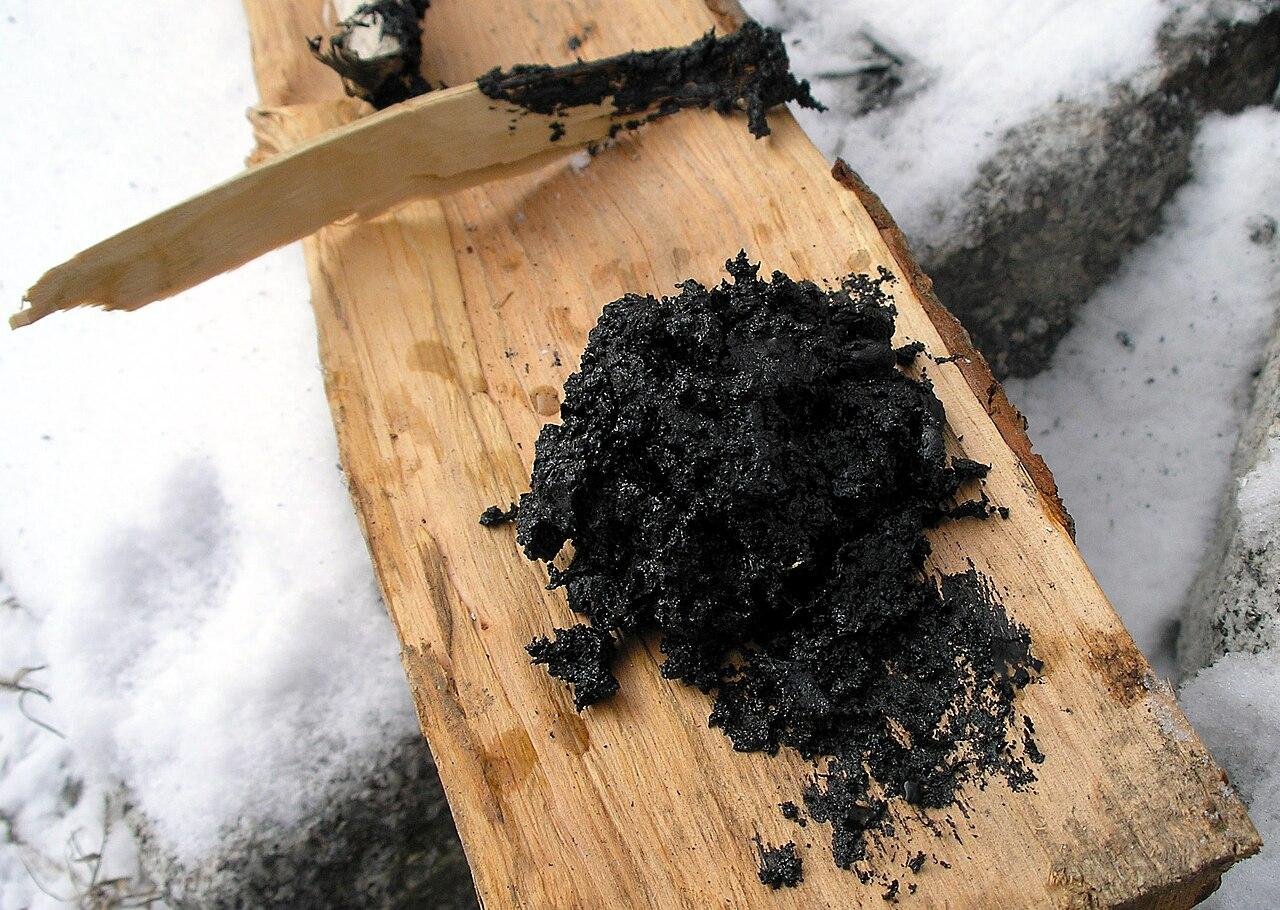
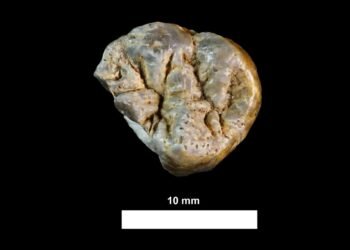
Birch bark tar. Credit: Jorre; CC BY-SA 3.0

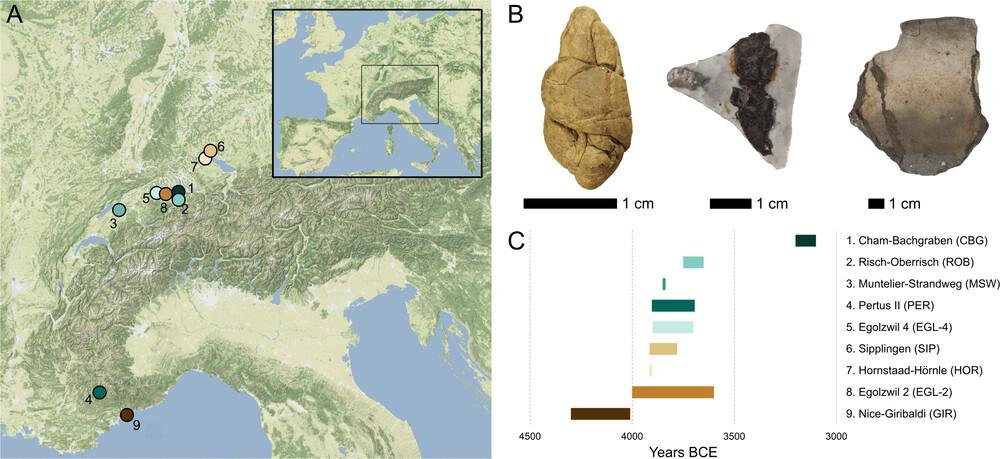
Archaeologists analyzed 30 birch tar pieces from nine Neolithic sites across the Alpine region. Some were found as loose lumps, while others were discovered as residue scraped from broken pottery or flint blades. With a combination of chemical analysis and ancient DNA sequencing, researchers confirmed that the samples were birch bark tar and uncovered human, plant, and microbial DNA trapped within.

Birch tar, produced through the process of heating birch bark in conditions of low oxygen, was already recognized as one of humanity’s earliest synthetic substances, being primarily utilized as glue. However, the recent discoveries indicate that Neolithic individuals used it for much more. Several lumps had been chewed, containing human DNA from males and females, and traces of oral bacteria. These samples served as molecular “snapshots” of ancient humans quite effectively.

The presence of plant DNA—barley, wheat, peas, hazel, and beech—provides evidence that the chewers had recently eaten these foods, offering information on Neolithic diets. Conifer resin even appeared in a few tar lumps, likely added to change the material’s texture or adhesive strength. Scientists believe people chewed tar to soften it before use, or perhaps for hygiene or medicinal purposes.
Ancient birch tar reveals how Europe’s first farmers chewed, cooked, and crafted 6,000 years ago
Sites and samples studied in the research (Photos by Theis Z. T. Jensen). Credit: A. White et al., Proceedings of the Royal Society B: Biological Sciences (2025).

Apart from chewing, the tar was also applied in everyday tasks. The presence of residue on pottery cracks shows that it was used to mend broken vessels. On flint blades, it was found where wood touched stone, confirming its role in hafting tools. In some pottery samples, the tar showed evidence of repeated heating, indicating reuse during cooking or food storage.

RelatedStories

Skeleton-filled well in Croatia reveals lost Roman soldiers from a forgotten battle

Skeleton-filled well in Croatia reveals lost Roman soldiers from a forgotten battle

October 19, 2025
Study reveals Akhetaten plague may never have happened

Study reveals Akhetaten plague may never have happened

October 18, 2025

What is most amazing about these discoveries is that tar can act as a preservative for DNA in cases where human bones cannot. The waterlogged lake environments of these settlements would typically destroy skeletal material, but the waterproof, stable nature of the tar ensured that biomolecules were preserved over millennia. Each chewed lump or piece of resin became a tiny time capsule of personal and cultural information.
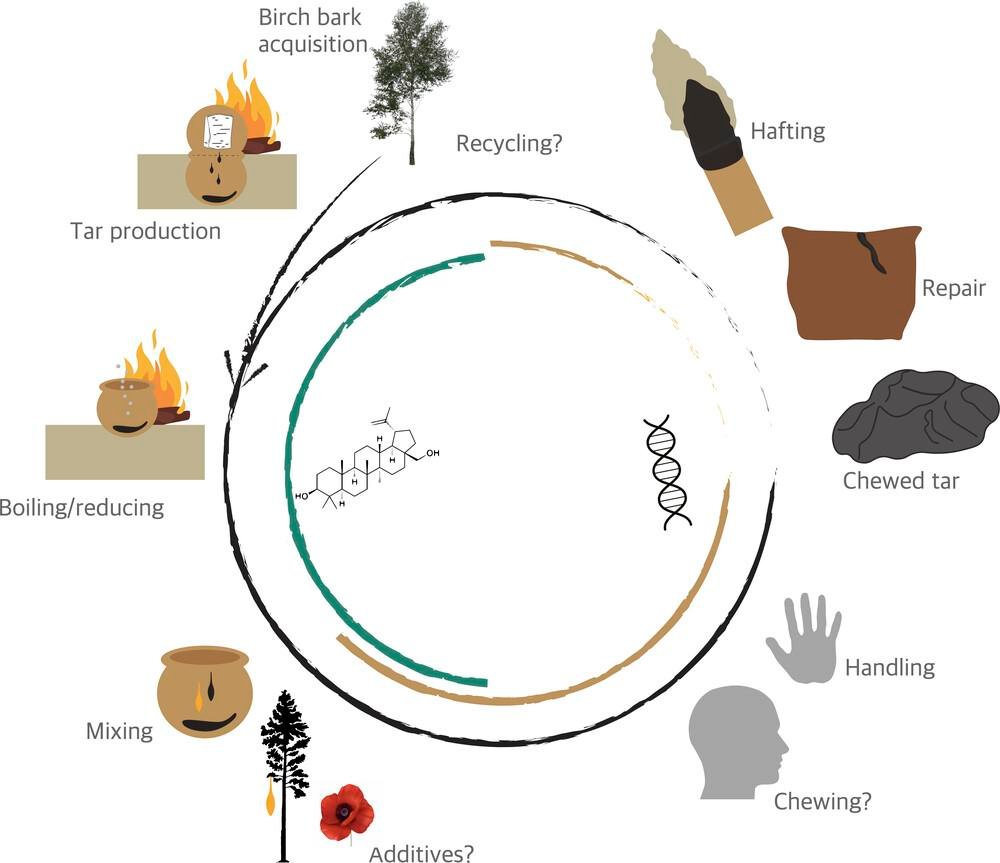
Ancient birch tar reveals how Europe’s first farmers chewed, cooked, and crafted 6,000 years ago
Making and using birch tar in Neolithic Europe. A possible chaîne opératoire from the initial production of birch tar to its final use, including potential recycling of tar, and the biochemical analyses used to investigate steps in this process. Credit: A. White et al., Proceedings of the Royal Society B: Biological Sciences (2025).

The study demonstrates how combining ancient DNA with organic residue analysis can reveal aspects of prehistoric life long thought lost—identity, diet, and technology—all through a tiny piece of resin. These tar samples show the practical ingenuity of Europe’s first farmers in transforming native materials into versatile tools and medicines.
More information: White, A. E., Koch, T. J., Jensen, T. Z. T., Niemann, J., Pedersen, M. W., Søtofte, M. B., … Schroeder, H. (2025). Ancient DNA and biomarkers from artefacts: insights into technology and cultural practices in Neolithic Europe. Proceedings. Biological Sciences, 292(2057). doi:10.1098/rspb.2025.0092
Share164Tweet103Share29ShareSend

You May Also Like...

Air-filled anomalies in the Menkaure Pyramid may point to a second entrance
Archaeology

Air-filled anomalies in the Menkaure Pyramid may point to a second entrance

November 11, 2025
Scientists uncover purpose of 5,200 mystery holes in Peru, revealing a lost Andean system of trade and record-keeping
Archaeology

Scientists uncover purpose of 5,200 mystery holes in Peru, revealing a lost Andean system of trade and record-keeping

November 10, 2025
Archaeologists uncover oldest and largest Maya monument built to represent the cosmos
Archaeology

Archaeologists uncover oldest and largest Maya monument built to represent the cosmos

November 10, 2025
Roman roads reimagined: new digital map expands the empire’s network to nearly 300,000 km
Archaeology

Roman roads reimagined: new digital map expands the empire’s network to nearly 300,000 km

November 9, 2025
New study debunks myth of Easter Island's ecological collapse
Archaeology

Rats and the fall of Rapa Nui’s forests: invasive species, not humans, drove the island’s deforestation

November 9, 2025
2.75-million-year-old stone tools in Kenya reveal 300,000 years of technological stability
Anthropology

2.75-million-year-old stone tools in Kenya reveal 300,000 years of technological stability

November 9, 2025

Comments 0

  1. Editorial Team says:
    1 second ago
    Disclaimer: This website is a science-focused magazine that welcomes both academic and non-academic audiences. Comments are written by users and may include personal opinions or unverified claims. They do not necessarily reflect the views of our editorial team or rely on scientific evidence.
    Reply

Leave a Reply Cancel reply

Your email address will not be published. Required fields are marked *

Follow us


Instagram
245K

Facebook
117K

Threads
45K

LinkedIn
14K

Twitter
6K

YouTube
1K
  • Trending
  • Comments
  • Latest
Shipwreck Salvage. Credit: rawpixel.com / Public Domain

2,000-year-old shipwreck discovered off Turkish coast with remarkably preserved stacked ceramics

July 2, 2025
Viking age DNA reveals 9,000-year-old HIV-resistant gene originating near the Black Sea

Viking age DNA reveals 9,000-year-old HIV-resistant gene originating near the Black Sea

May 18, 2025
Complete copy of the Canopus Decree unearthed in Egypt after 150 years

Complete copy of the Canopus Decree unearthed in Egypt after 150 years

September 13, 2025
Mystery of Armenia’s 6,000-year-old dragon stones solved

Mystery of Armenia’s 6,000-year-old dragon stones solved

September 23, 2025
Moses may be named in ancient Egyptian mine inscriptions, sparking debate over earliest biblical references

Moses may be named in ancient Egyptian mine inscriptions, sparking debate over earliest biblical references

July 31, 2025
Moses may be named in ancient Egyptian mine inscriptions, sparking debate over earliest biblical references

Moses may be named in ancient Egyptian mine inscriptions, sparking debate over earliest biblical references

3D analysis reveals Shroud of Turin image likely came from sculpture, not Jesus’ body

3D analysis reveals Shroud of Turin image likely came from sculpture, not Jesus’ body

$1 million prize offered to decipher 5,300-year-old Indus Valley script

$1 million prize offered to decipher 5,300-year-old Indus Valley script

Oldest ever genetic data from a human relative found in 2-million-year-old fossilized teeth

Oldest ever genetic data from a human relative found in 2-million-year-old fossilized teeth

Exceptionally large Roman shoes discovered at Magna fort near Hadrian’s Wall

Exceptionally large Roman shoes discovered at Magna fort near Hadrian’s Wall

Air-filled anomalies in the Menkaure Pyramid may point to a second entrance

Air-filled anomalies in the Menkaure Pyramid may point to a second entrance

November 11, 2025
Scientists uncover purpose of 5,200 mystery holes in Peru, revealing a lost Andean system of trade and record-keeping

Scientists uncover purpose of 5,200 mystery holes in Peru, revealing a lost Andean system of trade and record-keeping

November 10, 2025
Archaeologists uncover oldest and largest Maya monument built to represent the cosmos

Archaeologists uncover oldest and largest Maya monument built to represent the cosmos

November 10, 2025
Roman roads reimagined: new digital map expands the empire’s network to nearly 300,000 km

Roman roads reimagined: new digital map expands the empire’s network to nearly 300,000 km

November 9, 2025
New study debunks myth of Easter Island's ecological collapse

Rats and the fall of Rapa Nui’s forests: invasive species, not humans, drove the island’s deforestation

November 9, 2025

Archaeology News online magazine

Archaeology News is an international online magazine that covers all aspects of archaeology.


Categories

  • Academics
    • Books
    • Conferences
    • Universities
  • Articles
  • Download
  • Game
  • News
    • Anthropology
    • Archaeology
    • Paleontology
  • Quiz
  • Tours

Subscribe to our newsletter

© 2024 - Archaeology News Online Magazine. All Rights Reserved.

  • About
  • Privacy Policy
  • Terms of Use
  • Donation
  • Contact

Welcome Back!

Login to your account below

Forgotten Password? Sign Up

Create New Account!

Fill the forms below to register

All fields are required. Log In

Retrieve your password

Please enter your username or email address to reset your password.

Log In

Add New Playlist

Manage Consent
To provide the best experiences, we use technologies like cookies to store and/or access device information. Consenting to these technologies will allow us to process data such as browsing behavior or unique IDs on this site. Not consenting or withdrawing consent, may adversely affect certain features and functions.
Functional Always active
The technical storage or access is strictly necessary for the legitimate purpose of enabling the use of a specific service explicitly requested by the subscriber or user, or for the sole purpose of carrying out the transmission of a communication over an electronic communications network.
Preferences
The technical storage or access is necessary for the legitimate purpose of storing preferences that are not requested by the subscriber or user.
Statistics
The technical storage or access that is used exclusively for statistical purposes. The technical storage or access that is used exclusively for anonymous statistical purposes. Without a subpoena, voluntary compliance on the part of your Internet Service Provider, or additional records from a third party, information stored or retrieved for this purpose alone cannot usually be used to identify you.
Marketing
The technical storage or access is required to create user profiles to send advertising, or to track the user on a website or across several websites for similar marketing purposes.
Manage options Manage services Manage {vendor_count} vendors Read more about these purposes
View preferences
{title} {title} {title}
  • Home
  • News
    • Archaeology
    • Anthropology
    • Paleontology
  • Academics
    • Books
    • Conferences
    • Universities
  • Articles
  • VR Tours
  • Quiz & Game
  • Download
  • Encyclopedia
  • Forum

About  .  Contact  .  Donation

© 2024 - Archaeology News Online Magazine. All Rights Reserved