• About
  • Privacy Policy
  • Terms of Use
  • Donation
  • Contact
No Result
View All Result
Archaeology News
  • Home
  • News
    • Archaeology
    • Anthropology
    • Paleontology
  • Academic
    • Books
    • Conferences
    • Universities
  • Articles
  • VR Tours
  • Quiz & Game
  • Download
  • Encyclopedia
  • Forum
Archaeology News
No Result
View All Result
Home News Archaeology

Hidden signatures of ancient Roman master glassmakers uncovered

by Dario Radley
November 15, 2025

In 2023, an unexpected moment in a quiet museum gallery sparked a significant shift in how scholars understand some of the Roman Empire’s most intricate glass vessels. The turning point came when Washington State University art historian and glassblower Hallie Meredith was studying a private collection of carved glass cage cups, known as diatreta, at the Metropolitan Museum of Art. There she noticed something unusual on the back of one of the cups. What had been long dismissed as simple decoration suddenly seemed to form a repeated, intentional pattern.
Hidden signatures of ancient Rome’s master glassmakers uncovered
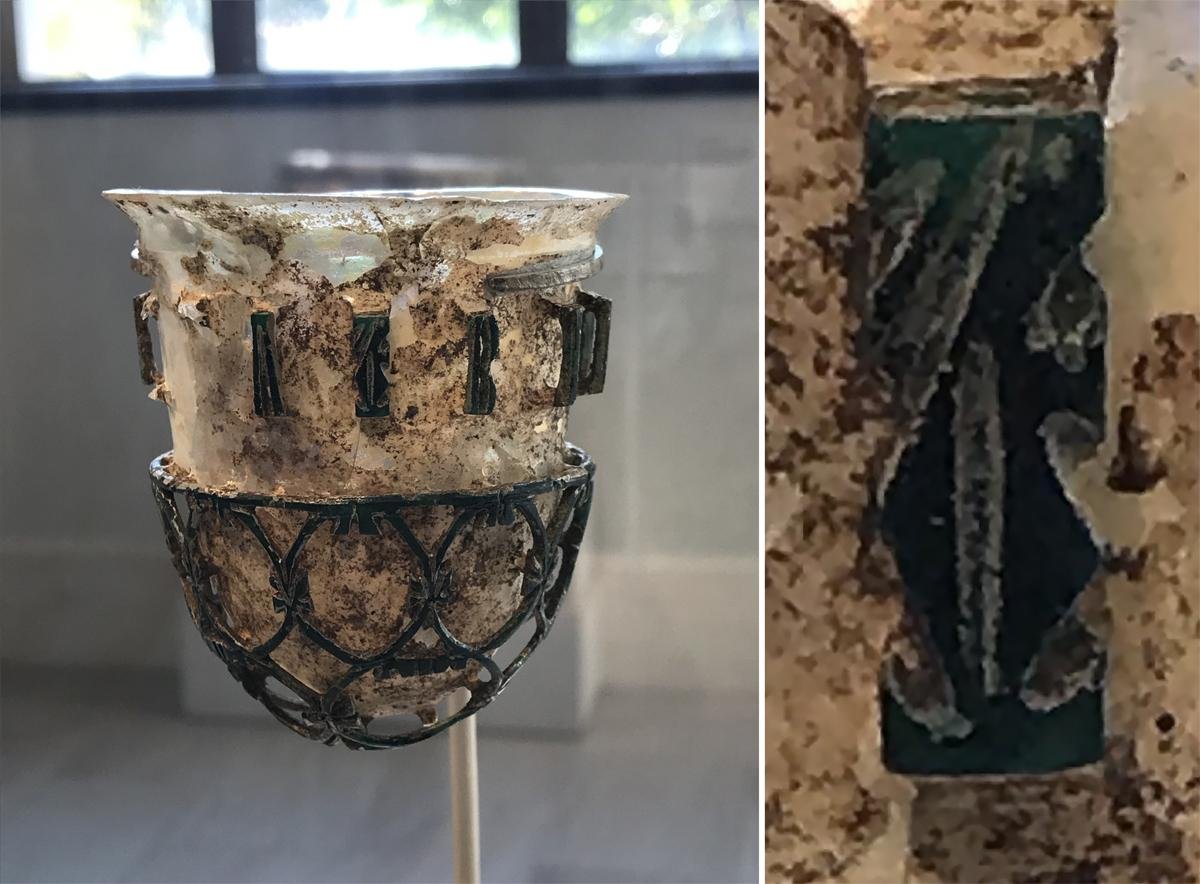
Roman glass openwork vessel with a detail of its symbol on the right. Inscription: BIBE V[I]VAS I[..]A (Drink may you live I[..]a!). Credit: Corning Museum of Glass
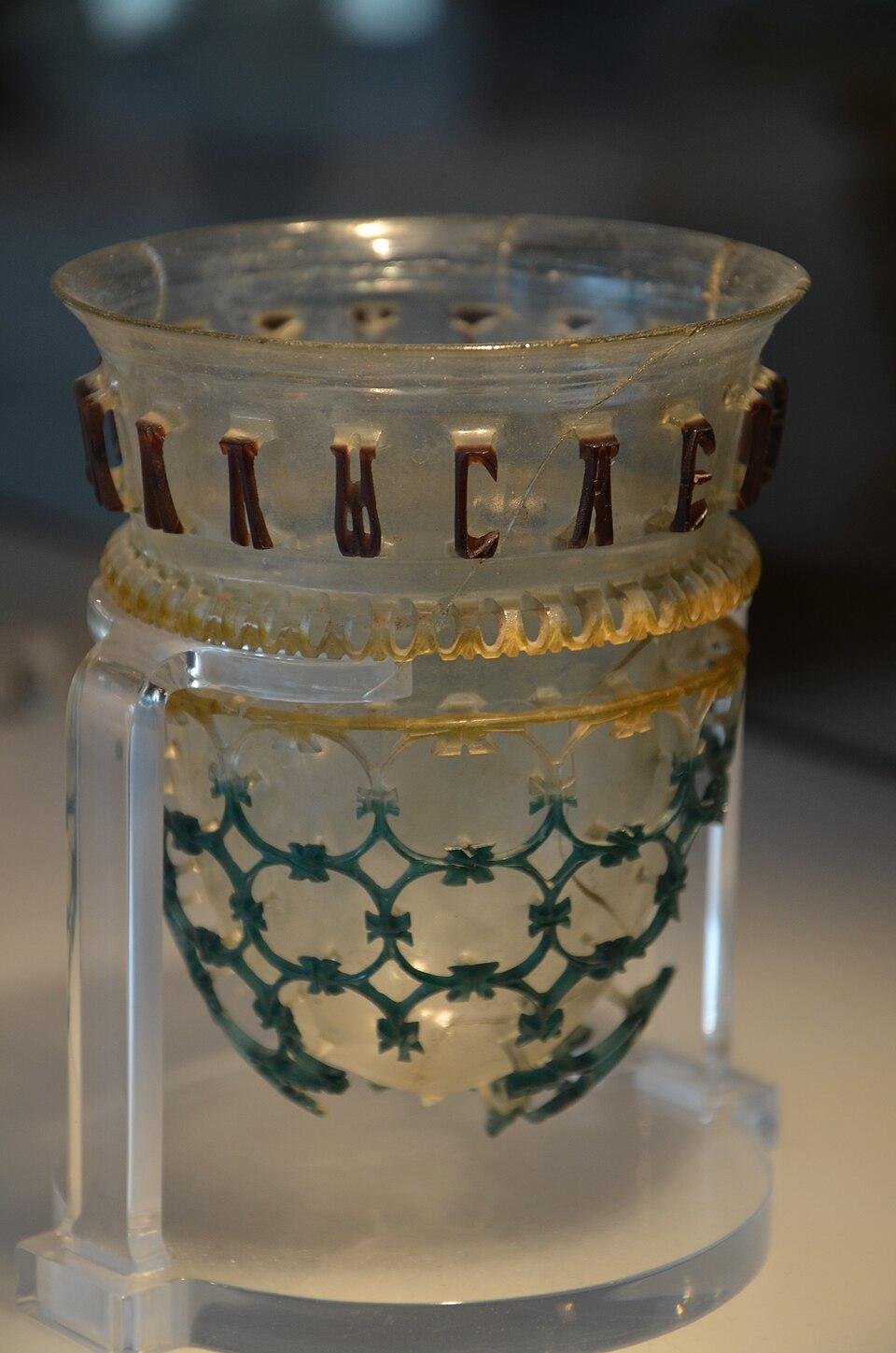
The vessels, which were produced between the fourth and sixth centuries CE, are renowned for their openwork designs and the technical prowess that went into making them. Each cup was carved from a thick glass blank into a thin inner bowl connected to an outer lattice by impossibly fine bridges. For centuries, scholars focused on their inscriptions and craftsmanship but rarely examined the abstract shapes carved near those inscriptions: motifs like diamonds, leaves, and cross-like figures.

Meredith’s close look suggests that these long-overlooked symbols were not ornaments at all, but makers’ marks, visual signatures of the workshops that created them. Her studies, published in the Journal of Glass Studies and World Archaeology, trace identical or near-identical symbols across several surviving pieces. This pattern, she argues, reveals coordinated production among teams of engravers and polishers rather than the work of solitary master artisans.

She examines tool marks, unfinished objects, and repaired or recycled fragments for evidence of a more complex craft world than had been assumed, one in which groups of workers collaborated and shared techniques across industries, leaving behind messages in code that scholars overlooked. The symbols accompanying inscriptions, once vaguely described as “stop-marks,” now appear to form a deliberate visual language used to communicate within and between workshops.
Hidden signatures of ancient Rome’s master glassmakers uncovered
The Cologne diatreta glass bowl (cage cup), 1st half of 4th century CE, found in Cologne, Romisch-Germanisches Museum, Cologne. Credit: Carole Raddato / CC BY-SA 2.0

This reinterpretation also reframes long-standing debates about how diatreta were produced. Rather than being generated through individual skill or reliant on a single method of carving, casting, or blowing, the vessels appear to be the result of a collective process that could stretch over an extended time. Makers’ marks may have functioned like studio logos, showing that branding existed in ancient craft traditions far earlier than modern scholars recognized.

RelatedStories

Roman cemetery in Egypt reveals golden tongues, mummies, and rare Iliad papyrus

Roman cemetery in Egypt reveals golden tongues, mummies, and rare Iliad papyrus

April 19, 2026
Pompeii ash analysis reveals Romans burned wine and imported frankincense in household rituals

Pompeii ash analysis reveals Romans burned wine and imported frankincense in household rituals

April 3, 2026

Meredith’s experience as an active glassblower provides her with rare insight into the physical demands of the craft. Her work stresses the importance of understanding ancient craftsmen not just by technical analysis, but also by considering their lived experiences: their labor, training, and creativity.

Her broader research investigates how these craftworkers communicated by means of irregular spellings, mixed alphabets, and unconventional inscriptions. A new database, developed in collaboration with computer science students, will trace these features on thousands of objects and thus illuminate the work of scribes and artisans operating in multilingual environments.

This evidence uncovers a dynamic, interconnected world of Roman craft production, one with its own systems of communication, collaboration, and identity.
More information: Meredith, H. G. (2025). An approach to craft and craftworkers in process: re-examining late 3rd-6th century CE Roman carvings, inscriptions, and engraved symbols. World Archaeology, 56(3), 310–322. doi:10.1080/00438243.2025.2570270
Meredith, H. G. (2025). Looking for—and finding?—workshop makers’ marks on late Roman diatreta. Journal of Glass Studies, 66(0). doi:10.3998/jgs.6943
Share110Tweet69Share19ShareSend

You May Also Like...

Roman cemetery in Egypt reveals golden tongues, mummies, and rare Iliad papyrus
Anthropology

Roman cemetery in Egypt reveals golden tongues, mummies, and rare Iliad papyrus

April 19, 2026
Basel plague study finds young workers had highest death rates in 17th century outbreak
Anthropology

Basel plague study finds young workers had highest death rates in 17th century outbreak

April 17, 2026
Ancient DNA reveals male lineage and family ties in Neolithic Scotland tombs
Anthropology

Ancient DNA reveals male lineage and family ties in Neolithic Scotland tombs

April 16, 2026
Council houses reveal shift from royal rule to collective governance in Terminal Classic Maya society
Archaeology

Council houses reveal shift from royal rule to collective governance in Terminal Classic Maya society

April 11, 2026
Bronze Age loom found inside ancient Spanish home reveals early textile production
Archaeology

Bronze Age loom found inside ancient Spanish home reveals early textile production

April 8, 2026
Pompeii ash analysis reveals Romans burned wine and imported frankincense in household rituals
Archaeology

Pompeii ash analysis reveals Romans burned wine and imported frankincense in household rituals

April 3, 2026

Comments 0

  1. Editorial Team says:
    1 second ago

    Disclaimer: This website is a science-focused magazine that welcomes both academic and non-academic audiences. Comments are written by users and may include personal opinions or unverified claims. They do not necessarily reflect the views of our editorial team or rely on scientific evidence.

    Comment Policy: We kindly ask all commenters to engage respectfully. Comments that contain offensive, insulting, degrading, discriminatory, or racist content will be automatically removed.

    Reply

Leave a Reply Cancel reply

Your email address will not be published. Required fields are marked *

Follow us


Instagram
244K

Facebook
118K

Threads
46K

LinkedIn
14K

Twitter
6K

YouTube
1K
  • Trending
  • Comments
  • Latest
Shipwreck Salvage. Credit: rawpixel.com / Public Domain

2,000-year-old shipwreck discovered off Turkish coast with remarkably preserved stacked ceramics

July 2, 2025
Viking age DNA reveals 9,000-year-old HIV-resistant gene originating near the Black Sea

Viking age DNA reveals 9,000-year-old HIV-resistant gene originating near the Black Sea

May 18, 2025
A new study suggests the mysterious Voynich Manuscript may be a medieval cipher

A new study suggests the mysterious Voynich Manuscript may be a medieval cipher

January 3, 2026
3D analysis reveals Shroud of Turin image likely came from sculpture, not Jesus’ body

3D analysis reveals Shroud of Turin image likely came from sculpture, not Jesus’ body

August 3, 2025
Moses may be named in ancient Egyptian mine inscriptions, sparking debate over earliest biblical references

Moses may be named in ancient Egyptian mine inscriptions, sparking debate over earliest biblical references

July 31, 2025
3D analysis reveals Shroud of Turin image likely came from sculpture, not Jesus’ body

3D analysis reveals Shroud of Turin image likely came from sculpture, not Jesus’ body

Moses may be named in ancient Egyptian mine inscriptions, sparking debate over earliest biblical references

Moses may be named in ancient Egyptian mine inscriptions, sparking debate over earliest biblical references

$1 million prize offered to decipher 5,300-year-old Indus Valley script

$1 million prize offered to decipher 5,300-year-old Indus Valley script

Oldest ever genetic data from a human relative found in 2-million-year-old fossilized teeth

Oldest ever genetic data from a human relative found in 2-million-year-old fossilized teeth

Exceptionally large Roman shoes discovered at Magna fort near Hadrian’s Wall

Exceptionally large Roman shoes discovered at Magna fort near Hadrian’s Wall

Roman cemetery in Egypt reveals golden tongues, mummies, and rare Iliad papyrus

Roman cemetery in Egypt reveals golden tongues, mummies, and rare Iliad papyrus

April 19, 2026
Basel plague study finds young workers had highest death rates in 17th century outbreak

Basel plague study finds young workers had highest death rates in 17th century outbreak

April 17, 2026
Ancient DNA reveals male lineage and family ties in Neolithic Scotland tombs

Ancient DNA reveals male lineage and family ties in Neolithic Scotland tombs

April 16, 2026
Council houses reveal shift from royal rule to collective governance in Terminal Classic Maya society

Council houses reveal shift from royal rule to collective governance in Terminal Classic Maya society

April 11, 2026
Bronze Age loom found inside ancient Spanish home reveals early textile production

Bronze Age loom found inside ancient Spanish home reveals early textile production

April 8, 2026

Archaeology News online magazine

Archaeology News is an international online magazine that covers all aspects of archaeology.


Categories

  • Academics
    • Books
    • Conferences
    • Universities
  • Articles
  • Download
  • Game
  • News
    • Anthropology
    • Archaeology
    • Paleontology
  • Quiz
  • Tours

Subscribe to our newsletter

© 2024 - Archaeology News Online Magazine. All Rights Reserved.

  • About
  • Privacy Policy
  • Terms of Use
  • Donation
  • Contact

Manage Consent
To provide the best experiences, we use technologies like cookies to store and/or access device information. Consenting to these technologies will allow us to process data such as browsing behavior or unique IDs on this site. Not consenting or withdrawing consent, may adversely affect certain features and functions.
Functional Always active
The technical storage or access is strictly necessary for the legitimate purpose of enabling the use of a specific service explicitly requested by the subscriber or user, or for the sole purpose of carrying out the transmission of a communication over an electronic communications network.
Preferences
The technical storage or access is necessary for the legitimate purpose of storing preferences that are not requested by the subscriber or user.
Statistics
The technical storage or access that is used exclusively for statistical purposes. The technical storage or access that is used exclusively for anonymous statistical purposes. Without a subpoena, voluntary compliance on the part of your Internet Service Provider, or additional records from a third party, information stored or retrieved for this purpose alone cannot usually be used to identify you.
Marketing
The technical storage or access is required to create user profiles to send advertising, or to track the user on a website or across several websites for similar marketing purposes.
  • Manage options
  • Manage services
  • Manage {vendor_count} vendors
  • Read more about these purposes
View preferences
  • {title}
  • {title}
  • {title}
  • Home
  • News
    • Archaeology
    • Anthropology
    • Paleontology
  • Academic
    • Books
    • Conferences
    • Universities
  • Articles
  • VR Tours
  • Quiz & Game
  • Download
  • Encyclopedia
  • Forum

About  .  Contact  .  Donation

© 2024 - Archaeology News Online Magazine. All Rights Reserved