• About
  • Privacy Policy
  • Terms of Use
  • Donation
  • Contact
No Result
View All Result
Archaeology News
  • Home
  • News
    • Archaeology
    • Anthropology
    • Paleontology
  • Academic
    • Books
    • Conferences
    • Universities
  • Articles
  • VR Tours
  • Quiz & Game
  • Download
  • Encyclopedia
  • Forum
Archaeology News
No Result
View All Result
Home News Archaeology

Roman basilica designed by Vitruvius identified in Fano, ending centuries of debate

by Dario Radley
January 21, 2026

Archaeologists working in central Italy have identified the remains of a Roman basilica designed by Marcus Vitruvius Pollio, the architect and engineer known for De Architectura. The structure surfaced during rescue excavations beneath Piazza Andrea Costa in Fano, carried out before planned urban redevelopment. Dating to the late first century BCE, the basilica represents the only building Vitruvius clearly described as his own work, resolving a debate that lasted for centuries.
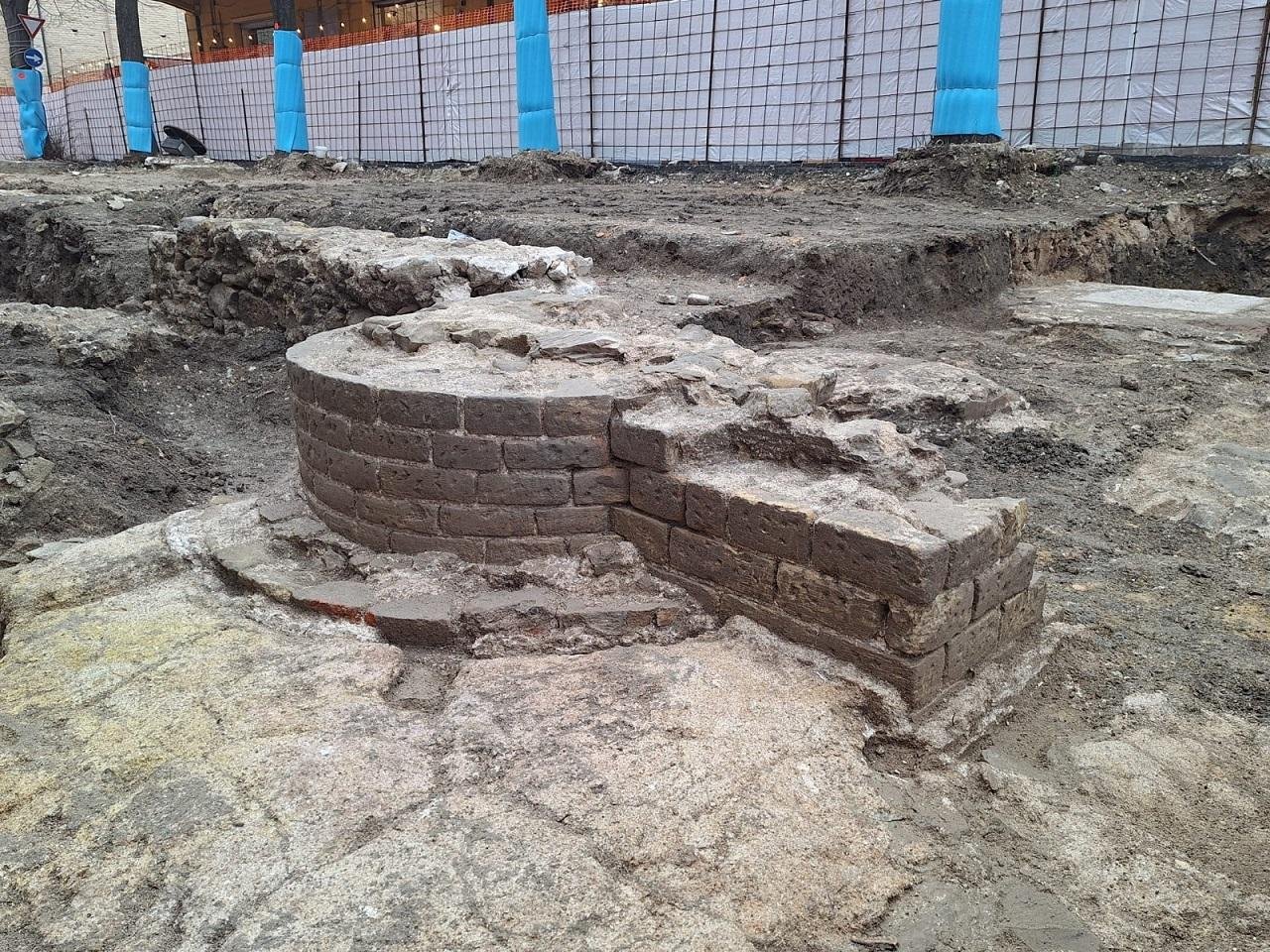
Roman basilica designed by Vitruvius identified in Fano, ending centuries of debate
Archaeologists uncovered remains of the 2,000-year-old basilica during excavations in Fano. Credit: Italian Ministry of Culture

Vitruvius wrote De Architectura during the Augustan period. The ten-book treatise set out rules of proportion, symmetry, and construction that shaped architectural thought across Europe for more than two thousand years. Scholars long relied only on written descriptions, since no physical structure had been securely linked to the architect. The basilica at Fano, described in Book V as a project executed in the Julian colony, stood at the center of this discussion.

Excavation results match Vitruvius’s account with striking accuracy. The uncovered plan shows a strict rectangle aligned with the ancient forum. Eight columns defined the long side facing the civic center, while four columns marked each short end. Two central columns on one side were intentionally omitted to preserve visual connections with nearby public and religious spaces. Archaeological measurements confirm these choices.
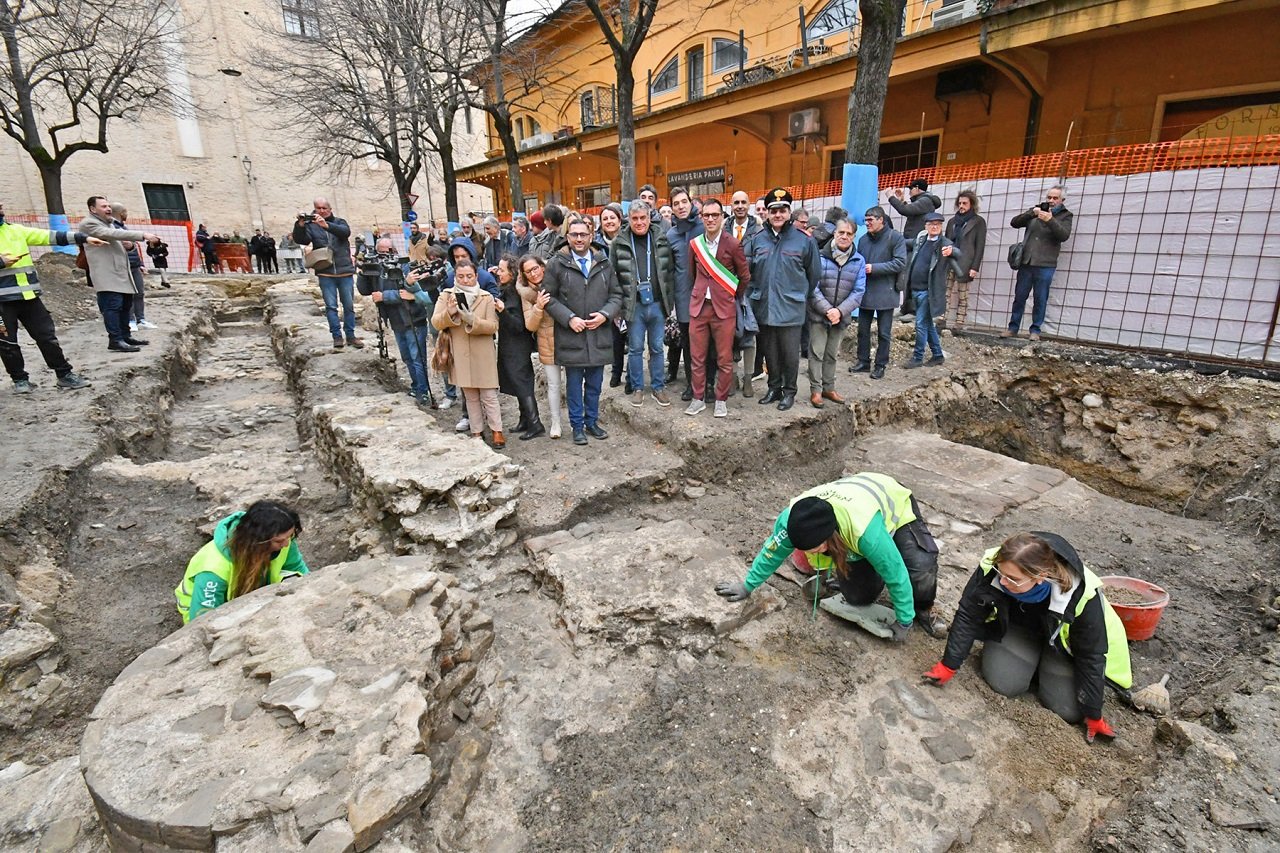
Roman basilica designed by Vitruvius identified in Fano, ending centuries of debate
Italian officials at the site of the basilica in Fano. Credit: Italian Ministry of Culture

Column bases measure close to five Roman feet, roughly sixty inches, in diameter. Architectural fragments indicate an original column height near forty nine to fifty feet. The arrangement of pilasters and corner supports corresponds with details recorded in De Architectura. Using those descriptions, researchers identified a previously unclear corner point, allowing a precise reconstruction of the building’s orientation and scale.
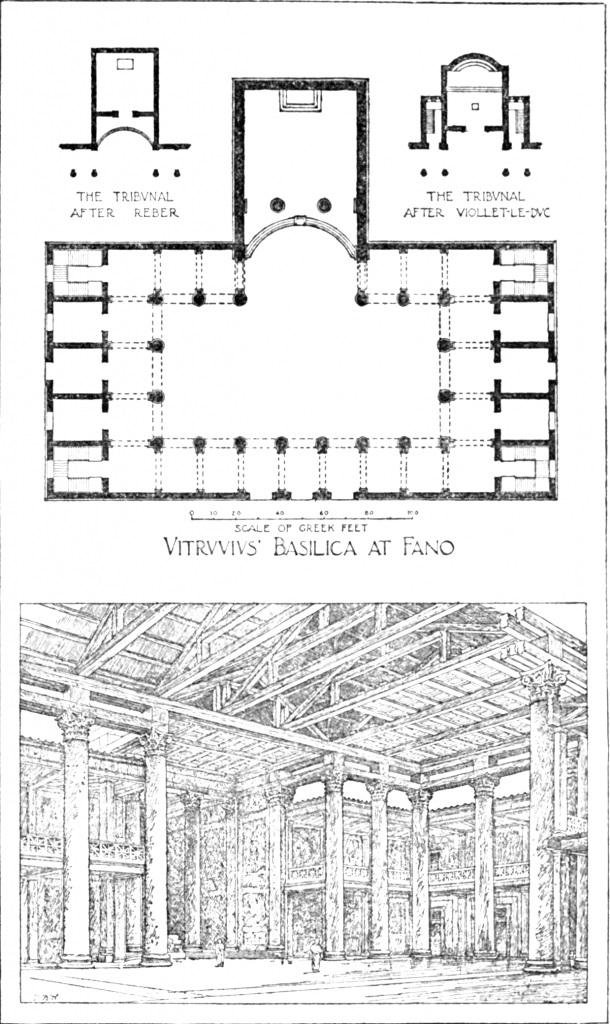
Roman basilica designed by Vitruvius identified in Fano, ending centuries of debate
1914 rendering and floor plan of Vitruvius’s basilica in Fano, the structure first described in his treatise De Architectura. Public domain

Earlier investigations in Fano suggested high-status Roman architecture in the area. A 2022 dig along Via Vitruvio revealed marble pavements and wall remains, hinting at a major public structure nearby. The current excavation confirmed those suspicions through stratigraphic analysis and direct correspondence with the ancient text.

RelatedStories

Roman cemetery in Egypt reveals golden tongues, mummies, and rare Iliad papyrus

Roman cemetery in Egypt reveals golden tongues, mummies, and rare Iliad papyrus

April 19, 2026
Pompeii ash analysis reveals Romans burned wine and imported frankincense in household rituals

Pompeii ash analysis reveals Romans burned wine and imported frankincense in household rituals

April 3, 2026

The basilica suffered destruction during late antiquity. Later conflicts and urban changes across centuries removed most visible traces of Roman Fano. Despite such losses, the newly exposed foundations survived beneath modern layers, preserving key architectural data.
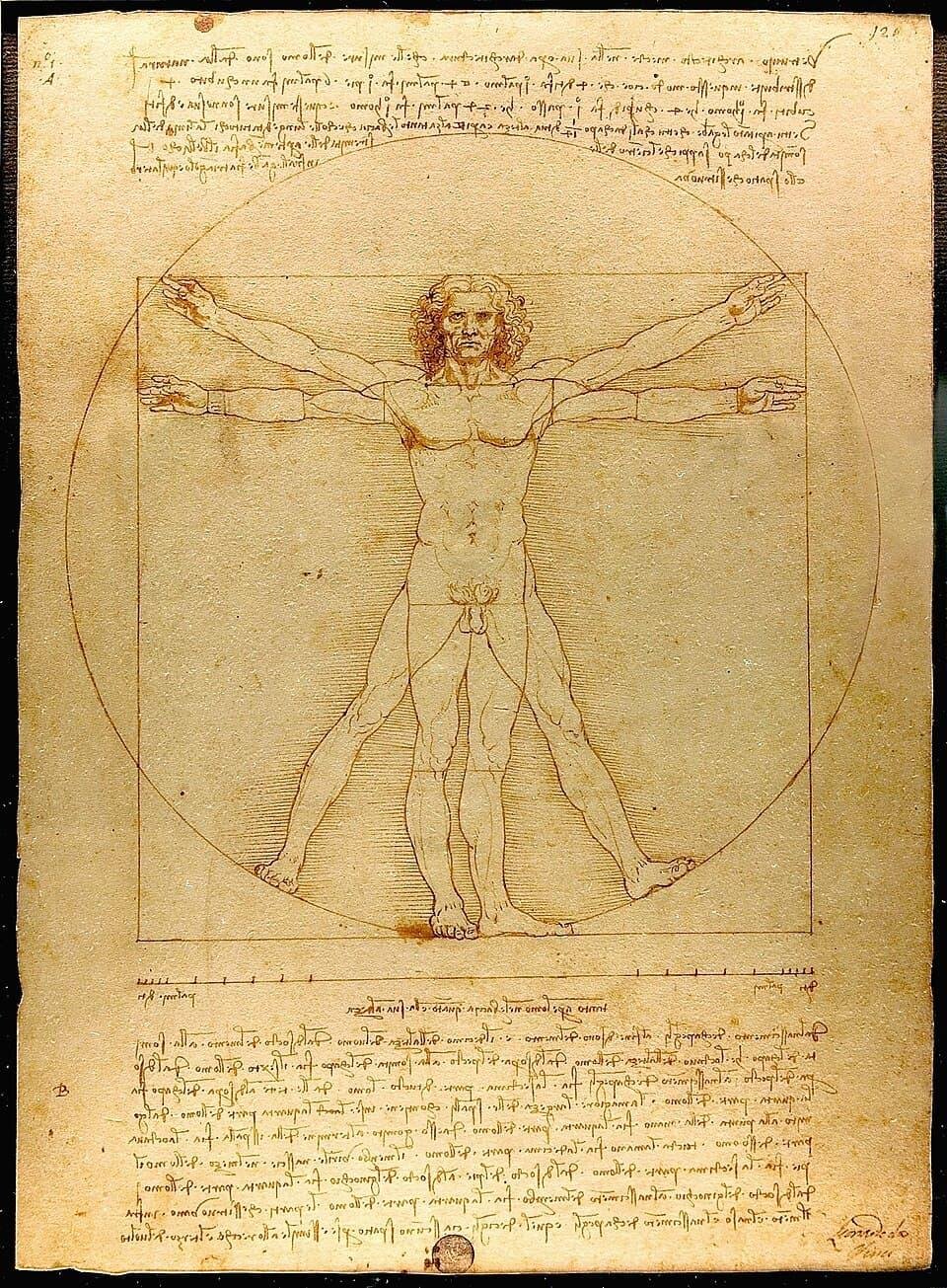
Roman basilica designed by Vitruvius identified in Fano, ending centuries of debate
The Vitruvian Man (L’uomo vitruviano), created by Leonardo da Vinci around 1490. This pen-and-ink drawing depicts ideal human proportions based on Vitruvius’s writings, showing a male figure in two overlapping poses within a circle and square. Public domain

Italian heritage authorities view the find as a milestone for Roman studies. Conservation work has begun to stabilize exposed elements, while planning continues for extended excavation and interdisciplinary research. Discussions also focus on long term protection and potential public access. Cultural officials have opened talks regarding UNESCO recognition for the site.

The identification of a built work described by Vitruvius offers direct insight into Roman architectural practice during the transition from Republic to Empire.

More information: Italian Ministry of Culture
Share17Tweet11Share3ShareSend

You May Also Like...

Roman cemetery in Egypt reveals golden tongues, mummies, and rare Iliad papyrus
Anthropology

Roman cemetery in Egypt reveals golden tongues, mummies, and rare Iliad papyrus

April 19, 2026
Basel plague study finds young workers had highest death rates in 17th century outbreak
Anthropology

Basel plague study finds young workers had highest death rates in 17th century outbreak

April 17, 2026
Ancient DNA reveals male lineage and family ties in Neolithic Scotland tombs
Anthropology

Ancient DNA reveals male lineage and family ties in Neolithic Scotland tombs

April 16, 2026
Council houses reveal shift from royal rule to collective governance in Terminal Classic Maya society
Archaeology

Council houses reveal shift from royal rule to collective governance in Terminal Classic Maya society

April 11, 2026
Bronze Age loom found inside ancient Spanish home reveals early textile production
Archaeology

Bronze Age loom found inside ancient Spanish home reveals early textile production

April 8, 2026
Pompeii ash analysis reveals Romans burned wine and imported frankincense in household rituals
Archaeology

Pompeii ash analysis reveals Romans burned wine and imported frankincense in household rituals

April 3, 2026

Comments 0

  1. Editorial Team says:
    1 second ago

    Disclaimer: This website is a science-focused magazine that welcomes both academic and non-academic audiences. Comments are written by users and may include personal opinions or unverified claims. They do not necessarily reflect the views of our editorial team or rely on scientific evidence.

    Comment Policy: We kindly ask all commenters to engage respectfully. Comments that contain offensive, insulting, degrading, discriminatory, or racist content will be automatically removed.

    Reply

Leave a Reply Cancel reply

Your email address will not be published. Required fields are marked *

Follow us


Instagram
244K

Facebook
118K

Threads
46K

LinkedIn
14K

Twitter
6K

YouTube
1K
  • Trending
  • Comments
  • Latest
Shipwreck Salvage. Credit: rawpixel.com / Public Domain

2,000-year-old shipwreck discovered off Turkish coast with remarkably preserved stacked ceramics

July 2, 2025
Viking age DNA reveals 9,000-year-old HIV-resistant gene originating near the Black Sea

Viking age DNA reveals 9,000-year-old HIV-resistant gene originating near the Black Sea

May 18, 2025
A new study suggests the mysterious Voynich Manuscript may be a medieval cipher

A new study suggests the mysterious Voynich Manuscript may be a medieval cipher

January 3, 2026
3D analysis reveals Shroud of Turin image likely came from sculpture, not Jesus’ body

3D analysis reveals Shroud of Turin image likely came from sculpture, not Jesus’ body

August 3, 2025
Moses may be named in ancient Egyptian mine inscriptions, sparking debate over earliest biblical references

Moses may be named in ancient Egyptian mine inscriptions, sparking debate over earliest biblical references

July 31, 2025
3D analysis reveals Shroud of Turin image likely came from sculpture, not Jesus’ body

3D analysis reveals Shroud of Turin image likely came from sculpture, not Jesus’ body

Moses may be named in ancient Egyptian mine inscriptions, sparking debate over earliest biblical references

Moses may be named in ancient Egyptian mine inscriptions, sparking debate over earliest biblical references

$1 million prize offered to decipher 5,300-year-old Indus Valley script

$1 million prize offered to decipher 5,300-year-old Indus Valley script

Oldest ever genetic data from a human relative found in 2-million-year-old fossilized teeth

Oldest ever genetic data from a human relative found in 2-million-year-old fossilized teeth

Exceptionally large Roman shoes discovered at Magna fort near Hadrian’s Wall

Exceptionally large Roman shoes discovered at Magna fort near Hadrian’s Wall

Roman cemetery in Egypt reveals golden tongues, mummies, and rare Iliad papyrus

Roman cemetery in Egypt reveals golden tongues, mummies, and rare Iliad papyrus

April 19, 2026
Basel plague study finds young workers had highest death rates in 17th century outbreak

Basel plague study finds young workers had highest death rates in 17th century outbreak

April 17, 2026
Ancient DNA reveals male lineage and family ties in Neolithic Scotland tombs

Ancient DNA reveals male lineage and family ties in Neolithic Scotland tombs

April 16, 2026
Council houses reveal shift from royal rule to collective governance in Terminal Classic Maya society

Council houses reveal shift from royal rule to collective governance in Terminal Classic Maya society

April 11, 2026
Bronze Age loom found inside ancient Spanish home reveals early textile production

Bronze Age loom found inside ancient Spanish home reveals early textile production

April 8, 2026

Archaeology News online magazine

Archaeology News is an international online magazine that covers all aspects of archaeology.


Categories

  • Academics
    • Books
    • Conferences
    • Universities
  • Articles
  • Download
  • Game
  • News
    • Anthropology
    • Archaeology
    • Paleontology
  • Quiz
  • Tours

Subscribe to our newsletter

© 2024 - Archaeology News Online Magazine. All Rights Reserved.

  • About
  • Privacy Policy
  • Terms of Use
  • Donation
  • Contact

Manage Consent
To provide the best experiences, we use technologies like cookies to store and/or access device information. Consenting to these technologies will allow us to process data such as browsing behavior or unique IDs on this site. Not consenting or withdrawing consent, may adversely affect certain features and functions.
Functional Always active
The technical storage or access is strictly necessary for the legitimate purpose of enabling the use of a specific service explicitly requested by the subscriber or user, or for the sole purpose of carrying out the transmission of a communication over an electronic communications network.
Preferences
The technical storage or access is necessary for the legitimate purpose of storing preferences that are not requested by the subscriber or user.
Statistics
The technical storage or access that is used exclusively for statistical purposes. The technical storage or access that is used exclusively for anonymous statistical purposes. Without a subpoena, voluntary compliance on the part of your Internet Service Provider, or additional records from a third party, information stored or retrieved for this purpose alone cannot usually be used to identify you.
Marketing
The technical storage or access is required to create user profiles to send advertising, or to track the user on a website or across several websites for similar marketing purposes.
  • Manage options
  • Manage services
  • Manage {vendor_count} vendors
  • Read more about these purposes
View preferences
  • {title}
  • {title}
  • {title}
  • Home
  • News
    • Archaeology
    • Anthropology
    • Paleontology
  • Academic
    • Books
    • Conferences
    • Universities
  • Articles
  • VR Tours
  • Quiz & Game
  • Download
  • Encyclopedia
  • Forum

About  .  Contact  .  Donation

© 2024 - Archaeology News Online Magazine. All Rights Reserved